
In the realm of precision engineering, the strain wave gear, also known as a harmonic drive, stands out due to its compact design, high torque capacity, minimal backlash, and exceptional positioning accuracy. These attributes make it indispensable in applications ranging from industrial robotics and aerospace to optical instruments and automotive systems. At the heart of a strain wave gear system lies the flexible bearing, a critical component that directly influences the device’s operational smoothness, repeatability, and overall reliability. However, the failure of flexible bearings is a prevalent issue, often stemming from the complex mechanical loads and deformations they endure during operation. To address this, a comprehensive understanding of the bearing’s behavior under no-load assembly conditions and its interaction with the flexspline (or柔轮) is paramount. This study delves into the mechanical analysis of flexible bearings within strain wave gears, employing finite element methods to simulate deformations and contact stresses. Our goal is to provide refined theoretical foundations for designing durable flexible bearings and optimizing gear tooth positioning and profile design, thereby enhancing the performance and longevity of strain wave gear systems.
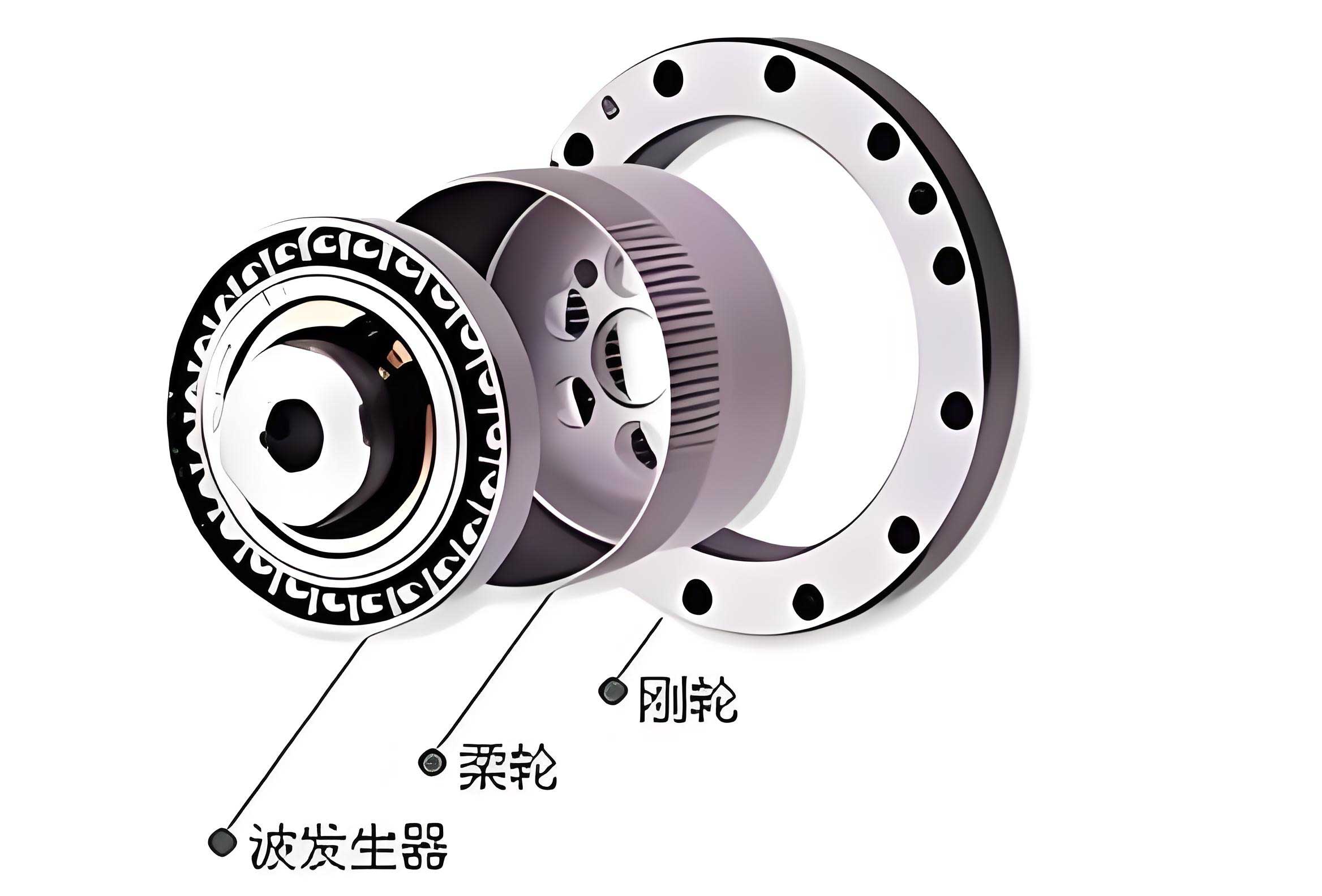
The operational principle of a strain wave gear involves four primary components: the circular spline (刚轮), the flexspline (柔轮), the wave generator (波发生器), and the flexible bearing. The wave generator, typically an elliptical cam, is press-fitted into the inner ring of the flexible bearing, forcing it to assume an elliptical shape. This deformation propagates through the bearing’s balls to the outer ring, which subsequently deforms the flexspline. The controlled elliptical deformation of the flexspline enables meshing with the circular spline, resulting in high reduction ratios. Throughout this process, the flexible bearing undergoes significant cyclic straining, making it susceptible to fatigue and failure. Notably, previous research has often overlooked the nuanced deformation of the bearing’s outer raceway and the stress state within the ball raceways when the flexspline exhibits coning deformation—a common occurrence in cup-type flexsplines. Our investigation fills this gap by meticulously modeling the assembly state and analyzing the contact mechanics between the bearing and the flexspline.
We adopt a finite element analysis (FEA) approach, which allows us to capture the highly nonlinear contact behavior and deformation patterns without the simplifications inherent in classical Hertzian contact theory. The models are constructed in ANSYS, focusing on the flexible bearing and the cup-type flexspline. For the bearing, we develop a detailed model incorporating the outer raceway and the balls, as these are directly involved in force transmission. The flexspline model is built according to standard dimensions, accounting for its geometry and material properties. The core of our methodology involves two sequential analyses: first, we examine the deformation of the flexible bearing under the influence of an elliptical wave generator alone; second, we investigate the coupled system where the pre-deformed bearing is assembled into the flexspline, inducing coning deformation. This two-stage approach enables us to isolate and understand the individual and interactive effects.
To ensure accuracy, we employ high-order solid elements (SOLID186 for the raceways and SOLID45 for the balls) and utilize hexahedral meshing with refinement in critical contact zones. Contact pairs are defined using CONTA185, CONTA173, and CONTA170 elements, with appropriate constraints and displacement boundary conditions applied. The material properties are assigned based on standard bearing steel, with an elastic modulus of 2.07 GPa for the raceways and 2.17 GPa for the balls, both having a Poisson’s ratio of 0.3. The following table summarizes the key structural parameters used for the flexible bearing in our analysis, corresponding to a common strain wave gear model.
| Parameter | Symbol | Value | Unit |
|---|---|---|---|
| Bearing Outer Diameter | Do | 74.65 | mm |
| Outer Ring Wall Thickness | tor | 2.096 | mm |
| Outer Ring Width | Wor | 11.81 | mm |
| Outer Raceway Groove Radius | Rg | 4.08 | mm |
| Maximum Radial Displacement at Major Axis | w0 | 0.407 | mm |
| Ball Diameter | db | 7.5 | mm |
| Number of Balls | N | 24 | – |
| Flexspline Inner Radius | Rfi | 37.325 | mm |
| Tooth Ring Width | Wt | 11 | mm |
The deformation imposed by the elliptical wave generator is central to the function of a strain wave gear. When the inner ring of the flexible bearing is forced into an ellipse, it transmits this deformation to the balls. Due to the constraint of the ball retainer, the balls arrange themselves along an equidistant curve of the elliptical inner raceway profile. This means the radial position of each ball is determined by the elliptical geometry. For an ellipse with semi-major axis \(a\) and semi-minor axis \(b\), the polar equation for the equidistant curve accounting for the ball radius can be derived. The radial displacement \(w(\phi)\) of a ball at an angular position \(\phi\) from the major axis is given by:
$$ \rho(\phi) = \sqrt{a^2 \cos^2\phi + b^2 \sin^2\phi} $$
$$ r_{ball\_center} = \rho(\phi) + r_{inner\_groove} – r_{ball} $$
$$ w(\phi) = r_{ball\_center} – r_{neutral} $$
where \(r_{neutral}\) is the nominal radius of the ball center circle in the undeformed state. For our model, the values are \(a = 33.066\) mm and \(b = 32.079\) mm. The theoretical radial displacements for balls at specific angles are calculated and applied as boundary conditions in the FEA. We select six balls symmetrically distributed about the major axis, starting at \(\phi = 7.5^\circ\) with an angular spacing of \(15^\circ\). The computed displacements are:
| Ball Position Index | Angle from Major Axis, \(\phi\) (degrees) | Theoretical Radial Displacement, \(w(\phi)\) (mm) |
|---|---|---|
| 1 | 7.5 | 0.4821 |
| 2 | 22.5 | 0.3471 |
| 3 | 37.5 | 0.1171 |
| 4 | 52.5 | -0.1426 |
| 5 | 67.5 | -0.3626 |
| 6 | 82.5 | -0.4875 |
In the finite element model of the bearing under wave generator action, we constrain the circumferential motion of the balls and apply these radial displacements. The resulting deformation of the outer raceway is extracted. The analysis confirms that the balls effectively follow the equidistant elliptical path. The maximum radial displacement at the major axis is found to be 0.4896 mm, which shows excellent agreement with the theoretical input value of 0.4821 mm, with a minor discrepancy attributable to numerical discretization and contact modeling. The radial displacement field of the outer raceway visually demonstrates the elliptical distortion, validating our modeling approach for this phase of the strain wave gear assembly.
A critical insight from this analysis is that not all balls actively exert force on the outer raceway simultaneously. Due to the elliptical deformation and clearance, only a subset of balls remains in load-bearing contact at any given orientation. Our results indicate that under the static assembly condition modeled, primarily three balls—those closest to the major axis—transmit significant force to the outer raceway. The contact pressure distribution on the outer raceway is highly non-uniform, peaking near the major axis region. This localized loading is a key factor in the fatigue life of flexible bearings in strain wave gears.
The next phase involves modeling the interaction between the pre-deformed flexible bearing and the cup-type flexspline. When the elliptical bearing is inserted into the flexspline, the inner wall of the flexspline constrains the bearing’s outer ring, inducing additional complex deformation known as coning deformation. This occurs because the flexspline is not a perfectly rigid cylinder; its cup-shaped geometry and thin walls allow it to deform in a tapered manner along its axis. To simulate this, we construct a detailed 3D solid model of the flexspline with parameters such as a cup length of 50 mm, a shell thickness of 1 mm, a tooth ring thickness of 2 mm, and appropriately filleted transitions to avoid stress concentrations. The bearing’s outer ring model, already deformed by the wave generator, is placed in contact with the flexspline’s inner surface.
We establish a multi-level contact scheme: primary contact between the bearing’s outer raceway and the flexspline’s inner wall, and secondary contact between the balls and the bearing’s outer raceway. Appropriate constraints are applied: the bottom of the flexspline cup is fully fixed, and symmetric boundary conditions are applied radially to the bearing outer ring to simulate the assembly. The pre-calculated radial displacements for the six balls are imposed as before. Solving this coupled contact problem reveals the coning deformation pattern of the bearing outer ring and the altered contact stress state.
To quantify the coning effect, we define three axial paths on the outer surface of the bearing’s outer ring: front (near the open end of the flexspline cup), middle, and rear (near the closed end or cup bottom). The radial displacements along these paths at various circumferential positions are extracted. The data is summarized in the table below, showing the radial displacement at the major and minor axes for the three sections.
| Axial Section | Radial Displacement at Major Axis (mm) | Radial Displacement at Minor Axis (mm) |
|---|---|---|
| Front Section | 0.430 (≈ +12% deviation from nominal w0) | -0.432 (≈ +6% deviation from theoretical min.) |
| Middle Section | 0.408 (≈ reference) | -0.407 (≈ reference) |
| Rear Section | 0.386 (≈ -12% deviation from nominal w0) | -0.350 (≈ -14% deviation from theoretical min.) |
The results clearly illustrate the coning deformation. At the major axis, the rear section of the bearing outer ring experiences less outward radial displacement than the front section, indicating that the flexspline wall presses more forcefully against the bearing’s rear side near the cup bottom. Conversely, at the minor axis, the front section shows a greater inward radial displacement (more negative) than the rear section, meaning the flexspline squeezes the bearing more strongly at the front open end. This differential axial deformation is crucial for understanding the load distribution in a functioning strain wave gear. The contact zone analysis visually shows that contact between the flexspline and the bearing outer ring shifts from predominantly the rear region at the major axis to the front region at the minor axis, continuously transitioning between these extremes.
The contact pressure between the balls and the outer raceway is critically re-evaluated in this assembled state. Even though six balls have prescribed displacements, the force transmission remains concentrated. The maximum contact pressure is found on the ball closest to the major axis (at \(\phi = 7.5^\circ\)), reaching a value of approximately 648.7 MPa. The pressure rapidly diminishes for balls farther from the major axis. The following formula, based on Hertzian contact principles but informed by our FEA results, can estimate the contact pressure \(P_{max}\) for a ball-raceway pair:
$$ P_{max} = \frac{3Q}{2\pi a b} $$
where \(Q\) is the normal contact force, and \(a\) and \(b\) are the semi-axes of the contact ellipse. However, our FEA captures the full complexity, including the coning effect, which modifies the contact geometry and load distribution. The high stress concentration at the major-axis-proximal balls highlights a critical area for potential fatigue crack initiation in strain wave gear flexible bearings.
To further elucidate the stress state, we can consider the von Mises stress in the bearing outer ring. The cyclical deformation during operation of the strain wave gear leads to alternating stresses. An approximate expression for the bending stress \(\sigma_b\) in the thin outer ring wall due to the elliptical deformation can be derived from plate theory:
$$ \sigma_b \approx \frac{E t_{or} \kappa}{1-\nu^2} $$
where \(E\) is Young’s modulus, \(t_{or}\) is the outer ring thickness, \(\nu\) is Poisson’s ratio, and \(\kappa\) is the curvature change induced by deformation. For the major axis region, the curvature change is significant. Our FEA results provide detailed maps of these stresses, confirming that maximum stresses occur at the inner surface of the outer raceway at the axial locations corresponding to the ball contact zones under highest load.
The implications of these findings for the design of strain wave gears are substantial. First, the identification that only a few balls carry the primary load during static assembly suggests that bearing life calculations should focus on these highly stressed balls. Second, the coning deformation induced by the flexspline interaction is not symmetric and must be accounted for in tolerance stack-ups and clearance designs. Specifically, for cup-type flexsplines, the bearing seating should perhaps be slightly tapered to match the expected coning, ensuring more uniform contact pressure distribution. Third, the tooth positioning on the flexspline is directly influenced by the exact deformed shape of its inner wall, which is now known to have an axial variation (coning). Therefore, optimal tooth profile modification and alignment should consider this three-dimensional deformed geometry rather than a simple planar ellipse.
In conclusion, our mechanical analysis of flexible bearings within strain wave gears has yielded several key insights. We have demonstrated through detailed finite element modeling that under the influence of an elliptical wave generator, the bearing’s outer raceway deforms into an elliptical shape with ball forces concentrated near the major axis. When this assembly is integrated into a cup-type flexspline, a distinct coning deformation occurs, characterized by axial variation in radial displacement: compression at the rear near the major axis and at the front near the minor axis. This results in a shifting contact zone between the bearing and flexspline and maintains high contact stresses on the balls closest to the major axis. These findings provide a more accurate computational basis for designing robust flexible bearings, precisely positioning flexspline teeth, and optimizing tooth profiles in strain wave gear systems. Future work will involve dynamic analysis under load, thermal effects, and experimental validation to further refine the models and enhance the reliability of these crucial power transmission components.
The performance and durability of a strain wave gear are inextricably linked to the behavior of its flexible bearing. By deepening our understanding of the complex mechanics during assembly and operation, we can push the boundaries of precision, load capacity, and service life for these remarkable devices. The methodologies and results presented here contribute to that ongoing engineering endeavor, underscoring the importance of integrated analysis in the advancement of strain wave gear technology.