
This paper presents an efficient mesh control methodology for contact simulation of helical gear pairs based on Hertzian contact theory validation. Through systematic analysis of multi-cylinder contact models and extended application to helical gear systems, we establish a generalized mesh refinement criterion that significantly improves simulation efficiency while maintaining calculation accuracy.
1. Theoretical Foundation of Contact Analysis
The Hertzian contact theory provides fundamental solutions for elastic body interactions. For two elastic cylinders with radii $R_1$ and $R_2$ under normal load $F$, the contact half-width $b$ and maximum contact pressure $p_{max}$ are given by:
$$b = \sqrt{\frac{4F}{\pi l} \cdot \frac{(1-\mu_1^2)/E_1 + (1-\mu_2^2)/E_2}{1/R_1 + 1/R_2}}$$
$$p_{max} = \frac{2F}{\pi b l}$$
Where $E$ denotes elastic modulus, $\mu$ Poisson’s ratio, and $l$ contact length. These equations form the basis for helical gear contact analysis through equivalent cylinder transformation.
2. Mesh Independence Study for Cylindrical Contact
Two representative cylinder contact models were analyzed to establish mesh convergence criteria:
| Parameter | Case 1 | Case 2 |
|---|---|---|
| Radius (mm) | 8/12 | 5/6 |
| Elastic Modulus (GPa) | 200 | 200 |
| Load (N) | 300 | 200 |
| Theoretical $b$ (mm) | 0.1552 | 0.0795 |
| Theoretical $p_{max}$ (MPa) | 1777 | 1601 |
Convergence analysis revealed critical mesh size thresholds:
| Mesh Size Ratio | Contact Pressure Error | Half-width Error |
|---|---|---|
| $b/2$ | 18.7% | 22.4% |
| $b/3$ | 9.2% | 11.8% |
| $b/4$ | 4.3% | 5.1% |
| $b/5$ | 2.1% | 2.8% |
The results demonstrate that mesh sizes smaller than $b/4$ achieve <5% error for both contact pressure and half-width, establishing this as the general convergence criterion.
3. Helical Gear Contact Simulation Methodology
For helical gear pairs, the equivalent contact parameters are derived through curvature transformation:
$$R_{eq} = \frac{R_p R_w}{R_p + R_w}$$
$$F_n = \frac{T}{R_b \cos\beta_b}$$
Where $R_p$ and $R_w$ are equivalent curvature radii, $T$ is torque, and $\beta_b$ is base helix angle. The contact half-width for helical gears becomes:
$$b_g = \sqrt{\frac{4F_n}{\pi l_s} \cdot \frac{(1-\mu_p^2)/E_p + (1-\mu_w^2)/E_w}{1/R_p + 1/R_w}}$$
4. Implementation for Helical Gear Systems
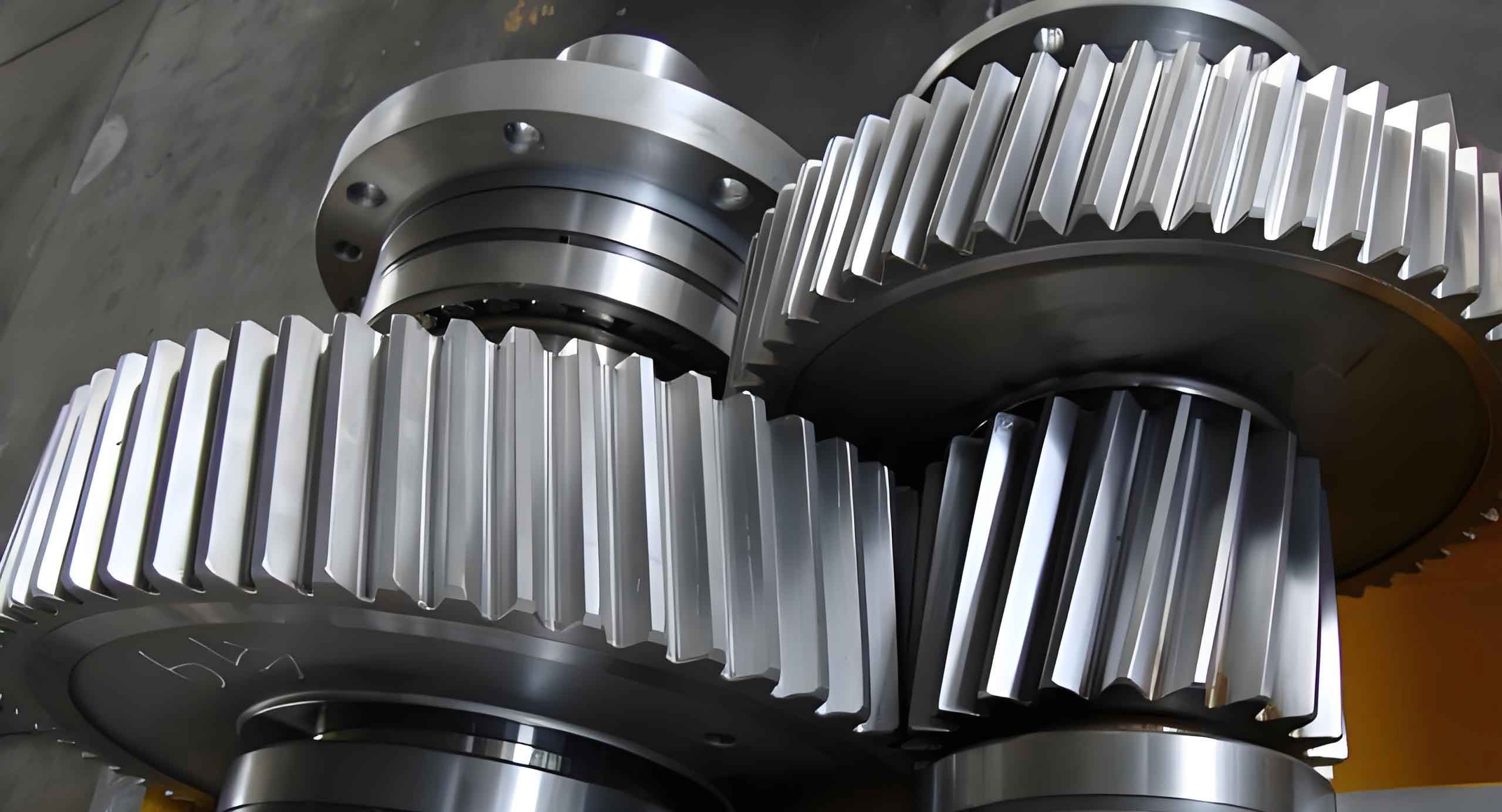
A practical example demonstrates the application to offshore wind turbine gearboxes:
| Parameter | Pinion | Gear |
|---|---|---|
| Module (mm) | 6 | 6 |
| Teeth | 35 | 85 |
| Helix Angle (°) | 18 | 18 |
| Face Width (mm) | 70 | 70 |
| Torque (Nm) | 8500 | – |
Key simulation steps include:
- Equivalent curvature radius calculation
- Theoretical contact parameter derivation
- Parametric FEM model construction
- Adaptive mesh refinement implementation
5. Results and Validation
The helical gear simulation achieved excellent agreement with theoretical predictions:
| Parameter | Theoretical | Simulation | Error |
|---|---|---|---|
| Contact Half-width (mm) | 0.6937 | 0.685 | 1.25% |
| Max Pressure (MPa) | 997.94 | 966.93 | 3.11% |
The mesh control strategy reduced computation time by 68% compared to conventional adaptive refinement approaches while maintaining equivalent accuracy.
6. Industrial Application Guidelines
For practical helical gear design, implement these mesh control procedures:
- Calculate preliminary contact parameters using Hertz equations
- Determine critical mesh size: $e_{critical} = b_g/4$
- Create mapped mesh with element size ≤ $e_{critical}$ in contact region
- Apply swept meshing for tooth profile geometry
- Use asymmetric contact formulation with penalty method
This methodology ensures efficient and accurate contact analysis for helical gear pairs in offshore wind applications, particularly crucial for large-scale gearboxes requiring high reliability under extreme operating conditions.