
The pursuit of higher operational speeds and power densities in mechanical transmission systems has intensified the focus on mitigating vibration and noise. These factors are critical for developing high-performance and reliable gear drives. The core of this challenge lies in the dynamic behavior of the gear mesh itself. During operation, the number of tooth pairs in contact fluctuates, leading to a time-varying mesh stiffness. This inherent variation is a primary source of dynamic excitation, significantly influencing the system’s vibration signature, load distribution, and overall acoustic performance. Therefore, accurately modeling the mesh stiffness under real-world operating conditions—which deviate from the ideal due to manufacturing tolerances and assembly imperfections—is fundamental for dynamic analysis and the optimization of spur gear transmissions.
The accuracy of the dynamic model hinges on the fidelity of the mesh stiffness calculation. Among various methods, the energy method offers a compelling balance between computational efficiency and accuracy, making it widely adopted. While classical energy method formulations exist, recent advancements have refined the approach. For instance, the deformation of the gear body (fillet foundation) has been revisited with correction factors to avoid overestimation in multi-tooth contact zones. Furthermore, the influence of adjacent teeth on the loaded tooth’s foundation deflection has been incorporated, leading to more precise equivalent stiffness calculations for the gear body. Notably, the role of sliding friction at the tooth interface, which alters the load path and energy distribution within the tooth, has been integrated into stiffness models for both spur and helical gears. However, these friction-inclusive models often assume perfect gear alignment. In practice, assembly errors such as shaft misalignments or eccentricities are inevitable. These errors fundamentally alter the gear meshing geometry—changing the effective center distance, pressure angles, and the contact path. This geometric shift inevitably interacts with the friction mechanisms. Existing studies have analyzed the isolated effects of either friction or assembly errors (like eccentricity or center distance variation) on mesh stiffness and dynamics. Yet, a coupled model that simultaneously accounts for the interplay between assembly-induced geometric changes and tooth surface friction in spur gears remains less explored. This gap is addressed in this work, which aims to develop a comprehensive mesh stiffness model for spur gears that incorporates both assembly errors and tooth surface friction, and to investigate their combined effect on the system’s dynamic response.
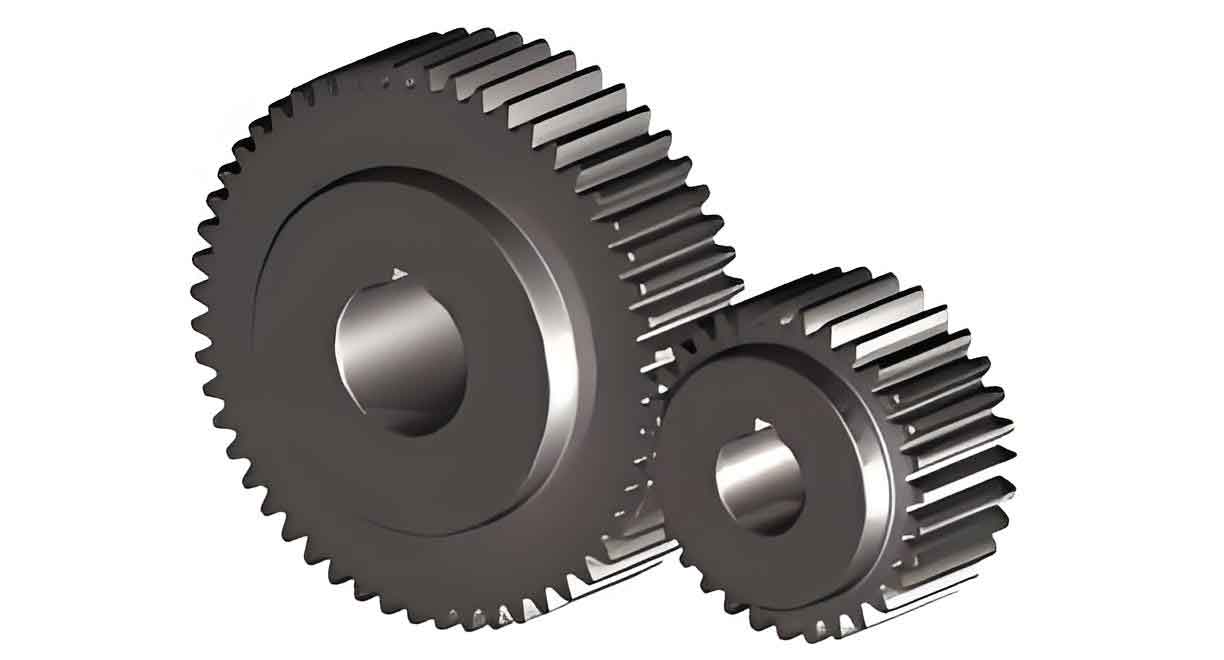
This article presents a coupled analytical framework. First, the geometric relationships for a spur gear pair are re-derived considering arbitrary assembly errors defined by deviations of the pinion and gear centers from their nominal positions. This establishes the actual line of action, contact points, and pressure angles. Second, the potential energy method is employed, but with the shear and axial force components modified to include the friction force. This yields the tooth pair stiffness as a function of the contact position and the coefficient of friction. By summing the contributions of all teeth in contact along the modified path of contact, the time-varying mesh stiffness of the spur gear pair is obtained. Subsequently, a six-degree-of-freedom (6-DOF) lumped-parameter dynamic model accounting for lateral-torsional coupling is established. The equations of motion are solved numerically to obtain the dynamic transmission error and other responses. Parametric studies are conducted to analyze the influence of varying friction coefficients and different magnitudes of assembly errors on the mesh stiffness characteristics and the resulting dynamic behavior of the spur gear system.
Theoretical Modelling of Mesh Stiffness for Spur Gears with Assembly Errors and Friction
Influence of Assembly Errors on the Meshing Zone of Spur Gears
The ideal meshing geometry of spur gears is disrupted when assembly errors are present. These errors can be represented as translational displacements of the gear centers from their theoretical locations. Let us consider a spur gear pair where the pinion is the driver. The nominal centers of the pinion and gear are denoted as $O_p$ and $O_g$, respectively. The actual installed centers are $O’_p$ and $O’_g$. The assembly errors are defined in a global coordinate system with its origin at the nominal pinion center $O_p$. The y-axis is aligned with the theoretical line of action, and the x-axis is perpendicular to it.
The coordinates of the actual centers are:
$$O’_p: (e_{xp}, e_{yp})$$
$$O’_g: (e_{xg} + a \sin\phi, \quad e_{yg} + a \cos\phi)$$
where $e_{xi}$ and $e_{yi}$ ($i = p, g$) are the assembly errors in the x and y directions for gear $i$, $a$ is the theoretical center distance, and $\phi$ is the theoretical operating pressure angle (equal to the standard pressure angle $\alpha_0$ for standard center distance assembly).
The actual line of action $A’B’$ is the common tangent to the two base circles from the actual installed centers. Its slope and intercept are determined by the geometry of the displaced base circles. The end points $A’$ and $B’$ of the effective line of action are found as the tangent points from $O’_p$ and $O’_g$ to their respective base circles of radius $R_{bp}$ and $R_{bg}$. The coordinates $(x_1, y_1)$ and $(x_2, y_2)$ of these points satisfy the system of equations for the base circle and the line passing through the actual gear center with the appropriate slope derived from the tangent condition. The actual contact points $A’_1$ and $B’_1$, which are the intersections of the line of action with the pinion and gear tip circles, are found similarly by solving the equations of the tip circles and the line of action. The pressure angle $\alpha_i$ at any contact point $X$ on the actual line of action is given by:
$$\alpha_i = \arccos\left( \frac{R_{bi}}{R_{Xi}} \right)$$
where $R_{Xi}$ is the distance from the contact point $X$ to the actual center of gear $i$, and $R_{bi}$ is its base radius.
Calculation of Spur Gear Pair Mesh Stiffness under the Influence of Tooth Surface Friction
According to the energy method, a gear tooth in contact is modeled as a non-uniform cantilever beam fixed at the root circle. The total potential energy stored in a meshing tooth pair comprises several components: bending energy $U_b$, shear energy $U_s$, axial compressive energy $U_a$, Hertzian contact energy $U_h$, and the fillet foundation deflection energy $U_f$. The stiffness associated with each energy component is derived from the relationship $U = F^2 / (2k)$, where $F$ is the applied normal load at the contact point.
The key modification introduced by friction lies in the decomposition of the normal contact force $F$ into components acting on the cantilever beam. The friction force $f$ acts tangentially at the contact point, opposing the relative sliding direction. The direction of sliding reverses at the pitch point. Therefore, the forces on the tooth vary depending on whether contact occurs before or after the pitch point.
The forces acting on the tooth in the directions parallel ($F_a$) and perpendicular ($F_b$) to the tooth centerline (the line from the gear center through the midpoint of the tooth thickness at the root) are:
$$
\begin{cases}
F_a = F \sin\alpha_1 \mp \mu F \cos\alpha_1 \\
F_b = F \cos\alpha_1 \pm \mu F \sin\alpha_1
\end{cases}
$$
where $\mu$ is the coefficient of friction, $\alpha_1$ is the load angle (pressure angle at the contact point relative to the tooth centerline), and the upper/lower signs correspond to the approach and recess segments of the meshing cycle, respectively. Here, $f = \mu F$.
Using these force components, the energy integrals are evaluated. The bending moment $M$ at a distance $x$ from the root is $M = F_b \cdot (h_x – x) – F_a \cdot q$, where $h_x$ is the distance from the root to the point of load application along the tooth centerline, and $q$ is a moment arm for the axial component. The area moment of inertia $I_x$ and the area $A_x$ of the tooth section at distance $x$ are functions of the local tooth thickness.
The individual stiffness components for a single tooth are then calculated as follows:
Bending Stiffness $k_b$:
$$\frac{1}{k_b} = \int_{0}^{d} \frac{\left[ (h_x – x)\cos\beta – (q \sin\beta) \right]^2}{E I_x} dx$$
where $\beta$ is the angle between the force component $F_b$ and the normal to the tooth centerline, and $d$ is the distance from the root to the load application point along the tooth centerline.
Shear Stiffness $k_s$:
$$\frac{1}{k_s} = \int_{0}^{d} \frac{1.2 \cos^2\beta}{G A_x} dx$$
where $G = E / [2(1+\nu)]$ is the shear modulus, $E$ is Young’s modulus, and $\nu$ is Poisson’s ratio.
Axial Compressive Stiffness $k_a$:
$$\frac{1}{k_a} = \int_{0}^{d} \frac{\sin^2\beta}{E A_x} dx$$
Hertzian Contact Stiffness $k_h$:
This stiffness is derived from the classical Hertzian contact theory for two parallel cylinders and is given by:
$$\frac{1}{k_h} = \frac{4(1-\nu^2)}{\pi E L}$$
where $L$ is the face width of the spur gears. A more precise logarithmic form is often used for variable curvature.
Fillet Foundation Stiffness $k_f$:
An empirical formula accounting for the flexibility of the gear body (fillet region) is used:
$$\frac{1}{k_f} = \frac{\cos^2\alpha_1}{EL} \left[ L^*\left(\frac{u_f}{S_f}\right)^2 + M^*\left(\frac{u_f}{S_f}\right) + P^* (1 + Q^* \tan^2\alpha_1) \right]$$
where $u_f$, $S_f$, $L^*$, $M^*$, $P^*$, and $Q^*$ are geometric parameters defined by the tooth dimensions and load angle.
The composite mesh stiffness $k_m(t)$ for the spur gear pair at any instant is the sum of the stiffnesses of all tooth pairs in contact, considering the series combination of the pinion and gear tooth stiffnesses for each pair, plus the contact stiffness:
$$\frac{1}{k_m(t)} = \sum_{i=1}^{n} \left[ \sum_{j=p,g} \left( \frac{1}{k_{b,j}^{(i)}} + \frac{1}{k_{s,j}^{(i)}} + \frac{1}{k_{a,j}^{(i)}} \right) + \frac{1}{k_h^{(i)}} \right] + \frac{1}{\varepsilon_p k_{f,p}} + \frac{1}{\varepsilon_g k_{f,g}}$$
where $n$ is the number of tooth pairs in contact, the superscript $(i)$ denotes the i-th mating pair, and $\varepsilon_j$ is a foundation correction factor (typically taken as 1.1).
Dynamic Model of the Spur Gear Transmission System
To analyze the dynamic response, a lumped-parameter model with six degrees of freedom is established for a single-stage spur gear pair, as shown in the schematic. The model considers both the torsional vibrations of the gears and the lateral vibrations of their supporting shafts/bearings in the x and y directions. The coordinate system is defined with displacements $x_p$, $y_p$, $\theta_p$ for the pinion and $x_g$, $y_g$, $\theta_g$ for the gear.
The equations of motion are derived using Newton’s second law:
For the Pinion:
$$
\begin{aligned}
m_p \ddot{x}_p + c_{xp} \dot{x}_p + k_{xp} x_p &= -F_m \\
m_p \ddot{y}_p + c_{yp} \dot{y}_p + k_{yp} y_p &= 0 \\
I_p \ddot{\theta}_p + F_m R_{bp} &= T_p
\end{aligned}
$$
For the Gear:
$$
\begin{aligned}
m_g \ddot{x}_g + c_{xg} \dot{x}_g + k_{xg} x_g &= F_m \\
m_g \ddot{y}_g + c_{yg} \dot{y}_g + k_{yg} y_g &= 0 \\
I_g \ddot{\theta}_g + F_m R_{bg} &= -T_g
\end{aligned}
$$
where $m_i$, $I_i$ are the mass and mass moment of inertia of gear $i$; $k_{xi}$, $k_{yi}$, $c_{xi}$, $c_{yi}$ are the bearing support stiffnesses and damping coefficients in the x and y directions; $T_p$ and $T_g$ are the input and output torques; $R_{bp}$ and $R_{bg}$ are the base circle radii.
The dynamic mesh force $F_m$ is the primary internal excitation and is formulated as:
$$F_m = k_m(t) \cdot \delta + c_m \dot{\delta}$$
where $k_m(t)$ is the time-varying mesh stiffness derived in the previous section, $c_m$ is the mesh damping (often expressed as $c_m = 2 \zeta \sqrt{k_m m_e}$ with $\zeta$ as the damping ratio and $m_e$ as the equivalent mass), and $\delta$ is the dynamic transmission error (DTE).
The dynamic transmission error $\delta$ represents the relative displacement of the gears along the line of action, considering both torsional and translational motions:
$$\delta = (x_p – x_g) \sin \bar{\alpha} + (y_p – y_g) \cos \bar{\alpha} + R_{bp} \theta_p + R_{bg} \theta_g$$
where $\bar{\alpha}$ is the average operating pressure angle. For simplicity in the presented model aligned with the line of action, this can reduce to $\delta = (x_p – x_g) + R_{bp}\theta_p – R_{bg}\theta_g$.
Numerical Simulation and Parametric Analysis
The system of ordinary differential equations is solved numerically using a time-step integration method like the fourth-order Runge-Kutta method. The time-varying mesh stiffness $k_m(t)$ is calculated at each time step based on the instantaneous angular position of the gears, the assembly error geometry, and the specified friction coefficient. The primary output of interest is the Dynamic Transmission Error (DTE), which is a direct indicator of vibratory excitation and transmission accuracy. The parameters for the base spur gear system are listed in the table below.
| Parameter | Symbol | Value |
|---|---|---|
| Number of teeth (Pinion/Gear) | $z_p$, $z_g$ | 50, 50 |
| Module | $m_n$ | 3 mm |
| Pressure angle | $\alpha_0$ | 20° |
| Face width | $L$ | 20 mm |
| Young’s Modulus | $E$ | 2.0e5 MPa |
| Poisson’s ratio | $\nu$ | 0.3 |
| Mass (Pinion/Gear) | $m_p$, $m_g$ | 2.52 kg, 2.52 kg |
| Moment of inertia (Pinion/Gear) | $I_p$, $I_g$ | 7.4e-3 kg·m², 7.4e-3 kg·m² |
| Bearing stiffness (x, y directions) | $k_x$, $k_y$ | 1.0e8 N/m |
| Bearing damping | $c_x$, $c_y$ | 100 N·s/m |
| Mesh damping ratio | $\zeta$ | 0.07 |
| Input torque (Pinion) | $T_p$ | 340 Nm |
| Input speed (Pinion) | $n_p$ | 2340 rpm |
Three distinct assembly error conditions are defined to analyze their impact alongside friction. These conditions represent increasing levels of misalignment.
| Condition | Description | $e_{xp}, e_{yp}$ (μm) | $e_{xg}, e_{yg}$ (μm) |
|---|---|---|---|
| Condition 1 | Ideal (No error) | 0, 0 | 0, 0 |
| Condition 2 | Small parallel offset | 0, 0 | 10, 10 |
| Condition 3 | Large parallel offset | 0, 0 | 100, 100 |
Influence of Tooth Surface Friction Coefficient
The mesh stiffness of the spur gear pair is first computed over one mesh cycle for different coefficients of friction ($\mu = 0, 0.05, 0.1$), assuming ideal assembly (Condition 1). The results reveal a clear trend: the amplitude of the mesh stiffness decreases as the friction coefficient increases. This is because friction introduces additional shear stresses and modifies the internal force distribution within the tooth, effectively making the tooth pair seem more compliant. The characteristic “step” changes at the single-tooth and double-tooth contact boundaries remain, but the overall stiffness level is reduced. This reduction in mesh stiffness amplitude directly influences the dynamic mesh force.
The dynamic response, characterized by the DTE, is subsequently analyzed. For the ideal assembly case, a moderate friction coefficient (e.g., $\mu=0.05$) results in the smallest amplitude of DTE fluctuation compared to both the frictionless case ($\mu=0$) and the higher friction case ($\mu=0.1$). This non-monotonic relationship suggests that while friction generally increases damping and might be thought to always reduce vibration, its effect on the excitation source—the mesh stiffness—is complex. A very low stiffness (from high friction) can lead to larger deflections, while zero friction yields the highest stiffness but no friction damping. An optimal, moderate friction value can therefore balance these effects to minimize the overall dynamic excitation in spur gears. The frequency spectrum of the DTE shows dominant components at the mesh frequency and its harmonics, with their relative magnitudes being sensitive to the friction coefficient.
Influence of Assembly Errors
Next, the effect of assembly errors is investigated, initially without friction ($\mu=0$) to isolate the geometric effect. The mesh stiffness profiles for Conditions 1, 2, and 3 show significant differences. The most notable impact is on the length of the double-tooth contact regions. Assembly errors that change the effective center distance alter the angles at which teeth come into and go out of contact. For the specific error vector in Condition 3, the double-tooth contact zone is visibly narrowed compared to the ideal case. This effectively reduces the instantaneous contact ratio and creates more pronounced transitions in mesh stiffness, leading to sharper excitation pulses. Condition 2, with a smaller error, shows an intermediate effect.
The dynamic transmission error under these three assembly conditions (with a fixed $\mu=0.05$) reveals a critical finding. Contrary to what might be intuitively expected, the largest error (Condition 3) does not necessarily produce the largest DTE amplitude. In fact, the simulation shows that Condition 2 (small offset) produces the largest DTE amplitude, while Condition 3 produces an amplitude smaller than Condition 2 and sometimes even comparable to or slightly different from the ideal case. This phenomenon can be attributed to the nonlinear relationship between center distance, pressure angle, and load sharing. A specific error pattern might accidentally improve load sharing between two pairs of teeth at certain moments or alter the phasing of stiffness variations, thereby reducing the peak dynamic force. This indicates that the dynamic performance of spur gears is highly sensitive to the specific nature of the assembly error, and simply minimizing error magnitude may not be the only criterion; controlling the error vector direction might also be important for dynamic optimization.
The combined effect of both assembly error and friction was also studied. For a given error condition (e.g., Condition 3), increasing the friction coefficient generally reduces the DTE amplitude, consistent with the damping effect, but the baseline amplitude is set by the error-modified stiffness. The most favorable dynamic performance (lowest, smoothest DTE) is achieved by a combination of a controlled assembly state and a moderate, well-lubricated friction coefficient.
Conclusion
This work developed a comprehensive analytical framework for modeling the mesh stiffness and dynamic response of spur gear pairs, explicitly considering the coupled effects of assembly errors and tooth surface friction. The key contributions and findings are summarized below:
1. A refined mesh stiffness model for spur gears was established by integrating geometric analysis of misaligned gears with an augmented energy method that accounts for friction forces. The model calculates the time-varying mesh stiffness along the actual line of action determined by the assembly error vector.
2. The parametric analysis demonstrates that the mesh stiffness amplitude of spur gears decreases with an increasing coefficient of friction. This is due to the altered internal stress distribution within the tooth caused by the tangential friction force.
3. Assembly errors have a significant and nonlinear impact on the meshing characteristics of spur gears. They alter the effective contact ratio and the shape of the stiffness waveform, which in turn modifies the dynamic excitation.
4. The dynamic response, measured by the Dynamic Transmission Error, is influenced by both parameters in a complex interplay. An optimal, moderate friction coefficient can minimize DTE amplitude for a given assembly state. Perhaps more importantly, the relationship between assembly error magnitude and dynamic performance is not monotonic. Certain error patterns may inadvertently lead to a more favorable dynamic response than smaller errors, highlighting the importance of considering the error vector, not just its magnitude, in the design and assembly of spur gear systems.
5. The overall vibration performance of spur gear transmissions can be improved by appropriately controlling both the assembly conditions (aiming for a favorable error state) and maintaining a reasonable tooth surface friction coefficient through proper lubrication. The presented model provides a valuable tool for such coupled analyses, aiding in the dynamic optimization and robustness assessment of spur gear drives operating under real-world, non-ideal conditions.