
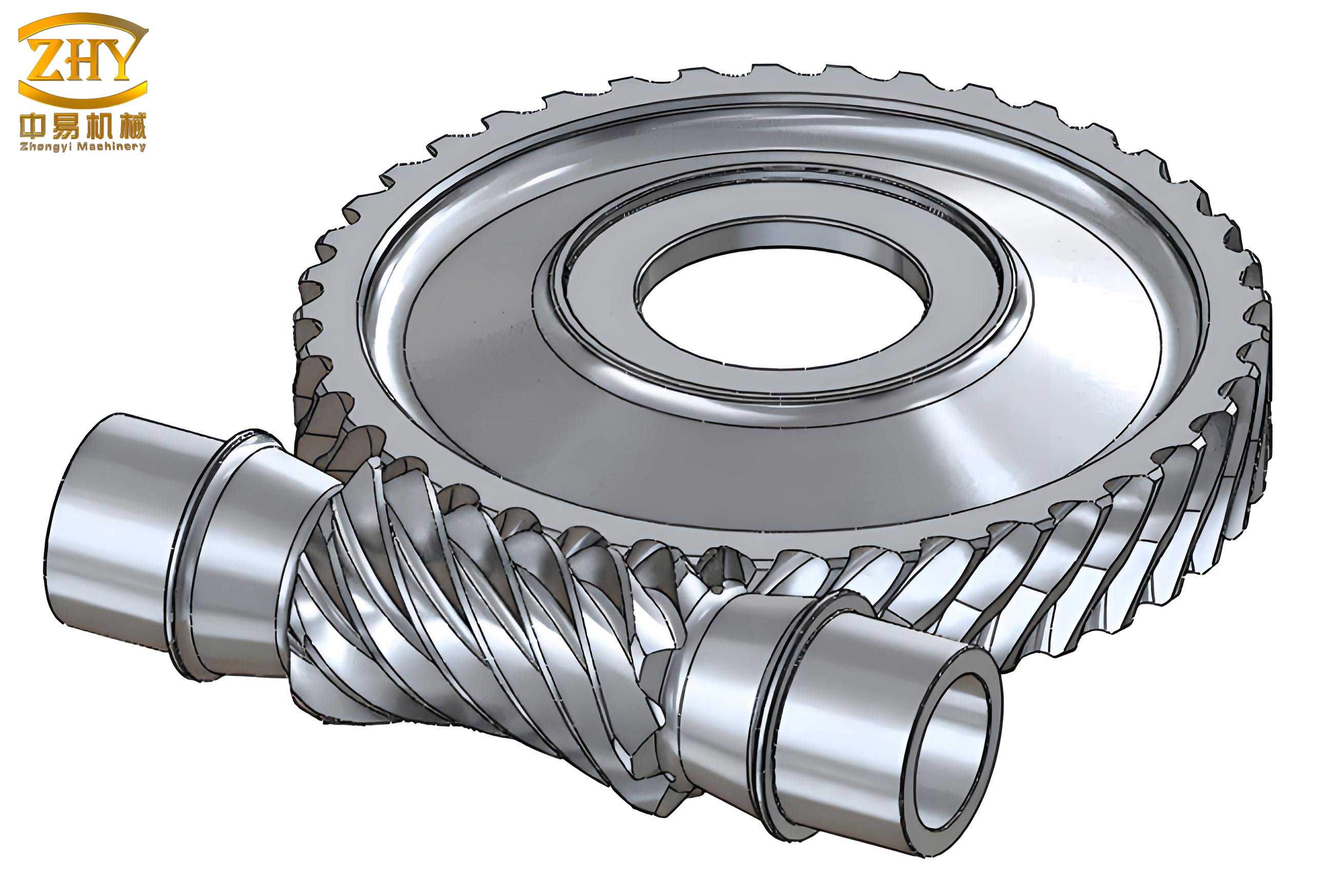
The transmission of motion and power through screw gears, particularly worm drives, is a fundamental aspect of many mechanical systems. This paper presents a detailed analysis of a novel configuration: the Tapered Roller Enveloping End-Face Meshing Worm Drive. The core innovation of this screw gear set lies in its worm wheel design, where the teeth are replaced by freely rotating tapered rollers. This design philosophy aims to fundamentally alter the contact mechanics from sliding to predominantly rolling friction, thereby addressing classical limitations associated with worm drives.
Traditional worm drives, while offering advantages like high reduction ratios, compactness, and smooth operation, are often plagued by relatively low transmission efficiency and limited load capacity. The primary source of these drawbacks is the significant sliding motion inherent between the conjugated tooth surfaces. This sliding friction leads to heat generation, accelerated wear, and demands rigorous lubrication regimes. In many practical industrial applications, from heavy machinery to precision robotics, improving the efficiency and durability of screw gear transmissions remains a critical engineering challenge. The proposed design mitigates this by utilizing tapered rollers as the worm wheel teeth. The rollers can rotate about their own axes, theoretically transforming the detrimental sliding at the mesh interface into beneficial rolling contact. This paper establishes the complete mathematical model for this novel screw gear set, derives its meshing performance parameters, and analyzes the influence of key geometric design variables.
1. Mathematical Model of the Meshing Principle
The foundation for analyzing any gear system lies in a rigorous mathematical description based on gear meshing theory and differential geometry. The following sections detail the coordinate system setup and the derivation of fundamental equations for the tapered roller enveloping worm drive.
1.1 Establishment of Coordinate Systems
To describe the relative motion and engagement between the worm and the worm wheel, multiple coordinate systems are established, as shown in the schematic below. The worm is designated as body 1 and the worm wheel as body 2.
Let $\sigma_1(O_1; \mathbf{i}_1, \mathbf{j}_1, \mathbf{k}_1)$ and $\sigma_2(O_2; \mathbf{i}_2, \mathbf{j}_2, \mathbf{k}_2)$ be the fixed coordinate systems attached to the worm and worm wheel frames, respectively. Their origins $O_1$ and $O_2$ are located at the centers of the respective components, with the $z$-axes aligned along the rotational axes: $\mathbf{k}_1$ for the worm and $\mathbf{k}_2$ for the worm wheel. The center distance is denoted by $A$, such that $\overrightarrow{O_1O_2} = A\mathbf{i}_2$ at the initial position.
The moving coordinate systems attached to the rotating bodies are $\sigma_{1′}(O_1; \mathbf{i}_{1′}, \mathbf{j}_{1′}, \mathbf{k}_{1′})$ and $\sigma_{2′}(O_2; \mathbf{i}_{2′}, \mathbf{j}_{2′}, \mathbf{k}_{2′})$, where $\mathbf{k}_{1′} = \mathbf{k}_1$ and $\mathbf{k}_{2′} = \mathbf{k}_2$. The rotation angles are $\varphi_1$ for the worm and $\varphi_2$ for the worm wheel, related by the transmission ratio $i_{12}$: $\varphi_1 / \varphi_2 = \omega_1 / \omega_2 = i_{12} = Z_2 / Z_1$, where $Z_1$ is the number of worm threads (starts) and $Z_2$ is the number of tapered rollers on the worm wheel.
A local coordinate system $\sigma_0(O_0; \mathbf{i}_0, \mathbf{j}_0, \mathbf{k}_0)$ is fixed at the apex of a representative tapered roller, with $\mathbf{k}_0$ oriented along the roller’s axis (radial direction of the worm wheel). The position of $O_0$ in $\sigma_2$ is $(a_2, b_2, c_2)$. Finally, an instantaneous contact point $O_p$ on the roller surface is described using a moving trihedron $\sigma_p(O_p; \mathbf{e}_1, \mathbf{e}_2, \mathbf{n})$, where $\mathbf{n}$ is the unit normal vector to the roller surface at $O_p$, and $\mathbf{e}_1, \mathbf{e}_2$ are orthogonal unit vectors in the tangent plane.
1.2 Coordinate Transformations
The analysis of meshing requires expressing vectors and equations in consistent frames. The transformation from the worm-moving frame $\sigma_{1′}$ to the wheel-moving frame $\sigma_{2′}$ is given by:
$$ \mathbf{B}_{2′} = \mathbf{A}_{2’1′} \mathbf{B}_{1′} $$
where $\mathbf{B}$ represents a vector, and the transformation matrix $\mathbf{A}_{2’1′}$ is:
$$
\mathbf{A}_{2’1′} = \begin{bmatrix}
-\cos\varphi_1 \cos\varphi_2 & -\sin\varphi_1 \cos\varphi_2 & \sin\varphi_2 \\
\cos\varphi_1 \sin\varphi_2 & \sin\varphi_1 \sin\varphi_2 & \cos\varphi_2 \\
-\sin\varphi_1 & \cos\varphi_1 & 0
\end{bmatrix}
$$
The transformation from the roller frame $\sigma_0$ to the contact point trihedron $\sigma_p$ is defined by the surface geometry. For a tapered roller with semi-cone angle $\beta$, the unit vectors are:
$$
\begin{aligned}
\mathbf{e}_1 &= -\sin\theta \mathbf{i}_0 + \cos\theta \mathbf{j}_0 \\
\mathbf{e}_2 &= \sin\beta \cos\theta \mathbf{i}_0 + \sin\beta \sin\theta \mathbf{j}_0 + \cos\beta \mathbf{k}_0 \\
\mathbf{n} &= \cos\beta \cos\theta \mathbf{i}_0 + \cos\beta \sin\theta \mathbf{j}_0 – \sin\beta \mathbf{k}_0
\end{aligned}
$$
where $\theta$ is a parameter defining the angular position of the contact line generator on the cone.
1.3 Surface Equation of the Tapered Roller
The surface of the tapered roller, which serves as the generating tool surface, is described in its local frame $\sigma_0$. Using parameters $u$ (axial distance from the apex) and $\theta$, the position vector $\mathbf{r}_0$ is:
$$
\mathbf{r}_0 = \begin{bmatrix}
x_0 \\ y_0 \\ z_0
\end{bmatrix} =
\begin{bmatrix}
(R + u \tan\beta)\cos\theta \\
(R + u \tan\beta)\sin\theta \\
u
\end{bmatrix}
$$
where $R$ is the radius of the small end of the tapered roller, and $\beta$ is its semi-cone angle.
1.4 Relative Velocity and the Meshing Equation
The condition for continuous contact between two gear surfaces is expressed by the meshing equation, which states that the relative velocity at the contact point must have no component along the common surface normal. The relative velocity $\mathbf{v}^{(1’2′)}$ between the worm surface (to be generated) and the roller surface is calculated from the kinematic chain.
Let $\boldsymbol{\xi}$ be the vector representing the center distance $A$ in the worm wheel frame $\sigma_{2′}$: $\boldsymbol{\xi} = A(\cos\varphi_2 \mathbf{i}_{2′} – \sin\varphi_2 \mathbf{j}_{2′})$. The relative velocity in the worm-moving frame $\sigma_{1′}$ is given by:
$$
\mathbf{v}^{(1’2′)} = \frac{d\boldsymbol{\xi}}{dt} + \boldsymbol{\omega}^{(1’2′)} \times \mathbf{r}_{1′} – \boldsymbol{\omega}_{2′} \times \boldsymbol{\xi}
$$
For a fixed center distance, $d\boldsymbol{\xi}/dt = 0$. Here, $\boldsymbol{\omega}^{(1’2′)} = \boldsymbol{\omega}_{1′} – \boldsymbol{\omega}_{2′}$ is the relative angular velocity. Projecting this velocity onto the contact trihedron $\sigma_p$ yields components $v^{(1’2′)}_1$, $v^{(1’2′)}_2$, and $v^{(1’2′)}_n$ along $\mathbf{e}_1$, $\mathbf{e}_2$, and $\mathbf{n}$ respectively.
The fundamental law of gear meshing requires:
$$ \Phi = \mathbf{n} \cdot \mathbf{v}^{(1’2′)} = v^{(1’2′)}_n = 0 $$
This scalar equation $\Phi(u, \theta, \varphi_2)=0$ is the meshing equation for this screw gear set. Its explicit form, after derivation, is:
$$
\Phi = M_1 \cos\varphi_2 + M_2 \sin\varphi_2 + M_3 = 0
$$
where $M_1$, $M_2$, and $M_3$ are functions of the geometric parameters $(R, \beta, A, a_2)$, the transmission ratio $i_{21} (1/i_{12})$, and the surface parameters $(u, \theta)$.
1.5 Equation of the Generated Worm Tooth Surface
The worm tooth surface is the envelope of the family of roller surfaces as the worm wheel rotates relative to the worm during the generation process (or vice-versa in the analysis). It is obtained by combining the equation of the roller surface transformed into the worm coordinate system with the meshing equation.
The position vector of a point on the worm surface in $\sigma_{1′}$ is:
$$
\mathbf{r}_{1′} = \mathbf{A}_{1’2′} (\mathbf{r}_{0} + \mathbf{O}_2\mathbf{O}_0|_{2′}) – \overrightarrow{O_1O_2}|_{1′}
$$
More concretely, the coordinates $(x_1, y_1, z_1)$ in $\sigma_{1′}$ can be expressed as functions of $\theta$, $u$, and $\varphi_2$. The complete set of equations defining the worm surface (a line of contact at each instant) is:
$$
\begin{cases}
x_1 = \cos\varphi_1\cos\varphi_2(z_0 – a_2) + \cos\varphi_1\sin\varphi_2 x_0 + y_0\sin\varphi_1 + A\cos\varphi_1 \\
y_1 = \sin\varphi_1\cos\varphi_2(z_0 – a_2) + \sin\varphi_1\sin\varphi_2 x_0 – y_0\cos\varphi_1 + A\sin\varphi_1 \\
z_1 = -\sin\varphi_2(a_2 – z_0) + \cos\varphi_2 x_0 \\
\Phi(u, \theta, \varphi_2) = 0 \\
\varphi_2 = i_{21}\varphi_1, \quad (-\pi \le \varphi_1 \le \pi)
\end{cases}
$$
Solving this system for a given set of parameters yields the conjugate worm surface. This surface is a complex 3D shape, an end-face type worm, whose flank geometry is directly determined by the tapered roller’s parameters and the kinematic setup of these screw gears.
2. Meshing Performance Evaluation Parameters
The quality of contact in gear drives is quantified by several key performance parameters. For the proposed tapered roller enveloping screw gears, we derive the formulas for the induced normal curvature, lubrication angle, self-rotation angle of the roller, and the entrainment velocity. These parameters collectively determine the contact stress, lubricant film thickness, wear rate, and overall transmission efficiency.
The following table summarizes the core parameters and their significance for screw gear performance.
| Performance Parameter | Symbol | Physical Significance | Desired Trend |
|---|---|---|---|
| Induced Normal Curvature | $k_\sigma^{(1’2′)}$ | Determines contact ellipse size and contact stress. Proportional to Hertzian stress. | Smaller values are better (reduces stress, increases film thickness). |
| Lubrication Angle | $\mu$ | Angle between relative velocity vector and contact line. Influences lubricant entrapment. | Close to 90° (promotes formation of elastohydrodynamic lubrication film). |
| Self-Rotation Angle | $\mu_{z0}$ | Angle between roller axis and relative velocity. Indicates rolling vs. sliding tendency. | Close to 90° (maximizes rolling component, minimizes sliding friction). |
| Entrainment Velocity | $v_{jx}$ | Average surface speed in the contact, crucial for building lubricant film pressure. | Larger values are better (increases elastohydrodynamic lubrication film thickness). |
2.1 Induced Normal Curvature
The induced normal curvature $k_\sigma^{(1’2′)}$ at a contact point is the difference between the normal curvatures of the two mating surfaces along the same direction. It is a fundamental parameter governing the size of the contact ellipse and the magnitude of the contact (Hertzian) stress. For the worm-roller contact, the formula is derived from differential geometry and the kinematics of the screw gear pair. The expression in the direction defined by the contact trihedron is:
$$
k_\sigma^{(1’2′)} = \frac{-\left(\omega_2^{(1’2′)}\right)^2 + \left( \frac{v_1^{(1’2′)} \cos\beta}{R + u\tan\beta} \right)^2 + \left(\omega_1^{(1’2′)}\right)^2}{\Psi}
$$
where $\omega_1^{(1’2′)}$ and $\omega_2^{(1’2′)}$ are the components of the relative angular velocity vector in $\sigma_p$, and $\Psi$ is a function related to the relative velocity magnitude and direction. A smaller induced normal curvature leads to a larger contact area, lower contact stress, and is also beneficial for forming a thicker elastohydrodynamic lubrication film.
2.2 Lubrication Angle
The lubrication angle $\mu$ is defined as the angle between the relative velocity vector $\mathbf{v}^{(1’2′)}$ and the tangent vector to the instantaneous contact line at the point of interest. A lubrication angle near 90° indicates that the relative sliding motion is almost perpendicular to the contact line, which is favorable for trapping lubricant within the contact zone and promoting the formation of a full fluid film. It is calculated as:
$$
\mu = \arcsin\left( \frac{u}{m \, n} \right)
$$
where
$$ u = v_1^{(1’2′)}\left( \frac{v_1^{(1’2′)} \cos\beta}{R + u\tan\beta} – \omega_2^{(1’2′)} \right) + v_2^{(1’2′)} \omega_1^{(1’2′)} $$
$$ m = \sqrt{ \left( \frac{v_1^{(1’2′)} \cos\beta}{R + u\tan\beta} – \omega_2^{(1’2′)} \right)^2 + \left( \omega_1^{(1’2′)} \right)^2 } $$
$$ n = \sqrt{ \left( v_1^{(1’2′)} \right)^2 + \left( v_2^{(1’2′)} \right)^2 } $$
2.3 Self-Rotation Angle of the Tapered Roller
A key advantage of this screw gear design is the potential for the tapered rollers to rotate freely, converting sliding into rolling. The self-rotation angle $\mu_{z0}$ measures the alignment between the relative velocity vector and the roller’s axis ($\mathbf{k}_0$). When this angle is 90°, the relative velocity vector lies perfectly in the plane perpendicular to the roller axis, maximizing the component that drives the roller’s spin and minimizing pure sliding along its axis. It is given by:
$$
\mu_{z0} = \arccos\left( \frac{ \mathbf{k}_0 \cdot \mathbf{v}^{(1’2′)} }{ | \mathbf{v}^{(1’2′)} | } \right) = \arccos\left( \frac{ | v_2^{(1’2′)} | }{ \sqrt{ (v_1^{(1’2′)})^2 + (v_2^{(1’2′)})^2 } } \right)
$$
2.4 Entrainment Velocity
In elastohydrodynamic lubrication analysis, the entrainment (or rolling) velocity $v_{jx}$ is the average of the surface velocities of the two contacting bodies in the direction of motion. It is a critical factor in the Reynolds equation for film thickness. A higher entrainment velocity generally promotes the formation of a thicker lubricant film, separating the surfaces and reducing wear. For the screw gear contact point, the entrainment velocity along the normal section is:
$$
v_{jx} = \frac{ v_{1’\sigma} + v_{2’\sigma} }{2}
$$
where $v_{1’\sigma}$ and $v_{2’\sigma}$ are the projections of the absolute velocities of the worm and roller surfaces at the contact point onto the direction normal to the contact line within the tangent plane.
3. Analysis of Geometric Parameter Influence
Using the derived mathematical model, the influence of three primary geometric design parameters on the meshing performance is systematically analyzed. A base set of parameters is defined: Center Distance $A = 140$ mm, Worm Starts $Z_1 = 1$, Number of Rollers $Z_2 = 25$, Throat Diameter Coefficient $k = 0.3$, Roller Semi-Cone Angle $\beta = 4^\circ$, Small End Radius $R = 5.5$ mm. Each parameter is then varied independently while others are held constant to study its effect. Performance is evaluated across the meshing cycle from the entry to the exit of the contact zone, typically corresponding to the worm rotation angle $\varphi_1$.
3.1 Influence of Tapered Roller Small End Radius (R)
The radius at the small end of the tapered roller $R$ is a fundamental dimension. The analysis varies $R$ from 4.5 mm to 6.5 mm.
Induced Normal Curvature: The induced normal curvature shows a consistent decreasing trend with increasing $R$ over most of the meshing cycle. This is a highly beneficial effect, as a larger $R$ effectively reduces the local surface curvature of the roller, leading to lower contact stresses and potentially better lubrication conditions in the screw gear mesh.
Lubrication Angle: The lubrication angle generally decreases from the entry to the exit of the mesh. As $R$ increases, the overall magnitude of the lubrication angle decreases, and the curve becomes slightly steeper. While a lower angle is less ideal for lubrication, the values remain in an acceptable range for the parameters studied.
Entrainment Velocity: The entrainment velocity profile decays from entry to exit. An interesting bifurcation is observed: on the drive side of the tooth flank, a larger $R$ leads to a higher $v_{jx}$, which is favorable. On the opposite flank, the trend reverses. This asymmetric effect must be considered in the load-bearing design of the screw gears.
Self-Rotation Angle: The self-rotation angle also declines from entry to exit. A larger $R$ results in a lower $\mu_{z0}$ throughout the mesh, meaning the rolling-promoting component of motion is slightly reduced. A smaller $R$ provides a more uniform and higher self-rotation angle across the cycle.
The following table summarizes the influence of increasing the small end radius $R$:
| Performance Parameter | Effect of Increasing R | Implication for Screw Gear Design |
|---|---|---|
| Induced Normal Curvature ($k_\sigma$) | Decreases | Favorable. Lowers contact stress, may increase film thickness. |
| Lubrication Angle ($\mu$) | Slightly Decreases | Slightly negative. May reduce lubrication effectiveness. |
| Entrainment Velocity ($v_{jx}$) on Drive Flank | Increases | Favorable. Promotes thicker elastohydrodynamic lubrication film. |
| Self-Rotation Angle ($\mu_{z0}$) | Decreases | Negative. Reduces the rolling component, potentially increasing sliding friction. |
3.2 Influence of Worm Throat Diameter Coefficient (k)
The throat diameter coefficient $k$ defines the worm’s throat diameter $d_1$ relative to the center distance: $d_1 = k \cdot A$. It is varied from 0.2 to 0.4.
Induced Normal Curvature: The effect of $k$ is complex and asymmetric. On the drive flank, $k_\sigma$ increases with $k$ in the first half of the mesh and decreases in the second half. On the opposite flank, $k_\sigma$ uniformly increases with $k$. This indicates a trade-off where an optimal $k$ must balance the curvature on both flanks of the screw gear teeth.
Lubrication Angle: The lubrication angle curves show that a smaller $k$ (e.g., 0.2) leads to a larger $\mu$ in the mid-to-late mesh phase, which is advantageous. The variation with $k$ is significant, offering a clear design lever to optimize this parameter.
Entrainment Velocity: The entrainment velocity profile shows a crossover point. Before this point, a larger $k$ yields a lower $v_{jx}$; after this point, the trend reverses, and a larger $k$ gives a higher $v_{jx}$. The designer must consider which phase of the mesh is more critical for lubrication.
Self-Rotation Angle: Similar to $v_{jx}$, the self-rotation angle’s dependence on $k$ changes during the mesh. In the initial phase, a larger $k$ slightly reduces $\mu_{z0}$; later in the mesh, a larger $k$ increases it. This non-linear relationship requires careful system-level analysis.
| Performance Parameter | Effect of Increasing k (Throat Coeff.) | Design Consideration |
|---|---|---|
| Induced Normal Curvature ($k_\sigma$) | Complex, flank-dependent increase. | Requires balancing stress on both tooth flanks. An intermediate k may be optimal. |
| Lubrication Angle ($\mu$) | Generally decreases, especially in later mesh. | A smaller k is beneficial for maintaining a high lubrication angle. |
| Entrainment Velocity ($v_{jx}$) | Decreases in early mesh, increases in late mesh. | Choice depends on critical lubrication phase. Larger k may benefit exit region. |
| Self-Rotation Angle ($\mu_{z0}$) | Slight decrease early, increase later. | Similar to $v_{jx}$, the impact is phase-dependent. |
3.3 Influence of Tapered Roller Semi-Cone Angle (β)
The semi-cone angle $\beta$ of the roller is crucial as it defines the taper. It is varied from $2^\circ$ to $6^\circ$.
Induced Normal Curvature: A clear and strong trend is observed: increasing $\beta$ leads to a substantial decrease in the induced normal curvature $k_\sigma$. This is one of the most significant findings, indicating that a steeper taper (larger $\beta$) is highly effective in reducing contact stresses in these screw gears.
Lubrication Angle: The lubrication angle $\mu$ decreases as $\beta$ increases. The reduction is more pronounced with larger $\beta$ values. This presents a direct trade-off: a larger $\beta$ improves stress (lower $k_\sigma$) but worsens the geometric condition for lubricant entrapment (lower $\mu$).
Entrainment Velocity: The effect on $v_{jx}$ is again asymmetric. On the drive flank, a larger $\beta$ increases the entrainment velocity, which is positive for film formation. On the opposite flank, the effect is reversed. This further emphasizes the need for flank-specific analysis in asymmetric screw gear contacts.
Self-Rotation Angle: Increasing the semi-cone angle $\beta$ causes a consistent decrease in the self-rotation angle $\mu_{z0}$ across the entire mesh. This suggests that while a steeper taper is good for contact stress, it may slightly impair the desired pure rolling motion of the roller, potentially leaving a larger sliding component.
| Performance Parameter | Effect of Increasing β (Semi-Cone Angle) | Design Trade-off |
|---|---|---|
| Induced Normal Curvature ($k_\sigma$) | Strong Decrease | Highly Favorable. Major lever for reducing contact stress. |
| Lubrication Angle ($\mu$) | Decrease | Unfavorable. Creates a direct conflict with stress reduction. |
| Entrainment Velocity ($v_{jx}$) on Drive Flank | Increases | Favorable. Complements the stress reduction benefit. |
| Self-Rotation Angle ($\mu_{z0}$) | Decreases | Unfavorable. May increase sliding friction despite lower stress. |
4. Discussion and Conclusions
The comprehensive mathematical modeling and parametric analysis of the tapered roller enveloping end-face meshing worm drive reveal its distinct characteristics and design sensitivities. The derived meshing equation and worm surface equations provide the necessary tools for exact geometry generation and manufacturing simulation. The analysis of performance parameters confirms the potential of this architecture to address classic worm drive limitations, while also highlighting critical design compromises.
The most significant outcome is the demonstration of favorable contact conditions. The induced normal curvature, a primary driver of contact stress, can be maintained at relatively low values and is highly responsive to geometric changes, particularly the roller’s semi-cone angle $\beta$. Furthermore, parameters like the lubrication angle and self-rotation angle, while showing some variation, generally maintain values that support improved performance compared to traditional sliding-contact screw gears. The existence of a substantial entrainment velocity is promising for establishing effective elastohydrodynamic lubrication films.
The parametric study yields crucial design insights:
- The roller semi-cone angle $\beta$ is a dominant parameter. Increasing $\beta$ dramatically reduces contact stress (lower $k_\sigma$) and can increase entrainment velocity on the load-bearing flank, but it simultaneously reduces the lubrication angle and self-rotation angle. An optimal value must balance high load capacity with acceptable lubrication and friction conditions.
- Asymmetric behavior is inherent. The drive flank and the opposite flank frequently respond differently to parameter changes (e.g., for $v_{jx}$ and $k_\sigma$ vs. $k$). This necessitates a design focus on the primarily loaded flank, but the other flank’s performance cannot be ignored, especially in reversing drives.
- Interdependence of parameters. The analysis reveals that parameters like $R$ and $\beta$ affect all performance metrics simultaneously. A systems-engineering approach is required for optimization, where a weighted combination of low $k_\sigma$, high $\mu$, high $\mu_{z0}$, and high $v_{jx}$ is sought.
- Design flexibility. The throat diameter coefficient $k$ offers a means to fine-tune the performance, especially the lubrication angle and the phase-dependent behavior of entrainment and self-rotation.
In conclusion, the tapered roller enveloping end-face meshing worm drive represents a viable and innovative evolution in screw gear technology. Its foundational principle of replacing fixed gear teeth with rotating tapered rollers successfully alters the contact mechanics toward rolling. The mathematical framework established here proves that this screw gear set can be designed to exhibit a combination of low contact stress, favorable lubrication geometry, and significant rolling motion. These attributes translate directly into the potential for higher load capacity, improved efficiency, and greater durability compared to conventional worm gears, making it a compelling candidate for advanced applications in robotics, aerospace, and high-performance machinery where reliable power transmission is critical. Future work should focus on multi-objective optimization of the geometric parameters, experimental validation of the predicted contact mechanics, and detailed efficiency measurements under load.