
In recent years, the development of modular structures in robotics has highlighted the need for compact, high-performance transmission systems. As an internal gear manufacturer, I have focused on addressing the limitations of traditional industrial robot joint reducers by proposing a novel beveloid internal gear enveloping external-rotor crown worm drive. This system integrates the advantages of internal gears with crown worm mechanisms, offering high load capacity, compact design, and adjustable backlash through beveloid internal gears. Internal gears play a critical role in this configuration, enabling precise motion control and wear compensation. In this paper, I analyze the meshing performance of this drive using spatial meshing theory, deriving key equations and examining the influence of parameters such as worm throat diameter coefficient, main base circle radius, and generating plane inclination angle. The goal is to provide a theoretical foundation for optimizing internal gear designs in robotic applications.
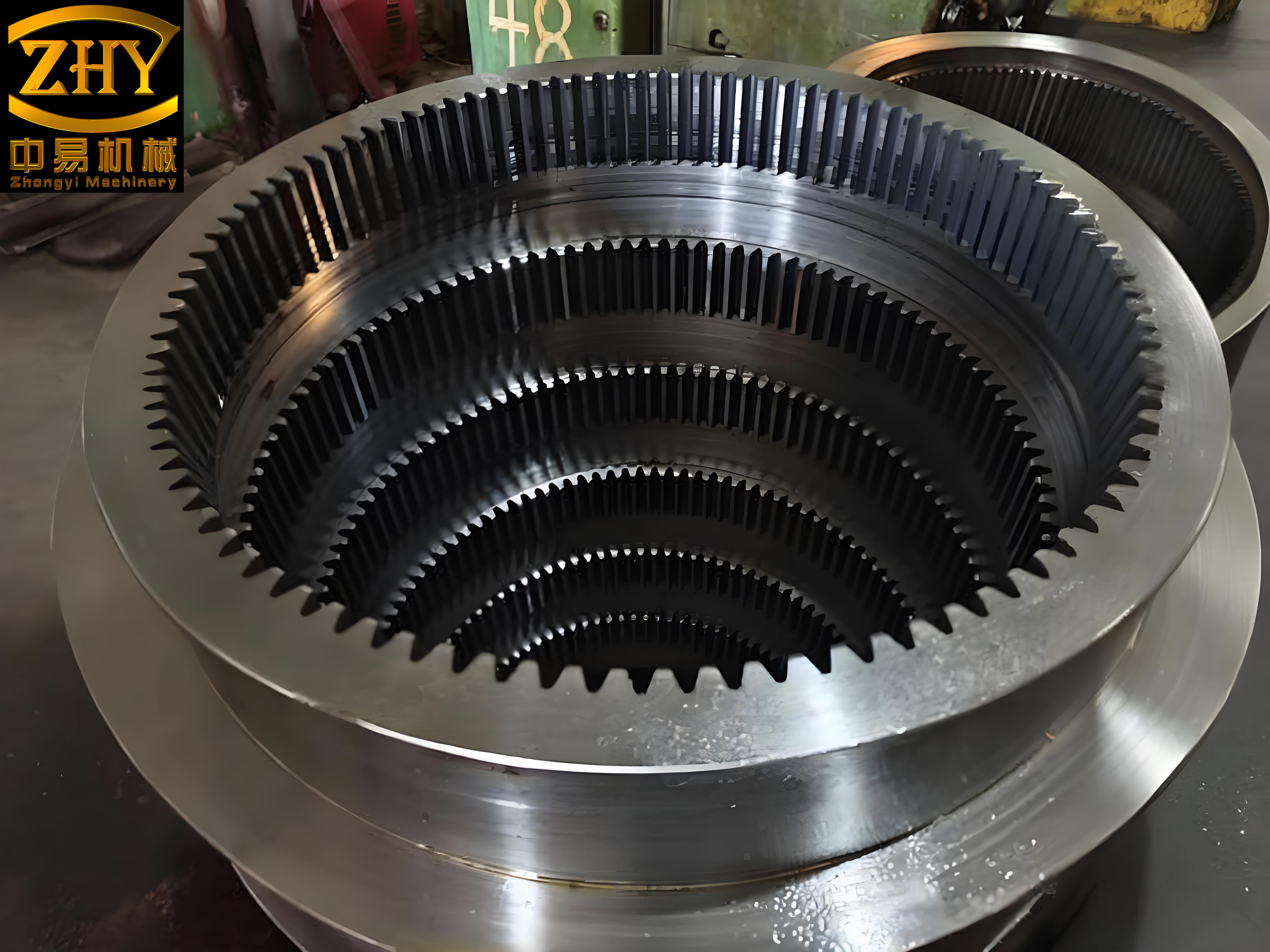
The transmission principle involves a beveloid internal gear with asymmetric tooth flank angles meshing with an external-rotor crown worm. The crown worm is enveloped by the internal gear through conjugate motion, and the wedge-shaped teeth of the internal gear allow for axial adjustment to control backlash and compensate for wear. This design combines the multi-tooth contact and high load-bearing characteristics of enveloping worm drives with the compactness of internal gears. The integration of the worm with an external-rotor permanent magnet motor further reduces the overall size and weight, making it ideal for intelligent joints in industrial robots. Internal gears manufactured with precise beveloid profiles ensure smooth operation and longevity. Below is an illustrative image of internal gears used in such systems:
To establish the mathematical model, I define coordinate systems for the crown worm and internal gear. Let Σ1′ (O1′; i1′, j1′, k1′) and Σ2′ (O2′; i2′, j2′, k2′) be the fixed coordinate systems for the worm and internal gear, respectively. The moving coordinate systems are Σ1 (O1; i1, j1, k1) for the worm and Σ2 (O2; i2, j2, k2) for the internal gear. The worm rotates with angular velocity ω1 about k1, and the internal gear rotates with ω2 about k2. The relationship between their angular displacements φ1 and φ2 is given by φ1/φ2 = ω1/ω2 = Z2/Z1 = i12, where Z1 and Z2 are the number of teeth. When φ1 = φ2 = 0, the moving and fixed systems coincide.
For the generating plane, I introduce a coordinate system Σ3 (O3; i3, j3, k3) with O3 located at (rb, 0, 0) in Σ2, where i3 is parallel to j2, and j3 forms an angle β with k2. Here, β is the inclination angle of the generating plane, and rb is the main base circle radius. The normal vector to the generating plane is n, and u and v are orthogonal parameters on the plane. To simplify calculations, I use the moving frame method by setting up a local coordinate system Σp (P; e1, e2, e3) at any meshing point P on the generating plane, where e1 is parallel to i3, and e3 is perpendicular to the plane.
The relative velocity vector between the worm and internal gear is derived from spatial kinematics. For the first enveloping process, the relative velocity in Σ2 is expressed as:
$$ \mathbf{v}^{(12)}_2 = v^{(12)}_{2x} \mathbf{i}_2 + v^{(12)}_{2y} \mathbf{j}_2 + v^{(12)}_{2z} \mathbf{k}_2 $$
where the components are:
$$ v^{(12)}_{2x} = z_2 \sin \phi_2 – y_2 i_{21} $$
$$ v^{(12)}_{2y} = -z_2 \cos \phi_2 + x_2 i_{21} $$
$$ v^{(12)}_{2z} = a + y_2 \cos \phi_2 – x_2 \sin \phi_2 $$
Here, a is the center distance, and i21 = 1/i12. Similarly, the relative angular velocity vector in Σ2 is:
$$ \boldsymbol{\omega}^{(12)}_2 = \omega^{(12)}_{2x} \mathbf{i}_2 + \omega^{(12)}_{2y} \mathbf{j}_2 + \omega^{(12)}_{2z} \mathbf{k}_2 $$
with components:
$$ \omega^{(12)}_{2x} = \cos \phi_2 $$
$$ \omega^{(12)}_{2y} = \sin \phi_2 $$
$$ \omega^{(12)}_{2z} = i_{21} $$
The meshing condition requires that the common normal at the contact point is perpendicular to the relative velocity, leading to the meshing function Φ:
$$ \Phi = \mathbf{n}^{(2)} \cdot \mathbf{v}^{(12)} = 0 $$
After coordinate transformations, the meshing function becomes:
$$ \Phi = N_1 \sin \phi_2 + N_2 \cos \phi_2 + N_3 $$
where:
$$ N_1 = -v + r_b \sin \beta $$
$$ N_2 = u \sin \beta $$
$$ N_3 = i_{21} u \cos \beta – a \sin \beta $$
Solving Φ = 0 gives the meshing equation:
$$ v = \frac{ -u i_{21} \cos \beta + \sin \beta (r_b \sin \phi_2 + u \cos \phi_2 – a) }{ \sin \phi_2 } $$
The contact line on the internal gear tooth surface is described by:
$$ \mathbf{r}^{(2)}_2 = x_2 \mathbf{i}_2 + y_2 \mathbf{j}_2 + z_2 \mathbf{k}_2 $$
with:
$$ x_2 = r_b – v \sin \beta $$
$$ y_2 = -u $$
$$ z_2 = v \cos \beta $$
$$ \Phi = 0 $$
The crown worm tooth surface, derived from the enveloping process, is given in Σ1 as:
$$ x_1 = -x_2 \cos \phi_1 \sin \phi_2 + y_2 \cos \phi_1 \cos \phi_2 + z_2 \sin \phi_1 + a \cos \phi_1 $$
$$ y_1 = x_2 \sin \phi_1 \sin \phi_2 – y_2 \sin \phi_1 \cos \phi_2 + z_2 \cos \phi_1 – a \sin \phi_1 $$
$$ z_1 = x_2 \cos \phi_2 + y_2 \sin \phi_2 $$
where v is substituted from the meshing equation. This formulation ensures accurate tooth geometry for internal gears manufactured with beveloid profiles.
To evaluate the meshing performance, I derive the induced normal curvature kδ, lubrication angle μ, and relative entrainment velocity vjx. The induced normal curvature along the contact line normal direction is:
$$ k_\delta = \frac{ (\omega^{(12)}_{3y})^2 + (\omega^{(12)}_{3x})^2 }{ \Psi } $$
where Ψ is the first-order transmission function:
$$ \Psi = \Phi_t + \omega^{(12)}_{3y} v^{(12)}_{3x} – \omega^{(12)}_{3x} v^{(12)}_{3y} $$
and Φt is the second-order function:
$$ \Phi_t = i_{21} \cos \phi_2 (-v + r_b \sin \beta) – i_{21} \sin \phi_2 u \sin \beta $$
The lubrication angle μ, which affects oil film formation, is:
$$ \mu = \arcsin \left( \frac{ v^{(12)}_{3x} \omega^{(12)}_{3y} – v^{(12)}_{3y} \omega^{(12)}_{3x} }{ \sqrt{ (v^{(12)}_{3x})^2 + (v^{(12)}_{3y})^2 } \sqrt{ (\omega^{(12)}_{3y})^2 + (\omega^{(12)}_{3x})^2 } } \right) $$
The relative entrainment velocity vjx, crucial for lubrication, is:
$$ v_{jx} = \frac{ v^{(12\Sigma)}_{3x} \omega^{(12)}_{3y} – v^{(12\Sigma)}_{3y} \omega^{(12)}_{3x} }{ 2 \sqrt{ (\omega^{(12)}_{3x})^2 + (\omega^{(12)}_{3y})^2 } } $$
Here, v^{(12Σ)}_{3x} and v^{(12Σ)}_{3y} are the components of the sum velocity in Σ3. These parameters are essential for internal gear manufacturers to optimize durability and efficiency.
I now analyze the influence of key parameters on meshing performance, assuming a fixed center distance and transmission ratio. The primary parameters are the worm throat diameter coefficient k, main base circle diameter db, and generating plane inclination angle β. The worm throat diameter is related to k by d1 = k * a, where d1 is the throat diameter. The main base circle radius rb = db/2. Internal gears with varying β values exhibit different contact patterns.
First, I examine the contact line distribution. The table below summarizes the effects of k, db, and β on contact lines, based on numerical simulations:
| Parameter | Effect on Contact Lines | Impact on Meshing |
|---|---|---|
| Worm throat diameter coefficient k | Increase reduces secondary action zones but decreases number of meshing teeth | Moderate contact area expansion |
| Main base circle diameter db | Increase eliminates secondary action and slightly enlarges contact region | Minor improvement in load distribution |
| Generating plane inclination angle β | Increase shifts contact right, disperses lines, and reduces secondary action | Significant contact area increase but fewer meshing teeth |
For instance, when k increases from 0.2 to 0.4, the contact area on internal gears expands slightly, but the number of simultaneously meshing teeth drops by approximately 15%. This trade-off is critical for internal gear manufacturers to balance load capacity and efficiency. Similarly, β values between 20° and 40° show that higher β disperses contact lines, reducing stress concentration but requiring precise manufacturing of internal gears.
Next, I evaluate the induced normal curvature kδ. The curvature affects contact stress and wear. The formula for kδ involves complex derivatives, but numerically, I observe:
$$ k_\delta \propto \frac{1}{\Psi} \left( (\omega^{(12)}_{3y})^2 + (\omega^{(12)}_{3x})^2 \right) $$
As k increases, kδ decreases overall, reducing contact stress. For db, kδ increases at the meshing start (φ2 ≈ 0°), remains constant near φ2 = 22°, and decreases thereafter. For β, kδ increases with β, indicating higher curvature and potential for wear. This is vital for internal gear manufacturers to select materials and heat treatments.
The lubrication angle μ is analyzed for its impact on oil film thickness. Values closer to 90° indicate better lubrication. The equation for μ shows dependence on velocity and angular components. Numerically, as k increases, μ increases, enhancing lubrication. For db, μ first decreases then increases, with optimal values around db = 0.3a. For β, μ increases significantly with β; at β = 40°, μ exceeds 82° throughout meshing, whereas at β = 20°, μ varies widely. Internal gears with higher β thus offer superior lubrication but require careful design to maintain tooth strength.
The relative entrainment velocity vjx influences the formation of elastohydrodynamic lubrication films. From the derivation, vjx is proportional to the numerator in its equation. As k increases, vjx increases, promoting better lubrication. For db, vjx decreases initially and then increases, with minima near db = 0.25a. For β, vjx increases with β, aiding in oil entrainment. This parameter is crucial for internal gear manufacturers to ensure long-term reliability in high-speed applications.
To summarize the parameter effects, I present a comprehensive table:
| Parameter | Induced Normal Curvature kδ | Lubrication Angle μ | Relative Entrainment Velocity vjx |
|---|---|---|---|
| k increase | Decreases | Increases | Increases |
| db increase | Increases at start, constant at mid, decreases at end | Decreases then increases | Decreases then increases |
| β increase | Increases | Increases | Increases |
These findings highlight that internal gear manufacturers must carefully choose parameters based on application requirements. For example, in robotics, where compactness and high load capacity are key, a lower k and moderate β may be optimal to maximize the number of meshing teeth while maintaining good lubrication. The mathematical models derived here facilitate such optimizations.
In conclusion, the beveloid internal gear enveloping external-rotor crown worm drive offers significant advantages for industrial robot joints. Through spatial meshing theory, I have established the meshing equations, tooth surface equations, and performance parameters. The analysis of k, db, and β reveals their profound effects on contact lines, induced curvature, lubrication, and entrainment velocity. Internal gears with adjustable beveloid profiles enable backlash control and wear compensation, making them ideal for precision applications. As an internal gear manufacturer, I emphasize that smaller k values increase meshing teeth count, while larger k values improve lubrication; db has minimal impact, and β critically influences contact distribution and lubrication performance. This research provides a foundation for designing high-efficiency internal gear systems, ensuring robustness and longevity in advanced robotic systems.