
1. Introduction
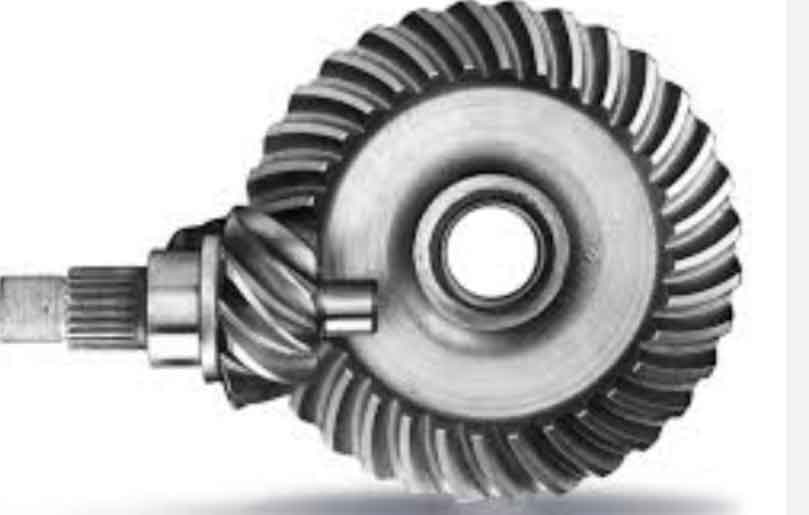
Hypoid gear is widely used in aerospace, automotive, and heavy machinery due to their high transmission ratio, load capacity, and smooth operation. However, achieving optimal meshing performance remains challenging, especially for gears manufactured using the duplex helical method (completing method). This study investigates the influence of installation errors, helical motion coefficients, and tooth surface mismatch on the meshing characteristics of hypoid gear. Through numerical analysis, experimental validation, and theoretical modeling, we reveal critical insights into the dual-sided modification principles of duplex helical machining and its impact on gear performance.
2. Mathematical Modeling of Hypoid Gear Cutting
2.1 Tooth Surface Generation with Linear Blade Profiles
The tooth surface of the pinion is generated using a linear blade profile. The coordinate system S0{X0,Y0,Z0} is fixed to the cutter head, with the cutter axis c0 aligned with Z0. The linear blade profile consists of two segments:
- Segment a: Primary working edge with a pressure angle α01.
- Segment b: Circular arc for root fillet generation (radius ρ1).
The position vector r01 and unit normal vector n01 of the blade profile in S0 are derived as:r01=(−rc1±s1sinα01)sinθ1(−rc1±s1sinα01)cosθ1s1cosα01,n01=−cosα01sinθ1−cosα01cosθ1∓sinα01
where rc1=r01±0.5pw1, s1 is the blade parameter, and θ1 is the cutter rotation angle.
2.2 Coordinate Transformation and Helical Motion
The pinion tooth surface is generated by coordinating the cutter motion (q) and helical feed (Hl1):XB=XB1−Hl1Δq1
where Hl1 is the helical motion coefficient. The meshing equation combines the relative velocity vp1 and angular velocity ωp1:n⋅vp1+n⋅(ωp1×r1)=0
3. Meshing Performance Analysis
3.1 Influence of Helical Motion Coefficient
The helical motion coefficient (Hl1) controls the diagonal contact pattern and contact trajectory length. We analyzed five cases with varying Hl1:
Table 1: Helical Motion Coefficient Cases
| Case | ΔHl1 (mm/rad) | Hl1 (mm/rad) |
|---|---|---|
| 1 | 0 (Baseline) | -1.4754 |
| 2 | -0.5 | -1.9754 |
| 3 | +0.5 | -0.9754 |
| 4 | -1.0 | -2.4754 |
| 5 | +1.0 | -0.4754 |
Key Findings:
- Contact Trajectory: Increasing Hl1 elongates the contact path and increases its angle relative to the root cone.
- Transmission Error: Non-working surfaces exhibit greater sensitivity to Hl1 changes than working surfaces.
- Tooth Modification: Diagonal crowning occurs asymmetrically on working/non-working surfaces.
3.2 Tooth Surface Mismatch (Ease-off)
Ease-off quantifies deviations between theoretical and actual tooth surfaces. For discrete grid points (i×j):mijk=(rijk−rij1)⋅nij1
where rij1 and nij1 are the baseline position and normal vectors.
Table 2: Maximum Ease-off Values
| Case | Working Surface (μm) | Non-Working Surface (μm) |
|---|---|---|
| 1 | 140 | 200 |
| 2 | 160 | 220 |
| 3 | 120 | 180 |
| 4 | 180 | 240 |
| 5 | 100 | 160 |
4. Installation Error Effects
Installation errors significantly alter contact patterns and transmission errors. We evaluated four types of misalignments:
Table 3: Installation Error Ranges
| Parameter | Adjustment Range |
|---|---|
| Pinion mounting distance (ΔH) | ±0.1 mm |
| Pinion offset (ΔV) | ±0.1 mm |
| Gear mounting distance (ΔJ) | ±0.1 mm |
| Shaft angle (ΔΣ) | ±0.5° |
4.1 Pinion Mounting Distance (ΔH)
- Contact Shift: +ΔH moves the contact toward the toe and tip; −ΔH shifts it toward the heel and root.
- Transmission Error: Working surface error increases with +ΔH, while non-working surface error decreases.
Table 4: ΔH Impact on Transmission Error
| ΔH (mm) | Working Surface (×10−5 rad) | Non-Working Surface (×10−5 rad) |
|---|---|---|
| -0.1 | -3.655 | -4.179 |
| 0 (Baseline) | -3.966 | -4.026 |
| +0.1 | -4.185 | -3.787 |
4.2 Shaft Angle Error (ΔΣ)
- Contact Trajectory: +ΔΣ increases contact length and direction angle.
- Transmission Error: Non-working surfaces are more sensitive to ΔΣ.
5. Experimental Validation
A hypoid gear pair (7×43) was ground and tested on a rolling inspection machine (1,440 rpm, 20 N·m load).
Table 5: Gear Pair Parameters
| Parameter | Pinion | Gear |
|---|---|---|
| Number of Teeth | 7 | 43 |
| Module (mm) | 6.860 | 6.860 |
| Spiral Angle (°) | 50.03 | 38.80 |
| Helical Motion Coefficient (mm/rad) | -1.4754 | 0.0 |
Results:
- Contact Patterns: Aligned with numerical predictions.
- Transmission Error: Experimental data matched TCA results within 5% deviation.
6. Conclusions
- Helical Motion Coefficient: Controls diagonal contact and crowning asymmetry. Increasing Hl1 enhances load capacity by elongating contact paths.
- Installation Errors: ΔH, ΔV, ΔJ, and ΔΣ induce predictable shifts in contact patterns. Non-working surfaces are more sensitive to misalignments.
- Ease-off Analysis: Quantifies tooth surface deviations, guiding precision manufacturing.
- Experimental Verification: Validated the accuracy of the mathematical model and duplex helical method’s efficacy.
This study provides a foundation for optimizing hypoid gear design and manufacturing, ensuring high performance under real-world operating conditions.