
In the field of mechanical transmissions, the worm gear drive has long been recognized for its high load-carrying capacity and compact design. However, traditional worm gear drives suffer from significant drawbacks, such as high sliding friction, which leads to reduced efficiency, increased heat generation, and potential issues like wear and seizure. Over the years, various solutions have been proposed to mitigate these problems, including improvements in lubrication materials, tooth profile modifications, and structural innovations that replace sliding friction with rolling friction. Among these, the roller-enveloping worm gear drive stands out as a promising approach, as it incorporates rolling elements to minimize friction and enhance performance. In this paper, I delve into a novel variant known as the parabolic modified roller enveloping hourglass worm gear drive, which builds upon the single-roller enveloping toroidal meshing worm gear drive by introducing a parabolic modification to the roller profile. This modification aims to further improve lubrication retention and prevent jamming due to thermal expansion. I will establish the fundamental mathematical model based on spatial meshing theory, derive key characteristic parameters, and analyze the meshing performance to demonstrate the advantages of this worm gear drive.
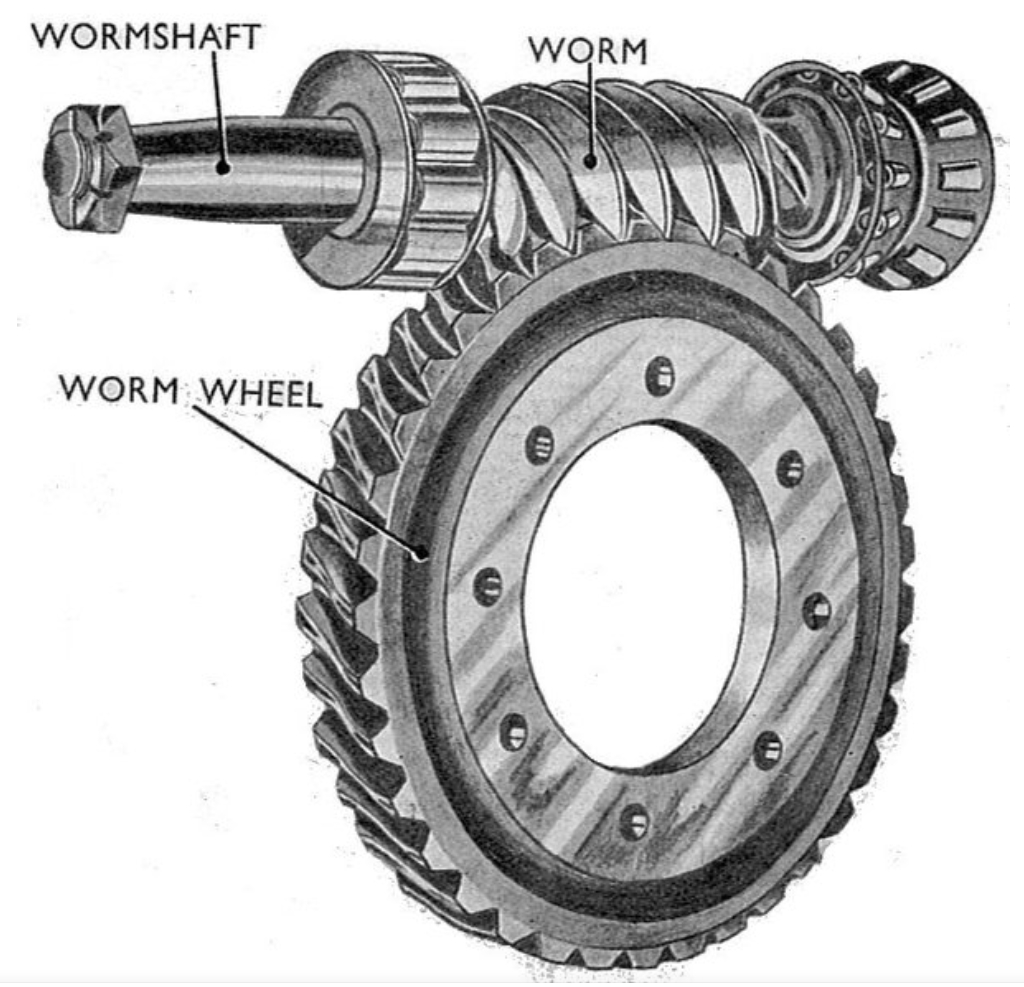
The parabolic modified roller enveloping hourglass worm gear drive operates on the principle of using rollers with a parabolic generatrix as the worm wheel teeth, which envelop the worm surface during meshing. This design allows multiple tooth pairs to engage simultaneously, increasing load capacity, while the rolling motion of the rollers reduces sliding friction, thereby boosting efficiency. The worm is typically a single-piece component, and the worm wheel consists of rollers that can rotate about their own axes, mounted on a wheel body. The central planes of the worm, worm wheel, and rollers coincide, ensuring proper alignment. Unlike traditional cylindrical or conical rollers, the parabolic profile facilitates better oil film formation and reduces the risk of thermal expansion-induced binding. To avoid jamming, the drive is designed for unilateral contact, with clearance on the non-working tooth surfaces. This worm gear drive represents a significant advancement in transmission technology, offering a blend of high performance and reliability.
To analyze the meshing behavior of this worm gear drive, I begin by establishing a comprehensive mathematical model. The foundation lies in setting up coordinate systems that describe the relative motion between the worm and the worm wheel. I define fixed and moving coordinate systems for both the worm and the worm wheel, along with a local coordinate system attached to the parabolic roller at the meshing point. The transformations between these systems are crucial for deriving the equations of motion and meshing conditions. Let \( S_1′ (O_1′; \mathbf{i}_1′, \mathbf{j}_1′, \mathbf{k}_1′) \) and \( S_2′ (O_2′; \mathbf{i}_2′, \mathbf{j}_2′, \mathbf{k}_2′) \) be the fixed coordinate systems for the worm and worm wheel, respectively, while \( S_1 (O_1; \mathbf{i}_1, \mathbf{j}_1, \mathbf{k}_1) \) and \( S_2 (O_2; \mathbf{i}_2, \mathbf{j}_2, \mathbf{k}_2) \) are their moving counterparts. The roller coordinate system \( S_0 (O_0; \mathbf{i}_0, \mathbf{j}_0, \mathbf{k}_0) \) is fixed to the roller, with its origin at the roller’s center. At the meshing point \( O_p \), I introduce an activity frame \( S_p (O_p; \mathbf{e}_1, \mathbf{e}_2, \mathbf{n}) \), where \( \mathbf{n} \) is the unit normal vector to the surface, and \( \mathbf{e}_1 \) and \( \mathbf{e}_2 \) are tangent vectors. The position vector of the meshing point in \( S_0 \) is given by:
$$ \mathbf{r}_0 = x_0 \mathbf{i}_0 + y_0 \mathbf{j}_0 + z_0 \mathbf{k}_0 $$
with
$$ x_0 = R \cos \theta, \quad y_0 = R \sin \theta, \quad z_0 = u $$
where \( u \) and \( \theta \) are surface parameters, and \( R \) is the radius of the parabolic roller, expressed as:
$$ R = \sqrt{ \frac{(R_1^2 – R_2^2) u + u_1 R_2^2}{u_1} } $$
Here, \( R_1 \) and \( R_2 \) are the root and tip radii of the roller, respectively, and \( u_1 \) is the total tooth height, related to design parameters such as the module \( m \), addendum coefficient \( h_{ac} \), dedendum coefficient \( h_{fc} \), and tip clearance coefficient \( c_c \). The coordinate transformation matrices between these systems are derived using rotational and translational operations. For instance, the transformation from \( S_1′ \) to \( S_1 \) involves a rotation by the worm’s rotation angle \( \phi_1 \):
$$ \mathbf{Q}_{1′} = \mathbf{M}_{1’1} \mathbf{Q}_1 $$
with
$$ \mathbf{M}_{1’1} = \begin{bmatrix} \cos \phi_1 & -\sin \phi_1 & 0 & 0 \\ \sin \phi_1 & \cos \phi_1 & 0 & 0 \\ 0 & 0 & 1 & 0 \\ 0 & 0 & 0 & 1 \end{bmatrix} $$
Similarly, transformations for the worm wheel and between the worm and worm wheel systems are established. These transformations are essential for expressing vectors and velocities in a common frame. The relative velocity and angular velocity at the meshing point are critical for meshing analysis. The relative angular velocity vector \( \boldsymbol{\omega}_{12} = \boldsymbol{\omega}_1 – \boldsymbol{\omega}_2 \) is derived, where \( \boldsymbol{\omega}_1 \) and \( \boldsymbol{\omega}_2 \) are the angular velocities of the worm and worm wheel, respectively. Assuming the worm rotates with angular speed \( \omega_1 = 1 \) (for generality), and the transmission ratio is \( i_{21} = \omega_2 / \omega_1 \), I obtain:
$$ \boldsymbol{\omega}_1 = -\sin \phi_2 \mathbf{i}_2 – \cos \phi_2 \mathbf{j}_2, \quad \boldsymbol{\omega}_2 = i_{21} \mathbf{k}_2 $$
Thus,
$$ \boldsymbol{\omega}_{12} = -\sin \phi_2 \mathbf{i}_2 – \cos \phi_2 \mathbf{j}_2 – i_{21} \mathbf{k}_2 $$
The relative velocity vector \( \mathbf{v}_{12} \) is calculated from the derivative of the position vector and the cross products of angular velocities and position vectors. In the worm wheel coordinate system \( S_2 \), it is expressed as:
$$ \mathbf{v}_{12} = B_1 \mathbf{i}_2 + B_2 \mathbf{j}_2 + B_3 \mathbf{k}_2 $$
with
$$ B_1 = y_2 i_{21} – z_2 \cos \phi_2, \quad B_2 = -x_2 i_{21} + z_2 \sin \phi_2, \quad B_3 = x_2 \cos \phi_2 – y_2 \sin \phi_2 – A $$
where \( A \) is the center distance, and \( (x_2, y_2, z_2) \) are the coordinates of the meshing point in \( S_2 \). Transforming these into the activity frame \( S_p \) yields the components \( v_{12}^1, v_{12}^2, v_{12}^n \) along \( \mathbf{e}_1, \mathbf{e}_2, \mathbf{n} \), respectively. The transformation matrix \( \mathbf{A}_{p2} \) depends on the angle \( \beta \), which is related to the parabolic profile:
$$ \beta = \frac{\pi}{2} – \arctan \left( \frac{2u_1}{R_1^2 – R_2^2} R \right) $$
This detailed mathematical setup forms the basis for further analysis of the worm gear drive.
With the coordinate systems and velocity relations established, I now derive the meshing function and equations for the worm gear drive. The fundamental condition for meshing is that the relative velocity has no component along the common normal at the contact point, i.e., \( v_{12}^n = 0 \). This leads to the meshing function \( \Phi \):
$$ \Phi = v_{12}^n = M_1 \cos \phi_2 + M_2 \sin \phi_2 + M_3 $$
where \( M_1, M_2, M_3 \) are coefficients derived from the geometry and motion parameters. The meshing equation is simply \( \Phi = 0 \), which defines the set of points on the roller surface that are in contact with the worm at a given instant. For a fixed worm wheel rotation angle \( \phi_2 \), the instantaneous contact line on the roller surface can be obtained by solving the meshing equation along with the roller surface equation. The contact line function is given by:
$$ \theta = f(u, \phi_2) = \arctan \left( \frac{P_1}{P_2} \right) $$
with
$$ P_1 = (\sin \beta \, R – x_2 \cos \beta) \cos \phi_2 + A \cos \beta, \quad P_2 = i_{21} (\sin \beta \, R – x_2 \cos \beta) $$
Here, \( \theta \) and \( u \) parameterize the roller surface. The contact lines are symmetric about \( \phi_2 = 0 \), corresponding to the worm’s throat section. For the left and right tooth flanks, \( \theta \) ranges in \( [0, \pi] \) and \( [-\pi, 0] \), respectively. The worm tooth surface is generated as the envelope of the roller surface family as \( \phi_2 \) varies. The worm surface equation is derived by transforming the contact points from the worm wheel system to the worm system:
$$ \mathbf{r}_1 = x_1 \mathbf{i}_1 + y_1 \mathbf{j}_1 + z_1 \mathbf{k}_1 $$
with
$$ \mathbf{F}_1 = \mathbf{A}_{12} (\mathbf{F}_2 – \boldsymbol{\xi}) $$
where \( \mathbf{F}_1 = [x_1, y_1, z_1]^T \), \( \mathbf{F}_2 = [x_2, y_2, z_2]^T \), \( \boldsymbol{\xi} = [A \cos \phi_2, -A \sin \phi_2, 0]^T \), and \( \mathbf{A}_{12} \) is the transformation matrix from \( S_2 \) to \( S_1 \). This equation, combined with the meshing condition, fully describes the worm tooth surface for this worm gear drive.
To evaluate the performance of the parabolic modified roller enveloping hourglass worm gear drive, I analyze key meshing parameters such as the induced normal curvature, lubrication angle, roller self-rotation angle, and relative entrainment velocity. These parameters provide insights into the contact conditions, lubrication effectiveness, and efficiency of the worm gear drive. I first consider the induced normal curvature \( k_{12}^\sigma \), which measures the curvature mismatch between the meshing surfaces and influences contact stress and wear. Using the activity frame method, it is expressed as:
$$ k_{12}^\sigma = -\frac{H_1 + H_2}{\Psi} $$
where
$$ H_1 = (v_{12}^1 k_1 + v_{12}^2 \tau_{g1} + \omega_{12}^2)^2, \quad H_2 = (v_{12}^2 k_2 + v_{12}^1 \tau_{g1} – \omega_{12}^1)^2 $$
and
$$ \Psi = \Phi_t + \omega_{12}^2 v_{12}^1 – \omega_{12}^1 v_{12}^2 + k_1 (v_{12}^1)^2 + k_2 (v_{12}^2)^2 + 2 \tau_{g1} v_{12}^1 v_{12}^2 $$
Here, \( k_1 \) and \( k_2 \) are the normal curvatures of the roller surface along \( \mathbf{e}_1 \) and \( \mathbf{e}_2 \), respectively, \( \tau_{g1} \) is the geodesic torsion (zero for this surface), and \( \Phi_t \) is the second-order meshing function. For the parabolic roller, \( k_1 = -\cos \beta / R \) and \( k_2 = -|u”| / (1 + u’^2)^{3/2} \), with \( u’ \) and \( u” \) derived from the profile equation. To illustrate typical values, I consider a worm gear drive with parameters: worm threads \( Z_1 = 1 \), worm wheel teeth \( Z_2 = 25 \), center distance \( A = 160 \, \text{mm} \), and throat diameter coefficient \( K = 0.4 \). The induced normal curvature varies slightly with \( \phi_2 \), indicating good surface conformity. Next, the lubrication angle \( \mu \) is defined as the angle between the tangent to the contact line and the relative velocity vector, with values closer to \( 90^\circ \) indicating better lubrication conditions. It is calculated as:
$$ \mu = \arcsin \left( \frac{C_1}{C_2 C_3} \right) $$
with
$$ C_1 = | v_{12}^1 (v_{12}^1 / R – \omega_{12}^2) + v_{12}^2 \omega_{12}^1 |, \quad C_2 = \sqrt{ (v_{12}^1 / R – \omega_{12}^2)^2 + (\omega_{12}^1)^2 }, \quad C_3 = \sqrt{ (v_{12}^1)^2 + (v_{12}^2)^2 } $$
For this worm gear drive, the lubrication angle remains high, typically between \( 85.6^\circ \) and \( 88.5^\circ \), demonstrating excellent lubrication potential. The roller self-rotation angle \( \mu_{z0} \) measures how well the roller rotates about its axis, given by the angle between the relative velocity vector and the roller axis. A value near \( 90^\circ \) implies efficient rolling. It is computed as:
$$ \mu_{z0} = \arccos \left( \frac{ | v_{12}^2 | }{ | \mathbf{v}_{12} | } \right) $$
In this case, it ranges from \( 87.5^\circ \) to \( 89.5^\circ \), confirming effective roller motion. Finally, the relative entrainment velocity \( v_{jx} \) influences the formation of lubricant films and is defined as half the sum of the surface velocities along the contact normal. It is derived as:
$$ v_{jx} = \frac{v_\sigma^1 + v_\sigma^2}{2} $$
with
$$ v_\sigma^1 = \frac{ v_1^1 (v_{12}^1 / R – \omega_{12}^2) + v_1^2 \omega_{12}^1 }{ T }, \quad v_\sigma^2 = \frac{ v_2^1 (v_{12}^1 / R – \omega_{12}^2) + v_2^2 \omega_{12}^1 }{ T } $$
where \( T = \sqrt{ (v_{12}^1 / R – \omega_{12}^2)^2 + (\omega_{12}^1)^2 } \), and \( v_1^1, v_1^2, v_2^1, v_2^2 \) are velocity components of the worm and roller surfaces. This velocity varies with \( \phi_2 \), reaching a minimum near the worm throat. To summarize these parameters, I present the following tables that consolidate key formulas and typical value ranges for this worm gear drive.
| Parameter | Symbol | Formula | Typical Range |
|---|---|---|---|
| Induced Normal Curvature | \( k_{12}^\sigma \) | $$ k_{12}^\sigma = -\frac{H_1 + H_2}{\Psi} $$ | Small variation, ~0.02 mm⁻¹ |
| Lubrication Angle | \( \mu \) | $$ \mu = \arcsin \left( \frac{C_1}{C_2 C_3} \right) $$ | 85.6° to 88.5° |
| Roller Self-Rotation Angle | \( \mu_{z0} \) | $$ \mu_{z0} = \arccos \left( \frac{ | v_{12}^2 | }{ | \mathbf{v}_{12} | } \right) $$ | 87.5° to 89.5° |
| Relative Entrainment Velocity | \( v_{jx} \) | $$ v_{jx} = \frac{v_\sigma^1 + v_\sigma^2}{2} $$ | Varies with \( \phi_2 \) |
Additionally, I provide a table of key geometric and motion parameters used in the analysis of the worm gear drive.
| Parameter | Symbol | Value/Expression |
|---|---|---|
| Center Distance | \( A \) | 160 mm |
| Worm Threads | \( Z_1 \) | 1 |
| Worm Wheel Teeth | \( Z_2 \) | 25 |
| Transmission Ratio | \( i_{21} \) | \( \omega_2 / \omega_1 = Z_1 / Z_2 \) |
| Roller Root Radius | \( R_1 \) | Design-dependent |
| Roller Tip Radius | \( R_2 \) | Design-dependent |
| Total Tooth Height | \( u_1 \) | \( m (h_{ac} + h_{fc} + c_c) \) |
| Module | \( m \) | \( (2 – K) A / Z_2 \) |
The meshing performance of this worm gear drive is further elucidated through the analysis of contact lines and surface equations. The contact lines on the roller surface, when plotted in a developed view, show inclined curves that are symmetric for left and right flanks. This symmetry stems from the design of the worm gear drive, where the worm throat acts as a plane of symmetry. The worm tooth surface, generated by enveloping the roller surface, exhibits complex geometry that ensures continuous meshing and load distribution. The mathematical derivations confirm that this worm gear drive maintains multiple points of contact along the tooth faces, enhancing its load-carrying capacity. The parabolic modification of the rollers not only improves lubrication but also allows for better clearance management, reducing the risk of jamming under thermal loads. In terms of dynamics, the relative motion analysis reveals that the sliding components are minimal due to the rolling nature of the rollers, which directly translates to higher efficiency and lower wear. This is a significant advantage over traditional worm gear drives, where sliding friction dominates. The derived equations for induced normal curvature show that the surfaces are well-matched, leading to reduced contact stresses and improved durability. The lubrication angle calculations indicate that the oil film formation is favorable across the meshing cycle, which is crucial for maintaining performance in high-load applications. Similarly, the roller self-rotation angle demonstrates that the rollers effectively rotate, minimizing sliding and further contributing to efficiency. The relative entrainment velocity, while varying, supports the formation of hydrodynamic lubricant films, especially at the entry and exit points of meshing. Overall, the parametric studies underscore the robustness of this worm gear drive design.
In conclusion, the parabolic modified roller enveloping hourglass worm gear drive presents a compelling solution to the limitations of traditional worm gear drives. Through detailed mathematical modeling based on spatial meshing theory, I have established the fundamental equations governing its operation, including coordinate transformations, meshing conditions, contact lines, and tooth surface generation. The analysis of key performance parameters, such as induced normal curvature, lubrication angle, roller self-rotation angle, and relative entrainment velocity, reveals that this worm gear drive offers excellent meshing characteristics. The induced normal curvature remains low and stable, indicating good surface conformity. The lubrication angle is consistently high, promoting effective lubrication, while the roller self-rotation angle confirms efficient rolling motion. The relative entrainment velocity variations are manageable and contribute to lubricant film formation. These attributes collectively enhance the load capacity, efficiency, and reliability of the worm gear drive. The parabolic profile of the rollers adds benefits in terms of oil retention and thermal expansion accommodation, making this design suitable for demanding applications. Future work could involve experimental validation, optimization of design parameters, and extension to multi-start worm configurations. Nonetheless, the theoretical foundations laid out in this paper provide a solid basis for the development and application of this advanced worm gear drive in various mechanical systems. The integration of rolling elements with modified profiles represents a significant step forward in transmission technology, addressing longstanding challenges associated with sliding friction and wear. As industries continue to seek efficient and durable drive solutions, innovations like this worm gear drive will play a crucial role in meeting those demands.