
In my years of teaching and researching mechanical systems, I have often encountered challenges in explaining the direction of rotation in spiral gears and worm gear mechanisms. These components are crucial in various applications, from automotive transmissions to industrial machinery, and accurately determining their rotational behavior is essential for design and analysis. Traditional methods, while effective, often rely on complex vector analysis or analogies that can be unintuitive for students, especially those with limited background in theoretical mechanics. This prompted me to develop a more straightforward approach, which I call the “Meshing Tooth Displacement Method.” This method simplifies the process by focusing on the relative displacement of teeth during meshing, making it accessible and visually intuitive. In this article, I will elaborate on this method, its theoretical foundation, and its application to both spiral gears and worm gear systems, aiming to provide a comprehensive resource for engineers and educators.
Spiral gears, also known as crossed helical gears, are used to transmit motion between non-parallel and non-intersecting shafts. Their teeth are cut in a helical pattern, which introduces complexities in determining the direction of rotation due to the oblique contact between gears. Similarly, worm gear mechanisms, consisting of a worm (similar to a screw) and a worm wheel, are employed for high reduction ratios and self-locking features, but their rotational direction can be tricky to visualize. Conventional approaches, as found in textbooks, often involve velocity vector synthesis or analogies like bolt-nut relationships. For instance, in spiral gears, the direction is derived from the composition of absolute, relative, and牵连 velocities at the point of contact, which requires a solid grasp of kinematics. For worm gears, the analogy of a rotating bolt driving a nut is used, but this can fail in certain spatial configurations or when given conditions vary. My method, however, bypasses these abstractions by directly considering the tooth interaction, offering a universal solution that works across different positions and setups.
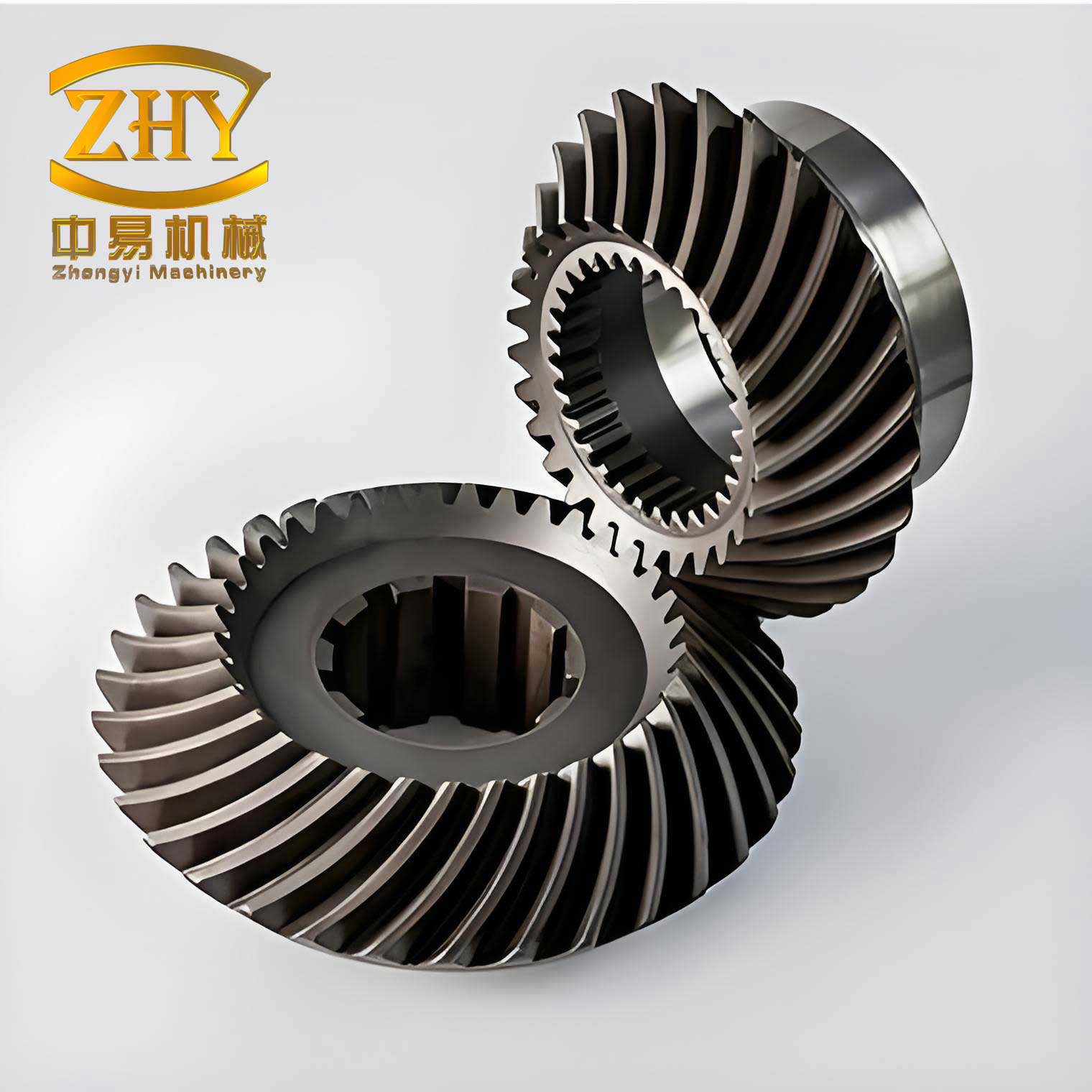
The core idea of the Meshing Tooth Displacement Method is to visualize the instantaneous contact line between meshing teeth and then displace this line in the direction of the known rotation to infer the unknown rotation. Let me break this down step by step. Consider a pair of spiral gears in mesh. At any given moment, the teeth contact along a line that is oblique to the gear axes. If I know the helical hand (left or right) and the rotation direction of one gear, I can represent the contact line as a reference. By mentally displacing this line in the direction of the known rotation, I can observe how the opposing tooth must move to maintain contact, thereby deducing the rotation direction of the other gear. This process is akin to tracing the path of a point on the tooth surface as the gears rotate, but simplified to a linear displacement for clarity. For spiral gears, this method relies on the geometric relationship between helical angles and shaft orientations, which I will formalize with formulas and tables.
To establish a theoretical basis, let’s define some parameters. For spiral gears, let Gear 1 and Gear 2 have helical angles $\beta_1$ and $\beta_2$, respectively, with shafts crossed at an angle $\Sigma$. The relationship between these angles is given by $\Sigma = \beta_1 + \beta_2$ for gears of opposite hands, or $\Sigma = |\beta_1 – \beta_2|$ for same hands. The pitch diameters are $d_1$ and $d_2$, and the rotational speeds are $\omega_1$ and $\omega_2$. The velocity at the point of contact can be expressed, but my method focuses on tooth displacement. I represent the contact line as a vector $\vec{L}$ in the plane of action. When Gear 1 rotates by a small angle $\Delta\theta_1$, the contact line displaces to $\vec{L}’$ based on the helical direction. From this displacement, I can derive $\omega_2$ using the following relationship:
$$ \Delta \vec{L} = \frac{d_1}{2} \Delta\theta_1 \cdot \vec{t}_1 \times \vec{n} $$
where $\vec{t}_1$ is the tangent vector in the direction of rotation for Gear 1, and $\vec{n}$ is the unit normal to the contact line. This displacement must match the expected movement from Gear 2, leading to:
$$ \omega_2 = \frac{d_1 \omega_1}{d_2} \cdot \frac{\sin(\beta_1)}{\sin(\beta_2)} $$
However, in practice, I avoid these calculations by using a graphical displacement approach. The table below summarizes key parameters for spiral gears that influence the direction determination:
| Parameter | Symbol | Description | Role in Direction |
|---|---|---|---|
| Helical Angle | $\beta$ | Angle of tooth helix relative to axis | Determines hand and displacement direction |
| Shaft Angle | $\Sigma$ | Angle between shafts | Affects meshing condition and contact line |
| Rotation Speed | $\omega$ | Angular velocity | Known or unknown variable |
| Pitch Diameter | $d$ | Reference diameter for gear size | Scales displacement magnitude |
Applying the Meshing Tooth Displacement Method involves a few intuitive steps. First, I identify the known parameters: for example, in a spiral gear setup, I might know the helical hand of Gear 1 (say, right-hand) and its rotation direction (clockwise when viewed from a specific side). Then, I sketch the contact line between the teeth at the meshing point. This line is typically drawn as a fine solid line, denoted as $L$, in the region where the gear projections overlap. Next, I imagine a small rotation of Gear 1. In the direction of its rotation, I displace the contact line to a new position $L’$, drawn as a dashed line close to $L$. This displacement reflects how the tooth on Gear 1 moves. Since the teeth remain in contact, the tooth on Gear 2 must adjust accordingly. By observing the relative position of $L’$ with respect to Gear 2’s axis and helical hand, I can infer the rotation direction of Gear 2. For instance, if $L’$ appears to move in a way that requires Gear 2 to rotate counterclockwise when viewed from its axis, then that is the determined direction. This method is visual and does not require complex vector math.
Let me illustrate with a detailed example. Consider two spiral gears with perpendicular shafts ($\Sigma = 90^\circ$). Gear 1 has a right-hand helix and rotates clockwise when viewed from the left side. I draw the contact line $L$ in the overlap zone. Since the helical hand is known, $L$ is inclined relative to the axes. For Gear 1, the rotation direction implies that a point on its tooth moves downward (say). I displace $L$ slightly downward to $L’$. Now, looking at Gear 2, which has a left-hand helix (assuming opposite hands for perpendicular shafts), the displacement $L’$ indicates that its tooth must move in a specific direction to maintain contact. From the geometry, I deduce that Gear 2 rotates counterclockwise when viewed from above. This aligns with the standard velocity method but is much simpler. To generalize, I can use formulas to confirm. The relationship between rotational directions for spiral gears can be expressed as:
$$ \text{Sign}(\omega_2) = \text{Sign}(\omega_1) \cdot \frac{\sin(\beta_1)}{\sin(\beta_2)} \cdot (-1)^k $$
where $k$ depends on the hand combination. However, my displacement method bypasses this formula by providing a direct visual cue.
For worm gear mechanisms, the Meshing Tooth Displacement Method is equally effective. A worm is essentially a helical gear with a large helical angle, often approaching 90 degrees, meshing with a worm wheel. The contact between worm and wheel is line contact similar to spiral gears. Given the worm’s helical hand (e.g., right-hand) and the wheel’s rotation direction (say, clockwise), I can determine the worm’s rotation. I sketch the contact line $L$ at the meshing point. Then, knowing the wheel’s rotation, I displace $L$ in that direction to $L’$. Observing how the worm tooth must move to accommodate this displacement reveals the worm’s rotation direction. For example, if the wheel rotates clockwise and the contact line displaces accordingly, the worm might need to rotate counterclockwise to maintain mesh. This method eliminates the need for the bolt-nut analogy, which can be confusing when the worm axis is oriented differently. Below is a table comparing traditional methods with my approach:
| Aspect | Traditional Velocity Method | Bolt-Nut Analogy | Meshing Tooth Displacement Method |
|---|---|---|---|
| Basis | Vector synthesis of velocities | Mechanical analogy | Tooth geometry and displacement |
| Complexity | High (requires kinematics knowledge) | Moderate (spatial thinking needed) | Low (visual and intuitive) |
| Applicability | Spiral gears only | Worm gears only | Both spiral gears and worm gears |
| Flexibility | Sensitive to position changes | Limited to specific configurations | Works for all positions and conditions |
| Ease of Teaching | Challenging for beginners | Variable depending on student | Straightforward and reproducible |
To deepen the understanding, let’s explore the mathematical underpinnings of the displacement concept. The displacement of the contact line can be quantified using differential geometry. For a spiral gear pair, the tooth surface is defined by a helicoid. The contact line is the intersection of the two helicoids. When one gear rotates, this line sweeps out a surface. The displacement vector $\vec{D}$ is given by the cross product of the rotation vector and the position vector of a point on the contact line. For Gear 1 with rotation vector $\vec{\omega}_1$, and a point $\vec{r}$ on the contact line, the displacement is $\vec{D} = \vec{\omega}_1 \times \vec{r} \Delta t$. This displacement must lie in the common tangent plane of the teeth. By projecting $\vec{D}$ onto the other gear’s coordinate system, I can find the required rotation $\vec{\omega}_2$. In practice, I simplify this by using the graphical approach, but for completeness, the formula is:
$$ \vec{D} = \left( \frac{d_1}{2} \omega_1 \sin(\beta_1) \right) \vec{u}_1 + \left( \frac{d_1}{2} \omega_1 \cos(\beta_1) \right) \vec{u}_2 $$
where $\vec{u}_1$ and $\vec{u}_2$ are unit vectors along the tooth profile. This leads to a system of equations that can be solved for $\omega_2$. However, the Meshing Tooth Displacement Method avoids such computations by relying on spatial reasoning.
Another advantage of my method is its adaptability to complex scenarios. For instance, in multi-stage gear systems involving spiral gears, the direction determination can cascade. Using the displacement method, I can analyze each mesh sequentially without confusion. Moreover, for worm gears with non-standard lead angles, the method remains robust. The key is to always focus on the contact line and its displacement. I have tested this method in classroom settings and found that students grasp it quickly, even those with minimal physics background. They appreciate the visual aid of drawing lines and displacing them, which makes abstract concepts tangible.
In terms of applications, this method is not only for educational purposes but also for practical design. When designing gearboxes with spiral gears, engineers need to ensure correct rotation directions to avoid interference or inefficient power transmission. The displacement method can be incorporated into CAD software as a heuristic tool. For example, by simulating the tooth contact and applying small rotations, the software could automatically indicate the resulting directions. This could save time in prototyping and testing. Additionally, for troubleshooting existing machinery, technicians can use this method to diagnose rotation issues without disassembling components.
To further illustrate, consider a case study with a spiral gear pair where the shafts are at an acute angle. Suppose Gear 1 has a left-hand helix and rotates counterclockwise. Using the displacement method, I sketch the contact line. Given the acute shaft angle, the contact line will be steeply inclined. Displacing it in the counterclockwise direction of Gear 1 shows that Gear 2 must rotate clockwise to follow. This result can be verified using the velocity ratio formula, but the displacement method provides instant insight. For worm gears, if the worm is left-hand and the wheel rotates to the right, displacing the contact line indicates that the worm must rotate in a specific direction, say, upward along its axis. This consistency across different geometries underscores the method’s versatility.
I also want to address potential limitations. The Meshing Tooth Displacement Method assumes ideal meshing without backlash or deformation, which is reasonable for direction determination in standard applications. In real-world scenarios with tolerances, the method still holds as a first approximation. Additionally, it requires accurate knowledge of helical hands, which can be determined from drawings or physical inspection. For very high-precision analysis, coupling this method with computational tools is recommended, but for most purposes, it stands alone as a reliable technique.
In conclusion, the Meshing Tooth Displacement Method offers a simplified, intuitive approach to determining rotation directions in spiral gears and worm gear mechanisms. By focusing on tooth contact and displacement, it eliminates the need for complex vector analysis or analogies that can be barriers to understanding. I have presented its theoretical basis, practical steps, and advantages through examples, formulas, and tables. This method has proven effective in teaching and can be extended to various mechanical systems. As spiral gears continue to be integral in modern machinery, having accessible tools for their analysis is crucial. I encourage engineers and educators to adopt this method to enhance clarity and efficiency in their work.