
The machining of miter gears has long been a focus in gear manufacturing due to their crucial role in transmitting motion between intersecting shafts at a 90-degree angle. As a specific type of straight bevel gear with a 1:1 ratio, miter gears share the common challenges associated with traditional straight bevel gear production. Conventional methods such as milling, planing, and broaching are fundamentally limited by their intermittent indexing nature. This stop-and-start process inherently caps production efficiency. Furthermore, the reliance on complex mechanical transmission chains in traditional machines often compromises precision and makes adjustments cumbersome. In stark contrast, the manufacturing technology for spiral bevel gears has seen rapid advancement, featuring continuous, generating motions that yield higher accuracy and productivity. This disparity motivates the exploration of novel, more efficient continuous machining principles for straight bevel and, by extension, miter gears. One promising avenue is the adaptation of cycloidal generation principles—successfully used for spiral bevel gears—to the machining of straight-sided bevel gears through a method known as cycloidal rotary index machining.
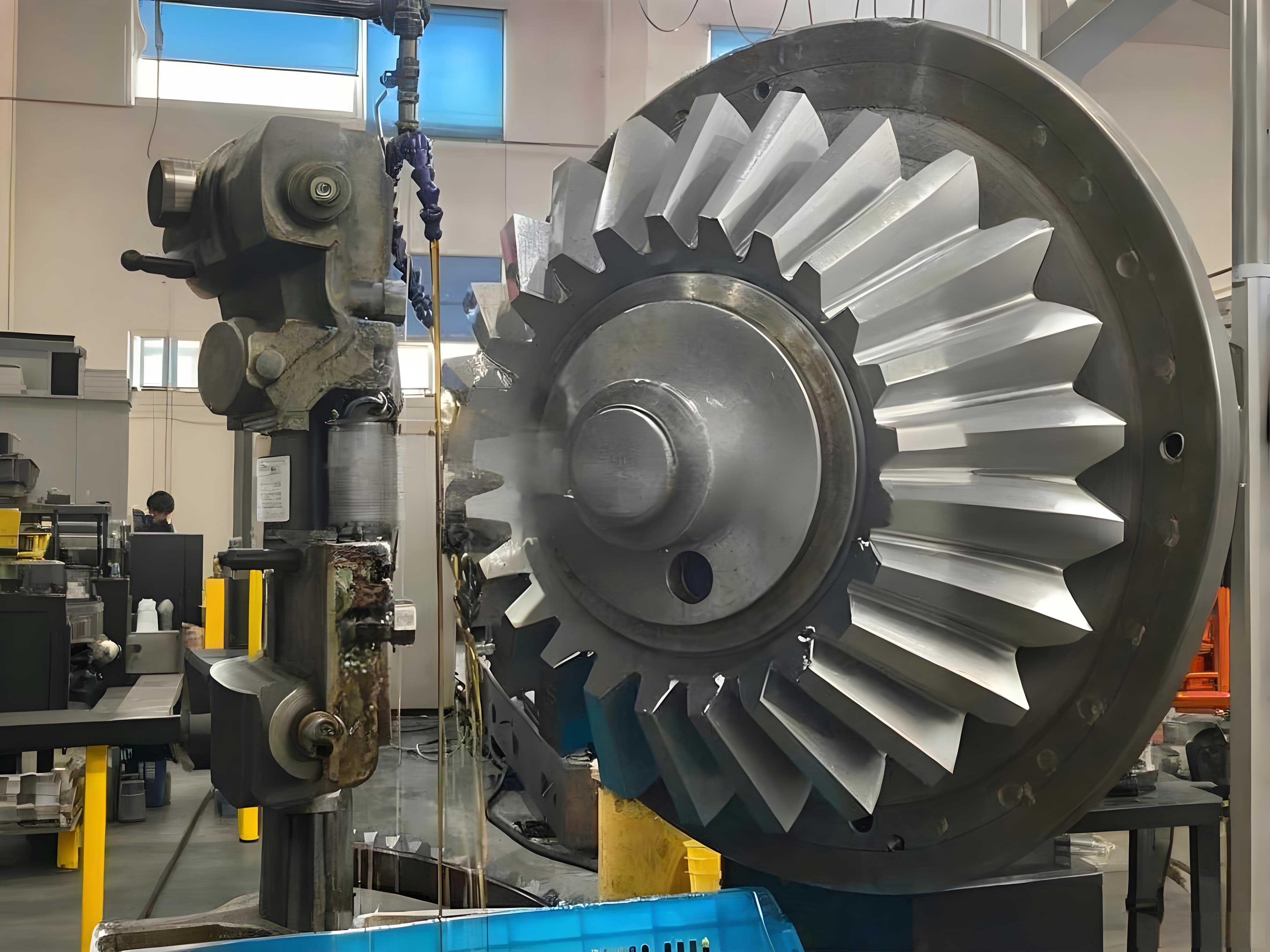
This article delves into the mathematical modeling and parameter optimization of the cycloidal rotary index machining process for straight bevel gears. The core challenge is to approximate the straight-line element (the conical bus) of the gear tooth flank using a carefully controlled spatial curve traced by a cutting tool. The success of this approximation dictates the final gear quality. Therefore, establishing a precise mathematical model for the cutter’s trajectory—often called the cutting point locus—and thoroughly understanding the influence of key process parameters are essential steps toward implementing this innovative machining strategy for miter gears and other straight bevel gears.
Fundamental Principle of Cycloidal Rotary Index Machining
Rotary index machining, in a broad sense, refers to a synchronous process where both the workpiece and the cutting tool rotate about their respective axes at a defined speed ratio. This continuous relative motion simultaneously performs the cutting and indexing (division) of the workpiece teeth. By simply altering the speed ratio, gears with different tooth numbers can be machined. For machining complex surfaces like straight bevel gear teeth, this principle is enhanced by superimposing a specific non-linear motion on the cutter, causing its tip to follow a cycloidal-like spatial trajectory. This combined method is termed cycloidal rotary index machining.
The foundation lies in the classic planar cycloid. When a circle of radius \( r \) (the generating circle) rolls without slipping on the circumference of a base circle of radius \( R \), the path traced by a point fixed at a distance \( e \) from the center of the generating circle is a cycloid. The parametric equations for this curve are:
$$ x = (R – r)\cos\alpha + e\cos(\theta + \beta) $$
$$ y = (R – r)\sin\alpha + e\sin(\theta + \beta) $$
where \( \alpha \) is the rotation angle of the generating circle’s center around the base circle, and \( \theta = (1 – R/r)\alpha \). The shape of this planar cycloid is entirely governed by the three parameters \( R \), \( r \), and \( e \). Crucially, by judiciously selecting these parameters, a segment of the cycloidal curve can be made to closely approximate a straight line.
The principle is extended into three dimensions for gear machining. If the axis of the generating circle (now representing the cutter head) is inclined at an angle to the axis of the base circle (representing the workpiece), and the same rolling-without-slipping relationship is maintained, the point traces a complex spatial curve. Under specific conditions, a projection or section of this spatial curve can approximate the straight-line element (conical bus) of a straight bevel gear tooth. The objective of cycloidal rotary index machining for miter gears is to adjust the system parameters—such as the speed ratio, cutter geometry, and spatial arrangement—so that the effective segment of the cutter’s spatial trajectory becomes an excellent approximation of the required straight line on the conical pitch surface.
Mathematical Model of the Cutting Point Locus
To analyze and control the process, a precise mathematical model describing the trajectory of a point on the cutting tool (the cutting point locus) relative to the workpiece must be established. This model is derived using coordinate transformation techniques. The spatial arrangement involves a workpiece coordinate system and a cutter head coordinate system, with the cutter head axis tilted relative to the workpiece axis. The following coordinate systems are defined, as illustrated conceptually in the machining layout:
- \( S_1 = \{O_1; X_1, Y_1, Z_1\} \): The initial position coordinate system of the cutter head.
- \( S_2 = \{O_2; X_2, Y_2, Z_2\} \): The workpiece coordinate system, fixed to the gear blank.
- \( S_3 = \{O_3; X_3, Y_3, Z_3\} \): The coordinate system of the cutter head after it is tilted by an angle \( \beta \) around a reference axis.
Consider a cutting point \( M \) on the cutter blade. In the cutter’s own coordinate system \( S_3 \), its coordinates can be expressed as \( (x_c, y_c, z_c) \), where typically for a simple blade, \( x_c = e \sin\phi \), \( y_c = e \cos\phi \), and \( z_c = 0 \). Here, \( e \) is the effective cutter radius (distance of point \( M \) from the cutter axis), and \( \phi \) is the cutter position angle.
The motion consists of two primary rotations: the cutter rotates around its own axis by an angle \( \alpha_1 \), and the workpiece rotates around its axis by an angle \( \alpha_2 \). These are linked by the speed ratio \( \eta \), such that \( \alpha_2 = \eta \cdot \alpha_1 \). The cutter tilt angle \( \beta \) may also vary during the cut, often linearly related to \( \alpha_1 \), expressed as \( \beta = (\beta_{\text{max}} / \alpha_{\text{max}}) \cdot \alpha_1 \), where \( \beta_{\text{max}} \) is the maximum tilt angle reached when the cutter has rotated through \( \alpha_{\text{max}} \).
The transformation from the cutter point coordinates to the workpiece coordinates involves a sequence of matrix multiplications accounting for rotations and the fixed offset between the two systems. The general form of the transformation is:
$$
\begin{bmatrix}
x \\
y \\
z \\
1
\end{bmatrix}_2 = \mathbf{M}_{21} \cdot \mathbf{M}_{13} \cdot \mathbf{R}_1(\alpha_1) \cdot
\begin{bmatrix}
x_c \\
y_c \\
z_c \\
1
\end{bmatrix}_3
$$
Where:
- \( \mathbf{R}_1(\alpha_1) \) is the rotation matrix for the cutter’s spin.
- \( \mathbf{M}_{13} \) is the constant transformation matrix from the tilted cutter system \( S_3 \) to the initial cutter system \( S_1 \).
- \( \mathbf{M}_{21} \) is the constant transformation matrix from \( S_1 \) to the workpiece system \( S_2 \), incorporating the fixed setup angles and offsets (like the workpiece swing angle \( \theta \) and cone distance \( R \)).
Carrying out this multiplication yields the parametric equations for the cutting point locus \( (x(\alpha_1), y(\alpha_1), z(\alpha_1)) \) in the workpiece coordinate system. This set of equations constitutes the complete mathematical model for the cycloidal rotary indexing process. The model’s variables and parameters are summarized below:
| Parameter Symbol | Description | Role in Model |
|---|---|---|
| \( \alpha_1 \) | Cutter rotation angle | Independent variable (time parameter) |
| \( \eta \) | Speed ratio (\( \omega_2 / \omega_1 \)) | Links workpiece rotation to cutter rotation |
| \( e \) | Cutter radius (point offset) | Defines the amplitude of the cycloidal component |
| \( \phi \) | Cutter position angle | Initial angular position of the cutting point |
| \( \beta_{\text{max}} \) | Maximum cutter tilt angle | Governs the inclination of the tool axis sweep |
| \( \alpha_{\text{max}} \) | Max cutter rotation for one tooth flank | Defines the active segment of the trajectory |
| \( \theta \) | Workpiece swing angle (related to pitch cone angle) | Sets the nominal angle of the conical bus |
| \( R \) | Workpiece cone distance | Geometric parameter of the gear blank |
| \( B \) | Face width of the gear tooth | Defines the required length of the approximated line |
Analysis and Ranges of Key Process Parameters
The accuracy with which the cutting point locus approximates the ideal straight line on the conical surface is highly sensitive to the parameters listed above. For practical implementation, especially for machining precision miter gears, it is crucial to define their permissible ranges and interrelationships.
1. Workpiece Swing Angle (\( \theta \))
This angle essentially determines the direction of the straight conical bus that needs to be approximated. For a standard straight bevel gear or a miter gear, it is directly related to the pitch cone angle. Its range is bounded by the geometry of the specific gear being cut. If \( \delta_f \) and \( \delta_a \) represent the root cone and face cone angles respectively, then:
$$ \delta_f \leq \theta \leq \delta_a $$
For a standard miter gear with a 90° shaft angle and equal gears, the pitch cone angle is typically 45°.
2. Speed Ratio (\( \eta \))
The speed ratio is the most critical kinematic parameter. It determines how many workpiece teeth are indexed per revolution of the cutter or per a specific cycle. It is calculated as:
$$ \eta = \frac{\omega_2}{\omega_1} = k_z \cdot \frac{z_1}{z} $$
where \( z \) is the number of teeth on the workpiece (miter gear), \( z_1 \) is the number of cutter blade groups, and \( k_z \) is the machining cross-tooth number (an integer). To ensure all teeth are machined, \( k_z \) must be chosen so that it is not divisible by \( z \).
3. Cutter Radius (\( e \))
The cutter radius influences the scale of the cycloidal motion. It must be large enough to physically accommodate the desired number of cutter groups but small enough relative to the workpiece to ensure a feasible tool path. A practical range is:
$$ \frac{z_1}{2\pi} \cdot B \leq e \leq 4 \cdot B $$
where \( B \) is the face width of the miter gear tooth.
4. Maximum Cutter Rotation Angle (\( \alpha_{\text{max}} \))
This parameter defines the angular travel of the cutter required to generate the entire active tooth flank from one end to the other (across face width \( B \)). A lower bound is given by the geometry:
$$ \alpha_{\text{max}} \geq \frac{B}{e} $$
5. Cutter Position Angle (\( \phi \)) & Maximum Tilt Angle (\( \beta_{\text{max}} \))
These two parameters are not independent but are geometrically coupled with others to ensure the tool path correctly spans the tooth face. They can be derived from closure conditions of the spatial mechanism. The cutter position angle \( \phi \) typically lies between 0° and 90° and can be expressed through a geometric relation involving \( e \), \( B \), \( R \), \( \theta \), \( \eta \), and \( \alpha_{\text{max}} \):
$$ \phi = \arccos\left( \frac{(2e\sin\frac{\alpha_{\text{max}}}{2})^2 + B^2 – (2R\sin\theta\sin\frac{\eta\alpha_{\text{max}}}{2})^2}{4B e \sin\frac{\alpha_{\text{max}}}{2}} \right) – \frac{\alpha_{\text{max}}}{2} $$
The maximum tilt angle \( \beta_{\text{max}} \) is usually a small angle (5° to 10°) and can be similarly derived:
$$ \beta_{\text{max}} = \arcsin\left( \frac{R \sin\theta \cos\theta \cdot [1 – \cos(\eta \alpha_{\text{max}})]}{2e \sin\frac{\alpha_{\text{max}}}{2} \sin(\phi + \frac{\alpha_{\text{max}}}{2})} \right) $$
Parameter Optimization for Minimizing Approximation Error
The ultimate goal is to select the free parameters such that the cutting point locus best fits the ideal straight line on the cone. The ideal conical bus in the workpiece coordinate system can be described by the line:
$$ x \tan\theta + z = 0, \quad y = 0 $$
Let \( k = \tan\theta \). For any point \( P(x_p, y_p, z_p) \) on the calculated cutter locus, the shortest distance \( d \) to this ideal line is the local approximation error. The distance from point \( P \) to the line can be computed as:
$$ d = \sqrt{ \frac{k^2}{1+k^2}(x_p – x_t)^2 + y_p^2 + \frac{1}{1+k^2}(z_p – z_t)^2 + \frac{2k(x_p – x_t)(z_p – z_t)}{1+k^2} } $$
where \( T(x_t, 0, z_t) \) is an arbitrary point on the ideal line.
The overall error metric \( \mu \) for the active segment of the curve can be defined as the maximum value of \( d \) over the range of \( \alpha_1 \) from 0 to \( \alpha_{\text{max}} \). The optimization objective is to minimize \( \mu \). Among the primary free parameters (\( \eta, e, \alpha_{\text{max}} \)), it is useful to combine \( \alpha_{\text{max}} \) and \( e \) into a dimensionless parameter \( k_{\alpha} = \alpha_{\text{max}} \cdot e / B \).
Sensitivity analysis reveals the relative influence of these parameters on the minimum achievable error \( \mu \):
| Parameter | Influence on Error \( \mu \) | Remarks |
|---|---|---|
| Speed Ratio (\( \eta \)) | Highest Influence | Small changes in \( \eta \) cause significant changes in the shape and phasing of the spatial curve, directly affecting its linearity. |
| Cutter Radius (\( e \)) | Medium Influence | Scales the cycloidal component; optimal value balances tool size with path curvature. |
| Combined Angle Parameter (\( k_{\alpha} \)) | Lowest Influence | Once \( \eta \) and \( e \) are chosen, \( k_{\alpha} \) (or \( \alpha_{\text{max}} \)) can be fine-tuned for minor error reduction. |
The optimization procedure therefore follows a logical sequence: First, determine the optimal combination of \( \eta \) and \( e \) that minimizes \( \mu \). The speed ratio \( \eta \) is often the most critical to get right initially. Second, with \( \eta \) and \( e \) fixed, perform a fine-tuning adjustment of \( k_{\alpha} \) (by adjusting \( \alpha_{\text{max}} \)) to reach the final minimum error. This structured approach efficiently navigates the parameter space to find a viable set of machining parameters for high-quality miter gears.
Conclusion and Outlook
The cycloidal rotary index machining method presents a theoretically sound and innovative approach to producing straight bevel gears, including miter gears. By moving away from intermittent indexing to a continuous, synchronized motion process, it holds the potential for significantly higher production efficiency. The core of implementing this technology lies in the precise mathematical modeling of the cutting tool’s trajectory—the cutting point locus. This model, derived from spatial coordinate transformations, explicitly shows the dependence of the generated tooth flank on a set of kinematic and geometric parameters.
A thorough analysis of these parameters—such as the speed ratio \( \eta \), cutter radius \( e \), and maximum rotation angle \( \alpha_{\text{max}} \)—allows for the establishment of their practical ranges and interrelationships. Crucially, understanding that the speed ratio exerts the strongest influence on the linear approximation error provides clear guidance for the optimization process. By strategically selecting and fine-tuning these parameters to minimize the deviation between the tool path and the ideal conical bus, a machining condition that meets the required accuracy for miter gears can be achieved.
Future work in this area would involve the physical implementation of this principle on a CNC platform capable of the required multi-axis synchronized motions. Experimental validation would be necessary to correlate the theoretical model with actual surface finish and gear accuracy. Furthermore, the model could be extended to account for cutter geometry (like blade profile), which would allow for the direct simulation and optimization of the complete tooth surface generation for miter gears, paving the way for a new, efficient class of straight bevel gear manufacturing technology.