
In the field of power transmission between intersecting axes, miter gears, a specific type of bevel gear with a 1:1 ratio, play a critical role in numerous precision applications. While traditional methods like gear planing exist, the use of a concave cutter on CNC bevel gear milling machines offers a modern and efficient manufacturing approach. This method, sometimes referred to as the Coniflex® principle, generates a localized bearing contact with a slight crowning along the tooth length, enhancing tolerance to misalignment. This article details the fundamental principles, mathematical modeling, and tooth contact analysis (TCA) methodology for miter gears produced using concave cutters, providing a comprehensive guide for process parameter determination and meshing quality control.
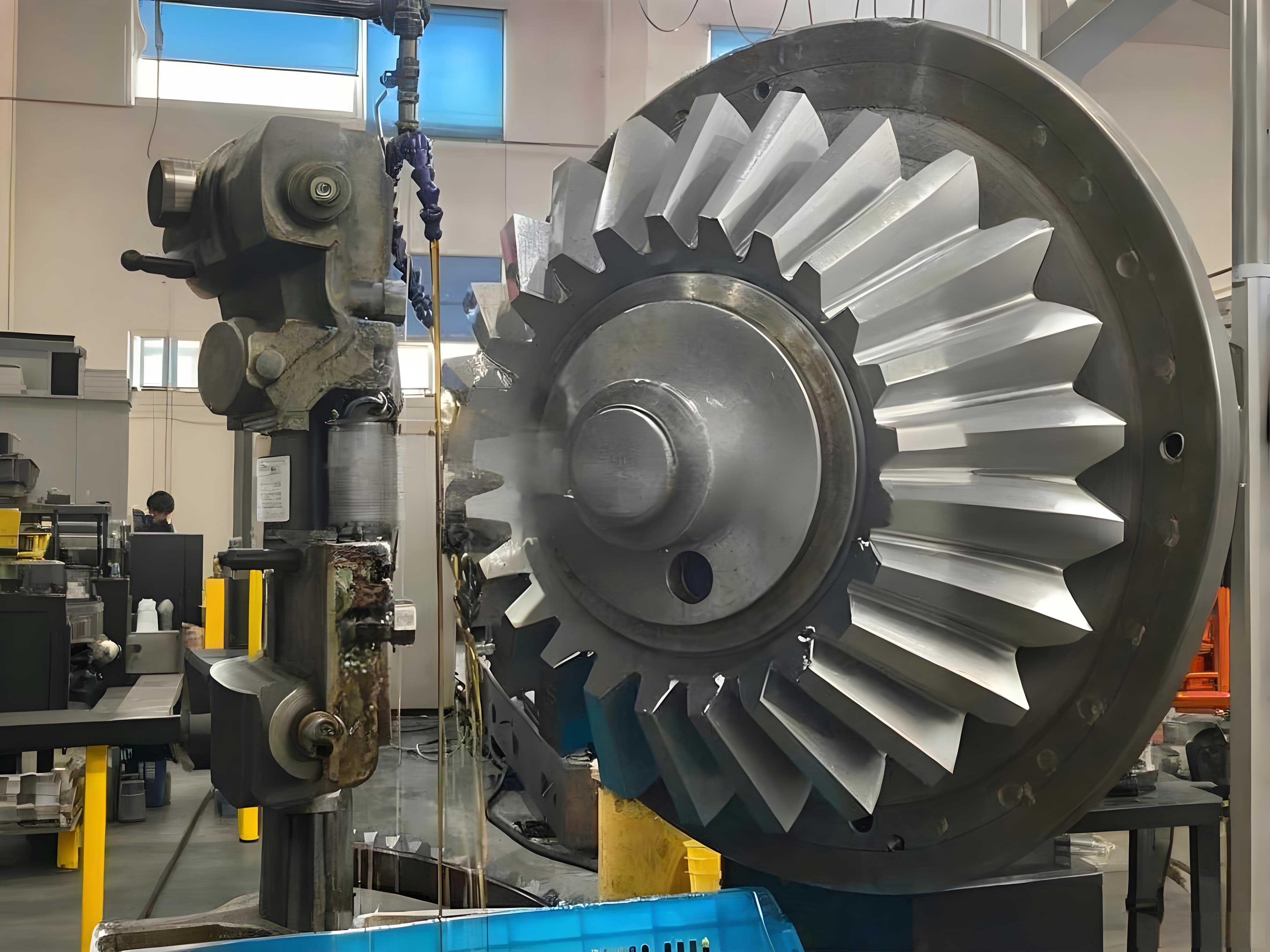
Fundamentals of the Concave Cutter and Miter Gear Generation
The machining process for a miter gear using a concave cutter is conceptually described using a virtual crown gear or generating gear. The rotation of the cutter forms the tooth surface of this virtual gear. The cutting process itself is then equivalent to the meshing motion between this virtual crown gear and the workpiece (the miter gear being cut). The defining feature of the concave cutter is that its main cutting edge is inclined inward relative to the cutter’s face plane by a specific angle, known as the concavity or hook angle (denoted as δ). As this cutter rotates, it generates a conical surface with an inward taper. This geometry is precisely what imparts the desired longitudinal crowning to the miter gear tooth.
The amount of crown (ΔS) at the ends of the tooth, relative to its midpoint, is a crucial parameter determined by the cutter and gear geometry. It can be calculated using the following relationships derived from the basic kinematics of the cutting process. The crown is essential for the proper functioning of the miter gear pair, as it prevents edge loading and ensures a stable contact pattern under light loads or slight misalignments.
$$
\Delta S = \Delta H \left[ \tan(\alpha_f + \delta) – \tan \alpha_0 \right]
$$
Where \(\alpha_f\) is the gear pressure angle, \(\delta\) is the cutter concavity angle, \(\alpha_0\) is the basic cutter pressure angle, and \(\Delta H\) is a depth parameter related to the curved root line. Furthermore, the crown can also be expressed in terms of the miter gear’s geometry:
$$
\Delta S = \frac{b^2 \cos \alpha_f \tan \delta}{4 D_e}
$$
Here, \(b\) is the face width of the miter gear and \(D_e\) is the nominal cutter diameter. These equations show that the crown on the miter gear tooth is directly proportional to the face width \(b\) and the concavity angle \(\delta\), and inversely proportional to the cutter diameter \(D_e\). The cutter diameter itself is selected based on the miter gear’s face width and pressure angle to control the root line curvature:
$$
D_e = \frac{b^2 \cos \alpha_f}{4 \Delta H}
$$
The top width of the cutter blade is another critical parameter. It must be chosen to satisfy two conditions simultaneously: it must be greater than half the slot width at the heel (large end) of the miter gear tooth space and less than the slot width at the toe (small end). This ensures proper generation of the tooth profile across the entire face width of the miter gear.
Mathematical Modeling of the Miter Gear Tooth Surface
Establishing a precise mathematical model is the foundation for analyzing the meshing behavior of miter gears. The process begins by defining the surface of the virtual generating gear, which is formed by the cutter’s cutting edge.
1. Coordinate Systems and Cutting Edge Surface
A series of coordinate systems are established to describe the spatial relationships between the cutter, the virtual generating gear, the machine tool, and the final miter gear workpiece. The cutter coordinate system \(S_t(O_t-X_tY_tZ_t)\) is fixed to the cutter, with its origin at the intersection of the cutter axis and the blade tip plane. In this system, the cutting edge surface can be represented parametrically. For a point \(m\) on the cutting edge, defined by its radial distance \(r\) from the cutter axis and its position \(s\) along the blade from the tip, the position vector \(\mathbf{r}_t\) and its corresponding unit normal vector \(\mathbf{n}_t\) are derived.
$$
\mathbf{r}_t(s, \theta) =
\begin{bmatrix}
\sin \theta \, (r – s \cos \delta) \\
\cos \theta \, (r – s \cos \delta) \\
s \sin \delta \\
1
\end{bmatrix}
$$
$$
\mathbf{n}_t(s, \theta) =
\begin{bmatrix}
-\sin \theta \sin \delta \\
\cos \theta \sin \delta \\
\cos \delta
\end{bmatrix}
$$
Here, \(\theta\) is the rotation angle parameter of the cutting edge around the cutter axis.
2. Kinematics of Miter Gear Generation
The transformation from the cutter surface to the finished miter gear tooth surface involves multiple coordinate changes, representing the machine tool settings. Key settings include the radial distance \(L\), the vertical offset \(E\), the axial offset \(D\), the blade tilt (swivel) angle \(\alpha\), and the phase angle \(\lambda\). These settings position the cutter correctly relative to the virtual generating gear. The machine’s generating roll, defined by the ratio \(I_{12}\) of the virtual gear rotation \(\phi_1\) to the workpiece rotation \(\psi_1\), is constant for a standard miter gear and is given by:
$$
I_{12} = \frac{\cos \theta_f}{\sin \delta_d}
$$
where \(\theta_f\) is the dedendum angle and \(\delta_d\) is the pitch angle of the miter gear. The relationship is \(\psi_1 = I_{12} \phi_1\).
The general transformation from the cutter coordinates \(S_t\) to the workpiece (miter gear) coordinates \(S_g\) can be expressed as:
$$
\mathbf{r}_g = \mathbf{M}_{g3} \mathbf{M}_{3m} \mathbf{M}_{mc} \mathbf{M}_{c2} \mathbf{M}_{21} \mathbf{M}_{1t} \mathbf{r}_t
$$
$$
\mathbf{n}_g = \mathbf{L}_{g3} \mathbf{L}_{3m} \mathbf{L}_{mc} \mathbf{L}_{c2} \mathbf{L}_{21} \mathbf{L}_{1t} \mathbf{n}_t
$$
Here, \(\mathbf{M}_{ij}\) and \(\mathbf{L}_{ij}\) are the homogeneous coordinate transformation matrix and its corresponding \(3 \times 3\) rotation submatrix between coordinate systems \(i\) and \(j\), respectively.
3. Meshing Condition and Tooth Surface Equation
During the generation of the miter gear, the cutter surface (representing the generating gear tooth) and the workpiece must satisfy the condition of continuous tangency. This is enforced by the equation of meshing, which states that the relative velocity vector at the contact point must be perpendicular to the common surface normal. In the machine coordinate system \(S_m\), this condition is:
$$
\mathbf{v}_{12}^{(m)} \cdot \mathbf{n}_m^{(m)} = 0
$$
where \(\mathbf{v}_{12}^{(m)}\) is the relative velocity and \(\mathbf{n}_m^{(m)}\) is the surface normal vector expressed in \(S_m\). Solving this equation allows one to express one of the surface parameters (typically \(s\)) as a function of the motion parameter \(\phi_1\) and the other surface parameter \(\theta\). Substituting this solution \(s(\phi_1, \theta)\) back into the transformation equation for \(\mathbf{r}_g\) yields the mathematical model of the miter gear tooth surface as a family of contact lines, parameterized by \(\theta\) and \(\phi_1\):
$$
\mathbf{r}_g = \mathbf{r}_g(\theta, \phi_1)
$$
This model is fundamental for predicting the geometry of the manufactured miter gear and forms the basis for subsequent contact analysis.
Tooth Contact Analysis (TCA) for Miter Gear Pairs
Tooth Contact Analysis is a computational simulation technique used to predict the contact pattern and transmission error of a gear pair under load-free conditions. It is essential for evaluating the performance and sensitivity to misalignment of the designed miter gear pair.
1. Mathematical Formulation of TCA
For a pair of conjugate miter gears (pinion and gear), the TCA is performed by solving for the conditions of continuous contact between their tooth surfaces. The tooth surfaces of both the pinion and the gear, derived using the method above, are expressed in a fixed global coordinate system \(S_f\), typically aligned with the pinion’s initial position.
Let \(\mathbf{r}_f^{(1)}(\theta_1, \phi_1)\) and \(\mathbf{n}_f^{(1)}(\theta_1, \phi_1)\) be the position and normal vectors of the pinion tooth surface in \(S_f\), and \(\mathbf{r}_f^{(2)}(\theta_2, \phi_2)\) and \(\mathbf{n}_f^{(2)}(\theta_2, \phi_2)\) be those of the gear tooth surface, transformed into \(S_f\). The contact equations for a given instant are:
$$
\mathbf{r}_f^{(1)}(\theta_1, \phi_1) = \mathbf{r}_f^{(2)}(\theta_2, \phi_2)
$$
$$
\mathbf{n}_f^{(1)}(\theta_1, \phi_1) = \mathbf{n}_f^{(2)}(\theta_2, \phi_2)
$$
This system of vector equations yields five independent scalar equations. The unknowns are the four surface parameters (\(\theta_1, \phi_1, \theta_2, \phi_2\)) and the rotation angle of one gear relative to the other. For a given rotation angle of the pinion, \(\eta_1\), the system is solved to find the corresponding gear rotation angle \(\eta_2\) and the contact point parameters.
2. Transmission Error and Contact Path
The transmission error (TE) is a key output of TCA. It quantifies the deviation from perfect conjugate motion and is calculated as:
$$
\Delta \eta_2(\eta_1) = (\eta_2 – \eta_{20}) – \frac{N_1}{N_2} (\eta_1 – \eta_{10})
$$
where \(N_1\) and \(N_2\) are the tooth numbers of the pinion and gear (equal for a miter gear), and \(\eta_{10}, \eta_{20}\) are the initial reference positions. A plot of \(\Delta \eta_2\) versus \(\eta_1\) reveals the kinematic performance. The locus of contact points on the gear tooth surface, calculated over a mesh cycle, defines the contact path. The contact pattern is then visualized as the elliptical imprint formed by the deformation of this path under a small assumed load.
3. TCA Results for a Miter Gear Pair
Applying the TCA methodology to a sample miter gear pair with parameters defined by the cutter and machine settings yields predictive results. The analysis is typically conducted for different potential misalignment conditions, represented by changes in the mounting distance (V) and axial offset (H).
| Parameter | Pinion / Gear Value |
|---|---|
| Number of Teeth (N) | 35 |
| Module (m) | 2.5 mm |
| Face Width (b) | 15 mm |
| Pressure Angle (\(\alpha_f\)) | 20° |
| Pitch Angle (\(\delta_d\)) | 45° |
| Cutter Concavity Angle (\(\delta\)) | 2° |
| Cutter Diameter (\(D_e\)) | 72.78 mm |
| Machine Setting | Value |
|---|---|
| Radial Setting (L) | 54.30 mm |
| Vertical Offset (E) | 28.05 mm |
| Axial Offset (D) | 67.12 mm |
| Blade Tilt Angle (\(\alpha\)) | Adjustment Dependent |
| Phase Angle (\(\lambda\)) | 1.612° |
| Machine Roll Ratio (\(I_{12}\)) | 1.412554 |
For the correctly aligned condition (V=0, H=0), the TCA predicts a well-centered contact pattern covering approximately 50% of the face width. The transmission error curve is parabolic in shape, which is characteristic of a longitudinally crowned tooth, such as that produced on a miter gear by a concave cutter. This parabolic error function is beneficial as it provides a “soft” entry and exit of contact for individual tooth pairs. The following table summarizes typical TCA outputs for different alignment scenarios.
| Alignment Case | Contact Pattern Location | Transmission Error Characteristic |
|---|---|---|
| Nominal (V=0, H=0) | Centered on tooth flank | Low-amplitude parabolic curve |
| Positive V-Misalignment | Shifts towards Heel | Amplitude and shape may change |
| Positive H-Misalignment | Shifts towards Toe | Amplitude and shape may change |
Experimental Validation and Conclusion
The theoretical models and TCA methodology were validated through practical machining and testing. A miter gear pair was manufactured on a modern CNC bevel gear milling machine using a concave cutter with the specified parameters. Subsequent rolling tests on a gear testing machine confirmed that the actual contact patterns aligned closely with the TCA predictions under various alignment settings (V and H adjustments). The contact ellipse moved as predicted when deliberate misalignments were introduced. Furthermore, coordinate measurement of the tooth flank form showed deviations within an acceptable range, confirming the accuracy of the generated miter gear geometry.
In conclusion, this article has presented a detailed framework for the modeling and analysis of miter gears produced via the concave cutter method. By establishing the mathematical model of the tooth surface based on the cutter geometry and machine kinematics, and implementing a robust Tooth Contact Analysis, it is possible to accurately predict the meshing behavior of the miter gear pair. This capability is indispensable for optimizing cutting parameters, selecting appropriate cutter specifications, and ensuring high-quality mating performance with controlled sensitivity to assembly errors. The successful experimental correlation confirms the validity of the approach, providing a solid theoretical foundation for the application of concave cutter technology in the precision manufacturing of miter gears.