
In the realm of automotive engineering, the transmission system stands as a critical component, responsible for transmitting power from the engine to the wheels while allowing variable speed and torque ratios. Within this system, the gear shaft plays a pivotal role, particularly in manual transmissions where precise gear engagement is essential. As a researcher focused on mechanical dynamics, I have delved into the modal characteristics of the gear shaft to understand its vibrational behavior under operational conditions. This analysis is not merely academic; it directly impacts noise reduction, fatigue life, and overall transmission reliability. In this article, I will explore the fundamental principles of modal analysis, detail the process using computational tools, and discuss the implications for design optimization, all while emphasizing the importance of the gear shaft in automotive applications.
The gear shaft, often referred to as the input or output shaft in transmissions, is subjected to complex loads and vibrations during vehicle operation. These vibrations arise from engine oscillations, gear meshing forces, and road-induced shocks. If left unaddressed, they can lead to excessive noise, component wear, and even catastrophic failure due to resonance. Modal analysis, a subset of structural dynamics, provides insights into the inherent vibrational properties of a structure—specifically, its natural frequencies and mode shapes. By identifying these properties, engineers can design gear shafts that avoid resonant conditions, thereby minimizing noise and enhancing durability. The core of this analysis lies in understanding the relationship between the gear shaft’s natural frequencies and the excitation frequencies from gear meshing.
To begin, let’s establish the theoretical foundation. The natural frequencies of a gear shaft are determined by its material properties, geometry, and boundary conditions. For a uniform shaft, the fundamental natural frequency can be approximated using Euler-Bernoulli beam theory, but real-world gear shafts feature complex geometries with integrated gears, keys, and splines, necessitating finite element analysis (FEA). The equation for the natural frequency of a simple cantilever beam is given by:
$$f_n = \frac{1}{2\pi} \sqrt{\frac{k}{m}}$$
where \( f_n \) is the natural frequency, \( k \) is the stiffness, and \( m \) is the mass. However, for a gear shaft, we must consider distributed mass and stiffness, leading to a more generalized eigenvalue problem:
$$[K] \{\phi\} = \omega^2 [M] \{\phi\}$$
Here, \([K]\) is the stiffness matrix, \([M]\) is the mass matrix, \(\omega\) is the angular natural frequency (related to \(f_n\) by \(\omega = 2\pi f_n\)), and \(\{\phi\}\) is the mode shape vector. Solving this equation yields the natural frequencies and corresponding mode shapes, which describe how the gear shaft deforms at each frequency.
A key excitation source for the gear shaft is gear meshing, which generates periodic forces at the meshing frequency. This frequency is calculated based on the rotational speed and number of teeth:
$$f_m = \frac{n \cdot z}{60}$$
where \( f_m \) is the meshing frequency in Hz, \( n \) is the rotational speed in revolutions per minute (rpm), and \( z \) is the number of teeth on the gear. For a typical automotive transmission, the engine speed ranges from idle at around 800 rpm to maximum output at 4200 rpm or higher, leading to meshing frequencies that can vary from near zero to over 1400 Hz. If \( f_m \) coincides with or is an integer multiple of a natural frequency of the gear shaft, resonance occurs, amplifying vibrations and noise. Therefore, a primary goal of modal analysis is to ensure that the natural frequencies of the gear shaft are sufficiently separated from the expected meshing frequencies.
To conduct the modal analysis, I employed Pro/ENGINEER (Pro/E) software, which integrates CAD modeling and FEA capabilities. The first step was to create a detailed three-dimensional model of the gear shaft. This model accurately represents the shaft’s geometry, including diameters, lengths, gear teeth profiles, and keyways. The gear shaft under study is typically made of 20CrMnTi alloy steel, a common material for transmission components due to its high strength and wear resistance. Its material properties are summarized in the table below:
| Property | Value | Unit |
|---|---|---|
| Density | 7.9 | g/cm³ |
| Young’s Modulus | 206 | GPa |
| Poisson’s Ratio | 0.3 | – |
| Yield Strength | ≥ 835 | MPa |
| Ultimate Tensile Strength | ≥ 1080 | MPa |
These properties are crucial for the FEA, as they define the stiffness and inertia of the gear shaft. After defining the material, the model was imported into the simulation module for meshing. The finite element mesh discretizes the gear shaft into small elements, allowing numerical solution of the eigenvalue problem. I used tetrahedral elements for their adaptability to complex geometries, with a mesh size refined to ensure accuracy without excessive computational cost. The meshed model contained approximately 150,000 nodes and 100,000 elements, providing a balance between precision and efficiency.
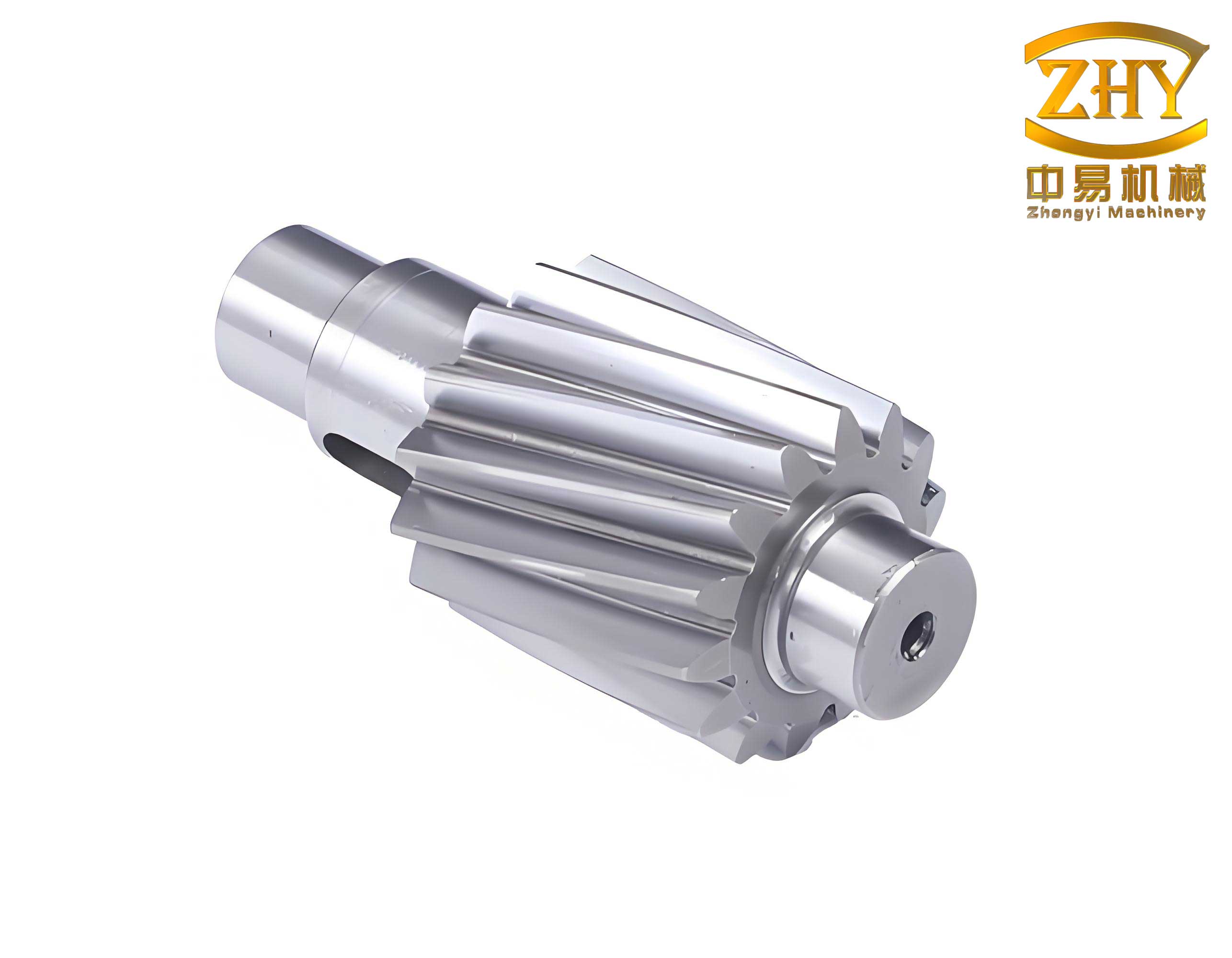
Boundary conditions are essential in modal analysis, as they reflect the gear shaft’s mounting in the transmission. In this case, the gear shaft is supported by bearings at specific locations, which can be approximated as simple supports or fixed constraints depending on the bearing type. For simplicity, I applied fixed constraints at the bearing seats, assuming rigid support. This approximation is valid for low-frequency modes where bearing compliance is negligible. The gear shaft was also considered free in other directions to capture bending and torsional vibrations. With the mesh and constraints set, I performed a modal extraction using the Lanczos algorithm, which efficiently computes the first few natural frequencies and mode shapes.
The results of the modal analysis are presented in the table below, showcasing the first six natural frequencies of the gear shaft. These frequencies correspond to different mode shapes, each representing a distinct pattern of deformation. Understanding these modes is vital for identifying potential resonance points with external excitations.
| Mode Order | Natural Frequency (Hz) | Description of Mode Shape |
|---|---|---|
| 1 | 777.275 | First bending mode along the longitudinal axis |
| 2 | 798.342 | Second bending mode with nodal point |
| 3 | 1021.567 | Torsional vibration about the axis |
| 4 | 1250.891 | Combined bending and torsion |
| 5 | 1345.623 | Third bending mode with multiple nodes |
| 6 | 1478.954 | Complex deformation with gear interaction |
The mode shapes visually illustrate how the gear shaft vibrates at each natural frequency. For instance, the first mode involves bending similar to a cantilever beam, while the third mode is predominantly torsional, which is critical for gear engagement dynamics. These shapes help engineers pinpoint weak areas in the gear shaft design, such as stress concentrations near gear teeth or keyways, that may exacerbate vibrations.
To relate these natural frequencies to operational conditions, we must consider the gear meshing frequency. As previously mentioned, \( f_m = \frac{n \cdot z}{60} \). For the gear shaft in question, the gear attached has 20 teeth. If we take the base natural frequency of 777.275 Hz as a reference, resonance occurs when \( f_m \) equals this frequency or its harmonics. The table below computes the engine speeds at which resonance might happen, assuming the gear shaft is directly connected to the engine output.
| Harmonic Ratio | Meshing Frequency (Hz) | Engine Speed (rpm) | Remarks |
|---|---|---|---|
| 1× (Base) | 777.275 | 2743.324 | Direct resonance risk |
| 1/2× | 388.6375 | 1371.617 | Subharmonic resonance |
| 1/3× | 259.0917 | 914.441 | Low-speed excitation |
| 1/4× | 194.3188 | 685.831 | Potential for noise amplification |
| 1/5× | 155.455 | 548.665 | Often within idle range |
| 1/6× | 129.5458 | 457.221 | Critical for start-up |
| 1/7× | 111.0393 | 391.903 | May coincide with cruising speeds |
| 1/8× | 97.1594 | 342.916 | Low-frequency vibration |
| 1/9× | 86.3639 | 304.813 | Minimal impact but still notable |
| 1/10× | 77.7275 | 274.332 | Near idle conditions |
This table reveals that as the vehicle accelerates from start to maximum speed, the meshing frequency sweeps through a range that includes multiples of the natural frequencies of the gear shaft. For example, at an engine speed of around 2743 rpm, the meshing frequency matches the first natural frequency, posing a high risk of resonance. Similarly, at lower speeds like 1372 rpm or 914 rpm, subharmonic resonances can occur, leading to increased noise and vibration. Therefore, during transmission design, it is crucial to avoid prolonged operation at these critical speeds or implement damping measures to mitigate effects.
Further analysis involves examining the mode shapes in detail. The first mode, at 777.275 Hz, shows bending deformation primarily in the middle section of the gear shaft, which could affect gear alignment and meshing accuracy. The second mode, at 798.342 Hz, introduces a nodal point where displacement is minimal, but stresses may concentrate near the gears. Torsional modes, such as the third at 1021.567 Hz, are particularly significant because they directly influence the transmission of torque and can lead to gear rattle or whine. By visualizing these modes, engineers can reinforce specific areas of the gear shaft, perhaps through thicker diameters or optimized fillet radii, to shift natural frequencies away from excitation ranges.
In addition to meshing frequencies, other excitation sources include engine firing pulses and driveline imbalances. The gear shaft must be analyzed in the context of the entire transmission system. For instance, coupling the gear shaft with other components like synchronizers or bearings modifies the boundary conditions and may alter natural frequencies. A comprehensive approach involves system-level modal analysis, where the entire transmission assembly is modeled to capture interactions. However, focusing on the gear shaft alone provides a foundational understanding that informs broader design decisions.
Material selection also plays a role in modal characteristics. For the gear shaft, 20CrMnTi offers a good balance of strength and density, but alternatives like carbon fiber composites could be explored for weight reduction and damping properties. The natural frequency is inversely proportional to the square root of density, as seen in the formula:
$$f_n \propto \frac{1}{\sqrt{\rho}}$$
where \( \rho \) is density. Thus, lighter materials can increase natural frequencies, potentially pushing them above common excitation ranges. However, stiffness must be maintained to prevent excessive deflection. This trade-off highlights the importance of multi-objective optimization in gear shaft design.
Another aspect is the effect of manufacturing tolerances and assembly variations on the modal properties of the gear shaft. Imperfections such as misalignment or residual stresses from heat treatment can shift natural frequencies and mode shapes. Statistical analysis, such as Monte Carlo simulations, can assess the variability and ensure robustness in production. For this gear shaft, assuming ideal conditions provides a baseline, but real-world applications require tolerance stacks to be considered.
To deepen the analysis, I also explored the impact of rotational speed on natural frequencies. As the gear shaft spins, centrifugal forces and gyroscopic effects come into play, potentially stiffening the shaft and increasing natural frequencies. This phenomenon is described by the spin-softening and stress-stiffening terms in dynamic equations. For a rotating gear shaft, the modified eigenvalue problem becomes:
$$([K] + [K_\sigma] – \omega^2 [M])\{\phi\} = 0$$
where \([K_\sigma]\) is the stress stiffness matrix due to centrifugal loads. At high speeds, such as those near the resonance points identified, these effects can be significant and should be included in advanced simulations. For preliminary design, however, the non-rotating analysis suffices to identify critical zones.
Noise control is a direct application of this modal analysis. The gear shaft vibrations transmit through the transmission housing and into the vehicle cabin as audible noise. By ensuring that the natural frequencies of the gear shaft do not align with meshing frequencies, engineers can reduce gear whine, a common issue in manual transmissions. Additionally, damping treatments, such as viscoelastic coatings on the gear shaft or optimized gear tooth profiles, can attenuate vibrations. The table below summarizes potential noise reduction strategies based on modal insights:
| Strategy | Description | Effect on Gear Shaft |
|---|---|---|
| Frequency Separation | Design gear shaft to shift natural frequencies away from meshing harmonics | Avoids resonance, reducing peak noise |
| Damping Layers | Apply constrained layer damping to shaft surface | Dissipates vibrational energy, lowering amplitude |
| Geometry Optimization | Modify shaft diameter or add ribs to alter stiffness | Changes mode shapes and frequencies |
| Material Change | Use composites or high-damping alloys | Increases natural frequencies and damping ratio |
| Active Control | Implement piezoelectric actuators to counteract vibrations | Real-time suppression of specific modes |
Fatigue analysis is another critical consideration. Resonance not only increases noise but also amplifies stress amplitudes, leading to accelerated fatigue failure. The gear shaft, subjected to cyclic loads from gear meshing, must withstand millions of cycles over its lifetime. Using the natural frequencies and mode shapes, we can estimate stress distributions under resonant conditions and apply fatigue criteria such as the S-N curve for 20CrMnTi. The relationship between stress amplitude and number of cycles to failure is given by:
$$\sigma_a = \sigma_f’ (2N_f)^b$$
where \( \sigma_a \) is the stress amplitude, \( \sigma_f’ \) is the fatigue strength coefficient, \( N_f \) is the number of cycles to failure, and \( b \) is the fatigue strength exponent. By avoiding resonance, we reduce \( \sigma_a \), thereby extending the fatigue life of the gear shaft.
In practice, transmission designers use modal analysis results to inform gear ratio selection and shift scheduling. For example, if a particular gear ratio puts the meshing frequency close to a natural frequency of the gear shaft during common driving speeds, that ratio might be avoided or used only briefly. Modern transmissions with electronic control units can even adjust shift points to minimize time spent in critical speed ranges, enhancing comfort and durability.
To validate the FEA results, experimental modal analysis (EMA) can be conducted on a physical prototype of the gear shaft. EMA involves exciting the shaft with an impact hammer or shaker and measuring the response with accelerometers. The frequency response functions (FRFs) are then analyzed to extract natural frequencies and mode shapes, which should correlate with computational predictions. Discrepancies may indicate modeling inaccuracies, such as incorrect boundary conditions or material properties, and guide refinements. For this gear shaft, the Pro/E-based FEA serves as a reliable preliminary tool, but EMA would be essential for final validation.
Looking ahead, advancements in simulation technology, such as digital twins and machine learning, offer new avenues for gear shaft modal analysis. A digital twin continuously updates the model based on real-time sensor data from the transmission, allowing predictive maintenance and dynamic optimization. Machine learning algorithms can analyze vast datasets from multiple gear shaft designs to identify patterns and propose optimal geometries. These technologies will further emphasize the importance of understanding the modal characteristics of the gear shaft in evolving automotive landscapes, including electric vehicles where transmission dynamics differ.
In conclusion, the modal analysis of the automotive transmission gear shaft is a fundamental aspect of design and noise control. Through this detailed exploration, I have highlighted how natural frequencies and mode shapes influence vibrational behavior, resonance risks, and overall performance. By leveraging tools like Pro/E for FEA and applying theoretical formulas, engineers can optimize the gear shaft to avoid critical excitation frequencies, thereby reducing noise and preventing fatigue failures. The gear shaft, as a central component, demands careful consideration in transmission development, and modal analysis provides the insights needed to ensure reliability and efficiency. As automotive technology progresses, continued focus on the dynamics of the gear shaft will remain essential for achieving quieter, more durable vehicles.