
It is widely recognized that gear transmission is extensively applied in the field of mechanical engineering, and its performance directly impacts the operation of various mechanical equipment. Consequently, research on the performance of gear transmission has always been accorded high importance. Among numerous mechanical transmission methods, gear transmission is widely adopted due to its stability, fixed transmission ratio, high efficiency, large operating range, and resistance to fatigue. With the continuous elevation of production requirements, the demands on gear performance—such as rotational speed, service life, load capacity, and efficiency—have become increasingly stringent. Therefore, addressing challenges like load concentration on gear teeth and the rational distribution of contact surface stress has become a significant research focus. In recent years, alongside advancements in science and technology, notable achievements have been made in the manufacturing and safety inspection of gears. Significant breakthroughs have been attained in areas such as research on gear tooth profile equations, strength calculation methods, vibration and noise control, friction, temperature, and lubrication theories. Particularly in the theoretical study of gear contact strength, remarkable accomplishments have been made. Additionally, substantial progress has been achieved in research on gear bending and contact strength, as well as methods to extend service life. The dedicated efforts of researchers in optimizing gear tooth profile design and innovating new gear tooth profiles have yielded significant results, fully demonstrating the irreplaceable position of gears in modern industrial production and their immense social value and enduring vitality.
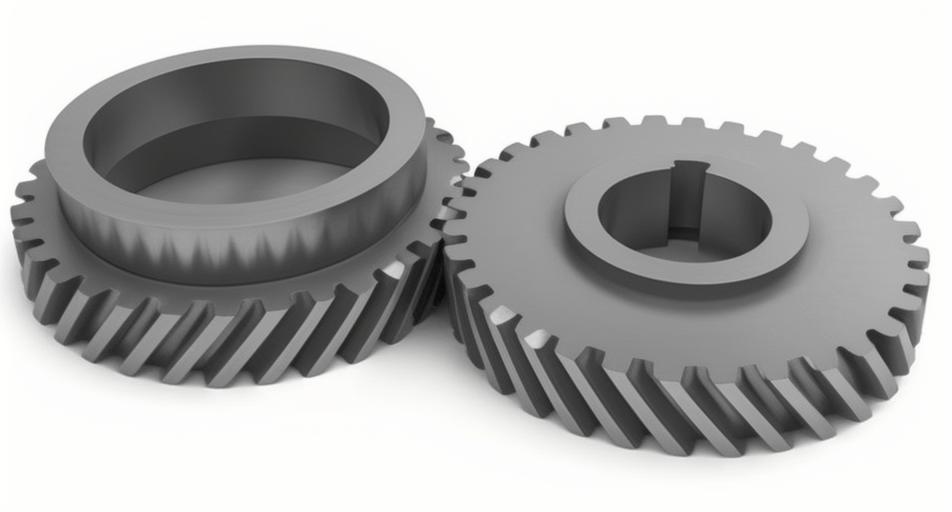
However, gear failure remains one of the primary causes of mechanical malfunctions, accounting for up to 60% of failures. During operation, gears are subjected to torque, leading to uneven stress distribution. Prolonged operation under such conditions makes them prone to damage or even fracture, resulting in production stoppages and significant losses. Furthermore, gear vibration and noise are also critical factors affecting production safety. Helical gears, known for their smooth power transmission and low impact noise, are thus extensively used in high-speed and heavy-duty applications. Various failure modes, such as surface contact fatigue and root bending fatigue fracture—triggered by repeated high contact stress and alternating bending stress, respectively—are common occurrences during the service of helical gears. To prevent such failures, research on gear strength verification is paramount. The finite element method can be employed to calculate the elastic deformation and root stress of helical gears. Many scholars have investigated the dynamic response of gear transmissions under time-varying loads. Nevertheless, a considerable portion of existing research focuses primarily on the static analysis of the gear meshing process, often neglecting the vibration response of gears under dynamic loading conditions. Furthermore, establishing accurate and complex finite element models for helical gears that account for the nonlinear effects of tooth surface contact presents challenges, and inaccuracies in contact simulation due to tooth surface errors can, to some extent, affect the results of finite element analysis.
The objective of this study is to leverage software tools such as ANSYS and SolidWorks to conduct a comprehensive investigation into helical gears, ranging from parametric design to dynamic simulation. Through these tools, we aim to gain a deeper understanding of the performance characteristics of helical gear transmissions and provide a theoretical foundation for optimizing design, reducing the risk of failure, and enhancing production efficiency. A crucial aspect of this dynamic performance evaluation is modal analysis.
Theoretical Foundation of Modal Analysis
Theoretical modal analysis, based on linear vibration theory, targets modal parameters to investigate the relationship between excitation, system, and response. In essence, it is a process of theoretical modeling. The primary approach involves discretizing a vibrating structure using the Finite Element Method (FEM), establishing a mathematical model for the system’s eigenvalue problem, and solving for the system’s eigenvalues and eigenvectors, which correspond to the system’s natural frequencies and natural mode shapes, respectively.
Mechanical systems are continuous systems composed of the mass, stiffness, and damping of their components. Their inherent dynamic characteristics can be described by partial differential equations. This physical system constitutes a vibrational system with infinite degrees of freedom (DOFs), characterized by its stiffness, damping, and mass parameters. Due to the geometrical complexity of system structures and the intricacy of boundary conditions, deriving applicable partial differential equations for various parts of such complex systems using analytical methods is exceedingly difficult. Therefore, it is common practice to discretize the complex continuous system, simplifying it into a finite number of DOFs. This transformation converts the complex partial differential equations into ordinary differential equations that can be solved via matrix operations.
Typically, the first step in performing a dynamic calculation is to determine the natural frequencies and mode shapes of the structure while neglecting damping. These results reflect the fundamental dynamic properties of the structure and indicate its likely response trends under dynamic loads. Considering the system as an elastic body comprised of parameters like mass, stiffness, and damping, the differential equation of motion describing the system’s vibration is:
$$ [M]\{\ddot{x}(t)\} + [C]\{\dot{x}(t)\} + [K]\{x(t)\} = \{F(t)\} $$
where $[M]$ is the mass matrix; $[C]$ is the damping matrix; $[K]$ is the stiffness matrix; $\{x(t)\}$ is the displacement response vector of the system’s points; and $\{F(t)\}$ is the excitation force vector acting on the system’s points.
For a free, undamped system with no external excitation, both the damping term and the force term are zero. Consequently, the above differential equation simplifies to:
$$ [M]\{\ddot{x}(t)\} + [K]\{x(t)\} = 0 $$
Since the free vibration of an elastic body can be decomposed into a superposition of a series of simple harmonic motions, to determine the natural frequencies and mode shapes of the elastic body’s free vibration, a solution in the form of simple harmonic motion is considered:
$$ \{x(t)\} = \{\phi\} \sin(\omega t + \theta) $$
Substituting this into the free vibration equation yields:
$$ (-\omega^2 [M] + [K]) \{\phi\} = 0 $$
This represents a system of n linear homogeneous algebraic equations concerning $\{\phi\}$. For this system to have a non-trivial solution (i.e., $\{\phi\} \neq 0$), its coefficient determinant must equal zero:
$$ \det([K] – \omega^2 [M]) = 0 $$
Assuming a harmonic solution of the form:
$$ \{u\} = \{\phi\} e^{i \omega_n t} $$
where $\{u\}$ is the displacement vector, $\{\phi\}$ is the eigenvector (amplitude of the displacement vector $\{u\}$), and $\omega_n$ is the natural angular frequency. This harmonic form implies that all degrees of freedom of the vibrating structure move synchronously. During this motion, the fundamental shape of the structure remains unchanged, with only the amplitude varying. This form is key to the numerical solution. Differentiating and substituting into the free vibration equation gives:
$$ (-\omega_n^2 [M] + [K]) \{\phi\} e^{i \omega_n t} = 0 $$
Simplifying, we obtain the generalized eigenvalue equation:
$$ ([K] – \lambda [M]) \{\phi\} = 0 $$
where $\lambda = \omega_n^2$. Equation (9) is termed the characteristic equation. It is a set of similar algebraic equations oriented towards the components of the eigenvector. The basic form of the eigenvalue problem in structural analysis is generally represented by this equation.
The determinant $\det([K] – \lambda [M])$ is zero only at a set of discrete eigenvalues $\lambda_i$. The eigenvectors $\{\phi_i\}$ satisfy Equation (9) and correspond to each eigenvalue. Thus, the equation can be rewritten for the i-th mode as:
$$ ([K] – \lambda_i [M]) \{\phi_i\} = 0 $$
Each eigenvalue and its corresponding eigenvector define a free vibration mode of the structure. The i-th eigenvalue $\lambda_i$ is related to the i-th natural frequency $f_i$ by:
$$ \lambda_i = \omega_i^2 = (2 \pi f_i)^2 $$
$$ f_i = \frac{\omega_i}{2\pi} = \frac{\sqrt{\lambda_i}}{2\pi} $$
Although mode shapes alone cannot be used to assess the dynamic performance of a system, the absolute amplitude of the dynamic response is indeed determined by the relationship between the structural loading (excitation) and the natural mode shapes. Modal analysis provides explicit scale factors for the relationship between a specific excitation pattern and a set of natural frequencies. These factors can be utilized to determine the extent to which each specific mode is excited by the load. The method of using modal results to determine the forced response is known as the mode superposition method.
Typically, there are three principal methods for solving the eigenvalue problem of a mathematical model: the Lanczos method, the Householder method, and the Sturm inverse power method. The Householder method is suitable for the dynamic reduction of small, dense matrices and is more commonly used in nonlinear vibration analysis. The Sturm inverse power method is generally employed to determine a smaller number of system modes. However, for modal analysis of medium to large-scale structures such as gearboxes, the Lanczos method, which supports the sparse matrix method, proves to be more reliable and efficient.
When using the Lanczos method to solve for eigenvalues, for given matrices $[M]$, $[K]$, and a starting vector $\{u\}$, a tridiagonal matrix $[T]$ is iteratively constructed. The original generalized eigenvalue problem is then projected onto a Krylov subspace, reducing it to a standard eigenvalue problem for the much smaller tridiagonal matrix $[T]$:
$$ [T] \{z\} = \theta \{z\} $$
The eigenvalues $\theta_i$ of $[T]$ approximate the eigenvalues $\lambda_i$ of the original problem $([K] – \lambda [M])\{\phi\} = 0$. The corresponding eigenvectors of the original system can be recovered from the Lanczos vectors and the eigenvectors $\{z_i\}$ of $[T]$. The Lanczos method efficiently extracts a subset of the extreme eigenvalues (e.g., the lowest frequencies) in large-scale problems, making it highly suitable for the modal analysis of complex assemblies like helical gear systems, which is the method adopted in this study.
Methods of Modal Analysis
Modal analysis methods can be broadly classified into two categories based on the theoretical formulation and implementation process: Computational Modal Analysis and Experimental Modal Analysis. Computational Modal Analysis involves creating a mathematical or finite element model of the object under study and solving it using modal analysis theory to obtain the system’s modal parameters, such as natural frequencies, modal damping, and mode shapes. Experimental Modal Analysis, grounded in vibration theory and signal processing technology, utilizes vibration measurement and signal analysis equipment to collect and study the system’s vibration response, thereby identifying the system’s modal parameters. Both analytical approaches hold significant value for the dynamic characteristic analysis and optimal design of systems.
The most commonly used method for Computational Modal Analysis is to establish a finite element model of the object and perform calculations using finite element analysis software. With advancements in computer performance and the development of FEM software, this method is widely adopted due to its advantages of low cost, high efficiency, and integrated design modification capabilities. However, modeling errors inherent in the finite element model can lead to discrepancies between calculation results and reality. If these errors are substantial, the computational results may lose their practical reference value.
Experimental Modal Analysis typically involves placing sensors on the surface of the test object, applying a known or measured excitation signal, and collecting the structural vibration response signals. Modal parameters are then identified by analyzing the input-output signals (or sometimes output-only signals). This method is theoretically mature and usually tests the actual structure under operational or controlled conditions, giving the results high credibility and reference value. However, for structures still in the design and development phase, this method is not directly applicable. It may require building a physical prototype for testing, modifying the design based on results, and then rebuilding the model for further testing. This process can reduce design efficiency and increase research and development costs significantly.
Since modes are inherent properties of a structure manifested under dynamic response, theoretically, the results obtained from computational and experimental modal analyses for the same structure under identical dynamic conditions should be consistent. Therefore, by using the experimental modal parameters of a structure as a benchmark, its finite element model can be updated or correlated. When the computational modal parameters align with the experimental ones, the finite element model can be considered dynamically consistent with the real structure. Consequently, the results obtained from subsequent analyses performed on this correlated model hold substantial reference value for design evaluation and optimization.
Finite Element Analysis Case Study of a Helical Gear Pair Assembly
Modeling and Assembly of the Helical Gear Pair
In this study, a pair of helical gears was designed for analysis. The first step involved creating a parameterized model of the helical gears in SolidWorks software based on the specified design parameters and the involute curve equation. Subsequently, the gears were assembled in the assembly module to achieve proper meshing. The completed assembly model was then saved in the ‘.x_t’ format for compatibility. This model was imported into the ANSYS Workbench environment. Within Workbench, a ‘Modal’ analysis system was set up, and the geometry was imported into the ‘Geometry’ cell. By double-clicking the ‘Model’ cell, the model was launched in the ANSYS Mechanical preprocessor to begin the modal analysis setup.
The key parameters defining the geometry of the helical gears in this study are summarized in the table below.
| Parameter | Symbol | Value |
|---|---|---|
| Normal Module | $m_n$ | 3.5 mm |
| Number of Teeth | $Z$ | 32 |
| Pressure Angle | $\alpha_n$ | 20° |
| Helix Angle | $\beta$ | 16.9° |
| Face Width | $B$ | 18.75 mm |
| Addendum Coefficient | $h_{a}^{*}$ | 0.96 |
| Dedendum Clearance Coefficient | $c^{*}$ | 0.2 |
Results of the Modal Analysis for the Helical Gears
Following the modeling phase, the three-dimensional assembly was imported into ANSYS Workbench. The material was assigned as structural steel with standard properties (Young’s Modulus, Poisson’s ratio, density). Boundary conditions were applied to simulate a realistic mounting scenario; typically, the inner bore surfaces of both the driving and driven helical gears were constrained to have zero displacement (fixed support) to represent their connection to rigid shafts for the purpose of extracting the assembly’s free-free or constrained natural modes. The contact region between the meshing teeth of the helical gears was defined, often using a ‘Bonded’ contact for a simplified modal analysis focusing on the structural modes, rather than the nonlinear contact dynamics. The mesh was generated with a fine enough element size to capture the geometry of the helical gear teeth accurately. The solver settings were configured to extract a specific number of modes. In this analysis, the first 20 modes of the helical gear assembly were calculated using the Lanczos solver. The results, specifically the natural frequencies for these first 20 modes, are presented in the table below.
| Mode Order | Natural Frequency (Hz) | Mode Order | Natural Frequency (Hz) |
|---|---|---|---|
| 1 | 216.47 | 11 | 19273 |
| 2 | 4873 | 12 | 19477 |
| 3 | 18873 | 13 | 20809 |
| 4 | 18876 | 14 | 20813 |
| 5 | 18893 | 15 | 20895 |
| 6 | 18903 | 16 | 21011 |
| 7 | 18934 | 17 | 23985 |
| 8 | 19025 | 18 | 23991 |
| 9 | 19209 | 19 | 24075 |
| 10 | 19212 | 20 | 24116 |
A dynamic system with n degrees of freedom possesses n natural frequencies and corresponding n principal mode shapes. Each pair of frequency value and its associated mode shape constitutes a single-degree-of-freedom vibration, collectively termed the structural modes. When conducting modal analysis of a structure, it is common practice to study the first several modes, often up to 20, as they typically dominate the low-frequency dynamic response. In this work, ANSYS software was used to calculate the first 20 natural frequencies of the helical gear assembly and to obtain the corresponding mode shapes for each order.
The results indicate that the first-order modal frequency of the helical gear assembly is 216.47 Hz. A notable frequency gap exists between the 1st, 2nd, and the subsequent modes which start from a much higher frequency (over 18 kHz). Consequently, when analyzing the vibration mode shapes for resonance avoidance in typical operating speed ranges (which excite lower frequencies), only the first 6 to 8 modes are usually considered, as higher-order modes have frequencies far beyond common excitation sources. These results can serve as a crucial reference for the design of supporting components like gear shafts, gearboxes, and gear housings. The primary goal is to ensure that the operating speeds and consequent excitation frequencies (e.g., from gear mesh frequency, shaft rotational frequencies, and their harmonics) do not coincide with any of the identified natural frequencies of the helical gear assembly or its housing system, thereby avoiding resonance, reducing gear noise, and minimizing vibration.
Conclusions
Through computational analysis, we obtained the modal results for the helical gear pair under the specified boundary conditions, including the first 20 orders of natural frequency data. The results demonstrate that the helical gear assembly possesses relatively high natural frequencies, particularly from the 3rd mode onward. This suggests that under normal operating conditions, the helical gears are unlikely to experience resonance with typical excitation frequencies emanating from the gear shafts or housing supports within their standard operational speed ranges. Therefore, the Noise, Vibration, and Harshness (NVH) performance of this helical gear transmission system is predicted to be favorable, characterized by lower vibration levels and reduced acoustic noise emission.
By examining the mode shapes of the helical gears across different orders, several key observations were made. In the 1st and 2nd order modes, significant deformation was observed in the gear contact region, indicating potential sensitivity to mesh stiffness variations at these frequencies. For the 3rd, 4th, 5th, and 6th order modes, the larger deformations primarily occurred at the lateral sides or rims of the gear bodies. This deformation pattern is beneficial as it helps prevent issues related to excessively low localized contact stiffness in the tooth mesh zone under these specific modal excitations. However, in the 7th and 8th order modes, the deformation exhibited asymmetric characteristics between the driving and driven helical gears. This asymmetry can lead to an imbalance in the effective stiffness of the two meshing members, potentially causing uneven load distribution and altered dynamic meshing forces if excited. These insights into the deformation patterns provided by the modal analysis offer valuable guidance for the structural optimization design of helical gear transmission systems. They can inform decisions on gear web design, rim thickness, bore geometry, and even the design of the housing to detune the system from critical excitations and promote more uniform dynamic behavior.
In summary, modal analysis serves as a powerful tool in the design and development phase of helical gear systems. By identifying the inherent dynamic characteristics—natural frequencies and mode shapes—of a helical gear assembly, engineers can proactively design systems that avoid resonant conditions, leading to enhanced reliability, durability, and quieter operation. The integration of parametric modeling, finite element analysis, and modal investigation forms a robust methodology for advancing the performance and application of helical gears in modern machinery.