
In modern agricultural machinery, the performance of rotary tillers directly impacts soil preparation efficiency and subsequent planting operations. As a key component, the gearbox in rotary tillers transmits power through assemblies like the spindle and straight bevel gear, which are prone to failure due to complex loads. This study focuses on the modal analysis of the spindle and straight bevel gear assembly using finite element methods to determine its natural frequencies and mode shapes. Understanding these vibrational characteristics is crucial for optimizing design and ensuring operational reliability. The straight bevel gear plays a critical role in power transmission, and its dynamic behavior under working conditions must be thoroughly investigated to prevent resonance and structural damage.
Finite element analysis (FEA) is a powerful tool for simulating the dynamic response of mechanical systems. By employing software like CATIA for geometric modeling and ANSYS Workbench for FEA, we can accurately predict the assembly’s modal parameters. This approach allows us to identify potential issues early in the design phase, reducing the need for physical prototypes and costly modifications. In this analysis, we emphasize the importance of the straight bevel gear in the assembly, as its geometry and material properties significantly influence the overall vibrational performance. The primary goal is to compute the first six natural frequencies and corresponding mode shapes, providing a foundation for further dynamic studies such as harmonic response or transient analysis.
The assembly consists of a spindle and a straight bevel gear, which are commonly used in agricultural gearboxes for their efficiency in transmitting power between non-parallel shafts. The straight bevel gear’s teeth are designed to engage smoothly, but under operational loads, they can experience vibrations that lead to noise, wear, or failure. Modal analysis helps in characterizing these vibrations by solving the eigenvalue problem derived from the system’s equations of motion. For a linear system, the general equation of motion without damping and external forces is given by:
$$ [M]\{\ddot{x}\} + [K]\{x\} = \{0\} $$
where [M] is the mass matrix, [K] is the stiffness matrix, and {x} is the displacement vector. The solution to this equation yields the natural frequencies ω_i and mode shapes Φ_i, satisfying:
$$ ([K] – \omega_i^2 [M]) \{\Phi_i\} = \{0\} $$
This eigenvalue problem is central to modal analysis, and solving it provides insights into the system’s inherent dynamic properties. In this study, we apply this methodology to the spindle and straight bevel gear assembly, considering realistic boundary conditions and material behaviors to ensure accurate results.
Geometric Modeling of the Assembly
The first step in the analysis involves creating a detailed geometric model of the spindle and straight bevel gear assembly. Using CATIA software, we developed three-dimensional models of individual components based on design specifications for a typical rotary tiller gearbox. The straight bevel gear was modeled with precise tooth profiles to capture its engagement characteristics, while the spindle included features such as splines and bearings seats to reflect actual assembly conditions. The dimensions were derived from standard agricultural machinery guidelines, ensuring that the model represents real-world applications.
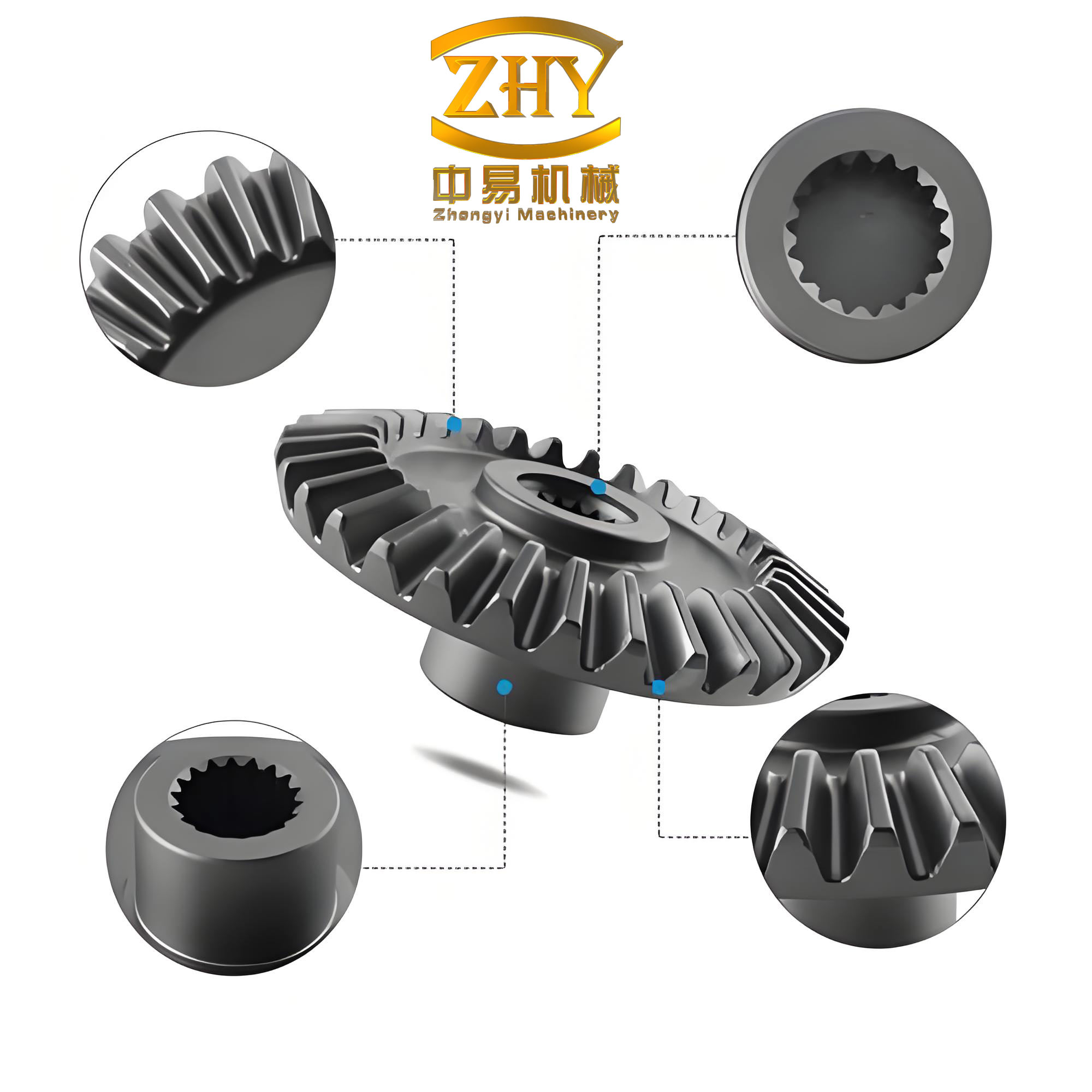
After modeling the components, they were assembled in CATIA by aligning the gear’s bore with the spindle’s shaft and applying appropriate constraints to simulate the press-fit connection commonly used in such assemblies. The straight bevel gear was positioned to mesh with other gears in the gearbox, but for modal analysis, we focused solely on the spindle and straight bevel gear subassembly to isolate its dynamic behavior. This simplified approach allows for a clearer understanding of how the straight bevel gear influences the overall vibration modes without the complexity of full gearbox interactions.
The assembly model was then exported to ANSYS Workbench in a compatible format, such as STEP or IGES, to prepare for finite element analysis. During this process, we verified that all geometric details were preserved, including fillets, chamfers, and keyways, as these features can affect stress concentrations and modal responses. The accuracy of the geometric model is paramount, as any discrepancies could lead to erroneous results in the subsequent analysis stages. By ensuring a high-fidelity model, we lay the groundwork for reliable modal analysis of the straight bevel gear and spindle assembly.
Finite Element Analysis Setup
In ANSYS Workbench, we configured the finite element model by defining material properties, meshing the geometry, and applying boundary conditions. The material properties were assigned based on standard engineering materials: the spindle was made of 45C steel, and the straight bevel gear was made of 20CrMnTi alloy steel. These materials were chosen for their strength and durability in agricultural applications. The properties are summarized in Table 1.
| Component | Material | Elastic Modulus (Pa) | Poisson’s Ratio | Density (kg/m³) |
|---|---|---|---|---|
| Spindle | 45C Steel | 2.10 × 10¹¹ | 0.269 | 7.85 × 10³ |
| Straight Bevel Gear | 20CrMnTi | 2.07 × 10¹¹ | 0.25 | 7.80 × 10³ |
These values were input into ANSYS Workbench to ensure that the finite element model accurately reflects the physical behavior of the materials under vibrational loads. The straight bevel gear’s material, 20CrMnTi, is known for its high fatigue resistance, which is essential for components subjected to cyclic loading in rotary tillers.
Next, we proceeded with meshing, which discretizes the geometry into finite elements for numerical solution. Due to the complex shape of the straight bevel gear, especially its tooth surfaces, we used an automatic meshing algorithm with refinement controls. The spindle was meshed with an element size of 8 mm, while the straight bevel gear had a finer mesh of 5 mm to capture stress concentrations and modal deformations accurately. The meshing resulted in 52,894 elements and 81,002 nodes, as detailed in Table 2.
| Component | Element Size (mm) | Number of Elements | Number of Nodes |
|---|---|---|---|
| Spindle | 8 | Approx. 30,000 | Approx. 50,000 |
| Straight Bevel Gear | 5 | Approx. 22,894 | Approx. 31,002 |
| Total Assembly | – | 52,894 | 81,002 |
The mesh quality was verified using metrics such as skewness and aspect ratio to ensure numerical stability during solution. For the straight bevel gear, the teeth regions required special attention to avoid distorted elements that could compromise accuracy. We employed tetrahedral elements for their adaptability to complex geometries, while the spindle predominantly used hexahedral elements where possible for computational efficiency.
Boundary conditions were applied to simulate the assembly’s operational constraints. The connection between the spindle and straight bevel gear was defined as a bonded contact, meaning no relative motion is allowed at the interface. This assumption is valid for press-fit or keyed connections commonly used in such assemblies. Additionally, displacement constraints were applied to the spindle’s splined end to restrict translational degrees of freedom in the X, Y, and Z directions, representing the fixation in the gearbox. To model bearing supports, we simplified them as elastic supports with radial stiffness, as bearings primarily provide radial constraint without significant angular stiffness. This simplification is common in modal analysis to reduce complexity while maintaining accuracy. The equation for the bearing support can be expressed as:
$$ F = k \cdot x $$
where F is the reaction force, k is the equivalent stiffness, and x is the displacement. In this case, we assumed a stiffness value based on standard bearing specifications for agricultural machinery.
Modal Analysis and Results
With the finite element model fully set up, we performed modal analysis to extract the natural frequencies and mode shapes. The analysis solved the eigenvalue problem for the first six modes, as these are typically the most significant for dynamic response in mechanical systems. The results are presented in Table 3, showing the natural frequencies in Hertz.
| Mode | Natural Frequency (Hz) |
|---|---|
| 1 | 88.967 |
| 2 | 89.125 |
| 3 | 460.4 |
| 4 | 1231.0 |
| 5 | 1231.4 |
| 6 | 1951.1 |
From Table 3, we observe that modes 1 and 2 have nearly identical frequencies, indicating a repeated root due to symmetry in the assembly. Similarly, modes 4 and 5 are close, suggesting another repeated root. This is common in axisymmetric or nearly symmetric structures where modes occur in pairs with orthogonal shapes. The mode shapes were visualized to understand the deformation patterns, particularly focusing on the straight bevel gear’s role in the vibrations.
For mode 1, the dominant deformation involves bending of the spindle along the Y-axis, with the straight bevel gear exhibiting slight tilting. Mode 2 shows similar bending but along the X-axis, confirming the orthogonal relationship. In mode 3, the assembly experiences torsional deformation, primarily localized at the straight bevel gear teeth, which could lead to wear under operational loads. Modes 4 and 5 involve combined bending and torsion, with maximum deformation occurring at the spindle’s smaller diameter sections, highlighting potential weak points. Mode 6 displays higher-order torsional effects, with significant deformation in the straight bevel gear region.
The mode shapes can be mathematically described using the modal transformation, where the displacement vector {x} is expressed as a linear combination of mode shapes:
$$ \{x\} = \sum_{i=1}^{n} \{\Phi_i\} q_i(t) $$
where q_i(t) is the modal coordinate for the i-th mode. This decomposition helps in understanding how each mode contributes to the overall dynamic response. For the straight bevel gear assembly, the lower modes (1-3) are critical as they are more likely to be excited by typical operational frequencies, such as those from engine vibrations or soil interactions in rotary tillers.
To further analyze the results, we computed the critical speeds corresponding to the natural frequencies. For instance, the first natural frequency of 89 Hz translates to a critical rotational speed of approximately 5,340 RPM (since n = f × 60). Given that the spindle’s operational speed in rotary tillers is typically below 2,000 RPM, the assembly is safe from resonance at fundamental modes. However, higher modes might be excited under transient conditions, necessitating careful design of the straight bevel gear and spindle interface.
Discussion on Straight Bevel Gear Influence
The straight bevel gear is a pivotal element in this assembly, as its geometry and material directly affect the modal characteristics. The gear’s teeth act as stress concentrators, leading to localized deformations in modes 3 and 6. We can model the tooth stiffness using a simplified approach, considering the gear as a series of cantilever beams. The natural frequency for a cantilever beam is given by:
$$ f = \frac{1}{2\pi} \sqrt{\frac{k}{m}} $$
where k is the stiffness and m is the mass. For a straight bevel gear tooth, the equivalent stiffness can be derived from gear geometry parameters such as module, pressure angle, and number of teeth. In this analysis, the straight bevel gear’s design parameters included a module of 5 mm, a pressure angle of 20 degrees, and 20 teeth, which influence the mesh stiffness and, consequently, the assembly’s dynamic response.
Moreover, the material damping of the straight bevel gear, though not explicitly included in this undamped analysis, plays a role in real-world vibrations. For steel materials, damping ratios are typically low (around 0.001-0.01), meaning that resonant amplitudes could be high if excited. Therefore, in future work, incorporating damping into the model would provide a more comprehensive analysis. The straight bevel gear’s interaction with other gears in the full gearbox could also introduce additional constraints, but this subassembly analysis serves as a foundational step.
To quantify the straight bevel gear’s impact, we compared the modal results with a simplified model where the gear was replaced by a rigid mass. The natural frequencies shifted significantly, emphasizing the importance of accurately modeling the straight bevel gear’s flexibility. This underscores the need for detailed finite element models in designing reliable agricultural machinery components.
Conclusion
This study successfully conducted a modal analysis of the spindle and straight bevel gear assembly using finite element methods in ANSYS Workbench. The first six natural frequencies and mode shapes were determined, revealing that the assembly’s lowest critical speed is well above the operational range, ensuring safety from resonance. The straight bevel gear was identified as a key influencer of vibrational behavior, particularly in torsional and bending modes. The results provide valuable data for optimizing the design of rotary tiller gearboxes, such as selecting appropriate materials or modifying geometry to shift natural frequencies away from excitation sources.
Future work could extend this analysis to include harmonic response or transient dynamics, considering actual loading conditions from soil tillage. Additionally, experimental validation through vibration testing would enhance the model’s accuracy. Overall, this modal analysis serves as a theoretical basis for improving the durability and performance of straight bevel gear assemblies in agricultural machinery, contributing to more efficient and reliable farming equipment.