
This study investigates the dynamic characteristics of Gleason spiral bevel gears under free and contact conditions through finite element analysis. The modal parameters and stress distribution patterns reveal critical insights for optimizing gear design in high-precision grinding applications.
1. Dynamic Equation and Contact Modal Theory
The fundamental dynamics of spiral bevel gear systems can be expressed through the n-degree-of-freedom equation:
$$ M\ddot{x} + C\dot{x} + Kx = F(t) $$
For contact modal analysis considering prestress effects, the modified characteristic equation becomes:
$$ (K + S) + \omega_{0i}^2M\phi_i = 0 $$
Where $S$ represents the stress stiffness matrix derived from static contact analysis.
2. Design Parameters of Gleason Spiral Bevel Gear
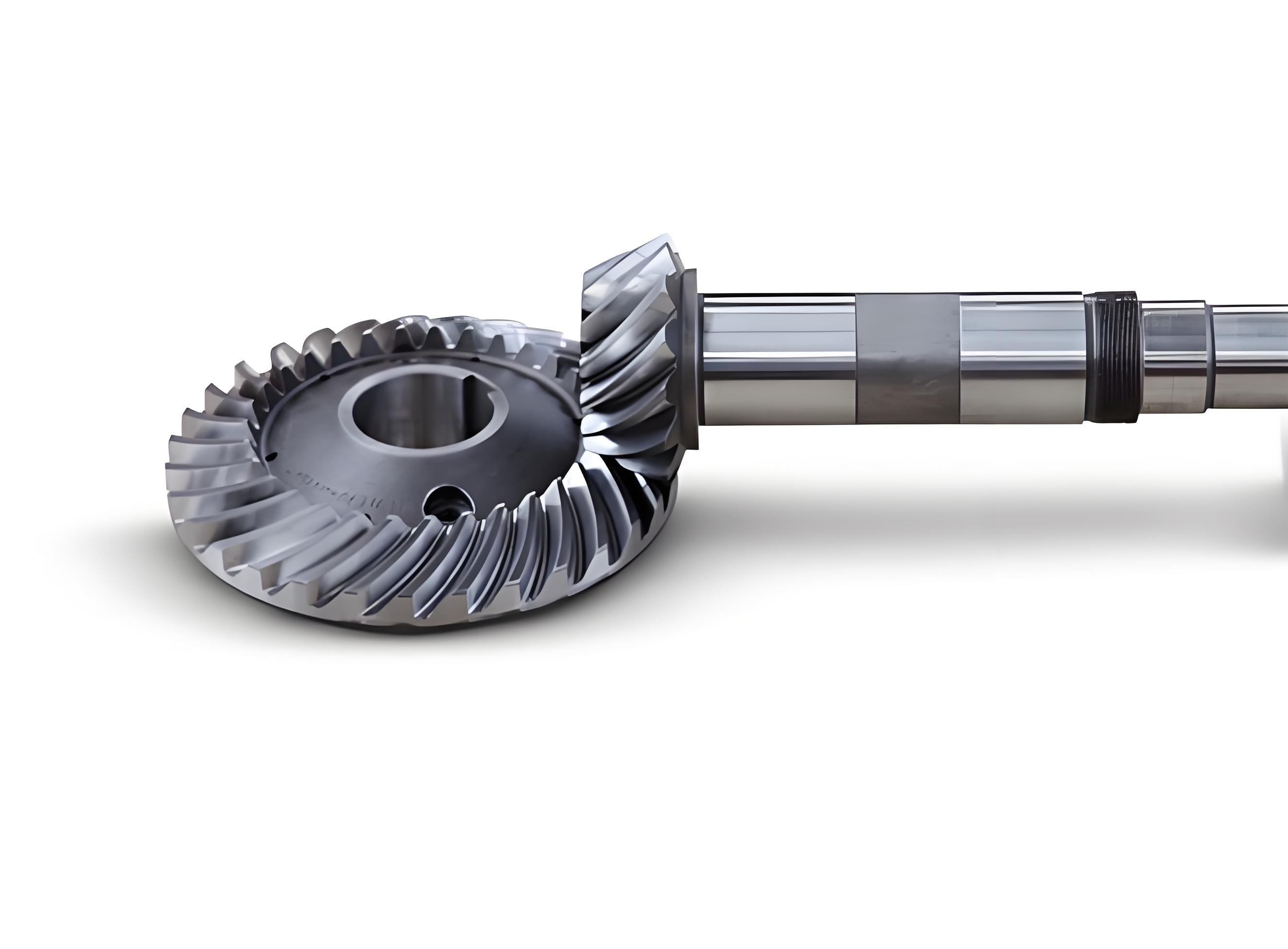
Key design parameters for the analyzed spiral bevel gear pair:
| Parameter | Value |
|---|---|
| Module | 5 mm |
| Pressure Angle | 20° |
| Spiral Angle | 35° |
| Number of Teeth (Pinion/Gear) | 21/42 |
| Material | 20CrMnTi |
3. Finite Element Modeling
The contact characteristics of spiral bevel gears were analyzed using nonlinear finite element methods with the following settings:
$$ \varepsilon_r = \sqrt{\varepsilon_\alpha^2 + \varepsilon_\beta^2} $$
| Mesh Parameter | Value |
|---|---|
| Element Type | SOLID185 |
| Contact Algorithm | Augmented Lagrangian |
| Friction Coefficient | 0.06 |
| Average Element Size | 2 mm |
4. Modal Characteristics Comparison
The first 10 natural frequencies under free and contact conditions:
| Mode | Free (Hz) | Contact (Hz) | Frequency Shift |
|---|---|---|---|
| 1 | 711.47 | 1,389.2 | +95.3% |
| 2 | 3,115.2 | 4,368.3 | +40.2% |
| 3 | 4,373.8 | 4,707.0 | +7.6% |
| 4 | 4,708.9 | 5,040.9 | +7.1% |
| 5 | 5,056.1 | 5,051.1 | -0.1% |
The dynamic transmission error (DTE) for spiral bevel gears can be expressed as:
$$ \Delta \phi = \frac{T}{k_m} + \sum_{i=1}^n \frac{F_i}{k_i} $$
Where $k_m$ represents mesh stiffness and $k_i$ the supporting stiffness components.
5. Stress Distribution Patterns
Maximum contact stress occurs at the root fillet region during initial engagement:
$$ \sigma_{Hmax} = 311.37\ \text{MPa} $$
The stress distribution follows the relationship:
$$ \sigma_c = \sqrt{\frac{F_n}{\pi b}\left(\frac{1}{\rho_1} + \frac{1}{\rho_2}\right)} $$
6. Vibration Mode Characteristics
Dominant vibration modes of spiral bevel gears include:
- Torsional vibration about gear axis
- Radial bending deformation
- Axial mode coupled with teeth deflection
- Complex helical deformation patterns
7. Resonance Avoidance Strategy
The critical speed range for spiral bevel gears in grinding applications:
$$ N_{critical} = \frac{60f_n}{Z(1 \pm \varepsilon)} $$
Where $f_n$ represents natural frequency and $\varepsilon$ the contact ratio.
8. Fatigue Life Prediction
The modified Miner’s rule for spiral bevel gear life estimation:
$$ \sum_{i=1}^k \frac{n_i}{N_{fi}} = 1 $$
Where $n_i$ is the number of cycles at stress level $\sigma_i$, and $N_{fi}$ the corresponding fatigue life.
Conclusion
This analysis demonstrates that contact conditions increase spiral bevel gear stiffness by 7-95%, significantly affecting modal characteristics. The maximum stress concentration at the root fillet region (311.37 MPa) dictates the need for optimized tooth profile modifications. These findings provide critical guidance for designing high-performance spiral bevel gear systems in precision grinding applications.