
The pursuit of higher efficiency, greater load capacity, and smoother, quieter operation in power transmission systems has consistently driven innovation in gear design. Among the various gear types, spiral bevel gears stand out for their exceptional performance in transmitting power between intersecting shafts, typically at a 90-degree angle. Their curved, oblique teeth allow for gradual engagement and multiple tooth contact, leading to superior performance compared to their straight-bevel counterparts. These advantages have cemented the role of spiral bevel gears as critical components in demanding applications across the aerospace, automotive, marine, and heavy machinery industries. However, the dynamic behavior of these gears, particularly under high-speed and heavy-load conditions, remains a paramount concern for designers. Vibrations induced by internal and external excitations can lead to noise, accelerated wear, and even catastrophic failure through resonance if the excitation frequencies coincide with the system’s natural frequencies. Therefore, a thorough understanding of the modal characteristics—the inherent vibration frequencies and shapes—of a spiral bevel gear assembly is indispensable for reliable design.
This article delves into the specialized domain of modal analysis for a novel variant: the logarithmically crowned spiral bevel gear. Traditional spiral bevel gears often employ a circular arc or other curves as their tooth line. A significant development is the application of the logarithmic spiral as the tooth trace. The defining property of a logarithmic spiral is that its angle relative to the radial line (the spiral angle) remains constant at every point along the curve. When applied to spiral bevel gears, this translates to a constant spiral angle along the entire face width of the tooth. This “constant spiral angle meshing” principle theoretically offers more uniform load distribution and smoother transmission dynamics by mitigating the varying meshing conditions present in conventional designs where the spiral angle changes along the tooth. This characteristic makes logarithmic spiral bevel gears particularly promising for modern high-performance applications. To accurately assess their dynamic response, this analysis focuses not on individual gears in isolation, but on the complete gear pair assembly under simulated operational conditions, employing a prestressed modal analysis methodology via the Finite Element Method (FEM).
Theoretical Foundation of Modal Analysis
The dynamic behavior of any elastic structure, including a gear system, is governed by the fundamental equations of motion. For a discretized finite element model, the equation is expressed in matrix form as:
$$ [M]\{\ddot{x}\} + [C]\{\dot{x}\} + [K]\{x\} = \{F(t)\} $$
Where:
$[M]$ is the global mass matrix,
$[C]$ is the global damping matrix,
$[K]$ is the global stiffness matrix,
$\{x\}$ is the nodal displacement vector,
$\{\dot{x}\}$ and $\{\ddot{x}\}$ are its first and second time derivatives (velocity and acceleration), respectively,
$\{F(t)\}$ is the time-varying external load vector.
Modal analysis specifically deals with the inherent, free-vibration characteristics of the structure, absent of external forcing and, in its basic form, damping. Setting $\{F(t)\} = 0$ and neglecting damping ($[C]=0$) yields the undamped free-vibration equation:
$$ [M]\{\ddot{x}\} + [K]\{x\} = 0 $$
Assuming a harmonic solution of the form $\{x\} = \{\phi\}_i \sin(\omega_i t)$, where $\{\phi\}_i$ is the mode shape vector and $\omega_i$ is the natural circular frequency for the $i$-th mode, leads to the classic eigenvalue problem:
$$ ([K] – \omega_i^2 [M]) \{\phi\}_i = 0 $$
Solving this eigenvalue problem yields the system’s natural frequencies $f_i$ (where $f_i = \omega_i / 2\pi$) and their corresponding mode shapes $\{\phi\}_i$. Each mode represents a specific pattern of deformation in which all points of the structure move sinusoidally in phase at that particular frequency.
The analysis of a spiral bevel gear assembly, however, introduces complexity. In operation, the gears are in contact, and a static torque or rotational speed is applied, creating a state of prestress. Furthermore, the stiffness matrix $[K]$ is not constant but changes with the gear rotation as the number of tooth pairs in contact alternates between one and two (or more). This is a nonlinear, contact-dependent problem. A robust engineering approach to handle this for modal analysis is the concept of “prestressed modal analysis.” The procedure involves two key steps:
- Static Prestress Analysis: First, a nonlinear static analysis is performed to simulate the operational state. This involves applying the rotational speed (inducing centrifugal forces) and torque, and establishing the contact conditions between the gear teeth. The solution provides the static stress and strain state of the assembly.
- Linear Modal Analysis on the Prestressed State: The stiffness matrix $[K]$ from the *final, loaded state* of the static analysis is then “frozen” and used as the base stiffness for a subsequent linear eigenvalue analysis. This $[K]$ now implicitly includes the stress-stiffening (or sometimes softening) effects and the contact configuration from the static step.
To bound the dynamic behavior, it is insightful to analyze the system in two critical, yet static, contact configurations representing extremes in mesh stiffness:
- Single-Tooth-Pair Engagement: The load is applied such that only one pair of teeth is primarily in contact. This represents the minimum mesh stiffness ($K_{min}$) condition in the cycle.
- Double-Tooth-Pair Engagement: The load is applied such that two pairs of teeth share the load. This represents the maximum mesh stiffness ($K_{max}$) condition.
The natural frequencies for the operating gear pair will oscillate between the values obtained from these two prestressed states: $\omega_i(K_{min}) \lesssim \omega_i(operational) \lesssim \omega_i(K_{max})$. This range provides crucial design guidance for avoiding resonance.
Finite Element Modeling of the Spiral Bevel Gear Assembly
An accurate finite element model is the cornerstone of reliable analysis. For this study, a logarithmic spiral bevel gear pair was modeled with the following primary geometric parameters, which are summarized in the table below:
| Parameter | Pinion (Driver) | Gear (Driven) |
|---|---|---|
| Number of Teeth (Z) | 15 | 28 |
| Module at Large End (m) [mm] | 6 | |
| Spiral Angle (β) | 39° 52′ (Constant, logarithmic) | |
| Pressure Angle (α) | 20° | |
| Transmission Ratio | 1.87 | |
The material assigned to both gears is alloy steel, with standard properties: Young’s Modulus $E = 2.06 \times 10^{11}$ Pa, Poisson’s Ratio $\mu = 0.3$, and Density $\rho = 7800$ kg/m³.
The complex three-dimensional geometry of the logarithmic spiral bevel gears was created using advanced CAD software (e.g., Pro/ENGINEER) and subsequently imported into the ANSYS finite element environment via a robust data exchange interface. The volume of the assembled gear pair was meshed using SOLID187 elements. This element type is a 10-node tetrahedral structural solid well-suited for modeling irregular meshes of complex geometries and for accurate deformation and stress analysis. A convergence study ensured mesh quality, resulting in a model with approximately 144,629 nodes and 92,969 elements. The fidelity of this mesh is sufficient to capture the detailed geometry of the tooth surfaces and the resulting deformation patterns during vibration.
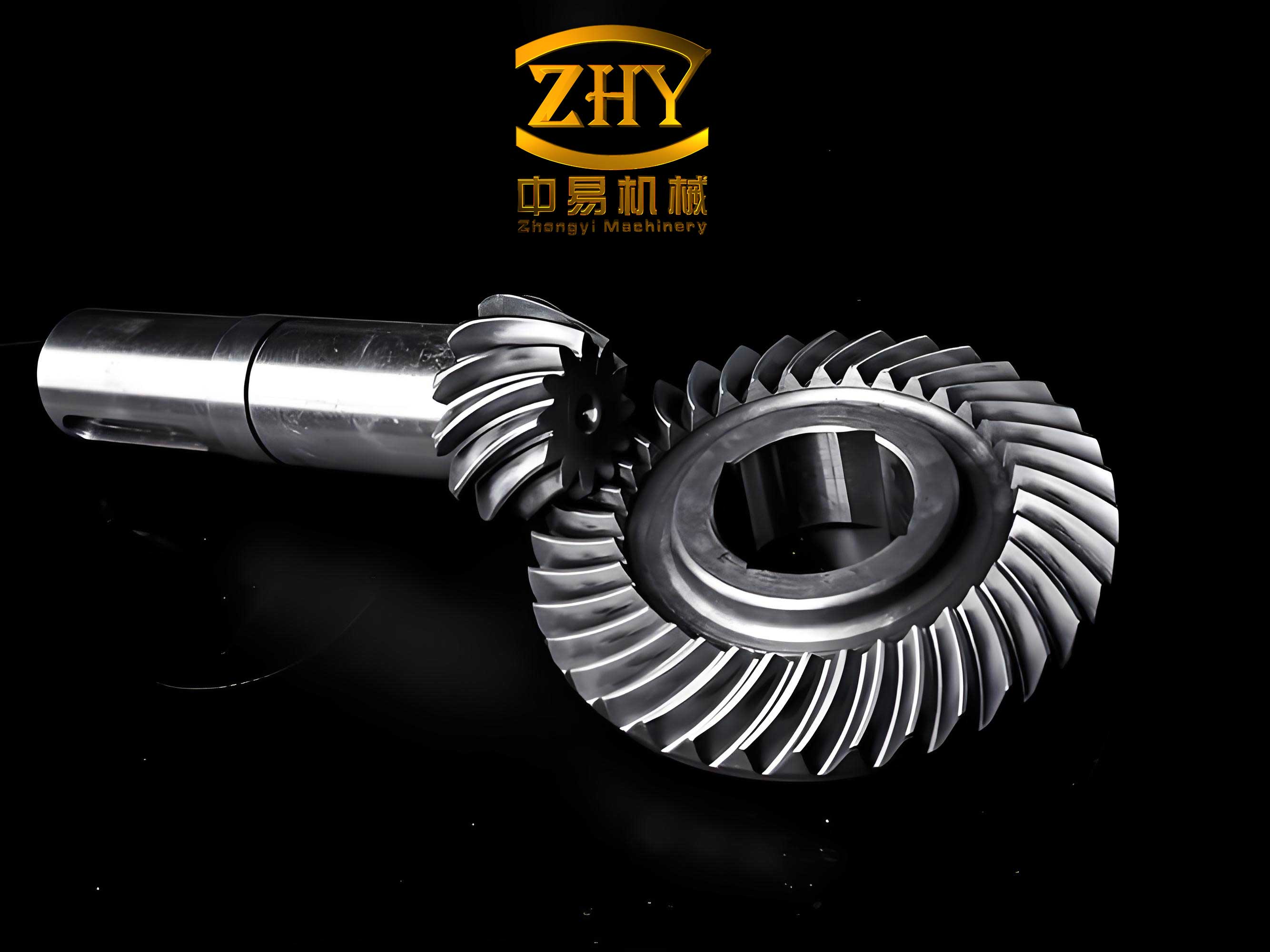
Analysis Procedure and Boundary Conditions
The modal extraction was performed following the prestressed analysis methodology outlined earlier, for both the single-tooth-pair and double-tooth-pair engagement scenarios. The general procedure is as follows:
- Static Prestress Step:
- The driven gear’s inner hub surface is assigned a fixed support condition (all degrees of freedom constrained).
- The driving pinion’s inner hub surface is constrained in the radial and axial translational directions, but left free to rotate. This simulates its connection to a shaft.
- A rotational velocity of 2000 rpm is applied to the pinion to simulate operational speed and induce centrifugal prestress.
- For the single-tooth-pair case, contact forces are adjusted (e.g., by applying a nominal torque at a specific angular position) to ensure load is concentrated on one tooth pair. For the double-tooth-pair case, the position/torque is adjusted to load two adjacent tooth pairs.
- A nonlinear static analysis is run to solve for the stressed state under these conditions.
- Modal Analysis Step:
- The prestressed state from the previous static solution is activated.
- The same boundary conditions (fixed gear, constrained pinion hub) are retained.
- The Block Lanczos eigenvalue extraction method is selected within ANSYS. This method is highly efficient for large models and is robust in extracting a specific number of modes within a desired frequency range.
- The first ten (10) modes are extracted. Lower-order modes are typically most significant as they are more easily excited and contain the majority of the system’s vibrational energy.
Results and Discussion
The results of the finite element modal analysis for the two critical engagement states are presented in the table below. The first mode for both cases is a rigid-body mode with a frequency near zero (theoretical zero, but numerically a very small value), which is typical for systems not fully constrained in all rigid-body motions. The subsequent modes are flexible modes of the gear assembly.
| Mode Order | Natural Frequency – Single-Tooth-Pair (Hz) | Natural Frequency – Double-Tooth-Pair (Hz) |
|---|---|---|
| 1 | ~0.0 | ~0.0 |
| 2 | 2449.2 | 2735.8 |
| 3 | 6150.1 | 6375.2 |
| 4 | 10427.0 | 12535.0 |
| 5 | 11022.8 | 13680.0 |
| 6 | 11023.0 | 13705.0 |
| 7 | 11300.0 | 14010.0 |
| 8 | 21672.0 | 23170.0 |
| 9 | 21673.0 | 23400.0 |
| 10 | 23967.7 | 26105.0 |
The key observation from these results is the consistent and significant increase in natural frequency for every flexible mode when moving from the single-tooth-pair to the double-tooth-pair engagement condition. For instance, the second natural frequency increases from 2449.2 Hz to 2735.8 Hz, a rise of approximately 286.6 Hz or 11.7%. This trend is observed across all higher modes, with percentage increases varying but remaining substantial. This phenomenon directly validates the theoretical premise: the mesh stiffness $K$ is higher during double-tooth engagement ($K_{max}$). Since natural frequency is proportional to the square root of stiffness ($\omega \propto \sqrt{K/m}$), an increase in $K$ leads directly to an increase in $\omega$ and thus $f$.
This finding has profound practical implications. It defines a frequency range for each vibrational mode of the operating spiral bevel gear assembly. For example, the second-mode frequency will not be a single value but will vary cyclically within the approximate band of 2450 Hz to 2735 Hz during each mesh cycle. Therefore, to avoid resonance, external excitations (such as those from engine orders, shaft misalignment, or variable loading) with frequencies within these identified bands must be carefully avoided or mitigated through design. The constant-spiral-angle design of these logarithmic spiral bevel gears aims to make this stiffness transition smoother, but the fundamental cyclic variation persists.
An examination of the mode shapes (not depicted here but described in the source study) provides further insight. The lower-order modes (e.g., 2nd and 3rd) often involve global bending or torsional deformation of the gear blanks and webs. As the mode order increases, the shapes become more localized, involving complex combinations of tooth bending, rim deformation, and web distortion. The fact that modes 5 & 6 and 8 & 9 appear in closely spaced pairs in the single-tooth case (11022.8/11023.0 Hz and 21672/21673 Hz) suggests the presence of degenerate or very similar mode shapes, possibly oriented in different planes due to the symmetry of the gear structure. The splitting of these frequencies in the double-tooth case indicates how the asymmetric contact condition breaks this near-symmetry.
Engineering Significance and Conclusion
The modal analysis of a spiral bevel gear assembly, particularly using the prestressed methodology for a novel logarithmic design, provides invaluable data for the engineer. This approach is far superior to analyzing gears in isolation, as it captures the dynamic interaction between the meshing pair and the critical influence of operational stress states. The primary outcomes and their significance are:
- Identification of Critical Frequency Ranges: The analysis quantitatively defines the lower and upper bounds of natural frequencies for the first ten modes of the logarithmic spiral bevel gear assembly. This is the most direct output for resonance avoidance. Designers can compare these ranges with potential excitation frequencies in the drivetrain (e.g., motor speeds, propeller shaft frequencies) and modify system parameters accordingly.
- Validation of Stiffness Modulation Effect: The clear frequency shift between single and double contact states experimentally confirms, via simulation, the significant cyclic stiffness variation inherent in gear meshing. This underscores the importance of considering the gear pair as a time-varying system in advanced dynamic response (e.g., dynamic transmission error) or noise, vibration, and harshness (NVH) studies.
- Foundation for Advanced Dynamics: The extracted mode shapes and frequencies serve as essential input for more sophisticated forced-response analyses, such as harmonic or transient dynamic simulations. They can also be used in system-level multi-body dynamics models where the gear mesh is represented by a spring-damper element with stiffness defined by these results.
- Design Optimization Guidance: The modal analysis highlights which parts of the gear structure (rim, web, tooth) are most active in specific vibration modes. This information can guide topology optimization or parametric design changes. For instance, if a troublesome frequency is linked to web bending, increasing web thickness or adding strategic ribs could be evaluated in subsequent analyses to shift the frequency out of a critical range.
In conclusion, the prestressed modal analysis of a logarithmic spiral bevel gear assembly using finite element software like ANSYS represents a powerful and necessary step in the modern design process for high-performance power transmission components. By moving beyond linear, unloaded analyses of single gears, this method delivers a realistic picture of the assembly’s dynamic characteristics under simulated operating conditions. For the promising class of constant-spiral-angle logarithmic spiral bevel gears, understanding these modal properties is crucial for harnessing their theoretical advantages in terms of smoothness and efficiency, while ensuring structural integrity and reliability by proactively designing systems that avoid destructive resonant conditions. The results form a critical dataset that bridges geometric design with dynamic performance, laying a solid foundation for subsequent noise, vibration, durability, and system integration studies.