
In this comprehensive study, I focus on the modal analysis of straight bevel gear transmission systems using advanced finite element methods. Straight bevel gears are critical components in various mechanical systems, such as automotive differentials and aerospace mechanisms, due to their ability to transmit power between intersecting shafts efficiently. However, these gears are prone to vibrations under dynamic loads, which can lead to resonance if the excitation frequencies align with their natural frequencies. Resonance can cause excessive noise, accelerated wear, and even catastrophic failure. Therefore, understanding the dynamic characteristics, including natural frequencies and mode shapes, is essential for optimizing the design and ensuring reliable operation. This analysis employs Pro/ENGINEER for precise three-dimensional modeling and ANSYS for finite element simulation, providing a detailed insight into the vibrational behavior of straight bevel gears. The primary objective is to compute the first ten natural frequencies and their corresponding mode shapes, which serve as a theoretical foundation for avoiding resonance in practical applications. Throughout this work, I emphasize the importance of accurate modeling and simulation techniques to enhance the performance and durability of straight bevel gear systems.
The modeling phase begins with the creation of a detailed three-dimensional solid model of the straight bevel gear. I utilize Pro/ENGINEER software, employing a bottom-up approach that involves point-line-surface-body methodology to ensure geometric accuracy. This method starts by defining key points on the gear tooth profile, connecting them to form curves, generating surfaces from these curves, and finally extruding these surfaces into a solid volume. The tooth profile is particularly challenging to model due to its complex spatial geometry, but this step is crucial as it directly influences the finite element analysis results. The straight bevel gear model includes parameters such as module, number of teeth, pressure angle, and shaft angle, which are defined based on standard gear design principles. Once the solid model is complete, I export it in IGES format for seamless integration into ANSYS. This format preserves the geometric integrity, allowing for accurate finite element mesh generation. The use of Pro/ENGINEER ensures that the model captures all necessary details, including fillets and chamfers, which are vital for stress concentration and dynamic analysis. This meticulous modeling process lays the groundwork for reliable modal analysis, as any inaccuracies in the geometry could lead to erroneous results in the subsequent simulations.
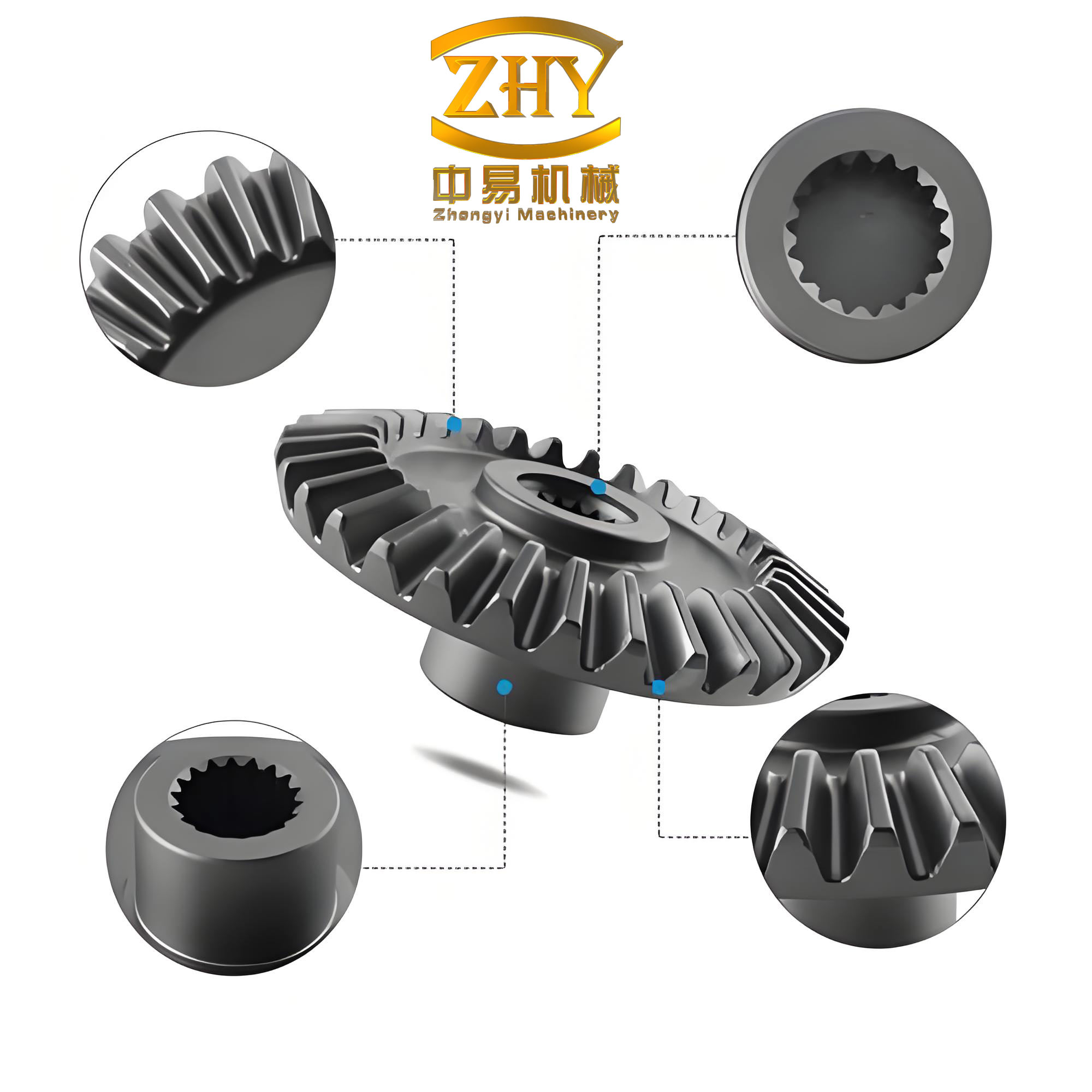
After importing the IGES file into ANSYS, I proceed to generate the finite element model. The straight bevel gear is discretized using SOLID185 elements, which are eight-node brick elements suitable for three-dimensional modeling of solid structures. These elements support large deflections and strain, making them ideal for dynamic analyses like modal studies. I apply a free meshing technique with a default refinement level of 6, which automatically divides the geometry into smaller elements while maintaining mesh quality. This results in a model comprising 120,734 nodes and 639,010 elements, ensuring sufficient resolution to capture the gear’s dynamic behavior. The material properties are assigned based on 20CrMnTi steel, a common alloy used in gear applications due to its high strength and toughness. The key material parameters include an elastic modulus of 207 GPa, a Poisson’s ratio of 0.25, and a density of 7.8 × 10³ kg/m³. These properties are input into ANSYS to define the linear elastic behavior of the straight bevel gear during modal analysis. The boundary conditions are applied by constraining the degrees of freedom on the inner surface of the gear bore and the keyway faces, simulating a fixed support condition that represents typical mounting in real-world applications. This setup ensures that the analysis focuses solely on the gear’s inherent vibrational characteristics without external influences.
The theoretical foundation of modal analysis is rooted in structural dynamics and finite element methods. In general, the equation of motion for a damped structural system can be expressed as:
$$ [M]\{\ddot{x}\} + [C]\{\dot{x}\} + [K]\{x\} = \{F(t)\} $$
where [M] is the mass matrix, [C] is the damping matrix, [K] is the stiffness matrix, {x} is the displacement vector, {ẋ} is the velocity vector, {ẍ} is the acceleration vector, and {F(t)} is the external force vector. For modal analysis, which aims to determine the natural frequencies and mode shapes, I neglect the damping and external forces because they have minimal impact on the inherent dynamic properties. Thus, the equation simplifies to the undamped free vibration form:
$$ [M]\{\ddot{x}\} + [K]\{x\} = \{0\} $$
Assuming harmonic motion, the solution takes the form {x} = {φ} sin(ωt), where {φ} is the mode shape vector and ω is the natural frequency in radians per second. Substituting this into the equation of motion leads to the eigenvalue problem:
$$ ([K] – \omega^2 [M])\{\phi\} = \{0\} $$
This equation can be expanded into a polynomial in ω², and solving it yields the natural frequencies of the system. The corresponding mode shapes {φ} are obtained by substituting each natural frequency back into the equation. In the context of the straight bevel gear, this theoretical framework allows me to compute the frequencies at which the gear will naturally vibrate, and the mode shapes illustrate the deformation patterns associated with each frequency. The Block Lanczos method in ANSYS is employed to extract the eigenvalues and eigenvectors, which efficiently handles large-scale models like the straight bevel gear. This method iteratively solves the eigenvalue problem, providing accurate results for the first ten modes, which are critical for assessing potential resonance issues in operational conditions.
For the finite element modal analysis, I configure ANSYS to extract the first ten natural frequencies and mode shapes of the straight bevel gear. The analysis settings include using the Block Lanczos solver with mode extraction set to 10, and expansion passes are enabled to compute the mode shapes. The solution process involves applying the constraints as described earlier and solving the eigenvalue problem. The results are summarized in Table 1, which lists the natural frequencies in Hertz for each mode. Additionally, I use post-processing tools to visualize the mode shapes, which help in understanding the vibrational behavior of the straight bevel gear under dynamic conditions.
| Mode Number | Frequency (Hz) | Description of Mode Shape |
|---|---|---|
| 1 | 14.494 | Torsional vibration about the axis in the XOZ plane |
| 2 | 19.891 | Swinging vibration along the axis |
| 3 | 20.120 | Swinging vibration along the axis (similar to mode 2 but with phase difference) |
| 4 | 23.068 | Bending vibration on one side of the gear in the XOY plane |
| 5 | 28.079 | Complex spatial bending vibration |
| 6 | 28.282 | Complex spatial bending vibration (similar to mode 5) |
| 7 | 30.877 | Symmetric torsional vibration in the XOZ plane about the axis |
| 8 | 31.828 | Symmetric torsional vibration in the XOZ plane about the axis (similar to mode 7) |
| 9 | 44.394 | Highly complex bending vibration with three peaks and valleys along the Y-axis |
| 10 | 44.427 | Highly complex bending vibration with three peaks and valleys along the Y-axis (similar to mode 9) |
The mode shapes reveal distinct vibrational patterns for the straight bevel gear. The first mode exhibits torsional vibration, where the gear rotates about its axis in the XOZ plane. Modes 2 and 3 are very close in frequency and represent swinging motions along the axis, indicating a tendency for lateral vibrations. Mode 4 shows bending on one side, which could lead to stress concentrations in that region. Modes 5 and 6 involve complex spatial bending, with deformations that include multiple directions. Modes 7 and 8 are symmetric torsional vibrations, differing from the first mode in that they involve simultaneous outward or inward rotations of teeth relative to a central tooth. Modes 9 and 10 display even more intricate bending patterns, characterized by three peaks and three valleys when viewed along the Y-axis, contrasting with the two-peak pattern in modes 5 and 6. These mode shapes are critical for identifying potential weak points in the straight bevel gear design and for ensuring that operational frequencies do not coincide with these natural frequencies to prevent resonance.
To further elucidate the vibrational characteristics, I derive the relationship between natural frequency and gear parameters. For a simplified model, the natural frequency f_n for a given mode can be approximated using the formula:
$$ f_n = \frac{1}{2\pi} \sqrt{\frac{K_{eq}}{M_{eq}}} $$
where K_{eq} is the equivalent stiffness and M_{eq} is the equivalent mass for that mode. In the case of a straight bevel gear, the stiffness is influenced by factors such as tooth geometry, material properties, and support conditions. For instance, the bending stiffness of a gear tooth can be estimated using the formula for a cantilever beam:
$$ K_b = \frac{3EI}{L^3} $$
where E is the elastic modulus, I is the area moment of inertia, and L is the effective length of the tooth. The mass M_{eq} can be derived from the volume and density of the gear. However, due to the complex shape of the straight bevel gear, these simplified formulas are insufficient, and finite element analysis provides a more accurate approach. The natural frequencies obtained from ANSYS reflect the combined effects of all these parameters, and the close values in certain modes (e.g., modes 2 and 3, or modes 9 and 10) are due to the symmetrical structure of the gear, leading to degenerate modes where frequencies are identical but mode shapes differ in phase.
In addition to the frequency analysis, I examine the modal participation factors and effective mass to assess the contribution of each mode to the overall dynamic response. The modal participation factor Γ for a mode i is given by:
$$ \Gamma_i = \{\phi_i\}^T [M] \{r\} $$
where {r} is the influence vector representing the direction of excitation. The effective mass M_eff,i for mode i is calculated as:
$$ M_{eff,i} = \frac{(\{\phi_i\}^T [M] \{r\})^2}{\{\phi_i\}^T [M] \{\phi_i\}} $$
These parameters help in understanding which modes are more significant under specific loading conditions. For the straight bevel gear, modes with higher effective masses are more likely to be excited by external forces, such as those from mating gears or operational loads. This information is vital for designing suppression strategies, such as adding dampers or modifying the gear geometry to shift natural frequencies away from excitation ranges.
The results of this modal analysis have practical implications for the design and application of straight bevel gears. By knowing the natural frequencies, engineers can avoid operating the gear at or near these frequencies to prevent resonance. For example, if a straight bevel gear is used in a system with a dominant excitation frequency of 30 Hz, modes 7 and 8 at around 31 Hz could be problematic, and design modifications might be necessary. Such modifications could include changing the material to one with a different density or stiffness, altering the tooth profile to adjust the mass distribution, or incorporating ribs to increase stiffness. Furthermore, the mode shapes indicate areas prone to high deformation, such as the tooth roots in bending modes, which should be reinforced in critical applications. This analysis also serves as a baseline for future structural optimization, where topology optimization or parametric studies can be performed to enhance the dynamic performance of the straight bevel gear.
In conclusion, this study successfully demonstrates the modal analysis of a straight bevel gear using Pro/ENGINEER and ANSYS. The detailed modeling and finite element simulation provide accurate natural frequencies and mode shapes, which are essential for avoiding resonance and improving reliability. The first ten modes cover a range from 14.494 Hz to 44.427 Hz, with distinct vibrational patterns including torsional, swinging, and bending modes. The close frequencies in some modes highlight the symmetrical nature of the gear, and the complex mode shapes reveal potential areas for design improvement. This work underscores the importance of dynamic analysis in the design process of straight bevel gears and offers a foundation for further investigations, such as harmonic response analysis or transient dynamics, to fully understand the gear behavior under operational conditions. By leveraging these insights, manufacturers can develop more robust and efficient straight bevel gear systems for various industrial applications.