
In modern mechanical engineering, the straight bevel gear plays a critical role in transmitting power between intersecting shafts, particularly in aerospace, automotive, and marine applications. The straight bevel gear design offers advantages such as smooth operation, high efficiency, and robust load-bearing capacity. However, under dynamic loading conditions, these gears are susceptible to vibrations that can lead to resonance if the excitation frequencies align with their natural frequencies. This paper presents a comprehensive modal analysis of a straight bevel gear using finite element methods to determine its dynamic characteristics and prevent resonance-related failures.
The analysis begins with the creation of a detailed three-dimensional solid model of the straight bevel gear. Utilizing a bottom-up approach—progressing from points to lines, surfaces, and finally volumes—ensures high accuracy in capturing the complex geometry of the gear teeth. This method is essential for generating a precise finite element model, as the tooth profile directly influences the stress distribution and vibrational behavior. The model is constructed using advanced CAD software, focusing on the intricate curvature of the straight bevel gear teeth to facilitate subsequent finite element analysis.
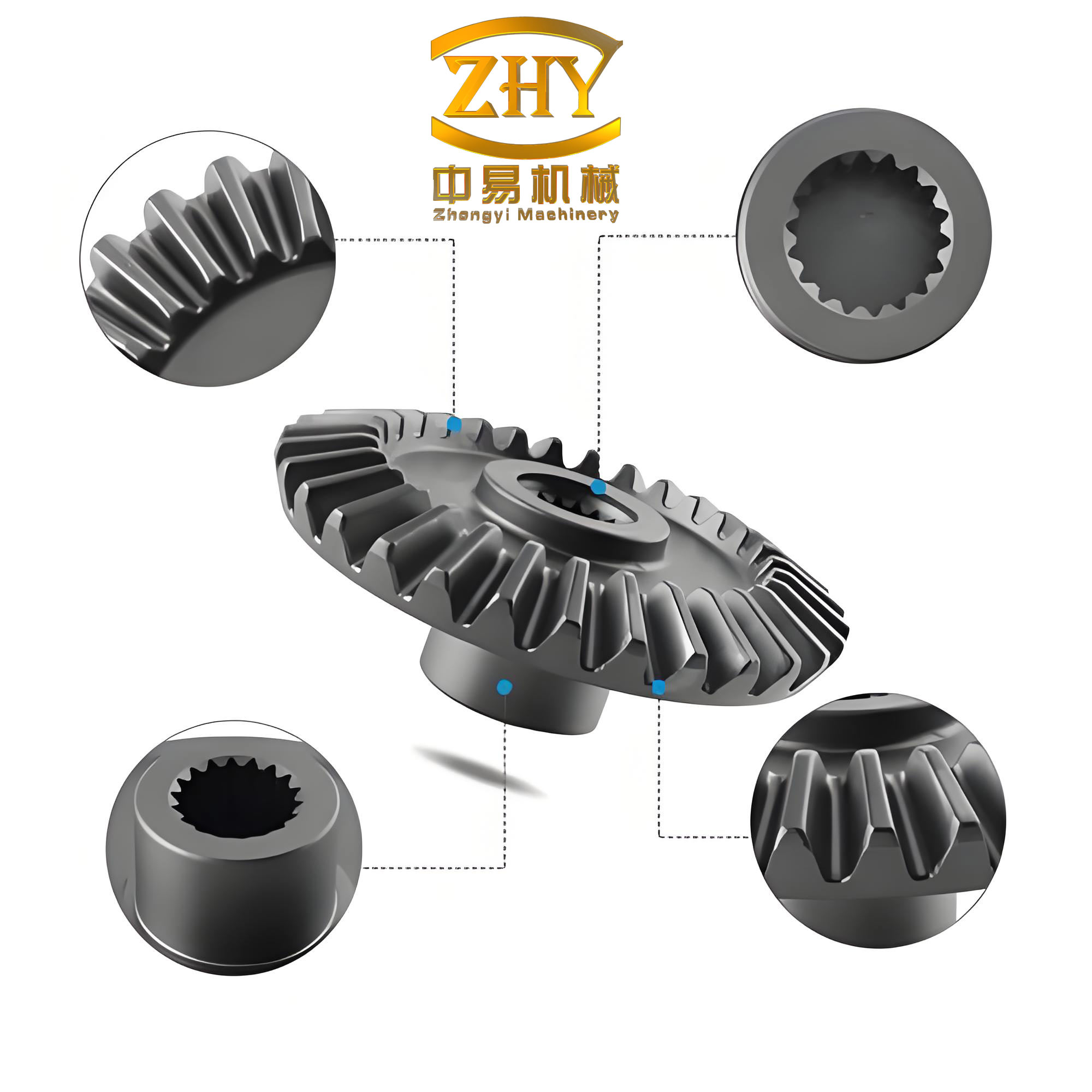
Once the solid model is complete, it is imported into ANSYS for finite element discretization. The mesh generation employs SOLID185 elements, which are well-suited for structural analyses due to their quadratic displacement behavior. The default mesh refinement level of 6 is applied to achieve a balance between computational efficiency and accuracy. The resulting finite element model comprises 120,734 nodes and 639,010 elements, ensuring a detailed representation of the straight bevel gear’s geometry. The material properties assigned to the model are based on 20CrMnTi steel, which is commonly used in high-strength applications. The elastic modulus is set to 207 GPa, Poisson’s ratio to 0.25, and density to 7.8 × 10³ kg/m³. These parameters are crucial for accurately simulating the dynamic response of the straight bevel gear under vibrational loads.
The theoretical foundation for modal analysis stems from structural dynamics and finite element theory. The general equation of motion for a damped system is given by:
$$ [M]\{\ddot{x}\} + [C]\{\dot{x}\} + [K]\{x\} = \{F(t)\} $$
where [M] is the mass matrix, [C] is the damping matrix, [K] is the stiffness matrix, {x} is the displacement vector, and {F(t)} is the external force vector. For modal analysis, the external forces and damping are neglected to focus on the inherent vibrational characteristics. Thus, the equation simplifies to the undamped free vibration form:
$$ [M]\{\ddot{x}\} + [K]\{x\} = \{0\} $$
Assuming harmonic motion, the displacement can be expressed as {x} = {φ} sin(ωt), leading to the eigenvalue problem:
$$ ([K] – ω²[M])\{φ\} = \{0\} $$
Here, ω represents the natural frequency, and {φ} is the corresponding mode shape vector. Solving this eigenvalue equation yields the natural frequencies and mode shapes of the straight bevel gear, which are essential for identifying potential resonance conditions.
To perform the modal analysis, boundary conditions are applied to constrain the degrees of freedom on the inner bore surface and keyway of the straight bevel gear. The Block Lanczos method is utilized to extract the first ten natural frequencies and their associated mode shapes. This method is efficient for large-scale eigenvalue problems and ensures accurate results for the straight bevel gear’s vibrational modes. The extracted frequencies are summarized in Table 1, which highlights the close values due to structural symmetries in the straight bevel gear.
| Mode Order | Frequency (Hz) |
|---|---|
| 1 | 14.494 |
| 2 | 19.891 |
| 3 | 20.120 |
| 4 | 23.068 |
| 5 | 28.079 |
| 6 | 28.282 |
| 7 | 30.877 |
| 8 | 31.828 |
| 9 | 44.394 |
| 10 | 44.427 |
The mode shapes corresponding to these frequencies reveal distinct vibrational patterns. The first mode involves torsional vibration around the axis in the XOZ plane, indicating a low-frequency oscillation that could be excited by steady-state operational loads. Modes 2 and 3, with closely spaced frequencies, exhibit swinging motions along the axis, suggesting susceptibility to axial misalignments in the straight bevel gear assembly. Mode 4 demonstrates bending vibration on one side of the gear, which may arise from asymmetric loading conditions. Modes 5 and 6 show complex spatial bending, characterized by multiple peaks and troughs in the displacement field. These modes highlight the three-dimensional flexibility of the straight bevel gear teeth under dynamic excitation.
Modes 7 and 8 represent symmetric torsional vibrations in the XOZ plane, where adjacent teeth oscillate in opposite directions relative to a central tooth. This pattern differs from the first mode by its symmetric nature, which could be induced by harmonic forces in the transmission system. Modes 9 and 10 exhibit even more intricate bending vibrations, with three peaks and three troughs observed along the Y-axis direction. The increased complexity in these higher-order modes underscores the importance of considering multiple vibrational forms in the design of a straight bevel gear to avoid resonant failures.
The relationship between natural frequency and mode shape can be further analyzed using the Rayleigh quotient, which provides an approximate value for the fundamental frequency:
$$ ω² = \frac{\{φ\}^T[K]\{φ\}}{\{φ\}^T[M]\{φ\}} $$
This equation emphasizes that the natural frequency depends on both the stiffness and mass distribution of the straight bevel gear. For instance, modes with higher frequencies, such as modes 9 and 10, correspond to greater strain energy concentrations in the tooth roots, indicating areas prone to fatigue damage. To quantify the modal participation, the effective mass for each mode can be calculated using:
$$ M_{eff} = \frac{(\{φ\}^T[M]\{1\})²}{\{φ\}^T[M]\{φ\}} $$
where {1} is a unit vector. This parameter helps in assessing the contribution of each mode to the overall dynamic response of the straight bevel gear.
In practical applications, the natural frequencies of the straight bevel gear must be separated from the excitation frequencies commonly encountered in operational environments. For example, in automotive differentials, the meshing frequency of the straight bevel gear pair can be calculated as:
$$ f_m = \frac{N \times RPM}{60} $$
where N is the number of teeth and RPM is the rotational speed. If f_m coincides with any natural frequency listed in Table 1, resonance may occur, leading to amplified vibrations and potential failure. Therefore, designers should ensure a sufficient margin between operational frequencies and the natural frequencies of the straight bevel gear.
The finite element model’s accuracy is validated by comparing the results with analytical solutions for simplified gear models. For a circular plate with similar boundary conditions, the fundamental frequency can be approximated by:
$$ f_1 = \frac{λ²}{2πR²} \sqrt{\frac{D}{ρh}} $$
where R is the radius, D is the flexural rigidity, ρ is density, h is thickness, and λ is a constant dependent on boundary conditions. Although this analogy is not exact for a straight bevel gear, it provides a benchmark for verifying the finite element results.
Moreover, the mode shapes obtained from the analysis can be used to identify critical regions on the straight bevel gear that require reinforcement or design modifications. For instance, modes involving bending vibrations suggest that increasing the tooth thickness or using fillet radii could enhance stiffness and shift natural frequencies away from excitation ranges. Additionally, the use of composite materials or damping treatments could be explored to reduce vibrational amplitudes in the straight bevel gear.
To further illustrate the vibrational behavior, the modal assurance criterion (MAC) can be applied to check the orthogonality of mode shapes:
$$ MAC_{ij} = \frac{|\{φ_i\}^T\{φ_j\}|²}{(\{φ_i\}^T\{φ_i\})(\{φ_j\}^T\{φ_j\})} $$
Values close to zero indicate distinct mode shapes, which is essential for accurate modal analysis of the straight bevel gear.
In conclusion, this modal analysis provides valuable insights into the dynamic characteristics of the straight bevel gear. The first ten natural frequencies and their corresponding mode shapes have been identified, revealing patterns such as torsional vibrations, bending oscillations, and complex spatial deformations. These findings are crucial for designing straight bevel gears that avoid resonance and ensure reliable performance in high-load applications. Future work could involve experimental validation through impact testing or operational modal analysis to corroborate the finite element results. Additionally, parametric studies on gear geometry and material properties could optimize the straight bevel gear design for enhanced vibrational resistance.
The methodology presented here—combining precise modeling with advanced finite element techniques—serves as a foundation for further structural dynamics studies. By repeatedly emphasizing the importance of the straight bevel gear in mechanical systems, this analysis underscores the need for thorough vibrational assessments in the design process. Ultimately, understanding the modal properties of the straight bevel gear contributes to longer service life, reduced noise, and improved efficiency in power transmission systems.