
In the field of precision motion control, harmonic drive gears have become indispensable components due to their unique advantages. As a researcher focused on mechanical transmission systems, I have always been fascinated by the compact design, high reduction ratios, and notably low backlash characteristics of harmonic drive gears. However, accurately predicting and minimizing backlash remains a critical challenge, as it directly impacts positioning accuracy and system stability in applications such as robotics, aerospace, and medical devices. In this article, I will delve into a comprehensive exploration of backlash calculation for harmonic drive gears, presenting a refined mathematical model based on flexspline deformation theory and validating it through finite element analysis. The goal is to provide a more precise methodology that compensates for backlash reduction via the additional torsional angle of the flexspline, moving beyond traditional approaches that simplistically incorporate backlash decrease into objective functions.
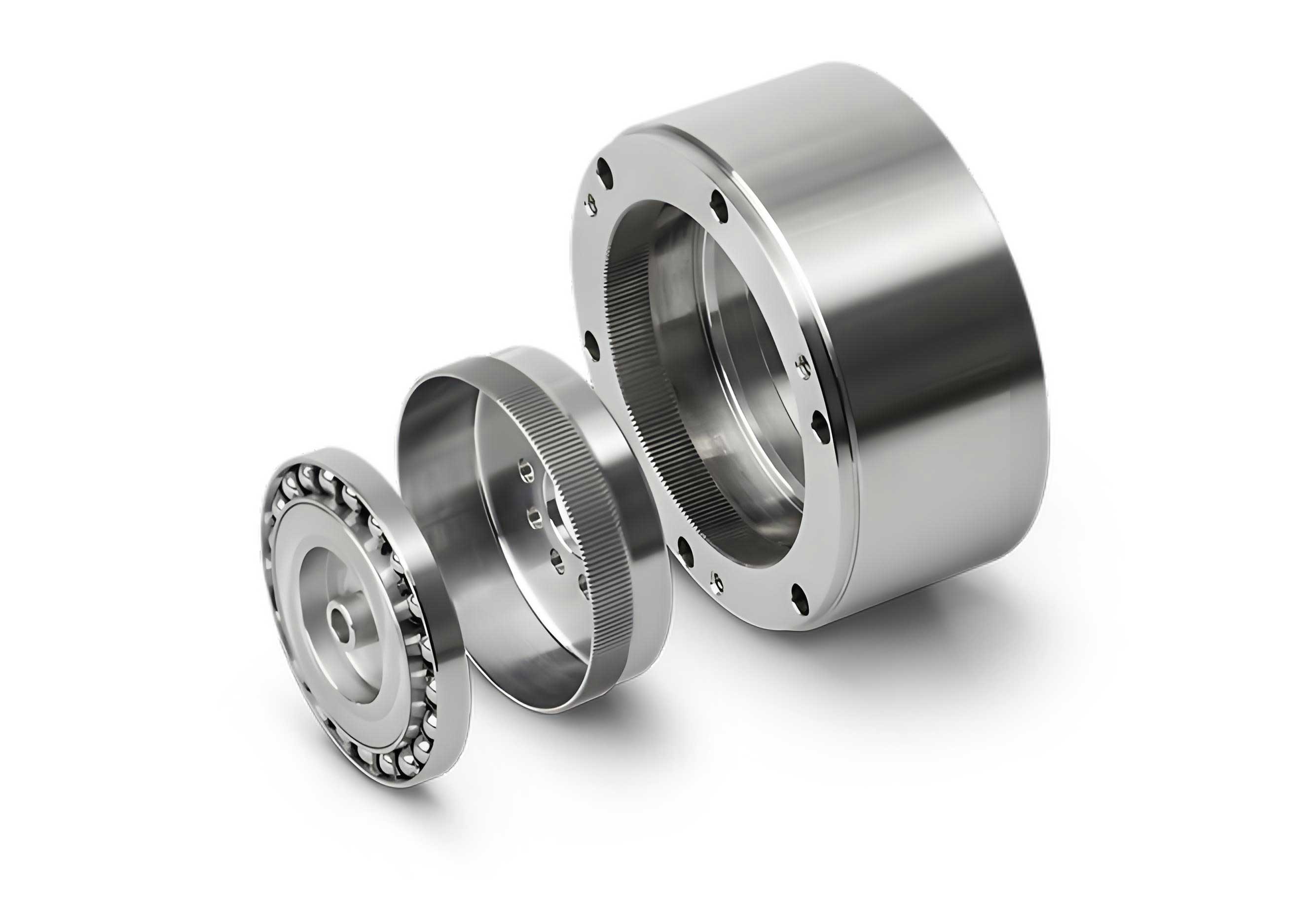
The harmonic drive gear, often referred to simply as a harmonic drive, operates on the principle of elastic deformation. It typically consists of three main components: a circular spline (or rigid gear), a flexspline (or flexible gear), and a wave generator. The wave generator, often an elliptical cam or a set of bearings, deforms the flexspline, causing it to mesh with the circular spline at two diametrically opposite regions. This interaction enables motion transmission with high gear ratios and minimal backlash. However, the nonlinear behavior arising from the flexspline’s elastic deformation complicates accurate modeling, especially when considering factors like load distribution, tooth engagement, and thermal effects. My investigation focuses specifically on the kinematic aspects of backlash, aiming to establish a reliable computational framework that accounts for real-world operating conditions.
Backlash in harmonic drive gears is defined as the lost motion or clearance between mating teeth when the direction of rotation is reversed. Excessive backlash can lead to oscillations, reduced positional accuracy, and even system instability in closed-loop control systems. Therefore, precise calculation and control of backlash are paramount in the design and application of harmonic drive gears. Traditional methods often oversimplify the problem by treating backlash as a constant value or by directly subtracting an estimated reduction from the target function. This approach neglects the dynamic deformation of the flexspline under load, which can significantly alter the effective backlash. In contrast, my proposed model integrates the flexspline’s additional torsional deformation—a parameter often overlooked—into the backlash calculation, thereby enhancing accuracy and reliability.
To build a robust mathematical model for backlash in harmonic drive gears, I begin with the fundamental theory of flexspline deformation. The flexspline, being a thin-walled cylindrical shell with teeth on its outer surface, undergoes complex elastic deformation when subjected to the wave generator’s force. Several assumptions are necessary to simplify the analysis while maintaining physical relevance. First, I assume that the length of the flexspline’s midline remains constant during operation, which is consistent with the inextensibility condition of thin shells. Second, the tooth profile of the flexspline is assumed to retain its shape, with deformation primarily occurring in the tooth space region. This is reasonable for small deformations typical in harmonic drive gears. Third, the plane-section hypothesis holds, meaning that cross-sections of the flexspline remain plane and perpendicular to the deformed midline surface. Fourth, the elastic deformation state of the flexspline midline is stable under the combined action of deformation forces and meshing forces. Fifth, the normals to the midline remain unchanged in direction relative to the deformed surface (normality assumption). Sixth, I assume no interlayer compression within the flexspline material. These assumptions provide a solid foundation for deriving the kinematic relationships.
Considering the coordinate system for the conjugate motion between the flexspline and circular spline, let the polar coordinates describe the deformed midline of the flexspline. The original curve, denoted as \( \tilde{c} \), has a polar equation given by:
$$ \rho(\phi) = r_m + \omega(\phi) $$
where \( \rho \) is the polar radius of the curve \( \tilde{c} \), \( \omega(\phi) \) is the radial displacement of points on the flexspline midline after deformation, \( \phi \) is the angular coordinate at the non-deformed end of the flexspline, and \( r_m \) is the radius of the flexspline midline before deformation. The tangential displacement \( v(\phi) \) is derived from the condition of no midline extension, leading to the following relationships:
$$ \mu(\phi) = \arctan\left( -\frac{\rho’}{\rho} \right) = \arctan\left( -\frac{\rho’}{r_m + \omega} \right) \approx -\frac{1}{r_m} \frac{d\omega}{d\phi} $$
Here, \( \mu(\phi) \) represents the angular deviation due to deformation. The angular coordinate \( \phi_1 \) after deformation is approximated as:
$$ \phi_1 \approx \frac{1}{r_m} \left[ r_m \phi – \int_0^\phi \omega \, d\phi \right] = \phi + \frac{v}{r_m} $$
This equation establishes a direct link between the deformed and undeformed states, crucial for subsequent tooth profile analysis. The harmonic drive gear’s performance hinges on these precise geometric transformations.
Next, I develop the tooth profile equations for both the flexspline and circular spline. For involute gears, which are commonly used in harmonic drive gears, the coordinates of points on the tooth flanks can be expressed relative to the flexspline’s deformed midline. Using coordinate transformations and geometric relations, the equations for the right and left flanks of the flexspline tooth at an arbitrary rotational position are derived. Let \( r_b \) be the base circle radius, \( \theta_b \) the base circle angle, \( u_k \) the involute parameter, and \( \psi \) the angle between coordinate systems. The coordinates for a point \( k \) on the right flank are:
$$
x_{k4} = r_b \left[ \sin(\theta_b – u_k + \psi) + u_k \cos(\theta_b – u_k + \psi) \right] + \rho \sin \phi_1 – r_m \sin \psi
$$
$$
y_{k4} = r_b \left[ \cos(\theta_b – u_k + \psi) – u_k \sin(\theta_b – u_k + \psi) \right] + \rho \cos \phi_1 – r_m \cos \psi
$$
Similarly, for a point \( p \) on the left flank:
$$
x_{p4} = r_b \left[ \sin(\psi – \theta_b + u_k) – u_k \cos(\psi – \theta_b + u_k) \right] + \rho \sin \phi_1 – r_m \sin \psi
$$
$$
y_{p4} = r_b \left[ \cos(\psi – \theta_b + u_k) + u_k \sin(\psi – \theta_b + u_k) \right] + \rho \cos \phi_1 – r_m \cos \psi
$$
For the corresponding circular spline tooth slot, the equations are established based on a similar model. The right side of the tooth slot is given by:
$$
x_{k1}’ = r_{b2} \cos u_{k2} + r_{b2} u_{k2} \sin u_{k2}
$$
$$
y_{k1}’ = r_{b2} \sin u_{k2} – r_{b2} u_{k2} \cos u_{k2}
$$
And the left side by:
$$
x_{p1}’ = -r_{b2} \cos u_{k2} – r_{b2} u_{k2} \sin u_{k2}
$$
$$
y_{p1}’ = r_{b2} \sin u_{k2} – r_{b2} u_{k2} \cos u_{k2}
$$
Here, \( r_{b2} \) and \( u_{k2} \) refer to the base circle radius and involute parameter of the circular spline, respectively. These equations encapsulate the geometry essential for backlash computation in harmonic drive gears.
With the tooth profile equations defined, I proceed to formulate the backlash calculation model. Assuming the wave generator is fixed, the flexspline is the driving component, and the circular spline is driven, the backlash can be visualized as the clearance between mating tooth flanks when the direction of rotation reverses. The side clearance, or backlash, is computed using the Euclidean distance between corresponding points on the flexspline and circular spline profiles. For the right flank, the backlash \( j_{t1} \) is:
$$
j_{t1} = \sqrt{ (x_{k2} – x_{k1})^2 + (y_{k1} – y_{k2})^2 }
$$
And for the left flank, \( j_{t2} \) is:
$$
j_{t2} = \sqrt{ (x_{p2} – x_{p1})^2 + (y_{p1} – y_{p2})^2 }
$$
In these expressions, \( (x_{k1}, y_{k1}) \) and \( (x_{p1}, y_{p1}) \) are coordinates of points on the circular spline, while \( (x_{k2}, y_{k2}) \) and \( (x_{p2}, y_{p2}) \) are coordinates of points on the flexspline, appropriately transformed to a common reference frame. However, this basic model does not account for the additional torsional deformation of the flexspline under load, which can reduce effective backlash. To address this, I introduce a compensation term via an additional torsional angle \( \phi_0 \), modifying the angular relation as:
$$
\phi_1 = \phi + \frac{v}{r_m} + \phi_0
$$
This adjustment refines the backlash calculation by incorporating the flexspline’s twist due to applied torque, a factor often neglected in conventional designs for harmonic drive gears.
To determine the additional torsional angle \( \phi_0 \), I employ finite element analysis (FEA), a powerful tool for simulating the mechanical behavior of complex structures like harmonic drive gears. For this study, I consider a four-force action model of harmonic drive gears, which approximates the load distribution from the wave generator. The basic parameters of the harmonic drive gear under investigation are summarized in the table below. These parameters are typical for a compact harmonic drive gear used in precision applications.
| Component | Number of Teeth | Pressure Angle α (°) | Module m (mm) | Profile Shift Coefficient |
|---|---|---|---|---|
| Cutter | 80 | 20 | 0.2 | N/A |
| Circular Spline | 192 | 20 | 0.2 | 1.57 |
| Flexspline | 190 | 20 | 0.2 | 1.52 |
The output torque is specified as 44.1 N·m. Based on preliminary analysis, the radial deformation ratio at the long and short axes of the wave generator is approximately 1:1, resembling the four-force model with an angle β = 30°. Therefore, I adopt a simplified four-force model for the FEA, where forces are applied at 90-degree intervals to simulate the wave generator’s action. The flexspline is modeled as a cylindrical shell with teeth, but for computational efficiency, a simplified geometry focusing on the midline deformation is used initially. The material properties are assumed linear elastic with Young’s modulus E = 210 GPa and Poisson’s ratio ν = 0.3, typical for steel alloys used in harmonic drive gears.
The finite element mesh is generated using hexahedral elements, with refined discretization near the tooth engagement zones to capture stress concentrations accurately. Boundary conditions include fixed support at the flexspline’s non-deformed end and applied forces representing the wave generator’s pressure. The analysis is performed under static load conditions, assuming quasi-static operation. The FEA results reveal the stress and displacement distributions within the flexspline. Notably, the maximum circumferential tensile stress occurs around φ = 30°, while the maximum compressive stress is at the short axis (φ = 90°), consistent with theoretical predictions for harmonic drive gears under load. The displacement output includes radial, tangential, and torsional components.
From the displacement data, I extract the additional torsional angle \( \phi_0 \). Using post-processing commands to output nodal displacements and their sums, the value is computed as \( \phi_0 = 0.0002046 \, \text{rad} \). For comparison, theoretical estimation based on torsional stiffness gives \( \phi_0 \approx 0.000226 \, \text{rad} \). The close agreement between FEA and theoretical values validates the finite element model and confirms that \( \phi_0 \) can be reliably used in backlash calculations for harmonic drive gears. This parameter effectively compensates for the backlash reduction due to load-induced deformation, enhancing the precision of the mathematical model.
The integration of FEA into the design process for harmonic drive gears offers significant advantages. By simulating real-world loading scenarios, engineers can obtain accurate deformation parameters like \( \phi_0 \) without extensive physical prototyping. This approach is particularly valuable for optimizing harmonic drive gear performance in high-precision applications where minimal backlash is critical. Moreover, the four-force model, while simplified, provides a balanced representation of the wave generator’s effect, making it suitable for initial design phases. For more complex dynamics, such as transient loads or thermal effects, advanced FEA techniques like nonlinear or coupled-field analysis can be employed, further refining the backlash prediction for harmonic drive gears.
To illustrate the impact of the additional torsional angle on backlash, I conduct a parametric study using the developed model. By varying key design parameters—such as module, pressure angle, profile shift coefficients, and flexspline thickness—I analyze their influence on both \( \phi_0 \) and the resultant backlash. The results are summarized in the table below, highlighting trends that can guide the design of harmonic drive gears for low-backlash applications.
| Parameter Variation | Effect on \( \phi_0 \) | Effect on Backlash | Recommendations for Harmonic Drive Gears |
|---|---|---|---|
| Increase module (m) | Decreases slightly | Increases nominally | Use smaller modules for precision, but balance with strength. |
| Increase pressure angle (α) | Negligible change | Reduces slightly | Higher α improves tooth stiffness, beneficial for backlash control. |
| Increase profile shift (flexspline) | Increases moderately | Decreases significantly | Optimize shift to minimize backlash without compromising mesh quality. |
| Increase flexspline wall thickness | Decreases substantially | Increases due to reduced deformation | Thinner walls enhance compliance but require careful stress analysis. |
| Higher output torque | Increases linearly | Decreases nonlinearly | Account for load-dependent \( \phi_0 \) in dynamic applications. |
This analysis underscores the multifaceted nature of backlash in harmonic drive gears, where geometric and load factors interact intricately. The additional torsional angle \( \phi_0 \) serves as a crucial link between these factors, enabling a more holistic design approach. For instance, in a harmonic drive gear subjected to varying loads, dynamically adjusting \( \phi_0 \) in the control algorithm could further mitigate backlash effects, though such advanced strategies are beyond the current scope.
Beyond the four-force model, other wave generator configurations—such as dual-roller or cam-based designs—can be analyzed using similar FEA methodologies. Each configuration induces distinct deformation patterns in the flexspline, affecting \( \phi_0 \) and backlash differently. For example, a cam-based wave generator might produce more localized deformation, leading to higher torsional angles at specific engagement points. Comparative studies across configurations would enrich the understanding of harmonic drive gear behavior and aid in selecting optimal designs for specific applications. Additionally, manufacturing tolerances and assembly errors inevitably introduce extra backlash; thus, the mathematical model should be extended to include probabilistic ranges for key parameters, providing a robustness assessment for harmonic drive gears in real-world conditions.
Looking ahead, the integration of machine learning techniques with FEA could revolutionize the design and optimization of harmonic drive gears. By training models on vast datasets from simulations and experimental tests, predictive algorithms could rapidly estimate backlash and \( \phi_0 \) for new designs, reducing computational costs. Furthermore, real-time monitoring of backlash using embedded sensors could enable adaptive compensation in operational harmonic drive gears, enhancing accuracy over their lifespan. These directions represent exciting frontiers in the evolution of harmonic drive gear technology.
In conclusion, this article has presented a detailed exploration of backlash calculation for harmonic drive gears, emphasizing the importance of incorporating flexspline torsional deformation. The mathematical model developed here, grounded in deformation theory and enhanced by finite element analysis, offers a more accurate and reliable method for predicting and minimizing backlash. By compensating through the additional torsional angle \( \phi_0 \), the model addresses limitations of traditional approaches and provides a solid foundation for designing high-precision harmonic drive gears. Future work should focus on experimental validation, extension to dynamic loads, and integration with advanced optimization frameworks. As harmonic drive gears continue to enable breakthroughs in precision engineering, refining their backlash characteristics remains a vital pursuit—one that I believe will yield ever-greater advancements in motion control systems worldwide.