
The efficient and reliable transmission of power is a cornerstone of mechanical design, particularly in demanding applications such as aerospace and heavy machinery. Among various gear types, bevel gears are indispensable for transmitting motion and power between intersecting axes. Their unique geometry, especially in the case of spiral bevel gears which offer high contact ratio and smooth operation, makes them the preferred choice for critical systems like the main and tail rotors of helicopters. However, the very complexity that grants bevel gears their advantages also renders them susceptible to specific failure modes, with surface distress like pitting and scuffing being prominent. A significant contributor to these failures is the heat generated from friction during meshing. Since nearly all frictional heat originates from the power loss due to sliding and rolling contact, accurately predicting the friction power loss in bevel gears is paramount for enhancing system reliability, efficiency, and operational life.
Traditional approaches to calculating power loss in bevel gears often fall short in accuracy or practicality. Empirical formulas, while simple, provide only average values and ignore critical dynamic and geometric factors. More precise methods based on Loaded Tooth Contact Analysis (LTCA) and elastohydrodynamic lubrication (EHL) theory are computationally intensive and struggle with the complex spatial geometry of bevel gears, making determination of load distribution and instantaneous parameters difficult. A common simplification involves transforming the bevel gears into equivalent spur or helical gears at the mean point. While this facilitates the use of established formulas, it often fails to account for the actual contact ratio greater than 2, typical for spiral bevel gears, leading to models that inaccurately predict periods of single-tooth contact and related loss profiles. Furthermore, many models discretize the path of contact (line of action) for integration, inadvertently assuming constant angular velocity for the contact point—a condition that contradicts the kinematics of a uniformly rotating gear. This introduces a fundamental error.
To overcome these limitations, this article develops a comprehensive time-domain model for instantaneous sliding friction power loss in bevel gears. The core innovation lies in treating the meshing process as a function of time rather than position along a discretized line. This approach inherently respects the correct kinematic relationship between gear rotation and contact point movement. The model integrates several key aspects: a time-varying load distribution model based on the actual contact ratio, calculation of instantaneous sliding velocities, and determination of a transient friction coefficient based on a mixed EHL regime characterized by the instantaneous lubricant film thickness ratio. This methodology provides a more physically accurate and computationally robust framework for analyzing the thermal loading and efficiency of bevel gear transmissions.
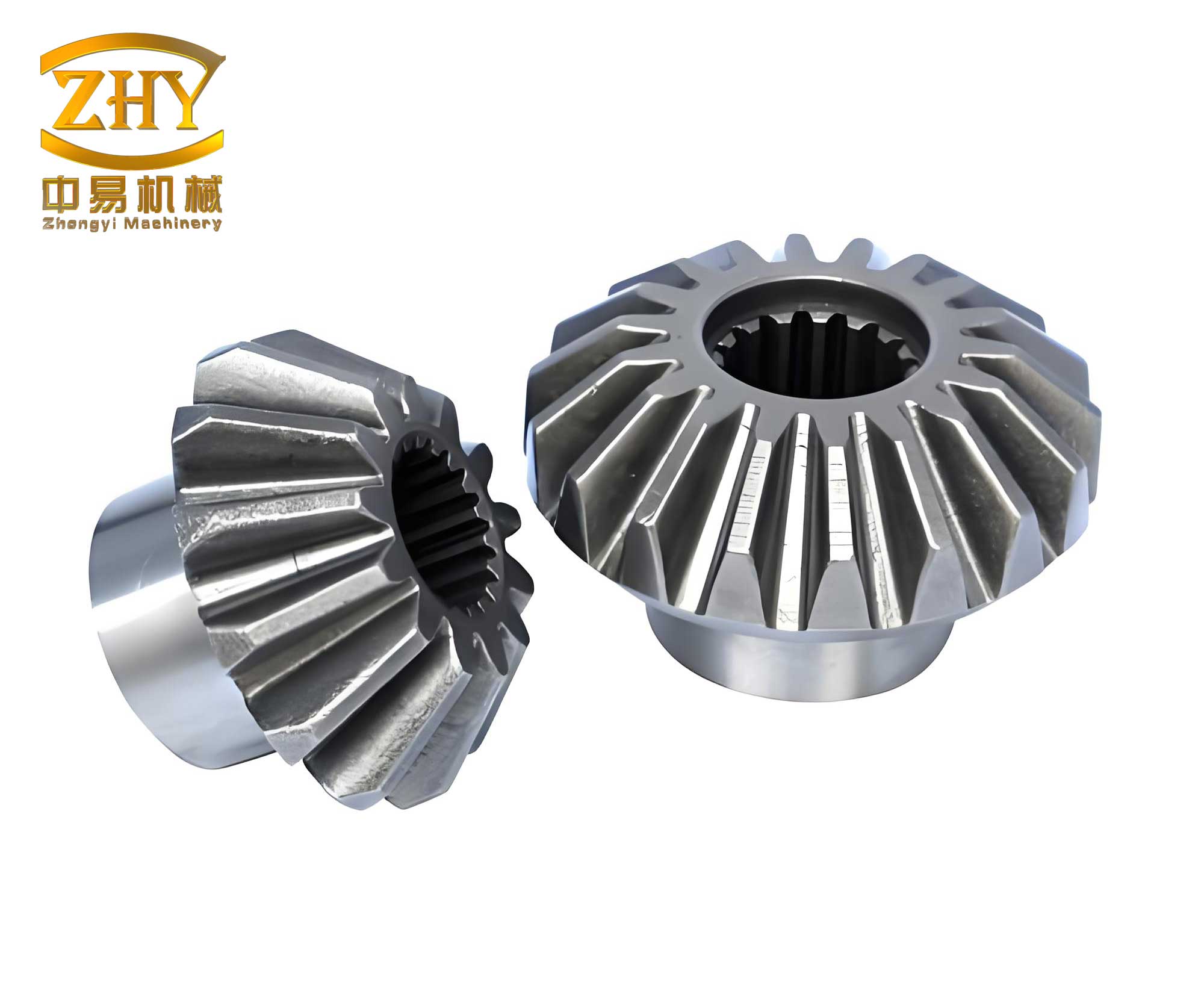
Modeling Fundamentals and Time-Varying Parameters
The three-dimensional meshing of bevel gears presents a significant challenge for direct analysis. A widely adopted and effective technique is the concept of the “equivalent gear” at the mean point. The complexity of bevel gear tooth geometry can be managed by projecting the gear pair onto a plane tangent to the pitch cone at its midpoint. This projection generates two equivalent cylindrical gears—spur gears for straight bevel gears and helical gears for spiral bevel gears. These equivalent gears share the same module, pressure angle, and contact ratio as the original bevel gears at the reference point, allowing well-established theories for cylindrical gears to be applied. The total contact ratio (\(\epsilon\)) for the equivalent gear, and hence for the bevel gears, is the sum of the transverse (\(\epsilon_{\alpha}\)) and overlap (\(\epsilon_{\beta}\)) ratios:
$$ \epsilon = \epsilon_{\alpha} + \epsilon_{\beta} $$
$$ \epsilon_{\alpha} = \frac{z_1 (\tan \alpha_{a1} – \tan \alpha’) + z_2 (\tan \alpha_{a2} – \tan \alpha’)}{2\pi} $$
$$ \epsilon_{\beta} = \frac{b \sin \beta}{\pi m_n} $$
where \(z_1, z_2\) are the tooth numbers, \(\alpha_{a1}, \alpha_{a2}\) the tip pressures angles, \(\alpha’\) the operating pressure angle, \(b\) the face width, \(\beta\) the spiral angle, and \(m_n\) the normal module at the mean point.
The core of the proposed model is the treatment of all influential parameters as functions of time within a meshing cycle. The instantaneous sliding power loss \(P_s(t)\) for a single contact point is given by:
$$ P_s(t) = f(t) \cdot F_n(t) \cdot v_h(t) $$
where \(f(t)\) is the instantaneous friction coefficient, \(F_n(t)\) is the instantaneous normal load at the contact point, and \(v_h(t)\) is the instantaneous sliding velocity. The calculation of each of these time-varying components for bevel gears is detailed in the following sections.
| Time-Varying Parameter | Description | Primary Influences |
|---|---|---|
| Load Distribution \(F_n(t)\) | How the total transmitted load is shared among the multiple pairs of teeth in contact. | Contact ratio, tooth stiffness, contact line length. |
| Sliding Velocity \(v_h(t)\) | The difference in tangential velocities of the two gear surfaces at the contact point. | Gear geometry, rotational speed, instant position on path of contact. |
| Friction Coefficient \(f(t)\) | The ratio of friction force to normal load, dependent on lubrication regime. | Lubricant properties, surface roughness, film thickness, sliding/rolling ratio. |
| Film Thickness Ratio \(\lambda(t)\) | Ratio of EHL film thickness to composite surface roughness, defining lubrication regime. | Load, rolling speed, lubricant viscosity and pressure-viscosity coefficient. |
Calculation of Time-Varying Tooth Load
Determining the load carried by each individual tooth pair is critical. For bevel gears with high contact ratio (\(\epsilon > 2\)), multiple teeth share the load simultaneously. The total normal load \(F_N\) is derived from the input torque \(T_1\) and geometry:
$$ F_N = \frac{T_1}{r_{m1} \cos \alpha_n \cos \beta_b} $$
where \(r_{m1}\) is the mean pitch radius of the pinion, \(\alpha_n\) is the normal pressure angle, and \(\beta_b\) is the base spiral angle.
This total load is distributed across the total length of contact lines \(L_{total}(t)\) present at any instant \(t\). The length of the contact line for a single tooth pair varies throughout its meshing period. For a spiral bevel gear, it typically increases, remains nearly constant, and then decreases. By superimposing the contact line histories of all tooth pairs in engagement (shifted by the mesh period \(T_0 = 2\pi /(\omega_1 z_1)\)), the total contact length \(L_{total}(t)\) over one mesh cycle can be obtained:
$$ L_{total}(t) = \sum_{i=1}^{n+1} L^{(i)}(t) $$
where \(n\) is the integer part of the contact ratio \(\epsilon\). The load per unit length \(p(t)\) is then:
$$ p(t) = \frac{F_N}{L_{total}(t)} $$
Consequently, the instantaneous normal load on the \(i\)-th tooth pair is:
$$ F_n^{(i)}(t) = p(t) \cdot L^{(i)}(t) $$
This formulation creates a dynamic load-sharing model where the load on each tooth pair varies smoothly with time, directly linking the complex contact pattern of bevel gears to the mechanical loading.
Calculation of Instantaneous Sliding Velocity
The sliding velocity arises because the radii of curvature at the contact point are different for the driving and driven bevel gears. Considering the equivalent gear pair and the path of contact, the distances from the contact point \(Q\) to the interference points \(N_1\) and \(N_2\) (akin to the start and end of active profile) define the instantaneous radii of curvature.
$$ \rho_1(t) = r_{b1} \cdot \tan\left( \alpha’ + \frac{s(t)}{r_{b1}} \right) $$
$$ \rho_2(t) = r_{b2} \cdot \tan\left( \alpha’ – \frac{s(t)}{r_{b2}} \right) $$
Here, \(r_{b1}, r_{b2}\) are the base circle radii of the equivalent gears, \(\alpha’\) is the operating pressure angle, and \(s(t)\) is the distance traveled by the contact point along the path of contact from the pitch point, a function of time. The tangential velocities at the contact point on each gear are:
$$ v_1(t) = \omega_1 \rho_1(t) $$
$$ v_2(t) = \omega_2 \rho_2(t) $$
The sliding velocity \(v_h(t)\) and the entraining (rolling) velocity \(v_e(t)\), crucial for lubrication analysis, are then:
$$ v_h(t) = | v_1(t) – v_2(t) | $$
$$ v_e(t) = \frac{v_1(t) + v_2(t)}{2} $$
At the pitch point, \(\rho_1\) and \(\rho_2\) are such that \(v_1 = v_2\), resulting in pure rolling (\(v_h=0\)) and maximum entraining velocity.
Determination of Instantaneous Friction Coefficient
The friction coefficient in gear contacts is highly transient and governed by the lubrication regime. The regime is determined by the film thickness ratio \(\lambda(t)\), defined as the ratio of the minimum elastohydrodynamic (EHL) film thickness \(h_{min}(t)\) to the composite surface roughness \(\sigma\). A widely accepted formula for central film thickness in the elastic-isoviscous regime is used:
$$ h_{min}(t) = 2.65 \frac{(\alpha \eta_0)^{0.54} (v_e(t))^{0.7} R^{0.43}}{(E’)^{0.03} (p(t))^{0.13}} $$
where \(\alpha\) is the pressure-viscosity coefficient, \(\eta_0\) is the dynamic viscosity at ambient pressure, \(R\) is the effective radius of curvature at the contact, \(E’\) is the equivalent elastic modulus, and \(p(t)\) is the load per unit length. The composite roughness \(\sigma = \sqrt{\sigma_1^2 + \sigma_2^2}\). Thus,
$$ \lambda(t) = \frac{h_{min}(t)}{\sigma} $$
The lubrication state is classified as: full-film EHL for \(\lambda \geq 3\), mixed/boundary lubrication for \(\lambda \leq 1\), and partial EHL for \(1 < \lambda < 3\). In mixed lubrication, the total load \(F_n\) is carried partly by the fluid film (\(F_f\)) and partly by asperity contact (\(F_a\)). Based on a micro-contact model, the load-sharing function \(\Phi\) is:
$$ \Phi(\lambda) = \frac{1.21 \lambda^{0.64}}{1 + 0.37 \lambda^{1.26}} $$
$$ F_f(t) = \Phi(\lambda(t)) \cdot F_n(t) $$
$$ F_a(t) = (1 – \Phi(\lambda(t))) \cdot F_n(t) $$
The overall instantaneous friction coefficient \(f(t)\) is then a weighted average of the fluid film friction coefficient \(f_f(t)\) and the boundary friction coefficient \(f_b\) (typically ~0.11):
$$ f(t) = \Phi(\lambda(t)) \cdot f_f(t) + (1 – \Phi(\lambda(t))) \cdot f_b $$
The fluid film friction for line/point contacts can be estimated from EHL theory. A common empirical relation is:
$$ f_f(t) = 0.0607 \cdot \eta_0^{-0.05} \left( \frac{\sigma}{2 R} \right)^{0.25} \cdot \left( \frac{v_e(t) \cdot p(t)}{v_h(t) \cdot R} \right)^{0.2} $$
This formulation ensures that the friction coefficient transitions smoothly between boundary and fluid-dominated regimes, capturing the essential physics of bevel gear lubrication.
Integration for Total Friction Power Loss
With expressions for \(F_n^{(i)}(t)\), \(v_h^{(i)}(t)\), and \(f^{(i)}(t)\) established, the instantaneous sliding power loss for the entire bevel gear pair is the sum of losses from all concurrently engaged tooth contacts \(i\):
$$ P_{s,total}(t) = \sum_{i=1}^{n+1} \left[ f^{(i)}(t) \cdot F_n^{(i)}(t) \cdot v_h^{(i)}(t) \right] $$
To find the average power loss over one complete mesh cycle \(T_{mesh}\), integration in the time domain is performed:
$$ \overline{P}_{s} = \frac{1}{T_{mesh}} \int_{0}^{T_{mesh}} P_{s,total}(t) \, dt $$
This time-based integration method is fundamentally correct for a gear rotating at constant angular velocity, as the relationship between the contact point’s position and time is explicitly accounted for in the kinematic equations, avoiding the principle error associated with discretizing the line of action.
Numerical Example and Analysis
To validate the proposed model, a case study of a high-power spiral bevel gear pair from a helicopter transmission is analyzed. The operating conditions and parameters are listed below.
| Parameter | Symbol | Value |
|---|---|---|
| Pinion Teeth | \(z_1\) | 30 |
| Gear Teeth | \(z_2\) | 80 |
| Normal Module (mean) | \(m_n\) | 3.8 mm |
| Normal Pressure Angle | \(\alpha_n\) | 20° |
| Mean Spiral Angle | \(\beta\) | 30° |
| Face Width | \(b\) | 50 mm |
| Shaft Angle | \(\Sigma\) | 87° |
| Pinion Speed | \(n_1\) | 5000 rpm |
| Input Power | \(P_{in}\) | 1000 kW |
| Surface Roughness (Ra) | \(\sigma_1, \sigma_2\) | 0.25 μm |
| Lubricant Viscosity (50°C) | \(\eta_0\) | 0.048 Pa·s |
| Pressure-Viscosity Coeff. | \(\alpha\) | 2.2e-8 Pa⁻¹ |
First, the geometry is analyzed. The equivalent gear contact ratio is calculated to be \(\epsilon = 3.80\), indicating that either three or four tooth pairs are in contact at any time (3+1 alternating contact). The variation of the total contact line length \(L_{total}(t)\) over a single mesh cycle for the pinion is plotted computationally, showing a continuous, non-constant profile without abrupt drops to zero.
The instantaneous velocities and film thickness ratio are calculated. The sliding velocity \(v_h(t)\) crosses zero at the pitch point, while the entraining velocity \(v_e(t)\) reaches a maximum there. The minimum film thickness \(h_{min}(t)\) and subsequently the ratio \(\lambda(t)\) vary throughout the cycle. For this example, \(\lambda(t)\) ranges between 1.9 and 2.7, confirming the gear pair operates predominantly in the partial/mixed EHL regime under these conditions.
The instantaneous friction coefficient \(f(t)\), calculated using the mixed lubrication model, varies between 0.043 and 0.07. This range aligns well with empirical data for lubricated gear contacts, lending credibility to the model.
Finally, the instantaneous and average sliding friction power loss is computed. The key result is the average sliding power loss \(\overline{P}_{s}\), which is approximately 0.53% of the input power for this pair of bevel gears. This value is consistent with handbook data suggesting mechanical efficiencies of 99.0% to 99.5% for well-lubricated spiral bevel gears, where the remaining 0.5-1.0% loss includes sliding friction, rolling friction, windage, and churning. Comparisons with other published simulation and experimental studies on similar bevel gear units show close agreement, typically within ±0.05% absolute efficiency.
Conclusions
This study has developed and demonstrated a rigorous time-domain methodology for predicting instantaneous sliding friction power loss in bevel gears. The principal outcomes and insights are as follows:
- Elimination of Principle Error: By formulating the power loss integration in the time domain, synchronized with the constant angular velocity of the gear, the model avoids the kinematic inconsistency inherent in methods that discretize the path of contact, thereby providing a more fundamentally sound calculation basis.
- Practical Load Modeling: The time-varying load distribution model, based on the instantaneous total contact line length derived from the actual high contact ratio of spiral bevel gears, offers a practical and accurate solution to the complex problem of determining inter-tooth loads without resorting to extremely computationally intensive full 3D LTCA for every simulation step.
- Dynamic Regime Analysis: The integration of a mixed EHL friction model, driven by the instantaneous film thickness ratio \(\lambda(t)\), captures the transient nature of the lubrication state in bevel gear contacts. The predicted friction coefficients realistically span the range between boundary and fluid-film values.
- Influence of High Contact Ratio: The analysis clearly shows that for high-contact-ratio spiral bevel gears, the instantaneous total friction power loss never falls to zero during the meshing cycle. This contrasts with simplified double/single tooth contact models and has significant implications for thermal modeling, as the heat source is continuous rather than intermittent.
- Design Insight: The model reveals that for a single tooth pair, the peak friction power loss (and thus heat generation) often occurs not at the pitch point (where sliding is zero) but in the region between the start of active profile and the pitch point. This insight can guide targeted lubrication cooling strategies and tooth profile optimization for bevel gears.
In summary, the proposed time-varying parameter model provides a comprehensive, accurate, and computationally efficient framework for analyzing the tribological performance of bevel gears. It serves as a powerful tool for designers aiming to enhance the efficiency, durability, and thermal management of power transmission systems utilizing these critical components.