
In this study, we focus on the parametric modeling and dynamic simulation of double circular arc spiral bevel gears, which represent an advanced type of gear transmission. Spiral bevel gears are widely used in various mechanical systems due to their ability to transmit power between intersecting shafts with high efficiency and smooth operation. The double circular arc design enhances these properties by featuring convex and concave tooth profiles in both the tooth line and height directions, leading to increased load capacity, longer service life, and higher transmission efficiency compared to conventional spiral bevel gears. However, the complex tooth geometry poses challenges in design and manufacturing. With advancements in computer technology, parametric modeling and simulation have become essential tools for optimizing such gears. This article details our approach using UG software for three-dimensional parametric modeling and ADAMS for dynamics simulation, providing insights into the gear’s performance under dynamic conditions.
The double circular arc spiral bevel gear is based on the standard GB 12759-91 for double circular arc cylindrical gears, with the normal module at the midpoint of the tooth width as the standard value. The manufacturing process follows the “imaginary plane gear” principle, similar to the Gleason system for spiral bevel gears. The tooth surface equation is derived from the cutting kinematics, considering the relative motion between the cutter and the gear blank. The coordinate systems involved in the cutting process are illustrated, and the tooth surface equation in the gear coordinate system is given by:
$$
\begin{aligned}
x_1 &= x_0 \cos \phi \cos \varphi + y_0 \sin \varphi – z_0 \cos \phi \sin \varphi, \\
y_1 &= -x_0 \sin \phi \cos \varphi + y_0 \cos \varphi + z_0 \sin \phi \sin \varphi, \\
z_1 &= x_0 \sin \phi + z_0 \cos \varphi,
\end{aligned}
$$
where:
$$
\begin{aligned}
x_0 &= \rho \sin \alpha + E, \\
y_0 &= -u(E + \rho \sin \alpha) \sin(q – \psi) / [(F + R_r) \tan \alpha – E], \\
z_0 &= (\rho \cos \alpha + F + R_r) \sqrt{1 – \left[ \frac{u \sin(q – \psi) \tan \alpha}{(F + R_r) \tan \alpha – E} \right]^2} + u \cos(q – \psi).
\end{aligned}
$$
In these equations, \(\alpha\) is the angular parameter for each arc segment, \(\psi\) is the instantaneous rotation angle of the generating gear around the \(x_p\)-axis, \(E\) and \(F\) are the coordinates of the arc centers, \(\rho\) is the arc radius, \(u\) is the cutter location, \(q\) is the cutter angle, and \(R_r\) is the cutter radius. The variables \(x_0\), \(y_0\), \(z_0\) represent the tooth surface coordinates in the generating gear coordinate system \(\sigma_0\), while \(x_1\), \(y_1\), \(z_1\) are in the gear coordinate system \(\sigma_1\). This equation forms the foundation for modeling the double circular arc spiral bevel gear tooth surface.
The spiral angle of a spiral bevel gear indicates the inclination of the tooth line relative to the generatrix of the pitch cone. It is typically defined at the midpoint of the tooth line, known as the nominal spiral angle \(\beta_n\). For a point at cone distance \(R’\) on the tooth line, the spiral angle \(\beta’\) can be calculated using the formula derived from differential geometry:
$$
\sin \beta’ = \frac{1}{2R_r} \left( R’ + \frac{R}{R’} (2R_r \sin \beta_n – R) \right),
$$
where \(R\) is the cone distance at the midpoint. At the midpoint \(P\), the spiral angle is influenced by machine parameters. According to the sine theorem:
$$
\cos \beta_n = \frac{u \sin q}{R_r}.
$$
Changes in cutter location, cutter angle, and cutter radius during machining affect the spiral angle of the gear tooth surface. To ensure proper meshing of the gear pair, machine parameters must be adjusted so that the spiral angles of both gears are equal. This is critical for achieving optimal contact patterns and transmission performance in spiral bevel gears.
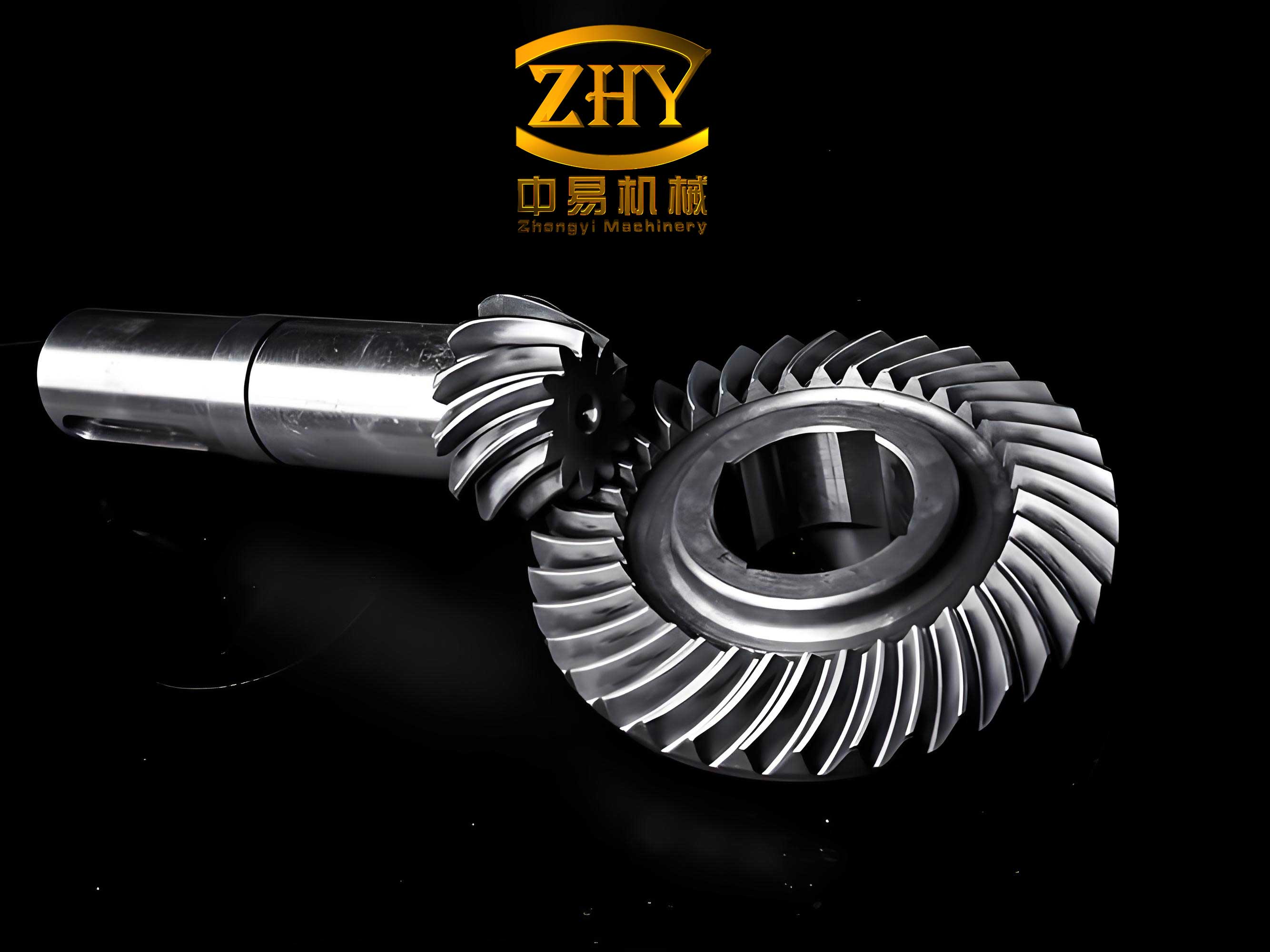
Parametric modeling of the double circular arc spiral bevel gear was implemented using UG software, leveraging its expression functionality to define mathematical relationships for gear parameters. This approach allows for automatic updates to the model when parameters change, reducing manual errors and improving efficiency. The modeling process involves creating the tooth surface and gear blank separately, then combining them through Boolean operations.
For tooth surface modeling, the surface is discretized into U-lines and V-lines. U-lines correspond to curves with constant \(\alpha\) values (the pressure angle parameter from the double circular arc basic tooth profile), while V-lines correspond to curves with constant \(\psi\) values (the instantaneous rotation angle during cutting). By selecting appropriate ranges for \(\alpha\) and \(\psi\), a grid of curves is generated. In UG, expressions are used to define the tooth surface equations parametrically. For example, key parameters such as the large-end transverse module, number of teeth, and tooth width coefficient are set as variables. The law curve function in UG is then employed to create U-lines and V-lines based on the parametric equations for \(x\), \(y\), and \(z\) coordinates. These curves are connected using the “curve mesh” command to form surface patches, which are then stitched into a complete tooth surface. The tooth surface consists of four segments: convex tooth profile, transition profile, concave tooth profile, and root profile, all seamlessly integrated.
The gear blank is modeled by defining three key cones: the face cone, front cone, and back cone. The pitch cone is imaginary and not modeled, while the root cone is omitted as it aligns with the tooth root surface. Mathematical expressions for these cones are input into UG’s expression system. For instance, parameters for the active gear include:
$$
\begin{aligned}
p_1 &= h_a / \sin(p_8 – \phi_i) \text{ [mm]}, \\
p_2 &= 2 (R_i + h_a / \tan(p_8 – \phi_i)) / \sin(p_8 – \phi_i) \text{ [mm]}, \\
p_3 &= 2 (R_e + h_a / \tan(p_8 – \phi_i)) / \sin(p_8 – \phi_i) \text{ [mm]},
\end{aligned}
$$
where \(h_a\) is the addendum, \(\phi_i\) is the shaft angle, \(R_i\) and \(R_e\) are inner and outer cone distances, and \(p_8 = 90^\circ\). Similar expressions are defined for the driven gear. Using the CONE command in UG, these expressions generate the conical surfaces, which are combined via Boolean operations to form a solid gear blank.
To create the gear teeth, the tooth surface model is used to cut the gear blank. The “trim body” command in UG is applied to excavate a complete tooth slot based on the tooth surface. This slot is then arrayed circularly using the “instance geometry” command to produce all teeth, resulting in a full three-dimensional model of the double circular arc spiral bevel gear. The gear pair is assembled in UG using a bottom-up approach: individual gear models are created and then constrained in an assembly environment. The assembly involves aligning the gear axes perpendicularly, setting distances, and adjusting angular orientations to ensure proper meshing. This parametric modeling process ensures that the spiral bevel gear design can be easily modified and optimized for different applications.
For dynamics simulation, the assembled gear pair is exported from UG in Parasolid format and imported into ADAMS via the ADAMS/Exchange module. In ADAMS, a virtual prototype is created by applying constraints, drives, and contact forces. The gears are assigned revolute joints, with a rotational drive applied to the active gear and a load torque applied to the driven gear. The contact between teeth is modeled using the Impact function, which is based on Hertzian elastic impact theory. The contact force \(F\) in ADAMS is defined as:
$$
F = \begin{cases}
\max\left(0, k(x_1 – x)^e – \text{step}(x, x_1 – d, C_{\text{max}}, x_1, 0) \cdot \dot{x}\right) & \text{if } x < x_1, \\
0 & \text{if } x \geq x_1,
\end{cases}
$$
where \(x\) is the distance variable, \(\dot{x}\) is the relative velocity, \(x_1\) is the free length, \(k\) is the stiffness coefficient, \(e\) is the force exponent, \(C_{\text{max}}\) is the maximum damping coefficient, and \(d\) is the penetration depth for full damping. The contact function is Impact\((x, \dot{x}, x_1, k, e, C_{\text{max}}, d)\). For the double circular arc spiral bevel gear, parameters are set based on material properties and gear geometry. A case study is conducted with the following gear parameters:
| Parameter | Active Gear | Driven Gear |
|---|---|---|
| Number of teeth, \(z\) | 12 | 35 |
| Large-end transverse module, \(m_{te}\) (mm) | 6 | 6 |
| Spiral angle, \(\beta\) (°) | 35 | 35 |
| Tooth width coefficient, \(\phi_R\) | 0.26 | 0.26 |
| Hand of spiral | Left | Right |
The gear material is 45 steel, with Poisson’s ratio \(\mu = 0.29\) and Young’s modulus \(E = 2.07 \times 10^5\) N/mm². The stiffness coefficient \(k\) is calculated as \(7.3 \times 10^5\) N/mm. Other contact parameters include: impact exponent \(e = 1.5\), damping \(C = 50\) N·s/mm, penetration depth \(d = 0.1\) mm, dynamic friction coefficient 0.05, and static friction coefficient 0.08. The simulation is run for 0.5 seconds with 5000 steps. The drive on the active gear is defined as a step function: \(\text{step}(\text{time}, 0, 0, 0.2, -3600^\circ/\text{s})\), which ramps up to a constant speed of 600 rpm to avoid initial shocks. The driven gear has a constant load torque of \(-10^5\) N·mm.
The simulation results provide insights into the dynamic behavior of the double circular arc spiral bevel gear pair. The angular velocity of the active and driven gears is monitored over time. As the active gear accelerates, the driven gear’s velocity increases correspondingly. After 0.2 seconds, the active gear reaches a steady speed of 600 rpm, while the driven gear exhibits small periodic fluctuations around an average value due to vibrations and impacts during meshing. The average angular velocity of the driven gear is 206.667 rpm, which corresponds to 21.642 rad/s. The theoretical value, based on the gear ratio, is 21.542 rad/s, giving a relative error of 0.46%. This error is acceptable considering approximations in contact parameters and simulation settings. The table below summarizes this comparison:
| Parameter | Simulation Value | Theoretical Value | Relative Error |
|---|---|---|---|
| Driven gear angular velocity (rad/s) | 21.642 | 21.542 | 0.46% |
The meshing force between the gears is also analyzed. Initially, there is a significant impact force, peaking at around 4000 N. During the acceleration phase (0 to 0.2 seconds), the meshing force fluctuates with increasing amplitude and decreasing period. After 0.2 seconds, the force stabilizes, oscillating around an average value of 1650 N with consistent period and amplitude. These fluctuations reflect the periodic engagement and disengagement of teeth, influenced by factors such as varying mesh stiffness and contact conditions. This behavior validates the dynamic characteristics of the double circular arc spiral bevel gear, confirming that the parametric model accurately captures its meshing dynamics.
To further elaborate on the modeling process, the UG expressions for the gear blank can be extended. For the active gear, additional parameters include:
$$
\begin{aligned}
p_4 &= 0.5 p_3 \tan(p_8 – \phi_i) – p_1 \text{ [mm]}, \\
p_5 &= 2(p_1 + p_4) \tan(p_8 – \phi_i) \text{ [mm]}, \\
p_6 &= 0.5 p_3 \tan(p_8 – \phi_i) \text{ [mm]}, \\
p_7 &= 0.5 p_2 \tan(p_8 – \phi_i) \text{ [mm]}.
\end{aligned}
$$
For the driven gear:
$$
\begin{aligned}
p_9 &= h_a / \sin(\phi_i) \text{ [mm]}, \\
p_{10} &= p_4 \tan(p_8 – \phi_i) + p_9 + 10 \text{ [mm]}, \\
p_{11} &= p_{10} \tan(\phi_i) \times 2 \text{ [mm]}, \\
p_{12} &= p_{10} – p_9 \text{ [mm]}, \\
p_{13} &= p_4 \times 2 + p_9 \tan(p_8 – \phi_i) \times 2 \text{ [mm]}, \\
p_{14} &= ((p_7 – p_1) \sin(p_8 – \phi_i) + 8) \sin(\phi_i) + p_9 \text{ [mm]}, \\
p_{15} &= (p_7 – p_1) \times 2 + p_9 \tan(p_8 – \phi_i) \times 2 \text{ [mm]}.
\end{aligned}
$$
These expressions automate the generation of cone dimensions, ensuring precision in the gear blank geometry. In UG, these are input as named expressions, allowing for easy modification and reuse in different gear designs.
The dynamics simulation in ADAMS also involves setting up the contact detection accurately. The Impact function parameters are derived from material and geometric properties. The stiffness coefficient \(k\) for the double circular arc spiral bevel gear is calculated using the formula:
$$
k = \frac{4}{3} E^* \sqrt{R^*},
$$
where \(E^*\) is the equivalent Young’s modulus and \(R^*\) is the equivalent radius of curvature at the contact point. For two gears made of the same material, \(E^* = E / (2(1 – \mu^2))\). The radius of curvature varies along the tooth profile due to the double circular arc design, but an average value can be used for simulation purposes. In our case, \(k = 7.3 \times 10^5\) N/mm is obtained from empirical relations based on gear parameters. The damping coefficient \(C\) is set to 50 N·s/mm to account for energy dissipation during impact, and the penetration depth \(d = 0.1\) mm ensures stable contact resolution without excessive computational cost.
The simulation results highlight the advantages of double circular arc spiral bevel gears in terms of load distribution and smooth transmission. The periodic fluctuations in meshing force are consistent with the expected behavior for spiral bevel gears, where the contact ratio and mesh stiffness vary during rotation. The double circular arc profile, with its convex-concave engagement, helps distribute loads more evenly, reducing stress concentrations and improving durability. This is evident from the stabilized meshing force after the initial transient phase. Additionally, the spiral angle plays a crucial role in determining the contact pattern and transmission error. By adjusting machine parameters like cutter location and angle, the spiral angle can be optimized to minimize vibrations and noise, enhancing the performance of spiral bevel gears in high-speed applications.
In conclusion, our study demonstrates a comprehensive approach to modeling and simulating double circular arc spiral bevel gears. The parametric modeling in UG allows for flexible and accurate design, while the dynamics simulation in ADAMS provides valuable insights into gear behavior under operating conditions. The results validate the rationality of the parametric model, with simulation outcomes closely matching theoretical expectations. This methodology can be used to optimize gear design, improve geometric and strength calculations, and reduce development time for spiral bevel gear systems. Future work could involve extending the model to include thermal effects, lubrication, or more detailed contact analysis using finite element methods. Overall, the integration of UG and ADAMS offers a powerful toolset for advancing the design and analysis of spiral bevel gears, particularly the double circular arc variant, which holds promise for high-performance mechanical transmissions.
To further emphasize the importance of spiral bevel gears, it is worth noting their applications in automotive differentials, aerospace systems, and industrial machinery. The double circular arc design enhances these applications by providing higher torque capacity and smoother operation. Our modeling and simulation framework can be adapted to other types of spiral bevel gears, such as those with modified tooth profiles or different spiral angles. By continuously refining the parametric expressions and simulation parameters, engineers can achieve better performance and reliability in gear transmissions. This study contributes to the ongoing efforts to leverage computer-aided design and simulation for innovative mechanical solutions.