
In modern mechanical engineering, spiral bevel gears play a pivotal role in transmitting motion and power between intersecting axes, owing to their smooth operation and high load-bearing capacity. As a critical component in industries such as automotive and aerospace, the precision and performance of spiral bevel gears directly reflect a nation’s level of mechanical manufacturing. Traditional gear milling methods, which rely on摇台式机床 with complex mechanical linkages, often suffer from low accuracy due to accumulated errors. With the advent of computer numerical control (CNC) technology, full CNC milling has emerged as an advanced alternative, integrating high-precision control capabilities to achieve efficient and accurate machining of spiral bevel gears. This article explores the methodology for transitioning from traditional摇台式机床 milling to five-axis full CNC milling, establishes a mathematical model for the cutting edge sweep trajectory, and develops a three-dimensional tooth surface model through envelope formation. Subsequently, finite element analysis (FEA) is employed to investigate the meshing behavior of spiral bevel gears under various loads, validating the feasibility of the proposed approach.
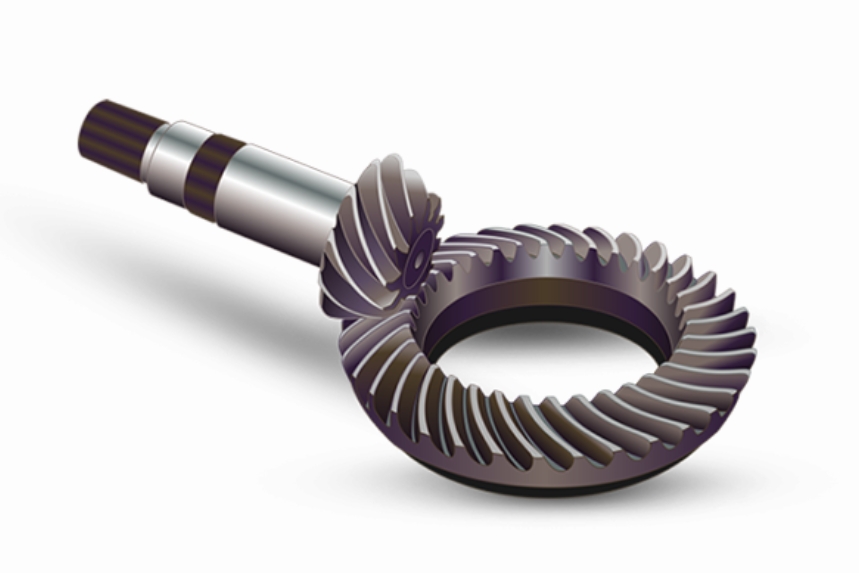
The manufacturing of spiral bevel gears involves intricate tooth surfaces that require specialized processing techniques. Traditional methods simulate a hypothetical gear through a摇台, where the workpiece and the imaginary gear rotate at a specific ratio, mimicking the meshing process of spiral bevel gears—a technique known as the generating method. However, the lengthy kinematic chains in traditional machines introduce errors, leading to reduced tooth surface accuracy. Full CNC milling overcomes these limitations by utilizing multi-axis servo control to replicate the generating motions, thereby enhancing precision. This article delves into the motion conversion principles, leveraging coordinate transformations to derive the cutting edge sweep surface (referred to as the刃扫面) and employing Boolean operations to generate accurate tooth surface models. The focus is on spiral bevel gears, as their complex geometry demands meticulous modeling and analysis.
To begin, let us consider the structural characteristics and milling principles of traditional摇台式机床. The machine tool coordinate system is established, with key parameters such as the cradle angle, tool radial distance, and workpiece orientation. By analyzing the kinematic relationships, the motions of the摇台 can be decomposed into five-axis servo movements in a CNC machine. The transformation matrices between coordinate systems are fundamental to this conversion. For instance, the transformation from the cradle coordinate system \( S_o \) to the tool coordinate system \( S_t \) is given by:
$$ M_{ot} = \begin{bmatrix}
\cos q & -\sin q & 0 & S \\
\sin q & \cos q & 0 & 0 \\
0 & 0 & 1 & 0 \\
0 & 0 & 0 & 1
\end{bmatrix} $$
where \( q \) is the cradle angle and \( S \) is the tool radial distance. Similarly, transformations to the workpiece coordinate system involve parameters like the vertical wheel setting \( E_m \), machine center to back distance \( X_b \), and workpiece installation angle \( \delta_M \). The overall transformation from the tool to the workpiece coordinate system \( S_q \) can be expressed as:
$$ M_{total} = M_{pq} M_p M_o M_{ot} M_{tc} M_{tb} $$
Here, \( M_{tc} \) and \( M_{tb} \) account for tool tilt and swivel angles, while \( M_{pq} \) incorporates the workpiece rotation angle \( \phi \). In a five-axis CNC machine, the tool center position \( R_m \) and orientation \( N_m \) in the machine coordinate system \( S_m \) are derived from these transformations. The servo axes movements—linear axes \( X \), \( Y \), \( Z \) and rotational axes \( A \), \( B \)—are computed as follows:
$$ N_m = M_{mw} M_{wp} N_p $$
$$ R_m = M_{mw} M_{wp} R_o $$
where \( N_p \) is the unit orientation vector in the workpiece system, and \( M_{mw} \) and \( M_{wp} \) represent the transformations for the rotational axes. The angles \( A \) and \( B \) are determined by:
$$ A = \arctan\left(\frac{-N_y}{N_z}\right) $$
$$ B = \arctan\left(\frac{-N_x}{\sqrt{N_y^2 + N_z^2}}\right) $$
and the linear displacements are:
$$ X = R_X, \quad Y = R_Y, \quad Z = X_b $$
This conversion effectively maps the complex generating motions of traditional spiral bevel gears milling onto a five-axis CNC platform, enabling precise control over the cutting process.
To illustrate the application, consider a pair of spiral bevel gears processed via the dual-face milling method. The gear parameters are summarized in the following tables, which highlight key dimensions and settings essential for spiral bevel gears.
| Parameter | Gear (Large) | Pinion (Small) |
|---|---|---|
| Number of Teeth | 43 | 11 |
| Shaft Angle (°) | 90 | |
| Module (mm) | 11 | |
| Outer Cone Distance (mm) | 244.116 | — |
| Spiral Direction | Left-hand | Right-hand |
| Pitch Cone Angle | 75°39′2″ | 14°20′58″ |
| Parameter | Large Gear Cutter | Small Gear Cutter |
|---|---|---|
| Nominal Cutter Radius (mm) | 152.400 | 152.400 |
| Blade Pressure Angle (Inner/Outer) | 21°16′56″ / 18°43′4″ | 20°31′57″ / 19°28′33″ |
| Blade Edge Length (mm) | — | — |
| Parameter | Large Gear | Small Gear |
|---|---|---|
| Tool Radial Distance (mm) | 170.892 | 170.892 |
| Cradle Angle (°) | 46.92922 | — |
| Workpiece Installation Angle | 73°24′57″ | 13°25′53″ |
| Machine Center to Back (mm) | 5.797 | 3.601 |
| Generating Ratio | 1.03142 | 4.03190 |
Using these parameters, the servo axis data for the five-axis CNC machine is computed. The tool path trajectory during generating milling is discretized into multiple positions, each representing a phase of the cutting process. The cutting edge sweep surface, or刃扫面, is mathematically modeled based on the cutter geometry. For a cutter with blade length \( l \) and rotation angle \( \theta \), the edge point coordinates in the cutter system \( S_t \) are:
$$ x_t = x(l, \theta), \quad y_t = y(l, \theta), \quad z_t = z(l, \theta) $$
By applying the transformation matrices for each discrete generating step \( n \), the edge points in the workpiece coordinate system are obtained:
$$ \begin{cases}
x_n = x(l, \theta, n) \\
y_n = y(l, \theta, n) \\
z_n = z(l, \theta, n)
\end{cases} $$
where \( n = 1, 2, \dots, N \), with \( N \) being the number of discrete positions. This formulation allows for precise simulation of the milling process for spiral bevel gears. The envelope of these sweep surfaces forms the tooth surface of the workpiece. Through Boolean operations in CAD software, the material removal is simulated, resulting in a three-dimensional model of the spiral bevel gear tooth surface. This method ensures high accuracy by capturing the continuous generating motion in discrete steps.
For the large gear in the example, the tool path trajectory in the CNC machine is derived. The linear axes \( X \) and \( Y \) movements approximate an elliptical arc, reflecting the influence of horizontal wheel settings in traditional machines. This trajectory is plotted using the computed servo data, confirming the motion conversion validity. The discrete cutter positions are then used to generate the tooth surface via Boolean subtraction from the gear blank. The process yields a gear model with fine surface details, though slight tool marks may appear, which are smoothed via surface fitting for subsequent analysis.
The meshing behavior of spiral bevel gears is critical for performance evaluation. After modeling both the large and small gears, they are assembled according to the shaft angle of 90°, with their pitch cone vertices aligned. The contact pattern and stress distribution under load are analyzed using finite element methods. The gear material is specified as 20CrMnTi, with properties summarized below:
| Property | Value |
|---|---|
| Density (kg/m³) | 7.8 × 10³ |
| Elastic Modulus (GPa) | 207 |
| Poisson’s Ratio | 0.25 |
To prepare for FEA, the gear models are meshed using hexahedral elements for higher accuracy and deformation resistance. A single tooth segment is first meshed in 2D and then extruded to 3D, as the complex geometry of spiral bevel gears benefits from this approach. The mesh models for both gears are assembled in the FEA software, with coupling constraints applied at the inner surfaces to reference points on the axes, enabling rotational degrees of freedom. Contact pairs are defined between the tooth surfaces with a friction coefficient of 0.1. Boundary conditions fix all degrees of freedom except rotation around the gear axes. The pinion is designated as the driver, and a rotational acceleration is applied, while the gear is subjected to resistive loads.
Three load cases are considered to study the meshing of spiral bevel gears: light load (200 N), medium load (500 N), and heavy load (700 N). The analysis steps include a load application phase followed by a meshing phase. The contact pressure, equivalent strain, and stress are evaluated over time. The results indicate that multiple tooth pairs engage simultaneously during meshing, with one pair in full contact, one entering, and one exiting. This multi-pair contact enhances the stability and durability of spiral bevel gears transmissions. The contact area shape remains relatively consistent across different loads, though the pressure magnitude increases with load.
The equivalent total strain analysis reveals that deformation increases with load, but the variation is minimal. For instance, the maximum strain differences between load cases are on the order of \( 1 \times 10^{-5} \) to \( 2 \times 10^{-5} \), demonstrating the robust anti-deformation capability of spiral bevel gears. The stress analysis shows that maximum contact stress occurs at the initial contact and separation instants, particularly at the tooth tip regions of the active gear. The stress variation over time exhibits periodic peaks corresponding to tooth engagement events. Below is a summary of maximum stress values under different loads at a specific time instant (1.47 s):
| Load (N) | Maximum Stress (Pa) |
|---|---|
| 200 | 4.70 × 10⁹ |
| 500 | 4.72 × 10⁹ |
| 700 | 4.74 × 10⁹ |
The stress-time plot illustrates cyclical patterns, with peaks during engagement and troughs during disengagement. This insight can guide tooth surface modifications, such as tip relief, to reduce stress concentrations in spiral bevel gears.
In conclusion, this article presents a comprehensive methodology for transitioning from traditional摇台式机床 milling to full CNC milling for spiral bevel gears. By establishing a motion conversion model based on coordinate transformations, the complex generating motions are accurately replicated on a five-axis CNC platform. The cutting edge sweep surface model enables precise simulation of the milling process, and Boolean operations yield high-fidelity three-dimensional tooth surface models. Finite element analysis confirms that the spiral bevel gears produced via this method exhibit proper meshing characteristics, with contact patterns and stress distributions adhering to design expectations. The minimal influence of load variation on deformation and contact area shape further validates the robustness of the approach. This work provides a foundation for subsequent error analysis, tooth surface modification, and machine parameter optimization for spiral bevel gears, contributing to advancements in high-precision gear manufacturing.
The integration of full CNC technology not only enhances the accuracy of spiral bevel gears but also offers flexibility in adapting to different gear designs. Future research could explore real-time monitoring and adaptive control during milling, as well as advanced materials for improved performance. As the demand for efficient power transmission grows, the development of reliable modeling and analysis techniques for spiral bevel gears will remain crucial in pushing the boundaries of mechanical engineering.