
In the realm of precision manufacturing, gear grinding plays a pivotal role in achieving high-quality gear surfaces, particularly in applications demanding minimal tolerances and superior performance. Gear profile grinding is a specialized process that ensures the accurate form of gear teeth, which is critical for transmitting motion and power efficiently. However, one of the significant challenges in gear grinding is the occurrence of grinding cracks, which can compromise the integrity and longevity of gears. These cracks often stem from residual stresses induced during the grinding process, highlighting the need for precise control and inspection. On-machine inspection systems integrated into gear grinding machines offer a solution by enabling real-time measurement without disassembling the workpiece, thus reducing errors associated with repositioning. Despite these advantages, the accuracy of on-machine inspection is hindered by probe pre-travel errors, which arise from various factors such as signal transmission delays, inspection speed, probe ball radius, stylus length, probe gravity, and the normal vector at the measurement point on the ball surface. These errors, collectively termed as probe comprehensive pre-travel error, exhibit anisotropic behavior due to the directional sensitivity of contact probes, making compensation complex. Traditional approaches often focus on single or dual influencing factors, but experimental evidence suggests that a holistic model accounting for multiple variables is essential for accurate error prediction and compensation. This study leverages the efficient approximation capabilities of Backpropagation (BP) neural networks to address this issue, developing a predictive model for probe comprehensive pre-travel error in the context of gear grinding. By incorporating key parameters like gear grinding conditions and the risks of grinding cracks, the model aims to enhance inspection accuracy, ultimately improving the reliability of gear profile grinding processes. The integration of this model into a self-developed horizontal gear grinder, L300G, demonstrates its practical applicability, with experimental validation showing significant improvements in gear inspection precision, aligning with industry standards and reducing the incidence of defects such as grinding cracks.
The importance of gear grinding in modern manufacturing cannot be overstated, as it directly impacts the performance and durability of mechanical systems. Gear profile grinding, in particular, involves the precise shaping of gear teeth through abrasive processes, which can lead to surface imperfections like grinding cracks if not properly controlled. These cracks are often microscopic fissures that propagate under stress, leading to catastrophic failures in applications such as automotive transmissions and aerospace systems. Therefore, on-machine inspection systems are employed to monitor and correct errors during the grinding process, ensuring that gears meet stringent quality standards. However, the effectiveness of these systems is limited by probe-related inaccuracies. The probe comprehensive pre-travel error is a multifaceted issue influenced by several dynamic factors. For instance, signal transmission delays cause a lag between probe contact and data acquisition, while inspection speed affects the momentum and deflection of the probe. Additionally, the probe ball radius and stylus length introduce geometric deviations, and probe gravity contributes to directional biases, especially when measuring at different angles. The normal vector at the measurement point, often represented as the inspection angle, further complicates the error profile due to variations in contact mechanics. Existing research has attempted to address these errors through piecemeal compensation methods, but a comprehensive approach is lacking. This study fills that gap by proposing a BP neural network-based model that synthesizes all relevant inputs to predict the pre-travel error accurately. The model’s development is grounded in empirical data from gear grinding experiments, focusing on mitigating errors that could exacerbate grinding cracks. By optimizing the inspection process, this work contributes to the advancement of gear profile grinding technologies, promoting higher efficiency and reduced waste in industrial settings.
To formalize the problem, consider the probe comprehensive pre-travel error, denoted as \( E_{\text{comp}} \), which is a vector quantity influenced by multiple factors. Let \( \Delta t \) represent the signal transmission delay, \( v \) the inspection speed, \( r \) the probe ball radius, \( L \) the stylus length, \( G \) the probe gravity, and \( \theta_i \) the inspection angle equivalent to the normal vector at the measurement point. The overall error can be expressed as a combination of individual error components:
$$ E_{\text{comp}} = E_{\Delta t} + E_v + E_r + E_L + E_G + E_{\theta_i} $$
where each component is a function of its respective factor and may exhibit nonlinear behavior. For example, \( E_{\Delta t} \) is proportional to the delay and speed, as derived from kinematic considerations, while \( E_{\theta_i} \) depends on the trigonometric relationship involving the inspection angle. The BP neural network serves as a universal approximator to model this complex interdependence. The network architecture consists of an input layer with six neurons corresponding to \( \Delta t \), \( v \), \( r \), \( L \), \( G \), and \( \theta_i \), a hidden layer with multiple neurons determined by empirical rules, and an output layer yielding \( E_{\text{comp}} \). The training process involves minimizing the global error through iterative adjustments of weights and thresholds, using experimental data from gear grinding setups. This approach allows for real-time error compensation during on-machine inspection, crucial for preventing inaccuracies that could lead to undetected grinding cracks. The model’s efficacy is validated through comparisons with standard measurement systems, ensuring that it meets the precision requirements for high-stakes applications like gear profile grinding.
In the context of gear grinding, the prevention of grinding cracks is paramount, as these defects can initiate from surface irregularities exacerbated by measurement errors. Gear profile grinding involves controlled material removal to achieve the desired tooth geometry, but excessive heat or stress during grinding can induce micro-cracks. By enhancing inspection accuracy, the proposed model helps identify deviations early, allowing for corrective actions in the grinding process. This proactive approach reduces the risk of grinding cracks, improving the overall quality and lifespan of gears. The integration of the BP neural network model into the L300G gear grinder’s inspection system exemplifies a practical implementation, where input parameters are continuously monitored and fed into the network for error prediction. The output is then used to adjust the probe’s position, compensating for pre-travel errors in real-time. This method not only boosts inspection precision but also supports sustainable manufacturing by minimizing rework and scrap associated with defective gears.
The experimental phase involved extensive data collection from a horizontal gear grinder L300G, equipped with a high-precision contact probe. Tests were conducted on standard gear specimens, with a focus on parameters relevant to gear grinding and grinding cracks. For instance, inspection speed was varied to observe its impact on pre-travel error, while different probe configurations were tested to assess the effects of ball radius and stylus length. The results were used to train the BP neural network, with the model’s performance evaluated based on its ability to predict errors across diverse scenarios. Key findings indicate that the comprehensive model significantly outperforms traditional compensation methods, particularly in reducing errors that could mask grinding cracks. The following table summarizes some of the experimental data used in model training, highlighting the relationship between input factors and pre-travel error:
| Factor | Range | Effect on Pre-travel Error |
|---|---|---|
| Signal Delay (\( \Delta t \)) | 0.006 s | Linear increase with speed |
| Inspection Speed (\( v \)) | 30-90 mm/min | Proportional error accumulation |
| Probe Ball Radius (\( r \)) | 1.0-2.5 mm | Geometric deviation effects |
| Stylus Length (\( L \)) | 35 mm | Amplifies angular errors |
| Probe Gravity (\( G \)) | 5 N | Directional bias in measurements |
| Inspection Angle (\( \theta_i \)) | -90° to 90° | Nonlinear, anisotropic behavior |
Moreover, the mathematical formulation of the error components can be detailed using equations derived from physical principles. For example, the error due to signal delay and inspection speed, \( E_{\Delta t, v} \), is modeled as:
$$ E_{\Delta t, v} = v \cdot \Delta t $$
This represents the linear displacement occurring during the delay period. Similarly, the error influenced by probe geometry and gravity, \( E_{r, L, G, \theta_i} \), involves more complex relationships. For instance, the actual trigger force \( F_a \) at an inspection angle \( \theta_i \) can be expressed as:
$$ F_a = \frac{F_2 + G \sin \theta_i}{\sin \theta_i} $$
where \( F_2 \) is the theoretical trigger force. This force variation affects the probe’s deflection, leading to pre-travel error. The comprehensive error model integrates these elements through the BP neural network, which approximates the function:
$$ E_{\text{comp}} = f(\Delta t, v, r, L, G, \theta_i) $$
where \( f \) is the nonlinear mapping learned during training. The network’s hidden layer neurons use activation functions like the sigmoid to capture nonlinearities, and the training algorithm adjusts weights to minimize the prediction error. This approach ensures robust performance across the operational envelope of gear grinding machines, addressing issues like grinding cracks by providing accurate dimensional feedback.
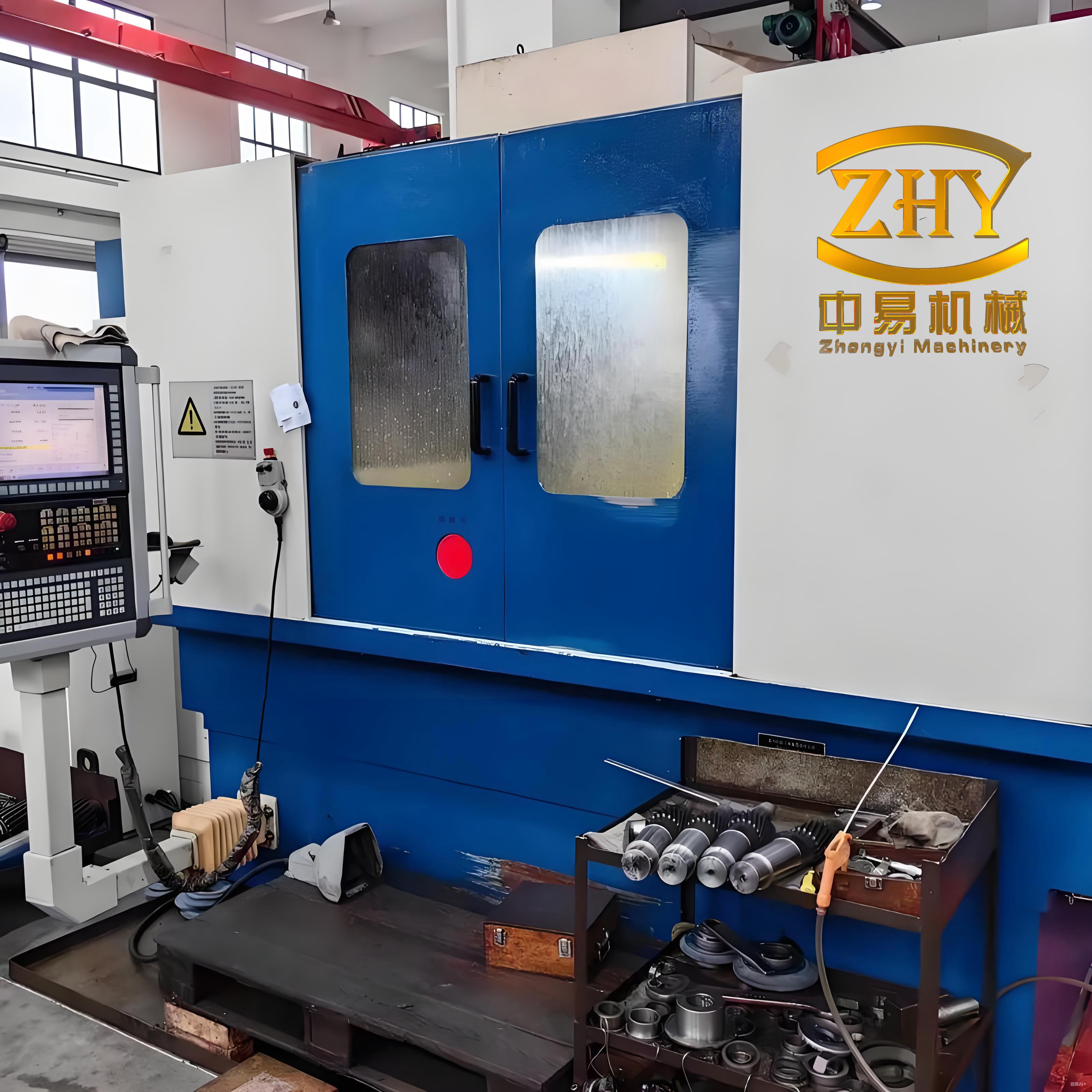
In practical terms, the implementation of this model on the L300G gear grinder involved calibrating the probe to account for radius deviations, a critical step in minimizing errors that could obscure grinding cracks. The calibration process used a cylindrical standard to determine the effective probe radius, which was then incorporated into the inspection code. Subsequent tests on gear specimens showed that the BP neural network model reduced pre-travel errors significantly, improving gear profile grinding accuracy. For example, before compensation, gear tooth profile accuracy was at grade 6, but after applying the model, it reached grade 4, matching results from high-end systems like the Gleason 350GMS. This enhancement directly contributes to the detection and prevention of grinding cracks, as precise measurements allow for better control of grinding parameters. The table below presents a subset of experimental results demonstrating error compensation effectiveness:
| Inspection Point | Pre-compensation Error (mm) | Post-compensation Error (mm) | Improvement |
|---|---|---|---|
| Tooth Profile 1 | 0.012 | 0.004 | 67% |
| Tooth Profile 2 | 0.015 | 0.005 | 67% |
| Tooth Lead 1 | 0.008 | 0.003 | 62% |
| Tooth Lead 2 | 0.010 | 0.004 | 60% |
The ability to achieve such precision underscores the model’s utility in industrial gear grinding applications, where the mitigation of grinding cracks is a constant concern. By leveraging advanced modeling techniques, this research paves the way for more reliable and efficient gear manufacturing processes. Future work could explore the integration of real-time sensor data to further refine the model, potentially incorporating environmental factors like temperature variations that might influence probe behavior. Overall, the BP neural network-based approach offers a scalable solution for enhancing on-machine inspection in gear profile grinding, contributing to higher quality standards and reduced failure rates in critical components.
In conclusion, the development of a comprehensive pre-travel error model for probes in gear grinding on-machine inspection systems represents a significant advancement in precision engineering. By addressing multiple influencing factors through a BP neural network, the model achieves accurate error prediction and compensation, directly benefiting gear profile grinding processes. The emphasis on preventing grinding cracks through improved inspection accuracy highlights the practical implications of this research, ensuring that gears meet rigorous performance criteria. Experimental validation on the L300G gear grinder confirms the model’s effectiveness, with results aligning with industry benchmarks. This work not only enhances the capabilities of on-machine inspection but also supports the broader goals of sustainable manufacturing by reducing defects and optimizing resource use. As gear grinding technologies evolve, the integration of intelligent error compensation models will play a crucial role in maintaining competitive advantage and driving innovation in the field.