
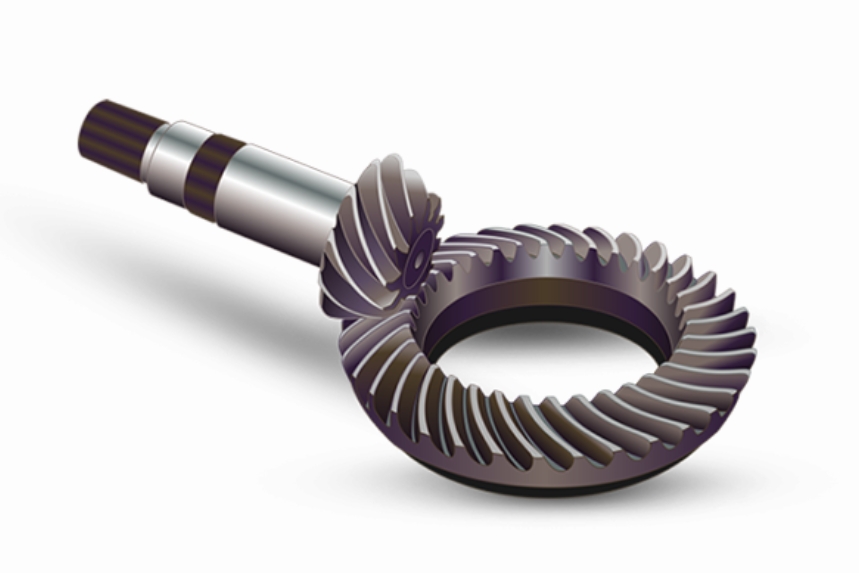
Spiral bevel gears are widely used in automotive and aerospace industries due to their high load capacity and smooth meshing characteristics. This paper presents an advanced parametric design system for spiral bevel gears, integrating tooth surface modeling, automated assembly, and engineering drawing generation. The system significantly improves design efficiency while maintaining geometric accuracy.
1. Tooth Surface Modeling Methodology
The mathematical foundation of spiral bevel gear tooth surface generation is established through coordinate transformation and meshing equations. The cutting tool geometry is defined as:
$$ r_g(s_g, \theta_g) = \begin{bmatrix}
(R_g \pm s_g \sin \alpha_g) \cos \theta_g \\
(R_g \pm s_g \sin \alpha_g) \sin \theta_g \\
-s_g \cos \alpha_g \\
1
\end{bmatrix}, \quad
n_g(\theta_g) = \begin{bmatrix}
\cos \alpha_g \cos \theta_g \\
\cos \alpha_g \sin \theta_g \\
\mp \sin \alpha_g
\end{bmatrix} $$
For circular blade segments:
$$ r_g(\theta, \theta_g) = \begin{bmatrix}
(C_x \pm \rho_g \sin \theta) \cos \theta_g \\
(C_x \pm \rho_g \sin \theta) \sin \theta_g \\
-\rho_g(1 – \cos \theta) \\
1
\end{bmatrix}, \quad
n_g(\theta, \theta_g) = \begin{bmatrix}
\sin \theta \cos \theta_g \\
\sin \theta \sin \theta_g \\
\pm \cos \theta
\end{bmatrix} $$
2. Parametric Design System Architecture
The software architecture consists of two main modules:
| Module | Components | Functions |
|---|---|---|
| Parametric Design | Gear parameters Machine settings Tooth data |
Automatic calculation Data storage File export |
| CAD Development | 3D modeling Assembly Engineering drawing |
Automated modeling Interference check Dimensioning |
3. Key Functional Modules
The coordinate transformation matrix for gear machining is derived as:
$$ r_2 = M_{2c2} \cdot M_{c2b2} \cdot M_{b2m2} \cdot M_{m2a2} \cdot M_{a2g} \cdot r_g $$
Discrete tooth surface points are calculated through:
$$ X_{L_{mn}} = \frac{k_n X_{L_{1n}} – k_m X_{L_{1m}} + Y_{L_{1m}} – Y_{L_{1n}}}{k_n – k_m} $$
$$ Y_{L_{mn}} = \frac{k_n k_m (X_{L_{1n}} – X_{L_{1m}}) + k_n Y_{L_{1m}} – k_m Y_{L_{1n}}}{k_n – k_m} $$
4. Software Implementation
Typical spiral bevel gear parameters:
| Parameter | Pinion | Gear |
|---|---|---|
| Teeth (Z) | 23 | 42 |
| Module (mm) | 4.00 | 4.00 |
| Spiral Angle (°) | 35.00 | 35.00 |
| Pressure Angle (°) | 20.00 | 20.00 |
Machine settings for concave surface generation:
| Parameter | Value |
|---|---|
| Cutter Radius (mm) | 96.95 |
| Radial Setting (mm) | 81.23 |
| Machine Center (mm) | 82.80 |
| Swivel Angle (°) | 73.03 |
5. System Validation
The developed software achieves 85% reduction in modeling time compared with manual CAD operations. The automatic assembly module ensures proper meshing through constraint equations:
$$ n_{m2} \cdot v_{m2}^{(g2)} = 0 $$
Engineering drawing automation implements dimension positioning algorithm:
$$ D_1 + D_3 = \text{Sheet Width} – 2\delta $$
$$ D_2 + D_4 = \text{Sheet Height} – 2\delta $$
6. Conclusion
The parametric design system for spiral bevel gears demonstrates significant advantages in design efficiency and modeling accuracy. By integrating advanced mathematical models with CAD automation, the software provides an effective solution for high-performance gear design and manufacturing.