
The dynamic performance of gear transmission systems is fundamentally governed by their internal excitation sources, among which the time-varying mesh stiffness (TVMS) of the gear pair is paramount. This stiffness varies periodically as the contact point moves along the tooth profile and the number of tooth pairs in contact alternates. While significant research has been dedicated to calculating TVMS using methods like the potential energy principle, the influence of sliding friction between contacting tooth flanks is often neglected. In reality, the friction coefficient is not constant; it exhibits a time-varying characteristic due to changes in load, sliding velocity, and contact conditions during the mesh cycle. This article presents a comprehensive analytical model for calculating the TVMS of spur gears that explicitly accounts for this time-varying friction, analyzes its distinct effects compared to frictionless and constant-friction models, and investigates the influence of key design and operational parameters.
The accurate prediction of dynamic behavior, noise, and durability of spur gears hinges on a precise understanding of their mesh stiffness. Traditional models based on the potential energy method decompose tooth deflection into components from bending, shear, axial compression, Hertzian contact, and fillet foundation deformation. However, the tangential friction force, which acts parallel to the tooth surface, induces additional deformations that alter the effective stiffness. Previous studies have incorporated constant friction coefficients, revealing that friction increases stiffness during the approach (involute to pitch point) and decreases it during the recess (pitch point to involute) phases. Yet, assuming a constant coefficient is a simplification. A more physically accurate model must consider the time-varying friction coefficient, which depends on instantaneous tribological conditions at the contact point. This work integrates an empirical time-varying friction model into the potential energy framework to derive closed-form stiffness expressions, offering a more refined tool for the dynamic analysis of spur gear pairs.
Geometric and Kinematic Model of Spur Gear Mesh
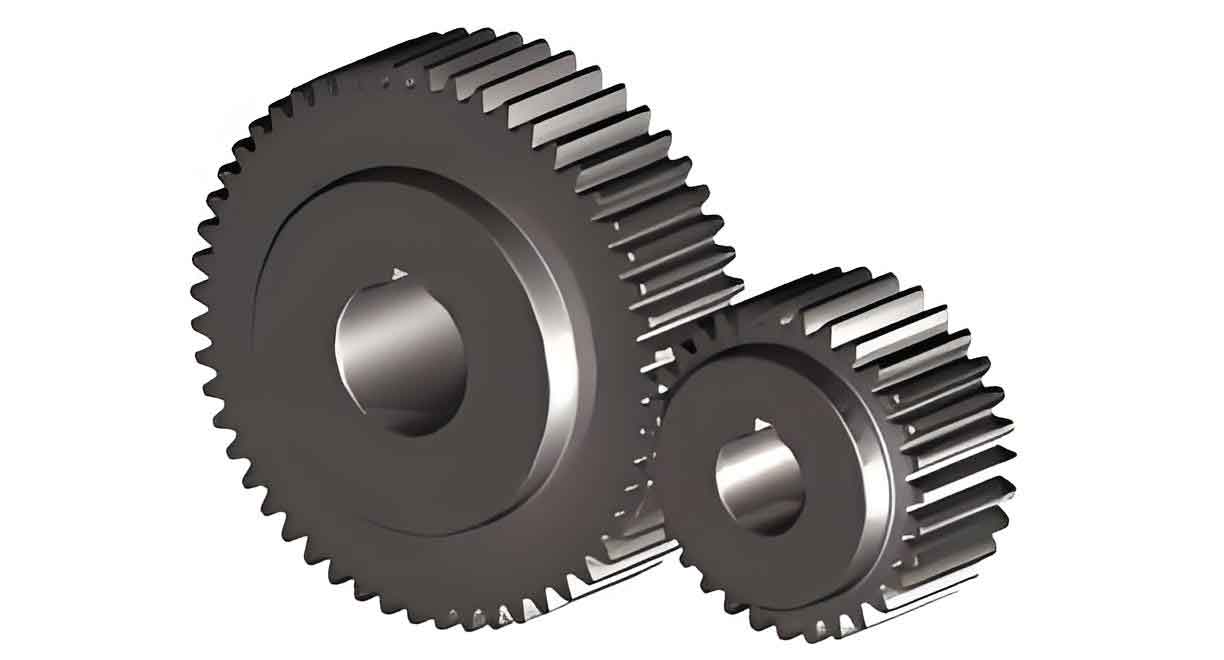
A model of an involute spur gear pair in mesh is essential for deriving contact parameters. Let \(O_1\) and \(O_2\) be the centers of the driving and driven gears, with base circle radii \(r_{b1}\) and \(r_{b2}\), and angular velocities \(\omega_1\) and \(\omega_2\), respectively. The line of action is defined between the tangent points \(N_1\) and \(N_2\), with the actual path of contact being the segment \(B_1B_2\). At any meshing point \(K\), the pressure angles for the driving and driven gears are \(\alpha_{K1}\) and \(\alpha_{K2}\). The key kinematic and geometric parameters are derived as follows.
The pressure angle at the start of active profile for the driving gear, \(\alpha_{B1}\), and at its tip, \(\alpha_{a1}\), are given by:
$$
\alpha_{B1} = \arctan\left( \frac{(z_1 + z_2) \tan\alpha_0 – z_2 \tan\alpha_{a2}}{z_1} \right)
$$
$$
\alpha_{a1} = \arccos\left( \frac{z_1 \cos\alpha_0}{z_1 + 2h_a^*} \right)
$$
where \(z_1, z_2\) are tooth numbers, \(\alpha_0\) is the standard pressure angle, \(h_a^*\) is the addendum coefficient, and \(\alpha_{a2} = \arccos(r_{b2}/r_{a2})\) is the tip pressure angle of the driven gear.
As the contact point moves, the pressure angles vary with time \(t\) (or rotational angle):
$$
\tan\alpha_{K1} = \tan\alpha_{B1} + \omega_1 t
$$
$$
\tan\alpha_{K2} = \tan\alpha_{a2} – \omega_2 t
$$
The sliding velocity \(v_s\), a critical parameter for friction, is the difference in the tangential velocities of the two surfaces at point \(K\):
$$
v_{sK} = \left| \frac{m z_1 \omega_1 (z_1 + z_2) \cos\alpha_0}{2z_2} (\tan\alpha_0 – \tan\alpha_{K1}) \right|
$$
The entrainment or rolling velocity \(v_e\), which influences the formation of the lubricant film, is the average of the two surface velocities:
$$
v_{eK} = \left| \frac{m z_1 \omega_1 \cos\alpha_0}{2z_2} \left[ (z_1 + z_2)\tan\alpha_0 + (z_2 – z_1)\tan\alpha_{K1} \right] \right| / 2
$$
The slide-to-roll ratio \(SR\) quantifies the severity of sliding:
$$
SR_K = 2 \left| \frac{(z_1 + z_2)(\tan\alpha_0 – \tan\alpha_{K1})}{(z_1 + z_2)\tan\alpha_0 + (z_2 – z_1)\tan\alpha_{K1}} \right|
$$
The equivalent radius of curvature \(R\) at the contact point, vital for Hertzian contact pressure calculation, is:
$$
R_K = r_{b1} \tan\alpha_{K1} – r_{b1} \frac{z_1}{(z_2 + z_1)\tan\alpha_0} \tan^2\alpha_{K1}
$$
Finally, the maximum Hertzian contact pressure \(P_h\) is:
$$
P_{hK} = \frac{F_K}{\pi R_K \left( \frac{1-\nu_1^2}{E_1} + \frac{1-\nu_2^2}{E_2} \right) }
$$
where \(E\) and \(\nu\) are Young’s modulus and Poisson’s ratio, and \(F_K\) is the normal load per unit face width at point \(K\). The load is shared between tooth pairs; for double-tooth contact, \(F_K = F/(2b)\), and for single-tooth contact, \(F_K = F/b\). Here, \(b\) is the face width and \(F = T_1 / r_{b1}\) is the total normal mesh force derived from the input torque \(T_1\).
Calculation of the Time-Varying Friction Coefficient
In spur gears, the friction coefficient is not static. It varies along the path of contact due to changes in \(SR\), \(P_h\), \(v_e\), and the surface roughness \(S\). An empirical model that captures these dependencies is employed:
$$
\mu = e^{f(SR_K, P_{hK}, \upsilon_0, S)} P_{hK}^{b_2} |SR_K|^{b_3} v_{eK}^{b_6} \upsilon_0^{b_7} R_K^{b_8}
$$
where \(\upsilon_0\) is the absolute viscosity of the lubricant, and \(b_i\) (i=1…9) are regression coefficients determined from experimental data. The exponent function \(f\) is given by:
$$
f = b_1 + b_4 |SR_K| P_{hK} \log_{10}(\upsilon_0) + b_5 e^{-|SR_K| P_{hK} \log_{10}(\upsilon_0)} + b_9 e^{S}
$$
This model accounts for the complex interactions in mixed or boundary lubrication regimes typical in gear contacts. The trends are summarized below:
| Parameter Change | Effect on Friction Coefficient μ | Primary Reason |
|---|---|---|
| Increasing Slide-to-Roll Ratio \(|SR|\) | Increases | Enhanced shearing of lubricant and increased asperity interaction. |
| Increasing Contact Pressure \(P_h\) | Increases | Reduces lubricant film thickness, promoting boundary contact. |
| Increasing Entrainment Velocity \(v_e\) | Decreases | Promotes the formation of a thicker elastohydrodynamic (EHD) film. |
| Increasing Surface Roughness \(S\) | Increases | Directly increases asperity-to-asperity contact. |
| Approaching Pitch Point | Decreases to near zero | Sliding velocity \(v_s\) approaches zero, minimizing frictional work. |
Consequently, the friction coefficient profile for a meshing cycle of spur gears has distinct features: it is theoretically zero at the pitch point (pure rolling), increases as the contact moves away from the pitch point due to rising sliding velocity, and experiences a step change at the transition between single and double tooth contact zones due to the instantaneous halving or doubling of the load per tooth \(F_K\), which affects \(P_h\). Typically, the friction is higher in the approach region than in the recess region for the same distance from the pitch point due to generally higher contact pressures and slide-to-roll ratios.
Analytical TVMS Model Incorporating Time-Varying Friction
To derive the mesh stiffness, each spur gear tooth is modeled as a non-uniform cantilever beam rooted at the base circle. The unique aspect here is the inclusion of the tangential friction force \(F_f = \mu F\) in the force balance. The direction of \(F_f\) is crucial: it always opposes the relative sliding. Therefore, on the driving gear, \(F_f\) points away from the pitch point during approach and towards the pitch point during recess. The opposite is true for the driven gear.
The components of the total contact force on a tooth in the local coordinate system (x-axis along the tooth centerline, y-axis perpendicular) differ for the two phases. For the driving gear during approach (\(\alpha_K < \alpha_0\)):
$$
F_x = F\sin\alpha_1 + F_f \cos\alpha_1 = F(\sin\alpha_1 + \mu \cos\alpha_1)
$$
$$
F_y = F\cos\alpha_1 – F_f \sin\alpha_1 = F(\cos\alpha_1 – \mu \sin\alpha_1)
$$
For the driving gear during recess (\(\alpha_K > \alpha_0\)):
$$
F_x = F\sin\alpha_1 – F_f \cos\alpha_1 = F(\sin\alpha_1 – \mu \cos\alpha_1)
$$
$$
F_y = F\cos\alpha_1 + F_f \sin\alpha_1 = F(\cos\alpha_1 + \mu \sin\alpha_1)
$$
Here, \(\alpha_1 = \tan\alpha_K – \alpha_2\) and \(\alpha_2 = \pi/(2z) + \tan\alpha_0 – \alpha_0\). For the driven gear, the sign convention for \(\mu\) in the equations would be reversed.
The potential energy method is then applied. The total energy stored in the tooth due to bending (\(U_b\)), shear (\(U_s\)), and axial compression (\(U_a\)) is calculated by integrating the strain energy density along the tooth height. The compliances (inverse of stiffnesses) are derived from \(\partial U / \partial F^2\). The expressions for the driving gear’s bending, shear, and axial stiffnesses are given below for the approach phase. The recess phase formulas follow similarly with the sign change for \(\mu\).
Bending Stiffness \(k_b\):
$$
\frac{1}{k_b} = \int_{-\alpha_1}^{\alpha_2} \frac{3\{1+\cos\alpha_1[(\alpha_2-\alpha)\sin\alpha-\cos\alpha] – \mu\{\alpha_1+\alpha_2+\sin\alpha_1[(\alpha_2-\alpha)\sin\alpha-\cos\alpha]\}\}^2 (\alpha_2-\alpha)\cos\alpha}{2Eb[\sin\alpha+(\alpha_2-\alpha)\cos\alpha]^3} d\alpha
$$
Shear Stiffness \(k_s\):
$$
\frac{1}{k_s} = \int_{-\alpha_1}^{\alpha_2} \frac{1.2(1+\nu)(\cos\alpha_1 – \mu\sin\alpha_1)^2 (\alpha_2-\alpha)\cos\alpha}{Eb[\sin\alpha+(\alpha_2-\alpha)\cos\alpha]} d\alpha
$$
Axial Compressive Stiffness \(k_a\):
$$
\frac{1}{k_a} = \int_{-\alpha_1}^{\alpha_2} \frac{(\alpha_2-\alpha)\cos\alpha (\sin\alpha_1 + \mu\cos\alpha_1)^2}{2Eb[\sin\alpha+(\alpha_2-\alpha)\cos\alpha]} d\alpha
$$
where \(E\) is Young’s modulus, \(\nu\) is Poisson’s ratio, and \(b\) is the face width.
The Hertzian contact stiffness \(k_h\) for a pair of teeth is independent of friction and depends only on material properties and instantaneous geometry:
$$
\frac{1}{k_h} = \frac{4(1-\nu^2)}{\pi E b}
$$
The fillet foundation stiffness \(k_f\) accounts for the deformation of the gear body beneath the tooth. A widely accepted formula is used:
$$
\frac{1}{k_f} = \frac{\cos^2\alpha_1}{Eb} \left[ L^* \left(\frac{u_f}{S_f}\right)^2 + M^* \left(\frac{u_f}{S_f}\right) + P^* (1 + Q^* \tan^2\alpha_1) \right]
$$
where \(L^*, M^*, P^*, Q^*\) are polynomial coefficients dependent on the gear geometry.
The single-tooth-pair stiffness \(k_{tp}\) is the series combination of all deflection sources from both the driving (1) and driven (2) gears:
$$
k_{tp} = \frac{1}{ \frac{1}{k_h} + \sum_{i=1}^2 \left( \frac{1}{k_{b,i}} + \frac{1}{k_{s,i}} + \frac{1}{k_{a,i}} + \frac{1}{k_{f,i}} \right) }
$$
Finally, the total TVMS \(k_t\) of the spur gear pair is the sum of the stiffnesses of all tooth pairs in simultaneous contact (typically 1 or 2):
$$
k_t = \sum_{j=1}^{N_{pair}} k_{tp}^{(j)}
$$
where \(N_{pair}\) is 1 or 2, and each \(k_{tp}^{(j)}\) is calculated for its respective contact point with its specific load share and time-varying friction coefficient \(\mu\).
Results and Discussion: Friction Effects on Mesh Stiffness
The model reveals significant differences between frictionless, constant-friction, and time-varying friction scenarios for spur gears.
1. Single Tooth Pair Stiffness: Under a constant friction force, the single tooth pair stiffness increases during the approach phase and decreases during the recess phase compared to the frictionless case. This asymmetry arises because the friction force either partially counteracts or augments the bending moment caused by the normal force, effectively changing the tooth’s resistance to deflection. With a time-varying friction coefficient, this trend holds, but the magnitude of the stiffness modulation varies smoothly along the path of contact, reaching zero at the pitch point where \(\mu=0\).
2. Total Mesh Stiffness with Constant Friction: A key artifact of the constant-friction model is a discontinuous jump in the total mesh stiffness at the pitch point. This is physically unrealistic and stems from the abrupt reversal in the direction of the friction force while its magnitude remains non-zero. The stiffness is higher just before the pitch point (approach) and lower just after it (recess), creating a discontinuity.
3. Total Mesh Stiffness with Time-Varying Friction: This model provides a more realistic stiffness profile. The discontinuity at the pitch point is eliminated because the friction coefficient smoothly decays to zero there, making the transition between approach and recess phases seamless and continuous. The primary discontinuities now occur only at the boundaries of the single and double contact zones, which are inherent to the gear geometry and load sharing. The step changes at these transition points are also altered in magnitude by the corresponding step change in the friction coefficient due to the sudden load variation.
| Characteristic | Frictionless Model | Constant-Friction Model | Time-Varying Friction Model |
|---|---|---|---|
| Stiffness at Pitch Point | Continuous, smooth maximum. | Discontinuous jump (artifact). | Continuous and smooth, matches frictionless value. |
| Stiffness in Approach | Baseline value. | Higher than baseline. | Higher than baseline, varying magnitude. |
| Stiffness in Recess | Baseline value. | Lower than baseline. | Lower than baseline, varying magnitude. |
| Transitions (Single/Double) | Step change due to load sharing. | Step change altered by constant friction. | Step change altered by a concurrent step in μ. |
| Physical Accuracy | Low (ignores a key physical effect). | Medium (captures asymmetry but has pitch point artifact). | High (captures asymmetric modulation and smooth pitch point transition). |
Parametric Influence on TVMS under Time-Varying Friction
The integrated model allows for a systematic study of how design and operational parameters of spur gears influence the TVMS when time-varying friction is considered. The analysis focuses on the modulation amplitude of the stiffness, i.e., how much friction deviates the stiffness from its frictionless value.
1. Module (\(m\)) and Face Width (\(b\)): Increasing the module or face width directly increases the absolute value of the mesh stiffness because the teeth become geometrically stiffer (larger cross-section) and load is distributed over a wider area. However, their effect on the friction-induced modulation is secondary. A larger module increases the radius of curvature \(R\), which tends to slightly decrease the friction coefficient. A larger face width reduces the unit load \(F_K\) and thus the contact pressure \(P_h\), also leading to a modest decrease in \(\mu\). Consequently, while \(k_t\) increases, the relative difference between frictionless and frictional stiffness might slightly decrease.
2. Pressure Angle (\(\alpha_0\)): An increase in the pressure angle makes the tooth stubbier and thicker at the root, which generally increases the bending stiffness. However, it also shortens the length of the line of action, reducing the sliding velocities and the slide-to-roll ratio. This reduction in kinematic severity leads to a lower time-varying friction coefficient. The net effect is that the mesh stiffness \(k_t\) may show a complex trend, but the amplitude of friction-induced stiffness variation is reduced with higher pressure angles.
3. Surface Roughness (\(S\)): This parameter has a very direct and pronounced impact on the time-varying friction coefficient. Rougher surfaces significantly increase \(\mu\) across the entire mesh cycle, especially in mixed/boundary lubrication regimes. Therefore, while the base frictionless stiffness is unaffected by roughness, the difference between the frictionless and frictional TVMS profiles grows substantially as roughness increases. The stiffness modulation amplitude is highly sensitive to this parameter.
4. Input Torque (\(T_1\)): Increasing the input torque raises the mesh force \(F\) and consequently the contact pressure \(P_h\). According to the friction model, higher \(P_h\) generally increases \(\mu\). However, the relationship is not linear in the context of stiffness. The absolute deflection due to friction increases, but the proportional contribution of friction to the total compliance may change. The stiffness modulation amplitude typically increases with torque, but the rate of increase diminishes at higher loads.
| Parameter | Effect on Base Mesh Stiffness \(k_t\) | Effect on Friction Coefficient μ | Net Effect on Friction-Induced Stiffness Modulation |
|---|---|---|---|
| Increase Module (\(m\)) | Strong Increase | Slight Decrease | Absolute modulation increases, relative effect may slightly decrease. |
| Increase Face Width (\(b\)) | Linear Increase | Slight Decrease (due to lower \(P_h\)) | Similar to module effect. |
| Increase Pressure Angle (\(\alpha_0\)) | Increase (thicker root) | Decrease (lower sliding) | Modulation amplitude decreases. |
| Increase Roughness (\(S\)) | No Direct Effect | Strong Increase | Modulation amplitude increases significantly. |
| Increase Input Torque (\(T_1\)) | No Direct Effect* | Increase | Modulation amplitude increases, with diminishing returns. |
Conclusion
This article has developed a refined analytical framework for calculating the time-varying mesh stiffness of spur gears that incorporates the physically realistic condition of a time-varying friction coefficient. The model integrates tribological conditions—sliding velocity, contact pressure, and surface roughness—into the established potential energy method for stiffness calculation. The key findings are that friction introduces an asymmetric modulation to the mesh stiffness, increasing it during the approach phase and decreasing it during recess. A constant-friction assumption leads to an unphysical discontinuity at the pitch point, which is resolved by the time-varying model as the friction coefficient naturally tends to zero at pure roll. The primary discontinuities in the TVMS profile occur at the single-to-double tooth contact transitions and are influenced by concurrent steps in the friction coefficient due to load sharing changes.
Parametric studies reveal that the amplitude of this friction-induced stiffness modulation is most significantly increased by higher surface roughness and input torque, while it can be reduced by employing a higher pressure angle. Understanding these detailed interactions is crucial for high-fidelity dynamic modeling, vibration and noise prediction, and durability analysis of spur gear transmissions. The presented model offers a valuable tool for designers and analysts seeking to account for the nuanced effects of friction in the performance evaluation of spur gears.