
The relentless advancement of modern machinery imposes ever-increasing demands on gear transmission systems. Traditional cylindrical gears, such as spur, helical, and herringbone gears, are increasingly challenged to meet the requirements for higher load capacity, smoother operation, and reduced noise in high-speed and heavy-duty applications. This has spurred significant research interest in novel gear geometries. Among these, the cylindrical gear with Variable Hyperbolic Circular-Arc-Tooth-Trace (VH-CATT) presents a promising alternative. This type of gear features a theoretical involute profile in its mid-plane cross-section, while the profiles in planes parallel to this mid-plane are envelopes of hyperbolic curves. Crucially, the tooth trace itself follows a circular arc path.
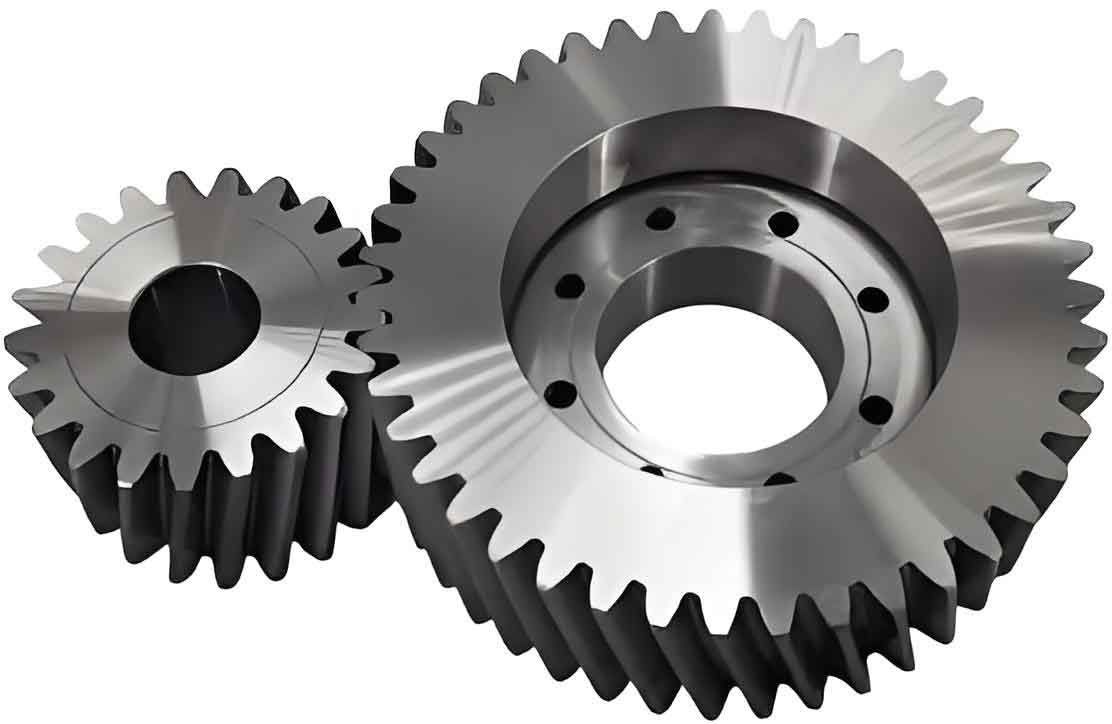
The unique geometry of VH-CATT cylindrical gears endows them with several advantageous characteristics, including a high contact ratio, automatic alignment capability, the absence of axial thrust forces, and reduced sensitivity to mounting errors. These attributes make them particularly suitable for complex transmission environments. Research on VH-CATT cylindrical gears has progressed in areas such as tooth surface generation, contact analysis, manufacturing techniques, and wear prediction. However, a critical aspect for practical application—tooth surface modification design aimed at optimizing load distribution and dynamic performance—requires more in-depth exploration. Unmodified VH-CATT gears theoretically exhibit point contact under no load, which expands to an elliptical area under load, but this contact is not across the full face width. Furthermore, manufacturing errors, assembly misalignments, and deflections can lead to concentrated stress and increased meshing impact, resulting in vibration and noise. Therefore, intentional modification of the tooth surface is essential to enhance the load-bearing capacity and acoustic performance of these advanced cylindrical gears.
This article proposes a novel modification method for VH-CATT cylindrical gears achieved by tilting the large cutter head during the milling process. The primary objective is to systematically design, model, and analyze the contact performance of the modified gear pair. The mathematical model for the modified tooth surface is derived based on gear generation theory. Subsequently, the influence of the modification parameter (cutter tilt angle) on the tooth surface geometry, specifically the principal curvatures, is investigated. Finally, a comprehensive finite element analysis is conducted to evaluate the effects of modification on the maximum contact stress and transmission error, which are key indicators of load capacity and dynamic excitation.
Mathematical Model of the Modified VH-CATT Cylindrical Gear
The standard VH-CATT cylindrical gear is generated using a double-edged large cutter head in a milling process. To introduce a controlled modification along the tooth trace direction, the proposed method involves tilting the cutter head by an angle γ. The coordinate systems for the inclined cutter and the gear generation process are established as shown in the referenced figures. The cutter profile coordinates are defined in the cutter coordinate system \( O_{df}x_{df}y_{df}z_{df} \). The profile of the cutting edge can be expressed as:
$$
\begin{cases}
x_{df} = \mp(\pi m/4) \mp u \sin\alpha \\
y_{df} = 0 \\
z_{df} = u \cos\alpha
\end{cases}
$$
where the upper sign ‘-‘ corresponds to the outer cutting edge, the lower sign ‘+’ corresponds to the inner cutting edge, \(m\) is the module, \(\alpha\) is the pressure angle, and \(u\) is the distance parameter along the cutting edge from the reference point.
Transforming this profile to the tilted cutter head coordinate system \( O_dx_dy_dz_d \) yields the equation for the cutting edge surface:
$$
\begin{aligned}
x_d &= \left\{ \left[ \mp(\pi m/4) \mp u \sin\alpha \right] \cos\gamma + u \cos\alpha \sin\gamma – R_T \right\} \cos\theta \\
y_d &= -\left\{ \left[ \mp(\pi m/4) \mp u \sin\alpha \right] \cos\gamma + u \cos\alpha \sin\gamma – R_T \right\} \sin\theta \\
z_d &= -\left[ \mp(\pi m/4) \mp u \sin\alpha \right] \sin\gamma + u \cos\alpha \cos\gamma
\end{aligned}
$$
where \(R_T\) is the nominal radius of the circular-arc tooth trace, \(\theta\) is the rotation parameter of the cutter head, and \(\gamma\) is the tilt angle of the cutter head (the modification parameter).
According to the theory of gearing, the necessary condition for the cutter surface to generate the gear tooth surface is that the relative velocity vector \(\mathbf{v}^{(d1)}\) at the contact point is orthogonal to the common surface normal vector \(\mathbf{n}\). This condition is expressed by the equation of meshing:
$$
\mathbf{n} \cdot \mathbf{v}^{(d1)} = 0
$$
The vectors are derived within the cutter coordinate system. Solving this equation provides the relationship between the generation parameters. The final mathematical model of the modified VH-CATT cylindrical gear tooth surface in the gear blank coordinate system \( O_1x_1y_1z_1 \) is obtained through a series of coordinate transformations. The transformation matrix from \( O_dx_dy_dz_d \) to \( O_1x_1y_1z_1 \) is:
$$
\mathbf{M}_{1d} =
\begin{bmatrix}
\cos(\gamma + \phi_1) & 0 & -\sin(\gamma + \phi_1) & (R_T \cos\gamma + R_1 \phi_1)\cos\phi_1 – R_T \sin\phi_1 \sin\gamma – R_1 \sin\phi_1 \\
\sin(\gamma + \phi_1) & 0 & \cos(\gamma + \phi_1) & (R_T \cos\gamma + R_1 \phi_1)\sin\phi_1 + R_T \cos\phi_1 \sin\gamma + R_1 \cos\phi_1 \\
0 & -1 & 0 & 0 \\
0 & 0 & 0 & 1
\end{bmatrix}
$$
where \(R_1\) is the pitch radius of the gear and \(\phi_1\) is the rotation angle of the gear blank (generation angle). Applying this transformation yields the modified tooth surface vector \(\mathbf{r}_1(\phi_1, \theta, \gamma)\):
$$
\begin{aligned}
x_1 &= \left[ \mp \frac{\pi m}{4} \cos\gamma + u \sin(\gamma \mp \alpha) – R_T \right] \cos\theta \cos(\gamma + \phi_1) \\
&\quad + \left[ \mp \frac{\pi m}{4} \sin\gamma – u \cos(\gamma \mp \alpha) \right] \sin(\gamma + \phi_1) \\
&\quad + R_T \cos(\gamma + \phi_1) + R_1 \phi_1 \cos\phi_1 – R_1 \sin\phi_1 \\[0.5em]
y_1 &= \left[ \mp \frac{\pi m}{4} \cos\gamma + u \sin(\gamma \mp \alpha) – R_T \right] \cos\theta \sin(\gamma + \phi_1) \\
&\quad – \left[ \mp \frac{\pi m}{4} \sin\gamma – u \cos(\gamma \mp \alpha) \right] \cos(\gamma + \phi_1) \\
&\quad + R_T \sin(\gamma + \phi_1) + R_1 \phi_1 \sin\phi_1 + R_1 \cos\phi_1 \\[0.5em]
z_1 &= \left[ \mp \frac{\pi m}{4} \cos\gamma + u \sin(\gamma \mp \alpha) – R_T \right] \sin\theta \\[0.5em]
u &= \frac{1}{\cos\theta} \left[ R_1 \phi_1 \sin\gamma \cos\theta \cos(\gamma \mp \alpha) – \frac{\pi m}{4} \sin\alpha \cos\theta – (R_1 \phi_1 \cos\gamma + R_T – R_T \cos\theta) \sin(\gamma \mp \alpha) \right]
\end{aligned}
$$
This set of equations, with \(\gamma\) as a key input parameter, defines the complete geometry of the modified VH-CATT cylindrical gear tooth surface. When \(\gamma = 0\), the model reverts to the standard, unmodified VH-CATT gear surface.
Tooth Surface Reconstruction and Geometric Analysis
Using the derived mathematical model, precise three-dimensional models of the modified VH-CATT cylindrical gears can be reconstructed. For analysis, a specific gear pair is defined with the following parameters: driver gear teeth \(z_1 = 29\), driven gear teeth \(z_2 = 41\), module \(m = 8\) mm, pressure angle \(\alpha = 20^\circ\), face width \(b = 60\) mm, and tooth trace radius \(R_T = 200\) mm. Point cloud data for the tooth surfaces are calculated using the model with various cutter tilt angles \(\gamma\) and then used to construct solid models.
Visual inspection of the reconstructed models for different \(\gamma\) values reveals a significant geometric effect: As the cutter tilt angle \(\gamma\) increases, the concavity of the driven gear’s concave flank increases, while the convexity of the driver gear’s convex flank decreases. Crucially, the tooth profile on the mid-plane remains unchanged regardless of \(\gamma\). This leads to a thickening of the tooth toward both ends of the face width. If \(\gamma\) becomes excessively large, the flanks bend so much that “bridge-type” contact may occur during meshing, which is an undesirable contact pattern detrimental to proper load transmission.
A more quantitative analysis involves examining the principal curvatures of the tooth surface. The first \((k_1)\) and second \((k_2)\) principal curvatures can be calculated from the fundamental forms of the surface defined by \(\mathbf{r}(\phi_1, \theta)\):
$$
K = \frac{LN – M^2}{EG – F^2}, \quad H = \frac{LG – 2MF + NE}{2(EG – F^2)}
$$
$$
k_1 = H + \sqrt{H^2 – K}, \quad k_2 = H – \sqrt{H^2 – K}
$$
where \(E, F, G\) are coefficients of the first fundamental form and \(L, M, N\) are coefficients of the second fundamental form. The principal curvature in the profile direction and the principal curvature in the tooth trace direction are identified from \(k_1\) and \(k_2\). The analysis of these curvatures for different \(\gamma\) angles (e.g., \(0^\circ, 3^\circ, 5^\circ, 6^\circ, 7^\circ, 9^\circ\)) yields clear trends, which are summarized in the table below:
| Cutter Tilt Angle \(\gamma\) (degrees) | Concave Flank (Tooth Trace Direction) | Convex Flank (Tooth Trace Direction) | Both Flanks (Profile Direction) |
|---|---|---|---|
| 0 | Baseline curvature | Baseline curvature | Unaffected |
| 3 | Increases | Decreases | Unaffected |
| 5 | Increases further | Decreases further | Unaffected |
| 6 | Increases further | Decreases further | Unaffected |
| 7 | Increases further | Decreases further | Unaffected |
| 9 | Increases significantly | Decreases significantly | Unaffected |
The table confirms that: 1) The principal curvature of the concave flank in the tooth trace direction increases with \(\gamma\), meaning its radius of curvature decreases and it becomes more curved. 2) The principal curvature of the convex flank in the tooth trace direction decreases with \(\gamma\), meaning its radius of curvature increases and it becomes flatter. 3) The principal curvature in the profile direction remains constant, as the cutter tilt does not alter the effective geometry of the cutting edge in the profile section at the mid-plane. This curvature analysis quantitatively explains the visual observations and is fundamental to understanding the subsequent contact behavior of these modified cylindrical gears.
Finite Element Analysis of Contact Performance
To evaluate the contact performance of the modified VH-CATT cylindrical gear pair, a static finite element analysis (FEA) is performed. A five-tooth segment model of the gear pair is used to balance computational accuracy and efficiency. The analysis considers the meshing between the unmodified convex flank of the driver gear (with \(\gamma = 0^\circ\)) and the modified concave flank of the driven gear (with varying \(\gamma\)). A torque load of \(T = 2000\) N·m is applied to the driven gear. The finite element model is constructed, meshed with appropriate elements, and contact pairs are defined between the engaging tooth surfaces. Boundary conditions are applied to simulate realistic mounting.
The FEA is solved for different values of the modification parameter \(\gamma\). The primary outputs of interest are the contact stress distribution on the tooth flanks and the static transmission error (STE) over a mesh cycle. The STE is calculated as the difference between the theoretical and actual angular positions of the driven gear under load, which is a major source of vibration and noise in gear systems.
Influence on Maximum Contact Stress
The contact stress nephograms for various \(\gamma\) angles reveal the evolution of the contact pattern. For the unmodified case (\(\gamma=0^\circ\)), the contact ellipse is relatively small and centrally located. As \(\gamma\) increases to \(3^\circ\), \(5^\circ\), \(6^\circ\), and \(7^\circ\), the contact ellipse elongates along the tooth trace, covering a larger area of the tooth surface. This spreading of the load over a larger area is the intended effect of the modification. However, when \(\gamma\) is increased to \(9^\circ\), the analysis shows the onset of “bridge-type” contact, where contact occurs at two separate patches near the edges of the tooth face, leaving the center unloaded. This is a highly unfavorable condition leading to severe stress concentration.
The maximum contact stress values extracted from the central tooth during a complete meshing cycle are plotted against the gear rotation angle for different \(\gamma\). The data clearly shows that as \(\gamma\) increases from \(0^\circ\) to \(7^\circ\), the peak contact stress consistently decreases. At \(\gamma = 9^\circ\), the peak stress increases dramatically due to the detrimental bridge contact. The percentage reduction in contact stress at a representative meshing position, compared to the unmodified gear, is quantified in the following table:
| Cutter Tilt Angle \(\gamma\) (degrees) | Approximate Contact Stress Reduction (%) | Observation |
|---|---|---|
| 3 | 6.73 | Beneficial, larger contact area |
| 5 | 11.75 | Beneficial, larger contact area |
| 6 | 16.67 | Beneficial, larger contact area |
| 7 | 16.87 | Near-optimal reduction |
| 9 | -14.26 (Increase) | Detrimental, bridge-type contact occurs |
The mechanism is directly linked to the curvature analysis. Increasing \(\gamma\) decreases the relative curvature difference between the convex and concave flanks in the tooth trace direction (the convex flank flattens, and the concave flank becomes more curved in a complementary manner). This reduced relative curvature leads to a larger contact ellipse under load, distributing the force over a greater surface area and thus lowering the maximum contact stress. There exists a critical value \(\gamma_0\) (between \(7^\circ\) and \(9^\circ\) for this specific design) beyond which the modification becomes excessive, causing a mismatch that results in bridge contact and a rapid rise in stress.
Influence on Static Transmission Error
The static transmission error is a critical dynamic excitation parameter. The calculated STE for different \(\gamma\) angles shows characteristic patterns: the error is larger in the single-tooth contact region and smaller in the double-tooth contact regions. The amplitude of the STE variation is a key metric. The results demonstrate that as \(\gamma\) increases from \(0^\circ\) to \(7^\circ\), the peak-to-peak amplitude of the STE decreases. For example, the maximum STE reduces from approximately \(2.476 \times 10^{-4}\) rad for \(\gamma=0^\circ\) to about \(2.051 \times 10^{-4}\) rad for \(\gamma=7^\circ\). This reduction is directly related to the increased contact area and consequently reduced contact deformation under load. A stiffer contact zone (due to a larger ellipse) deforms less for the same load, leading to smaller deviations from perfect kinematic motion, i.e., smaller transmission error. Conversely, for \(\gamma = 9^\circ\), the STE increases again due to the unstable and concentrated bridge-type contact. The trend of STE variation with \(\gamma\) is therefore consistent with the trend observed for contact stress.
Conclusions
This study has presented a systematic investigation into the modification design and contact performance analysis of Variable Hyperbolic Circular-Arc-Tooth-Trace (VH-CATT) cylindrical gears. The inclined cutter head milling method was proposed as an effective way to modify the tooth surface geometry along the tooth trace. The following key conclusions are drawn:
- Mathematical Modeling: A comprehensive mathematical model for the modified tooth surface of VH-CATT cylindrical gears was successfully derived based on the theory of gearing and coordinate transformations, incorporating the cutter tilt angle \(\gamma\) as the primary modification parameter.
- Geometric Effect: The modification parameter \(\gamma\) significantly alters the principal curvatures of the tooth flanks in the tooth trace direction. Increasing \(\gamma\) increases the curvature (decreases the radius) of the concave flank and decreases the curvature (increases the radius) of the convex flank. The profile direction curvature remains unaffected, ensuring the mid-plane geometry is preserved.
- Contact Stress Performance: Finite element analysis confirmed that within a optimal range (\(0^\circ < \gamma < \gamma_0\)), increasing the cutter tilt angle reduces the maximum contact stress on the tooth surface of VH-CATT cylindrical gears. This is attributed to a larger contact ellipse area resulting from favorable curvature matching. A critical tilt angle \(\gamma_0\) exists; exceeding this value induces detrimental bridge-type contact, leading to a sharp increase in contact stress.
- Transmission Error Performance: The modification similarly benefits the static transmission error. An appropriate increase in \(\gamma\) reduces the amplitude of transmission error by diminishing the elastic contact deformation under load. This trend is consistent with the contact stress results, and the error increases again when \(\gamma\) exceeds \(\gamma_0\).
This research establishes a foundational framework for the intentional modification of VH-CATT cylindrical gears. The findings provide clear guidance for selecting modification parameters to enhance load capacity and improve dynamic performance (reduce vibration and noise). Future work could involve multi-objective optimization of \(\gamma\) considering manufacturing constraints, dynamic analysis of modified gear pairs, and experimental validation of the predicted performance benefits. The development of such modification techniques is crucial for unlocking the full potential of advanced cylindrical gear geometries like the VH-CATT in demanding industrial applications.