
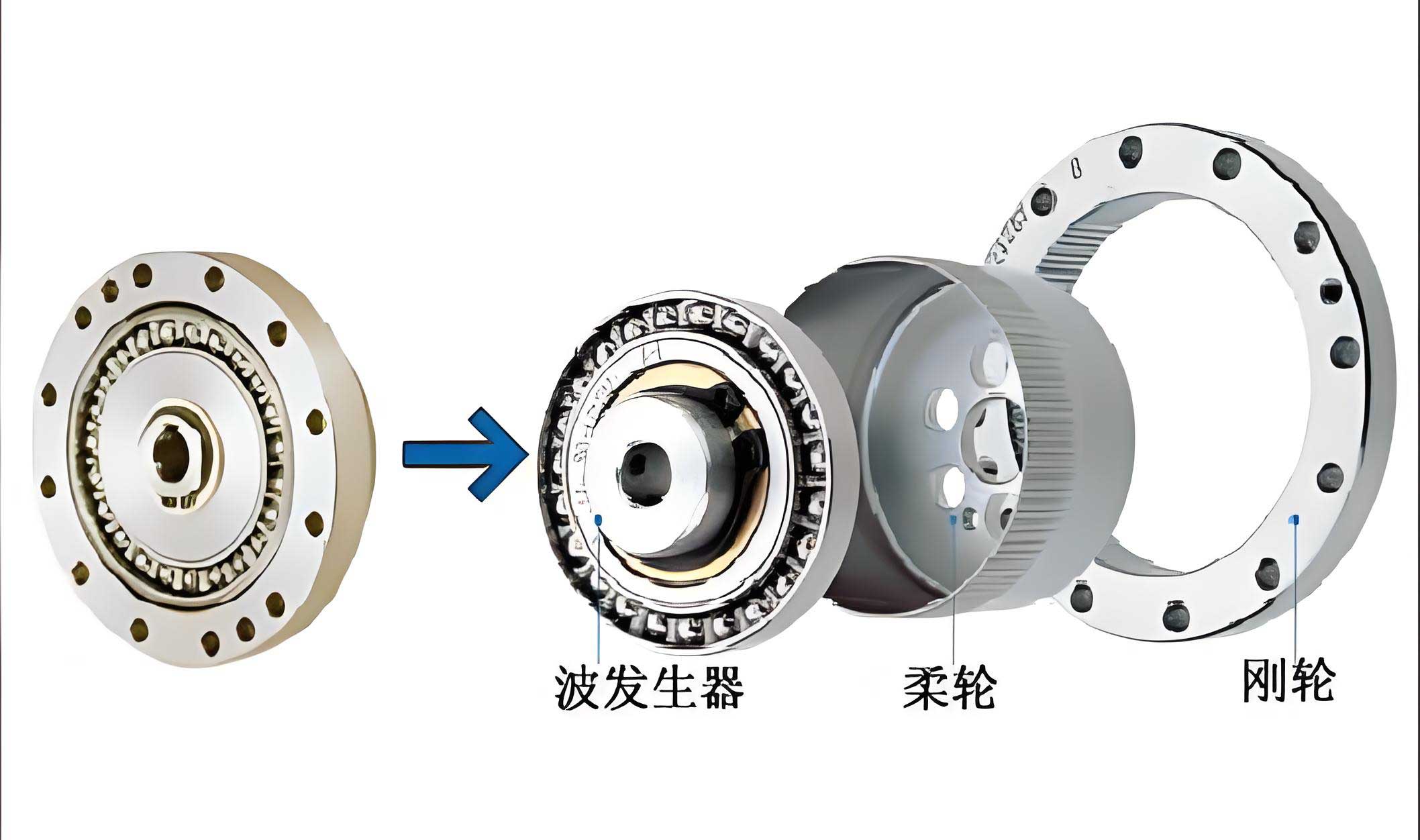
As an engineer specializing in precision mechanical systems, I have long been fascinated by the innovative design and superior performance of strain wave gears. These gears, also known as harmonic drives, are renowned for their high torque capacity, compact size, and precise motion control, making them indispensable in robotics, aerospace, and industrial automation. In this article, I will delve into a critical aspect of strain wave gear optimization: the modification of tooth surfaces for asymmetric meshing pairs. Specifically, I focus on the tooth surface modification of the wave generator’s end face cam, which is essential for enhancing the operational smoothness and longevity of strain wave gear systems. The need for such modification arises from the inherent challenges in asymmetric tooth profiles, where sudden changes in motion direction can induce severe inertial impacts, leading to vibration, noise, and reduced lifespan. By employing a method based on secondary curve cluster envelope surfaces, I aim to demonstrate how strategic tooth surface reshaping can mitigate these issues, thereby improving the overall efficiency and reliability of strain wave gear mechanisms.
Strain wave gears operate on the principle of elastic deformation, where a flexible spline engages with a rigid circular spline via a wave generator. In asymmetric meshing pairs, the tooth profiles are designed to increase the arc length of the working engagement segment while reducing the non-working segment, effectively implementing a “slow-in, fast-out” motion. This design enhances the number of teeth in simultaneous contact, thereby boosting power transmission capacity in strain wave gear applications. However, this asymmetry introduces discontinuities in the oscillating tooth’s motion, particularly at the crest and root of the wave generator’s cam teeth. As I analyze the kinematic behavior, the oscillating tooth’s axial displacement, velocity, and acceleration exhibit abrupt changes—specifically, infinite acceleration spikes at the reversal points—which can cause detrimental冲击 and振动. Thus, tooth surface modification becomes imperative to control these accelerations and ensure a gradual transition in velocity, ultimately safeguarding the strain wave gear from premature failure.
To address this, I propose a modification technique using secondary curve clusters to envelop the tooth surfaces. This approach involves reshaping the crest and root regions of the wave generator’s end face cam with parabolic segments, ensuring smooth continuity with the unmodified theoretical tooth surfaces. The mathematical foundation relies on coordinate transformations and envelope theory, where I derive the modified tooth surface equations for both the crest and root regions. For the crest modification, I establish a local coordinate system aligned with the tooth crest, as illustrated in the analysis diagrams. The secondary curve equations for the rising and falling segments are expressed as:
$$ z’_1 = a_1 x’^2 + b_1 x’ + c_1 \quad \text{(rising segment)} $$
$$ z’_2 = a_2 x’^2 + b_2 x’ + c_2 \quad \text{(falling segment)} $$
Here, $a_1$, $b_1$, $c_1$, $a_2$, $b_2$, and $c_2$ are coefficients determined by boundary conditions that ensure seamless transitions. For the rising segment, the conditions include $f_1(-x’_1) = 0$, $f’_1(-x’_1) = k_1$, and $f’_1(0) = 0$, where $k_1 = \tan \theta_1 = hU / (2\pi r \lambda_W)$. Similarly, for the falling segment, $f_2(x’_2) = 0$, $f’_2(x’_2) = -k_2$, and $f’_2(0) = 0$, with $k_2 = \tan \theta_2 = hU / (2\pi r (1-\lambda_W))$. In these expressions, $h$ is the theoretical lift of the wave generator cam, $U$ is the wave number, $r$ is the cylindrical radius, and $\lambda_W$ is the asymmetry coefficient of the strain wave gear tooth profile. Solving these yields:
$$ a_1 = -\frac{k_1}{2x’_1}, \quad b_1 = 0, \quad c_1 = \frac{k_1 x’_1}{2} $$
$$ a_2 = -\frac{k_2}{2x’_2}, \quad b_2 = 0, \quad c_2 = \frac{k_2 x’_2}{2} $$
Substituting $k_1 x’_1 = k_2 x’_2 = h_{W1}$, where $h_{W1}$ is the theoretical tooth height corresponding to the crest modification zone, I obtain the modified curves in the local coordinates:
$$ z’_1 = -\frac{p’_{W1}}{r^2} x’^2 + \frac{h_{W1}}{2} \quad \text{for} \quad -x’_1 \leq x’ \leq 0 $$
$$ z’_2 = -\frac{p’_{W2}}{r^2} x’^2 + \frac{h_{W1}}{2} \quad \text{for} \quad 0 \leq x’ \leq x’_2 $$
with $p’_{W1} = (hU)^2 / (8\pi^2 \lambda_W^2 h_{W1})$ and $p’_{W2} = (hU)^2 / (8\pi^2 (1-\lambda_W)^2 h_{W1})$. Transforming these to the global coordinate system linked to the wave generator cam, where $z_1 = z’ + h – h_{W1}$ and $x_1 = x’ + \lambda_W \psi_W r$ with $\psi_W = 2\pi / U$, the modified tooth surface equations for the crest region become:
$$ z_1 = -p’_{W1} (\phi_W – \lambda_W \psi_W – n \psi_W)^2 + h – \frac{h_{W1}}{2} \quad \text{(rising segment)} $$
$$ z_1 = -p’_{W2} (\phi_W – \lambda_W \psi_W – n \psi_W)^2 + h – \frac{h_{W1}}{2} \quad \text{(falling segment)} $$
for $n = 0, 1, 2, \dots, U-1$, within specified angular ranges. This derivation highlights the envelope nature of the modification, as the $z_1$ coordinate depends solely on the rotation angle $\phi_W$, independent of radius $r$, ensuring a consistent tooth surface across the strain wave gear cam.
For the root modification, a similar approach is applied. I establish a local coordinate system at the tooth root and derive the secondary curve equations. The resulting modified tooth surface equations for the root region are:
$$ z_1 = p”_{W1} (\phi_W – n \psi_W)^2 + \frac{h_{W2}}{2} \quad \text{(rising segment)} $$
$$ z_1 = p”_{W2} (n \psi_W – \phi_W)^2 + \frac{h_{W2}}{2} \quad \text{(falling segment)} $$
where $p”_{W1} = (hU)^2 / (8\pi^2 \lambda_W^2 h_{W2})$, $p”_{W2} = (hU)^2 / (8\pi^2 (1-\lambda_W)^2 h_{W2})$, and $h_{W2}$ is the theoretical tooth height for the root modification zone in the strain wave gear. These equations collectively define the complete modified tooth surface of the wave generator cam, segmented into six distinct regions: rising and falling segments for both crest and root modifications, along with unmodified theoretical zones. The comprehensive set of equations is summarized in Table 1, which provides a clear overview of the $z_1$ coordinate expressions across different angular intervals, crucial for manufacturing and analysis of strain wave gear systems.
| Region | Angular Range ($\phi_W$) | $z_1$ Equation | Parameters |
|---|---|---|---|
| Crest Modification (Rising) | $-\lambda_W \psi_W (h-h_{W1})/h \leq \phi_W – \lambda_W \psi_W – n\psi_W \leq \lambda_W \psi_W$ | $z_1 = -p’_{W1} (\phi_W – \lambda_W \psi_W – n\psi_W)^2 + h – h_{W1}/2$ | $p’_{W1} = (hU)^2/(8\pi^2 \lambda_W^2 h_{W1})$ |
| Crest Modification (Falling) | $\lambda_W \psi_W \leq \phi_W – \lambda_W \psi_W – n\psi_W \leq \lambda_W \psi_W + (1-\lambda_W)\psi_W (h_{W1}/h)$ | $z_1 = -p’_{W2} (\phi_W – \lambda_W \psi_W – n\psi_W)^2 + h – h_{W1}/2$ | $p’_{W2} = (hU)^2/(8\pi^2 (1-\lambda_W)^2 h_{W1})$ |
| Root Modification (Rising) | $0 \leq \phi_W – n\psi_W \leq \lambda_W \psi_W (h_{W2}/h)$ | $z_1 = p”_{W1} (\phi_W – n\psi_W)^2 + h_{W2}/2$ | $p”_{W1} = (hU)^2/(8\pi^2 \lambda_W^2 h_{W2})$ |
| Root Modification (Falling) | $\psi_W (h-(1-\lambda_W)h_{W2})/h \leq n\psi_W – \phi_W \leq \psi_W$ | $z_1 = p”_{W2} (n\psi_W – \phi_W)^2 + h_{W2}/2$ | $p”_{W2} = (hU)^2/(8\pi^2 (1-\lambda_W)^2 h_{W2})$ |
| Theoretical Unmodified (Rising) | $\lambda_W \psi_W (h_{W2}/h) \leq \phi_W – n\psi_W \leq \lambda_W \psi_W (h-h_{W1})/h$ | $z_1 = p_{W1} (\phi_W – n\psi_W)$ | $p_{W1} = hU/(2\pi \lambda_W)$ |
| Theoretical Unmodified (Falling) | $\lambda_W \psi_W + (1-\lambda_W)\psi_W (h_{W1}/h) \leq n\psi_W – \phi_W \leq \psi_W (h-(1-\lambda_W)h_{W2})/h$ | $z_1 = p_{W2} (n\psi_W – \phi_W)$ | $p_{W2} = hU/(2\pi (1-\lambda_W))$ |
With these modifications in place, I proceed to analyze the kinematic behavior of the oscillating tooth in the strain wave gear. Prior to modification, the tooth’s axial motion exhibits linear displacement with constant velocity, but abrupt reversals at the cam crest and root result in infinite acceleration, as shown in the theoretical plots. After modification, however, the velocity changes gradually, eliminating discontinuities and constraining acceleration within finite limits. To quantify this, I consider a numerical example with typical strain wave gear parameters: wave number $U = 2$, theoretical lift $h = 12 \text{ mm}$, asymmetry coefficient $\lambda_W = 0.8$, and modification heights $h_{W1} = h_{W2} = 2 \text{ mm}$. The oscillating tooth’s velocity $\dot{z}$ and acceleration $\ddot{z}$ are derived from the modified tooth surface equations by differentiating $z_1$ with respect to time, assuming a constant angular velocity $\dot{\phi}_W$ for the wave generator. The results are summarized in Table 2, which details the formulas and computed values at key points across one wave period, illustrating the smooth transitions achieved through tooth surface modification in the strain wave gear.
| Tooth Surface Region | Angular Range ($\phi_W$) | Velocity $\dot{z}$ (mm/s) | Acceleration $\ddot{z}$ (mm/s²) | Sample Values (for $n$ = 60 rpm) |
|---|---|---|---|---|
| Crest Modification (Rising) | $-0.533 \leq \phi_W – 0.8\psi_W \leq 0$ | $\dot{z} = -2p’_{W1} (\phi_W – \lambda_W \psi_W) \dot{\phi}_W$ | $\ddot{z} = -2p’_{W1} \dot{\phi}_W^2$ | $\dot{z}$: 0 to -30; $\ddot{z}$: -141.37 |
| Crest Modification (Falling) | $0 \leq \phi_W – 0.8\psi_W \leq 0.133$ | $\dot{z} = -2p’_{W2} (\phi_W – \lambda_W \psi_W) \dot{\phi}_W$ | $\ddot{z} = -2p’_{W2} \dot{\phi}_W^2$ | $\dot{z}$: -30 to -60; $\ddot{z}$: -565.49 |
| Root Modification (Rising) | $0 \leq \phi_W \leq 0.133$ | $\dot{z} = 2p”_{W1} \phi_W \dot{\phi}_W$ | $\ddot{z} = 2p”_{W1} \dot{\phi}_W^2$ | $\dot{z}$: 0 to 30; $\ddot{z}$: 141.37 |
| Root Modification (Falling) | $2.967 \leq \phi_W \leq 3.142$ | $\dot{z} = -2p”_{W2} (\psi_W – \phi_W) \dot{\phi}_W$ | $\ddot{z} = 2p”_{W2} \dot{\phi}_W^2$ | $\dot{z}$: -60 to -30; $\ddot{z}$: 565.49 |
| Theoretical Unmodified (Rising) | $0.133 \leq \phi_W \leq 2.093$ | $\dot{z} = p_{W1} \dot{\phi}_W$ | $\ddot{z} = 0$ | $\dot{z}$: 30 constant; $\ddot{z}$: 0 |
| Theoretical Unmodified (Falling) | $2.133 \leq \phi_W \leq 2.967$ | $\dot{z} = -p_{W2} \dot{\phi}_W$ | $\ddot{z} = 0$ | $\dot{z}$: -60 constant; $\ddot{z}$: 0 |
The data in Table 2 clearly demonstrates that after modification, the oscillating tooth’s velocity transitions smoothly between positive and negative values, without sudden jumps. Consequently, the acceleration remains finite and controlled, peaking at around $565.49 \text{ mm/s}^2$ in this example, compared to the theoretical infinite spikes. This reduction in acceleration directly translates to lower inertial forces, minimized impact, and reduced vibration in the strain wave gear assembly. Such improvements are crucial for high-precision applications where smooth operation and durability are paramount. Additionally, the modification preserves the axial distance between the wave generator cam and the end face gear, ensuring that the meshing pairs in both modified and unmodified regions function correctly—a key consideration for maintaining the integrity of the strain wave gear transmission.
To further illustrate the benefits, I can express the kinematic relationships mathematically. The displacement $z_1$ as a function of $\phi_W$ is piecewise-defined by the equations in Table 1. The velocity is the first derivative: $\dot{z} = dz_1/dt = (dz_1/d\phi_W) \cdot \dot{\phi}_W$, and acceleration is the second derivative: $\ddot{z} = d^2z_1/dt^2 = (d^2z_1/d\phi_W^2) \cdot \dot{\phi}_W^2$. For the crest modification rising segment, from $z_1 = -p’_{W1} (\phi_W – \lambda_W \psi_W – n\psi_W)^2 + h – h_{W1}/2$, we have:
$$ \frac{dz_1}{d\phi_W} = -2p’_{W1} (\phi_W – \lambda_W \psi_W – n\psi_W) $$
$$ \frac{d^2z_1}{d\phi_W^2} = -2p’_{W1} $$
Thus, $\dot{z} = -2p’_{W1} (\phi_W – \lambda_W \psi_W – n\psi_W) \dot{\phi}_W$ and $\ddot{z} = -2p’_{W1} \dot{\phi}_W^2$, confirming the linear velocity change and constant acceleration in this zone. Similar derivations apply to other regions, as tabulated. This mathematical framework not only validates the modification effectiveness but also provides a design tool for optimizing strain wave gear performance. For instance, by adjusting parameters like $h_{W1}$, $h_{W2}$, or $\lambda_W$, engineers can tailor the acceleration profiles to meet specific application demands, such as reducing noise in robotic joints or enhancing torque capacity in aerospace actuators.
In conclusion, the modification of asymmetric tooth surfaces in strain wave gears through secondary curve envelope methods is a viable and effective strategy to mitigate kinematic discontinuities. By reshaping the crest and root regions of the wave generator cam, we achieve smooth velocity transitions and controlled accelerations, thereby reducing impact and vibration. This advancement contributes to the longevity and reliability of strain wave gear systems, which are pivotal in modern precision engineering. Future work should explore the corresponding modifications for the end face gear and oscillating tooth surfaces to ensure full compatibility, as well as experimental validation in real-world strain wave gear applications. Through continuous innovation in tooth profile design, we can further unlock the potential of strain wave gears for even more demanding technological challenges.
As I reflect on this analysis, it becomes evident that the interplay between geometry and kinematics in strain wave gears is profound. The asymmetric meshing pair, while boosting power transmission, introduces complexities that necessitate careful engineering. The modification technique described here not only addresses these complexities but also underscores the importance of mathematical modeling in mechanical design. By leveraging equations and tables, we can systematically optimize strain wave gear components, ensuring they meet the rigorous standards of industries like robotics and automation. I encourage fellow engineers to adopt such analytical approaches, as they pave the way for more efficient and robust strain wave gear solutions in the future.
Moreover, the integration of this modification into manufacturing processes is straightforward, given the explicit equations provided. CNC machining or additive manufacturing can be employed to produce the modified tooth surfaces with high precision. Quality control can involve verifying the $z_1$ coordinates against the angular parameters $\phi_W$, using the formulas in Table 1 as a reference. This practical applicability makes the method attractive for mass production of strain wave gears, where consistency and performance are critical. Additionally, computational simulations using finite element analysis can further validate the dynamic behavior, predicting stress distributions and wear patterns in modified strain wave gear teeth under load.
In summary, the journey from theoretical necessity to practical solution in strain wave gear tooth modification highlights the power of engineering innovation. By embracing mathematical rigor and kinematic insight, we transform potential weaknesses into strengths, enhancing the overall ecosystem of precision mechanical systems. As strain wave gears continue to evolve, such modifications will play a key role in pushing the boundaries of what these remarkable devices can achieve, from space exploration to medical robotics. I am confident that the insights shared here will inspire further research and development, driving the strain wave gear technology toward new horizons of excellence.