
In the field of mechanical transmission systems, the harmonic drive gear has long been recognized for its compact design, high reduction ratios, and precision motion control. However, traditional radial harmonic drives often face limitations due to the deformation of the flexible wheel, which restricts their load-bearing capacity. To overcome this, I have focused on a novel configuration known as the harmonic drive gear with oscillating teeth, specifically the end-face variant. This design integrates the advantages of both harmonic drive and oscillating tooth mechanisms, enabling a significant increase in transmitted power while maintaining smooth operation. In this article, I will delve into the motion parameters of the sliding pair within this harmonic drive gear system, providing a comprehensive analysis based on modified tooth surface equations. My goal is to offer a theoretical foundation for designing and optimizing these harmonic drive gear components, ensuring enhanced performance and reliability.
The harmonic drive gear with oscillating teeth operates through a unique arrangement involving a wave generator, an end-face gear, and oscillating teeth that slide within a slot wheel. This configuration creates a sliding pair and two meshing pairs: one between the wave generator’s end-face cam and the rear of the oscillating teeth, and another between the front of the oscillating teeth and the end-face gear. To ensure constant instantaneous transmission ratios and facilitate manufacturing, the theoretical tooth surfaces are based on multi-start Archimedes helicoids with straight generatrices perpendicular to the axis of rotation. However, I have found that without modification, these surfaces can lead to abrupt velocity changes when the oscillating teeth reverse direction, causing impact and wear. Thus, tooth surface modification becomes essential for smoothing the transition and improving the durability of the harmonic drive gear.
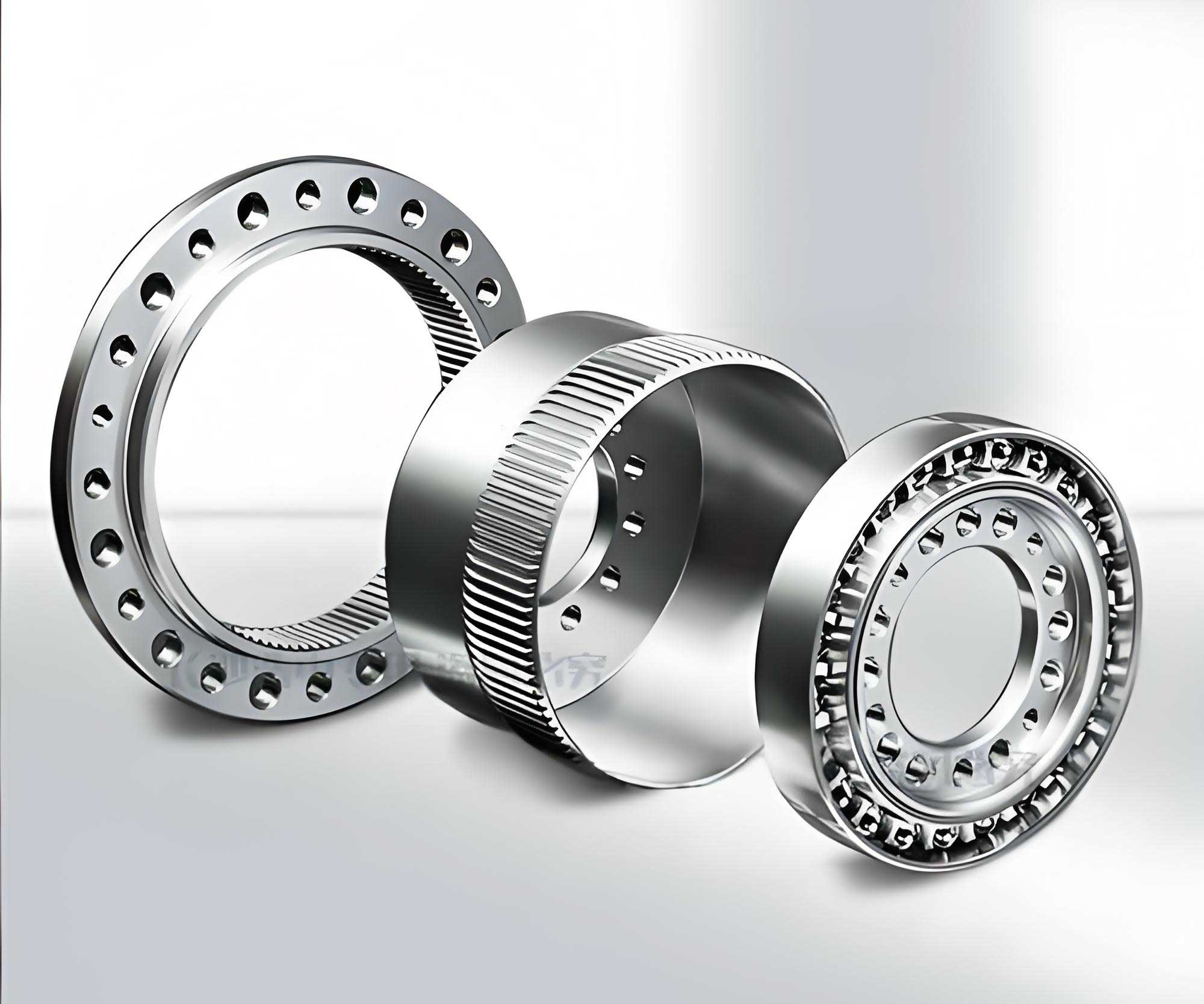
Modification involves reshaping the tooth surfaces at the crest and root of the wave generator’s cam, as well as corresponding adjustments to the oscillating teeth and end-face gear. This process creates rounded profiles that eliminate sharp edges, thereby reducing冲击 and enhancing the lifespan of the harmonic drive gear. The modification heights must satisfy specific relationships to maintain proper meshing across all components. For instance, if the wave generator’s crest modification height is denoted as \( h_{W1} \), the root modification height as \( h_{W2} \), and the oscillating tooth’s rear modification height as \( h_{O1} \), they must be coordinated to ensure continuous contact. I will explore these relationships in detail, as they are crucial for the harmonic drive gear’s operational smoothness.
To analyze the motion of the oscillating teeth, I consider their behavior over one complete wave of the wave generator’s cam. The motion can be divided into five distinct regions, each characterized by different contact conditions between the oscillating teeth and the cam. These regions are defined based on whether the surfaces are modified or unmodified, and they dictate the acceleration, constant velocity, and deceleration phases of the oscillating teeth. Understanding these regions is key to deriving the motion parameters for the sliding pair in the harmonic drive gear. Below, I outline each region:
- Region I: Line contact between the modified rear of the oscillating tooth and the modified root of the wave generator’s rising section. Here, the oscillating tooth accelerates forward.
- Region II: Surface contact between the unmodified rear of the oscillating tooth and the unmodified rising section of the wave generator. The oscillating tooth moves at constant velocity forward.
- Region III: Line contact between the modified rear of the oscillating tooth and the modified crest of the wave generator. This region includes deceleration to zero velocity at the crest, followed by acceleration backward.
- Region IV: Surface contact between the unmodified rear of the oscillating tooth and the unmodified falling section of the wave generator. The oscillating tooth moves at constant velocity backward.
- Region V: Line contact between the modified rear of the oscillating tooth and the modified root of the wave generator’s falling section. The oscillating tooth decelerates backward until it returns to its starting position.
The time spent in each region depends on the modification heights and the wave generator’s parameters. Let \( h \) be the cam’s lift (tooth height), \( \theta \) the cam’s rise angle, \( U \) the number of waves (teeth) on the cam, and \( n_i \) the input speed in rpm. Using geometric relationships, I derive the time intervals for each region. For Region I, the time \( t_1 \) is given by:
$$ t_1 = \frac{30(h_{W2} – h_{O1})}{h U n_i} $$
Similarly, for Regions II, III, IV, and V, the times are:
$$ t_2 = \frac{30(h – h_{W1} – h_{O1})}{h U n_i} $$
$$ t_3 = \frac{30(h + h_{O1} + h_{W1})}{h U n_i} $$
$$ t_4 = \frac{30(2h + h_{O1} – h_{W2})}{h U n_i} $$
Note that the time for Region V is equal to that of Region I, i.e., \( t_5 = t_1 \). These equations highlight how modification heights influence the motion timing in the harmonic drive gear. To better visualize this, I present a summary table of these time intervals based on typical parameters.
| Region | Time Interval Formula | Description |
|---|---|---|
| I | \( t_1 = \frac{30(h_{W2} – h_{O1})}{h U n_i} \) | Acceleration forward with line contact at root |
| II | \( t_2 = \frac{30(h – h_{W1} – h_{O1})}{h U n_i} \) | Constant velocity forward with surface contact |
| III | \( t_3 = \frac{30(h + h_{O1} + h_{W1})}{h U n_i} \) | Deceleration to crest then acceleration backward |
| IV | \( t_4 = \frac{30(2h + h_{O1} – h_{W2})}{h U n_i} \) | Constant velocity backward with surface contact |
| V | \( t_5 = t_1 \) | Deceleration backward to starting position |
With the time intervals established, I proceed to derive the motion parameters—displacement, velocity, and acceleration—for the oscillating teeth in each region. These parameters are vital for designing the harmonic drive gear to minimize dynamic loads and ensure smooth operation. I start with the displacement equations, considering the modified tooth surfaces. In Region I, the displacement \( Z \) as a function of time \( t \) is derived from the cam’s root modification curve and the oscillating tooth’s rear modification curve. After coordinate transformations and applying the condition of line contact (equal slopes at the tangent point), I obtain:
$$ Z = \frac{h^2 U^2 n_i^2 t^2}{1800(h_{W2} – h_{O1})} + \frac{h_{W2}}{2}, \quad t \in [0, t_1] $$
For Region II, where the motion is at constant velocity, the displacement is linear:
$$ Z = \frac{h U n_i t}{30} + \frac{h_{O1}}{2}, \quad t \in [t_1, t_2] $$
In Region III, the displacement involves a parabolic curve due to the deceleration and acceleration phases. Let \( t_W \) be the time at the crest, which can be derived from the previous intervals. The displacement is:
$$ Z = -\frac{h^2 U^2 n_i^2}{1800(h_{W1} + h_{O1})} (t – t_W)^2 + h – \frac{h_{W1}}{2}, \quad t \in [t_2, t_3] $$
For Region IV, again at constant velocity but backward, the displacement is:
$$ Z = 2h – \frac{h U n_i t}{30} + \frac{h_{O1}}{2}, \quad t \in [t_3, t_4] $$
Finally, in Region V, similar to Region I but for the falling section, the displacement is:
$$ Z = \frac{h^2 U^2 n_i^2}{1800(h_{W2} – h_{O1})} \left(t – \frac{60}{U n_i}\right)^2 + \frac{h_{W2}}{2}, \quad t \in [t_4, t_4 + t_1] $$
These displacement equations comprehensively describe the oscillating tooth’s position over one wave cycle in the harmonic drive gear. To find the velocity and acceleration, I differentiate these equations with respect to time. The velocity equations are as follows:
$$ \dot{Z} = \frac{h^2 U^2 n_i^2 t}{900(h_{W2} – h_{O1})}, \quad t \in [0, t_1] $$
$$ \dot{Z} = \frac{h U n_i}{30}, \quad t \in [t_1, t_2] $$
$$ \dot{Z} = -\frac{h^2 U^2 n_i^2}{900(h_{W1} + h_{O1})} (t – t_W), \quad t \in [t_2, t_3] $$
$$ \dot{Z} = -\frac{h U n_i}{30}, \quad t \in [t_3, t_4] $$
$$ \dot{Z} = \frac{h^2 U^2 n_i^2}{900(h_{W2} – h_{O1})} \left(t – \frac{60}{U n_i}\right), \quad t \in [t_4, t_4 + t_1] $$
Differentiating again yields the acceleration equations:
$$ \ddot{Z} = \frac{h^2 U^2 n_i^2}{900(h_{W2} – h_{O1})}, \quad t \in [0, t_1] $$
$$ \ddot{Z} = 0, \quad t \in [t_1, t_2] $$
$$ \ddot{Z} = -\frac{h^2 U^2 n_i^2}{900(h_{W1} + h_{O1})}, \quad t \in [t_2, t_3] $$
$$ \ddot{Z} = 0, \quad t \in [t_3, t_4] $$
$$ \ddot{Z} = \frac{h^2 U^2 n_i^2}{900(h_{W2} – h_{O1})}, \quad t \in [t_4, t_4 + t_1] $$
From these equations, I observe that the acceleration in Regions I and V is constant and positive, while in Region III, it is constant and negative. The magnitudes depend on the modification heights: smaller cam lift \( h \) or larger modification heights \( h_{W1} \) and \( h_{W2} \) reduce acceleration, which minimizes dynamic forces. However, this also reduces the total meshing area, potentially lowering the load capacity of the harmonic drive gear. Therefore, a trade-off exists, and designers must optimize these parameters based on application requirements.
To illustrate the practical implications, I provide a calculation example for a specific harmonic drive gear with oscillating teeth. Assume the following parameters: wave generator waves \( U = 2 \), input speed \( n_i = 1450 \, \text{rpm} \), cam lift \( h = 21.17 \, \text{mm} \), oscillating tooth rear modification height \( h_{O1} = 1.4 \, \text{mm} \), wave generator crest modification height \( h_{W1} = 5 \, \text{mm} \), and root modification height \( h_{W2} = 7 \, \text{mm} \). Using the derived equations, I compute the time intervals and acceleration values for each region. First, the time intervals are calculated as follows:
$$ t_1 = \frac{30(7 – 1.4)}{21.17 \times 2 \times 1450} \approx 0.0027 \, \text{s} $$
$$ t_2 = \frac{30(21.17 – 5 – 1.4)}{21.17 \times 2 \times 1450} \approx 0.0072 \, \text{s} $$
$$ t_3 = \frac{30(21.17 + 1.4 + 5)}{21.17 \times 2 \times 1450} \approx 0.0134 \, \text{s} $$
$$ t_4 = \frac{30(2 \times 21.17 + 1.4 – 7)}{21.17 \times 2 \times 1450} \approx 0.0179 \, \text{s} $$
The maximum velocity occurs at the end of Region I or beginning of Region II, calculated as:
$$ \dot{Z}_{\text{max}} = \frac{h U n_i}{30} = \frac{21.17 \times 2 \times 1450}{30} \approx 2.047 \, \text{m/s} $$
The acceleration values in each region are constant and can be expressed in terms of gravitational acceleration \( g \approx 9.81 \, \text{m/s}^2 \). I summarize these results in a table to enhance clarity.
| Region | Time Range (s) | Acceleration \( \ddot{Z} \) (m/s²) | Acceleration in \( g \) |
|---|---|---|---|
| I | 0 to 0.0027 | 747.84 | 76.31 |
| II | 0.0027 to 0.0072 | 0 | 0 |
| III | 0.0072 to 0.0134 | -654.36 | -66.77 |
| IV | 0.0134 to 0.0179 | 0 | 0 |
| V | 0.0179 to 0.0206 | 747.84 | 76.31 |
This example demonstrates that the harmonic drive gear experiences high accelerations during the modified contact regions, which underscores the importance of proper modification to mitigate冲击. By adjusting the modification heights, designers can tailor the acceleration profiles to suit specific operational needs, such as reducing noise or increasing durability in high-power applications of the harmonic drive gear.
Beyond the basic motion parameters, I explore additional factors that influence the performance of the harmonic drive gear with oscillating teeth. For instance, the choice of materials for the wave generator, oscillating teeth, and end-face gear can affect friction and wear in the sliding pair. Lubrication strategies also play a crucial role in maintaining smooth motion and extending the lifespan of the harmonic drive gear. Furthermore, manufacturing tolerances for the modified tooth surfaces must be tightly controlled to ensure the theoretical motion parameters are achieved in practice. I recommend using advanced CNC machining or additive manufacturing techniques to produce these components with high precision.
Another aspect to consider is the dynamic behavior of the harmonic drive gear under varying loads. The derived motion parameters assume ideal conditions, but in real-world applications, external forces can introduce vibrations or deviations. To address this, I suggest incorporating dynamic modeling techniques, such as finite element analysis (FEA), to simulate the stress distribution and deformation in the oscillating teeth and cam surfaces. This can help optimize the modification heights for both motion smoothness and structural integrity in the harmonic drive gear.
Additionally, the harmonic drive gear with oscillating teeth offers potential advantages in robotics and aerospace applications, where compact, high-torque transmissions are essential. By reducing the impact through tooth modification, this harmonic drive gear can achieve higher positioning accuracy and longer service life compared to traditional designs. I envision future research focusing on integrating smart materials or sensors into the oscillating teeth to monitor wear and performance in real-time, further enhancing the reliability of the harmonic drive gear.
In summary, the motion parameters of the sliding pair in a harmonic drive gear with oscillating teeth are critical for its performance. Through detailed analysis of the five motion regions and derivation of displacement, velocity, and acceleration equations, I have provided a framework for designing and optimizing these systems. The modification of tooth surfaces is essential to avoid velocity discontinuities and reduce dynamic loads, as demonstrated by the calculation example. By balancing modification heights with meshing area requirements, engineers can develop harmonic drive gear configurations that maximize power transmission while ensuring smooth operation. This work lays the groundwork for advancing harmonic drive gear technology, paving the way for more efficient and durable mechanical transmissions in various industries.
To further support designers, I propose a set of general guidelines for selecting modification heights in harmonic drive gear systems. Based on the acceleration equations, the acceleration magnitude is inversely proportional to the modification height differences. For example, to limit acceleration to a specific value \( a_{\text{max}} \), one can use the relation:
$$ h_{W2} – h_{O1} = \frac{h^2 U^2 n_i^2}{900 a_{\text{max}}} $$
Similarly, for the crest region:
$$ h_{W1} + h_{O1} = \frac{h^2 U^2 n_i^2}{900 |a_{\text{max}}|} $$
These formulas allow for quick estimations during the initial design phase of a harmonic drive gear. However, they should be validated through prototyping and testing, as real-world factors like elasticity and clearance may affect the motion. I encourage continued experimentation and innovation in this field to unlock the full potential of harmonic drive gear mechanisms.
In conclusion, my analysis underscores the importance of motion parameter optimization in harmonic drive gear with oscillating teeth. By leveraging mathematical models and practical examples, I have shown how tooth modification can enhance performance and reliability. As technology evolves, I believe that harmonic drive gear systems will play an increasingly vital role in precision engineering, driven by ongoing research and development efforts.