
The planetary roller screw assembly represents a sophisticated and highly efficient mechanical actuator that converts rotary motion into linear thrust. As a researcher deeply involved in the advancement of precision mechanical drives, I find its architecture and performance characteristics particularly compelling. This assembly distinguishes itself from conventional ball screws by offering superior load capacity, higher stiffness, exceptional resistance to shock loads, and extended operational life. These attributes make the planetary roller screw assembly indispensable in demanding applications ranging from aerospace flight control systems and industrial robotics to heavy-duty machine tools and defense equipment. The core of its functionality lies in the ingenious combination of planetary motion and helical thread engagement. Understanding the precise kinematic relationships governing its components is paramount for optimal design. Furthermore, evaluating the contact mechanics under load through advanced simulation techniques like Finite Element Analysis (FEA) is crucial for predicting performance, ensuring structural integrity, and guiding the optimization process. This article delves into a comprehensive analysis of the motion principles, derives critical design equations, and presents a detailed finite element study to investigate the stress state within a standard planetary roller screw assembly.
The standard planetary roller screw assembly comprises several key components working in unison. The central element is the screw, which is typically the rotating input member. It is encircled by multiple rollers (or planetary threads), which are arranged around its circumference. These rollers engage with both the screw’s threads and the internal threads of the nut, which is usually the translating output member. To synchronize the motion of the rollers and prevent them from colliding, a retainer or planet carrier is employed. Additionally, an internal ring gear is fixed to the nut, which meshes with spur gears machined on the ends of each roller. This gear train enforces the correct kinematic relationship. Finally, components like elastic rings or washers may be used for axial positioning. The coordinated interaction among these parts enables efficient power transmission.
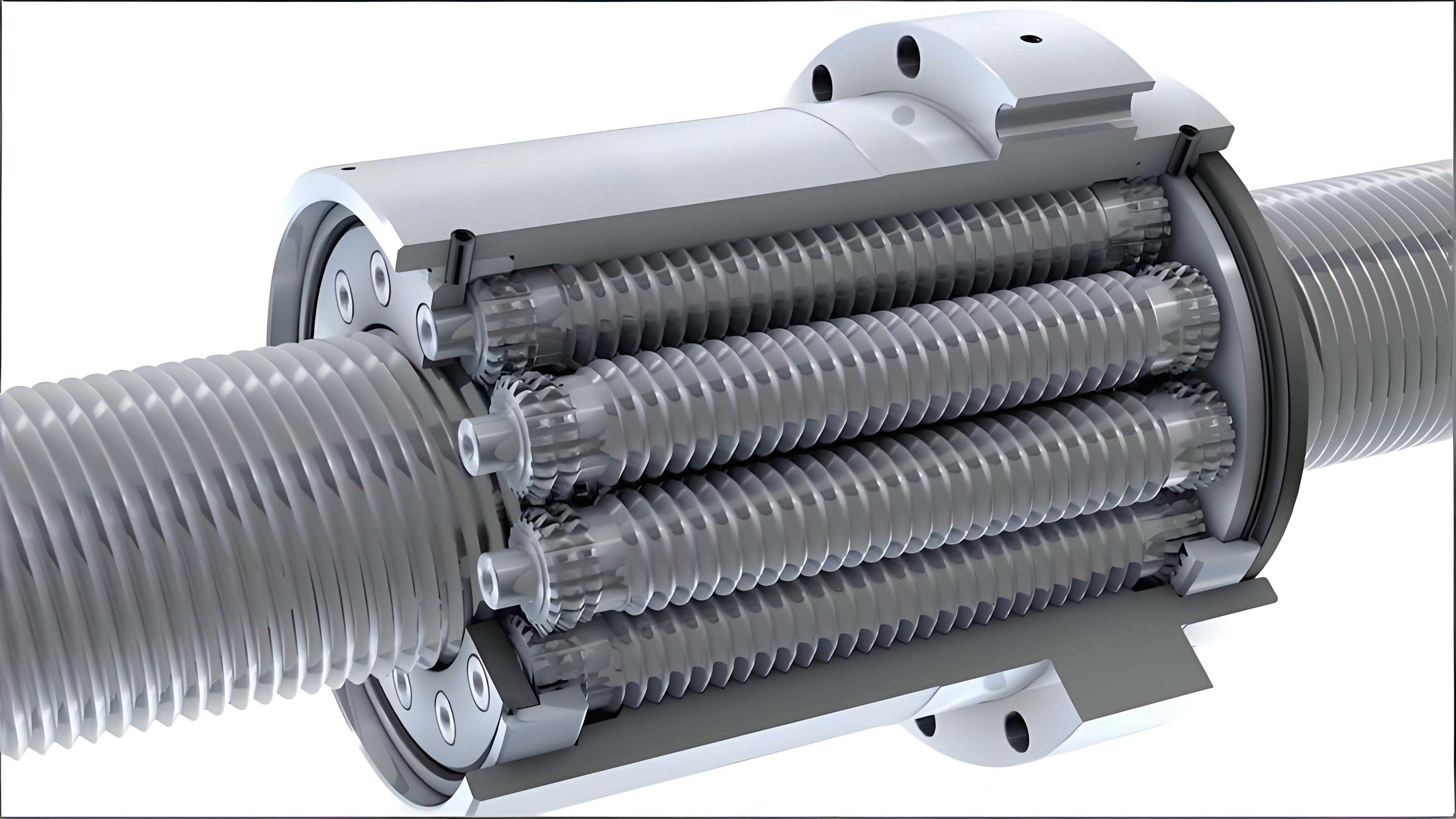
In a typical operational configuration, the screw rotates about its axis. The nut, constrained from rotating, translates axially. The rollers execute a complex composite motion: they rotate about their own axes (spin) while simultaneously revolving around the screw’s axis (orbit), much like planets in a solar system. Crucially, for a standard design, there is no net axial displacement between the rollers and the nut; they translate together. The retainer, which houses the rollers, undergoes the same orbital motion. The following notation is established for analysis: $d_S$, $d_R$, $d_N$ represent the pitch diameters of the screw, roller, and nut threads, respectively. Their geometric relationship is fundamental: $d_N = d_S + 2d_R$. The angular velocities are denoted as $\omega_S$ for the screw, $\omega_R$ for the roller (spin), $\omega_P$ for the retainer/roller orbit (planet carrier), and $\omega_N$ for the nut (usually zero). The thread leads are $L_S$, $L_R$, $L_N$, and for multi-start threads, they relate to the pitch $p$ and number of starts $n$ by $L = n \cdot p$. It is standard that $L_S = L_R = L_N = L$ and typically $n_R = 1$ for the rollers.
Kinematic Analysis: Deriving the Motion Equations
The kinematics of the planetary roller screw assembly can be elegantly analyzed by drawing an analogy to planetary gear systems. The method of inversion is applied: a common angular velocity ($-\omega_P$) is added to the entire system. This makes the planet carrier (retainer) stationary, transforming the mechanism into an ordinary gear train for analysis. The transformed angular velocities are summarized in the table below.
| Component | Original Angular Velocity | Transformed Angular Velocity (After adding $-\omega_P$) |
|---|---|---|
| Screw | $\omega_S$ | $\omega_S – \omega_P$ |
| Roller | $\omega_R$ | $\omega_R + \omega_P$ |
| Nut | 0 (or $\omega_N$) | $-\omega_P$ (or $\omega_N – \omega_P$) |
| Planet Carrier (Retainer) | $\omega_P$ | 0 |
In this inverted stationary frame, the velocity ratio between the screw (now acting as a sun gear) and the nut (acting as a ring gear) must be satisfied via the rollers (planets). Considering the gear ratios through the roller threads as “gears,” we have:
1. Ratio between Screw and Nut via Rollers: The transformed speed of the screw relative to the carrier drives the roller, which in turn drives the nut. The kinematic chain is: Screw -> Roller (Thread 1) -> Roller (Thread 2) -> Nut. This yields:
$$ \frac{\omega_S – \omega_P}{-\omega_P} = \left( \frac{d_R}{d_S} \right) \cdot \left( \frac{d_N}{d_R} \right) $$
Simplifying, and noting $d_N = d_S + 2d_R$, we get:
$$ \frac{\omega_S – \omega_P}{-\omega_P} = \frac{d_N}{d_S} = \frac{d_S + 2d_R}{d_S} $$
2. Ratio between Screw and Roller Spin: Considering just the screw-roller mesh in the inverted frame:
$$ \frac{\omega_S – \omega_P}{\omega_R + \omega_P} = -\frac{d_R}{d_S} $$
The negative sign indicates opposite rotation directions in the inverted frame, which is consistent.
Solving these equations simultaneously allows us to express $\omega_P$ and $\omega_R$ in terms of the input $\omega_S$ and the pitch diameters. From the first equation:
$$ \omega_S – \omega_P = -\omega_P \cdot \frac{d_S + 2d_R}{d_S} $$
$$ \omega_S = \omega_P \left(1 – \frac{d_S + 2d_R}{d_S} \right) = -\omega_P \cdot \frac{2d_R}{d_S} $$
Therefore, the orbital angular velocity of the retainer is:
$$ \omega_P = -\frac{d_S}{2d_R} \omega_S $$
The sign confirms the retainer orbits in the opposite direction to the screw’s rotation. Substituting $\omega_P$ into the second equation gives the roller’s spin velocity:
$$ \omega_R = -\frac{d_S}{2d_R} \omega_S – \omega_P = -\frac{d_S}{2d_R} \omega_S – \left( -\frac{d_S}{2d_R} \omega_S \right)??? $$
A more straightforward derivation from the inverted frame ratio $\frac{\omega_S – \omega_P}{\omega_R + \omega_P} = -\frac{d_R}{d_S}$ is better. Using $\omega_P = -\frac{d_S}{2d_R} \omega_S$:
$$ \frac{\omega_S – (-\frac{d_S}{2d_R} \omega_S)}{\omega_R – \frac{d_S}{2d_R} \omega_S} = \frac{\omega_S (1 + \frac{d_S}{2d_R})}{\omega_R – \frac{d_S}{2d_R} \omega_S} = -\frac{d_R}{d_S} $$
Solving for $\omega_R$:
$$ \omega_S (1 + \frac{d_S}{2d_R}) = -\frac{d_R}{d_S} (\omega_R – \frac{d_S}{2d_R} \omega_S) $$
$$ \omega_S (\frac{2d_R + d_S}{2d_R}) = -\frac{d_R}{d_S} \omega_R + \frac{1}{2} \omega_S $$
$$ \frac{d_S + 2d_R}{2d_R} \omega_S – \frac{1}{2} \omega_S = -\frac{d_R}{d_S} \omega_R $$
$$ \frac{d_S + 2d_R – d_R}{2d_R} \omega_S = \frac{d_S + d_R}{2d_R} \omega_S = -\frac{d_R}{d_S} \omega_R $$
Thus, the spin angular velocity of the roller is:
$$ \omega_R = -\frac{d_S (d_S + d_R)}{2 d_R^2} \omega_S $$
These theoretical values assume perfect rolling contact at the thread interfaces. In reality, micro-slip exists, causing the actual magnitudes of $\omega_R$ and $\omega_P$ to be slightly lower than these calculated values. The primary kinematic result for design is the relationship between input rotation and output translation. The axial travel $L$ of the nut per revolution of the screw is determined by the lead of the screw threads. For a screw with $n_S$ starts and pitch $p$, the lead is $L_S = n_S \cdot p$. Therefore, the axial displacement per unit time is:
$$ v = \frac{\omega_S}{2\pi} \cdot L_S = \frac{\omega_S}{2\pi} \cdot n_S \cdot p $$
Parametric Design Constraints: Thread Hand, Starts, and Gear Matching
A successful design of a planetary roller screw assembly must satisfy specific geometric and kinematic matching conditions to ensure proper meshing and pure rolling motion without binding.
1. Thread Hand and Number of Starts: For the threads to engage correctly and maintain the derived kinematics, relationships between the thread hands (direction) and the number of starts must be enforced. Let’s analyze the relative axial displacement between components over a small time $t$.
Roller-Nut Pair: The nut is typically stationary in rotation ($\omega_N=0$). The relative axial displacement $L_{RN}$ between a roller and the nut arises from two contributions: the roller’s spin and the nut’s hypothetical rotation in the inverted frame. Based on the transformation table, the roller’s spin contribution relative to a stationary nut is $(\omega_R + \omega_P)t / (2\pi) * L_R$. The nut’s motion relative to a stationary roller is $\pm (\omega_P t)/(2\pi) * L_N$, where the sign depends on thread hand. For no net relative displacement ($L_{RN}=0$), we have:
$$ \frac{(\omega_R + \omega_P)t}{2\pi} L_R \pm \frac{\omega_P t}{2\pi} L_N = 0 $$
Given $L_R = n_R p = p$ (since $n_R=1$) and $L_N = n_N p$, and substituting the expressions for $\omega_R$ and $\omega_P$, the equation only holds with a negative sign, implying the threads of the roller and nut must have the same hand. Solving yields the critical relationship for the number of nut starts:
$$ n_N = \frac{d_S}{d_R} + 2 $$
Screw-Roller Pair: A similar analysis for the screw and roller relative displacement $L_{SR}$ gives:
$$ L_{SR} = \frac{(\omega_S – \omega_P)t}{2\pi} L_S \pm \frac{(\omega_R + \omega_P)t}{2\pi} L_R $$
The sign is positive if screw and roller threads have the same hand, negative if opposite. Substituting the angular velocities shows that $L_{SR}$ contains a term dependent on the uncertain $\omega_P$ due to slip. To ensure stable, predictable transmission independent of slip variations, the coefficient of the $\omega_P$ term must be zero. This condition forces the choice of the positive sign, meaning the screw and roller threads must also have the same hand. Consequently, all three components—screw, rollers, and nut—have threads of the same hand (all right-handed or all left-handed). This condition then gives the relationship for the screw starts:
$$ n_S = \frac{d_S}{d_R} + 2 = n_N $$
These are fundamental design equations for the standard planetary roller screw assembly:
$$ \boxed{n_S = n_N = \frac{d_S}{d_R} + 2} \quad \text{and} \quad \boxed{\text{All threads: Same Hand}} $$
2. Gear Train Matching: The spur gears at the ends of the rollers engaging with the internal ring gear on the nut are primarily for phasing and synchronization, not for bearing the main load. Their design must satisfy the kinematic ratio enforced by the threads. Let $z_R$ and $z_N$ be the number of teeth on the roller end gear and the nut’s internal ring gear, respectively, and $m$ their module.
- Speed Ratio Condition: The gear ratio must match the thread-based speed ratio between the roller’s orbit and its spin, as seen from the nut (which is fixed to the ring gear). From the kinematics, the roller spins relative to the nut. The ratio is $\omega_R / \omega_P$ (considering directions). Matching this with the gear ratio $z_N / z_R$ gives:
$$ \frac{z_N}{z_R} = \frac{d_N}{d_R} = \frac{d_S + 2d_R}{d_R} $$ - Interference Avoidance: The tip diameter of the roller end gear must not interfere with the root diameter of the screw thread. This imposes a size constraint:
$$ m(z_R + 2h_a^*) \leq d_{Ra} $$
where $h_a^*$ is the addendum coefficient and $d_{Ra}$ is the major diameter of the roller thread. - Minimum Tooth Number: To avoid undercutting and ensure proper mesh strength, the roller gear must have a sufficient number of teeth:
$$ z_R \geq \frac{2h_a^*}{\sin^2\alpha} $$
where $\alpha$ is the gear pressure angle (typically 20°). If standard gears cannot meet this in the available space, design strategies such as profile shifting (using positive addendum modification) or employing a stub tooth system ($h_a^* < 1$) can be adopted.
| Parameter | Equation / Constraint | Description |
|---|---|---|
| Pitch Diameter Relationship | $d_N = d_S + 2d_R$ | Fundamental geometry |
| Thread Lead | $L_S = L_R = L_N = L$ | Required for meshing |
| Number of Thread Starts | $n_S = n_N = \dfrac{d_S}{d_R} + 2$; $n_R=1$ | Critical design rule |
| Thread Hand | Identical for Screw, Roller, Nut | Ensures kinematic consistency |
| Gear Teeth Ratio | $\dfrac{z_N}{z_R} = \dfrac{d_N}{d_R}$ | Matches thread kinematics |
| Gear Interference | $m(z_R + 2h_a^*) \leq d_{Ra}$ | Prevents clash with screw root |
| Gear Undercutting | $z_R \geq \dfrac{2h_a^*}{\sin^2\alpha}$ | Ensures proper tooth form |
Finite Element Modeling of the Planetary Roller Screw Assembly
While kinematic and geometric design ensures proper motion, evaluating the structural integrity and contact stresses under load is essential. Finite Element Analysis (FEA) provides a powerful tool for this. Here, I detail the process of creating and solving a finite element model for a representative planetary roller screw assembly.
1. Specification and 3D Model Creation: Based on typical performance requirements, a set of design parameters was selected, adhering to the derived equations. The primary parameters for the threaded components and the gear components are listed below.
| Thread Parameters | ||
|---|---|---|
| Parameter | Screw & Nut | Roller |
| Pitch Diameter, $d$ (mm) | 30 / 50 | 10 |
| Major Diameter (mm) | 30.8 / 51.0 | 10.8 |
| Minor Diameter (mm) | 29.0 / 49.2 | 9.0 |
| Pitch, $p$ (mm) | 2 | 2 |
| Number of Starts, $n$ | 5 ($=\frac{30}{10}+2$) | 1 |
| Thread Profile Angle, $\beta$ | 90° | 90° |
| Gear Parameters (Spur, Standard) | ||
| Parameter | Roller End Gear | Internal Ring Gear (Nut) |
| Number of Teeth, $z$ | 20 | 100 ($=20 \times \frac{50}{10}$) |
| Module, $m$ (mm) | 0.5 | |
| Pressure Angle, $\alpha$ | 20° | |
| Addendum Coefficient, $h_a^*$ | 1.0 | |
| Dedendum Coefficient, $h_f^*$ | 1.25 (approx.) | |
| Pitch Diameter (mm) | 10 ($=m \cdot z_R$) | 50 ($=m \cdot z_N$) |
2. Model Simplification for FEA: A full 360-degree model with all rollers is computationally expensive. Leveraging the cyclic symmetry of the planetary roller screw assembly, a sector model comprising one roller and corresponding sections of the screw, nut, retainer, and ring gear was created. Non-essential features like small chamfers, lubrication holes, and mounting flanges were suppressed. The axial load on the nut was specified as 150 kN. For the 1/10th sector model (assuming 10 rollers), this translates to a proportional load of 15 kN applied to the nut segment.
3. Material Properties and Mesh Generation: All primary load-bearing components (screw, nut, rollers) were assigned the properties of through-hardened bearing steel AISI 52100 (GCr15 equivalent). This material is chosen for its high hardness, excellent wear resistance, and good fatigue strength, making it ideal for the demanding contact conditions in a planetary roller screw assembly.
$$ E = 200 \text{ GPa}, \quad \nu = 0.3, \quad \sigma_y \approx 1.7 – 1.8 \text{ GPa} $$
The mesh was generated using a combination of tetrahedral and hexahedral elements, with refined sizing in the critical thread contact regions to capture high stress gradients accurately. A mesh convergence study was performed to ensure results were independent of element size.
4. Contact Definition: Defining appropriate contact conditions is the most critical step in modeling the planetary roller screw assembly.
- Screw-Roller & Roller-Nut Thread Interfaces: These are defined as Frictional contacts. This allows for separation in the normal direction and sliding in the tangential direction once the frictional shear stress is exceeded. A coefficient of friction of 0.05-0.1 is typical for lubricated steel-on-steel contacts. This setting realistically models the load transfer and potential micro-slip.
- Roller Gear – Ring Gear Interface: Also defined as a Frictional contact, as it transmits motion but may experience sliding under certain conditions.
- Ring Gear – Nut Body: Since these are typically manufactured as one piece or rigidly connected, a Bonded contact is used, preventing any relative motion.
- Roller – Retainer & Retainer – Ring Gear: The retainer primarily provides axial and radial location without carrying significant load. These interfaces are modeled as Frictionless contacts, allowing free movement except for penetration.
5. Boundary Conditions and Constraints:
- Nut: Constrained with a Displacement Support allowing only translation along its axis (Z-direction). A force of 15 kN is applied to its reference surface in the axial direction, simulating the external load.
- Roller: Constrained with a Cylindrical Support on its central axis, allowing rotation about and translation along its own axis, mimicking its planetary motion.
- Retainer: Similarly, a Cylindrical Support is applied to allow its orbital rotation and axial translation.
- Screw: One end is fixed (Fixed Support), simulating a bearing location. The other end is supported with a Displacement Support allowing only axial translation, simulating a simple bearing.
- Symmetry/Sector Conditions: The two radial faces of the 36-degree sector model are constrained with Frictionless Supports. This enforces the cyclic symmetry condition, meaning the faces can deform normally but remain planar and parallel to their original orientation relative to each other.
Finite Element Results and Parametric Influence Study
Solving the nonlinear contact problem provides detailed insights into the stress state of the planetary roller screw assembly under load.
1. Contact Stress Distribution: The von Mises equivalent stress contours at the thread contact zones reveal the load paths. The maximum stresses occur at the localized contact ellipses between the threads.
- Screw-Roller Contact: The peak equivalent stress was found to be approximately 1491 MPa, located on the screw thread flank. This is below the yield strength of the material, indicating a safe design under static load.
- Nut-Roller Contact: The peak equivalent stress here was slightly higher, at about 1499 MPa, located on the roller thread flank.
A significant observation common to both contacts is the uneven distribution of load among engaged thread turns. The first fully engaged thread turn adjacent to the load application zone bears the highest proportion of the load, exhibiting the maximum stress. The stress level decreases progressively for subsequent thread turns along the axis. This non-uniform load distribution is a classic characteristic of threaded connections and is a critical factor in the fatigue life of the planetary roller screw assembly.
2. Influence of Thread Profile Angle ($\beta$): The thread profile angle significantly affects both the contact stress and the transmission efficiency. To study its impact, a series of simulations were run, varying $\beta$ while keeping the pitch ($p=2$ mm) and other geometric ratios constant. The maximum equivalent contact stresses for the two primary interfaces are summarized below.
| Thread Profile Angle, $\beta$ | Max Stress: Screw-Roller (MPa) | Max Stress: Nut-Roller (MPa) |
|---|---|---|
| 60° | 1505 | 1246 |
| 70° | 1354 | 1387 |
| 80° | 1557 | 1331 |
| 90° | 1491 | 1500 |
| 100° | 1419 | 1585 |
The data indicates that a profile angle of 70° yields the lowest overall contact stresses. However, the selection of the profile angle involves a trade-off. Research shows that a larger profile angle generally leads to higher transmission efficiency in a planetary roller screw assembly due to reduced friction losses from lower normal contact forces for a given axial load. The 90° profile offers a reasonable compromise, providing good efficiency (superior to 60° or 70°) while maintaining acceptable contact stress levels (lower than some alternatives like 80°). This is why the 90° profile is a common standard in many industrial designs.
3. Influence of Thread Pitch ($p$): The pitch is a fundamental parameter determining the lead and thus the speed of the planetary roller screw assembly. Its effect on contact stress was investigated by varying $p$ while maintaining a 90° profile angle and proportional scaling of other dimensions where necessary. The results are tabulated below.
| Thread Pitch, $p$ (mm) | Max Stress: Screw-Roller (MPa) | Max Stress: Nut-Roller (MPa) |
|---|---|---|
| 1.5 | 1345 | 1262 |
| 2.0 | 1491 | 1500 |
| 2.5 | 1638 | 1681 |
| 3.0 | 1727 | 1595 |
| 3.5 | 2159 | 1717 |
A clear trend is observed: the maximum contact stress increases with increasing pitch. This relationship is primarily due to the reduction in the number of load-bearing thread turns over a given axial length. For a fixed nut length, a larger pitch means fewer threads are engaged to share the total axial load. Consequently, the load per thread increases, leading to higher Hertzian contact stresses. Therefore, while a larger pitch offers a higher lead for faster translation, it comes at the cost of reduced static load capacity and potentially higher contact stresses in the planetary roller screw assembly. Designers must balance the need for speed against the requirement for load capacity and longevity.
Conclusion
The planetary roller screw assembly is a complex and high-performance actuation system whose design requires a meticulous integration of kinematic principles and mechanical strength analysis. Through this detailed examination, several key conclusions can be drawn. First, the kinematic analysis, analogous to planetary gearing, yields essential design rules: the screw, rollers, and nut must have threads with the same hand, and the number of starts must satisfy $n_S = n_N = d_S/d_R + 2$. Second, the matching gear train on the roller ends must adhere to the ratio $z_N/z_R = d_N/d_R$ while avoiding interference with the screw and meeting minimum tooth requirements. Third, finite element analysis reveals that contact stresses, while within the yield limit for a well-designed assembly, are not uniformly distributed across thread turns, with the first engaged turn experiencing the highest load. This uneven distribution is a critical consideration for fatigue design. Finally, parametric studies demonstrate that the thread profile angle involves a trade-off between contact stress and efficiency, with 90° being a common practical choice. The thread pitch has a more direct effect on contact stress, with larger pitches leading to significantly higher stresses due to fewer engaged threads, thereby impacting the load capacity of the planetary roller screw assembly. These analyses and findings provide a robust framework for the design, optimization, and selection of planetary roller screw assemblies for demanding engineering applications.