
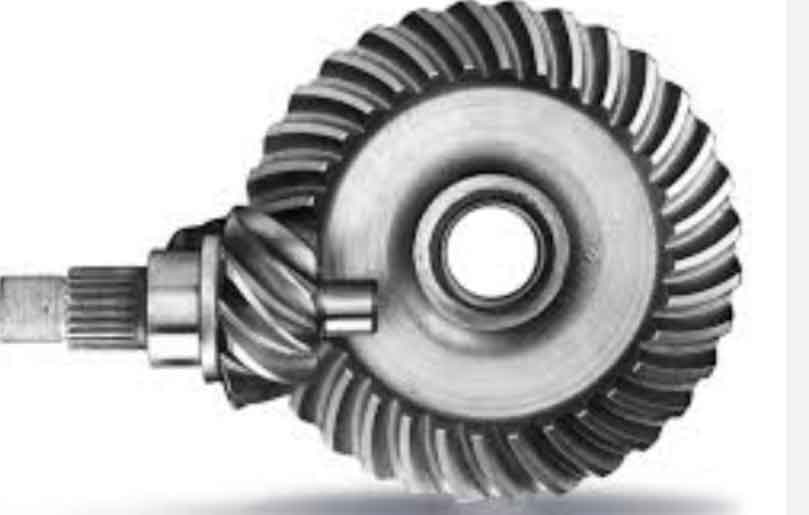
Hypoid gears are widely used in automotive transmissions due to their compact structure, high load capacity, and low noise characteristics. However, traditional design methods often rely on empirical parameter selection, leading to suboptimal solutions in terms of manufacturing cost and noise performance. This paper proposes a multi-objective optimization framework using the NSGA-II algorithm to minimize hypoid gear pair volume and noise while meeting strength requirements.
Mathematical Model for Hypoid Gear Optimization
The optimization model focuses on five independent design variables:
$$ \mathbf{X} = [z_1, d_{e2}, b_2, E, \beta_2]^T $$
where \( z_1 \) is the pinion tooth count, \( d_{e2} \) the gear outer pitch diameter, \( b_2 \) the gear face width, \( E \) the offset distance, and \( \beta_2 \) the gear mean spiral angle.
Objective Functions
1. Volume Minimization:
The total volume of hypoid gear pair is approximated as:
$$ \min F_1(\mathbf{X}) = \frac{\pi}{4} \left[ b_1 \left( d_{e1}^2 – 2d_{e1}b_1 \sin\delta_1 + \frac{4}{3}b_1^2 \sin^2\delta_1 \right) \cos\delta_1 + b_2 \left( d_{e2}^2 – 2d_{e2}b_2 \sin\delta_2 + \frac{4}{3}b_2^2 \sin^2\delta_2 \right) \cos\delta_2 \right] $$
2. Noise Minimization:
Noise reduction is achieved by targeting a transverse contact ratio \( \varepsilon_F \) close to 2:
$$ \min F_2(\mathbf{X}) = \left| 2 – \left( k_2 \tan\beta – \frac{k_3^2}{3} \tan^3\beta \right) \frac{A_0}{\pi m} \right| $$
where \( \beta \) represents the average spiral angle, \( A_0 \) the cone distance, and \( m \) the gear module.
Design Constraints
| Parameter | Constraint |
|---|---|
| Pinion teeth count | 5 ≤ \( z_1 \) ≤ 12 |
| Total teeth count | 40 ≤ \( z_1 + z_2 \) ≤ 60 |
| Offset distance | 0.1\( d_{e2} \) ≤ E ≤ 0.2\( d_{e2} \) |
| Face width | 4m ≤ \( b_2 \) ≤ 10m |
| Spiral angle | 30° ≤ \( \beta_m \) ≤ 50° |
NSGA-II Implementation
The optimization process follows these key steps:
- Population initialization with 150 individuals
- Non-dominated sorting for Pareto frontier identification
- Crowding distance calculation for diversity maintenance
- Genetic operations (crossover: 80%, mutation: 20%)
- Elitism strategy for preserving superior solutions
The algorithm termination criteria include:
$$ \Delta F_{\text{best}}^{(k)} < 10^{-6} \quad \text{or} \quad k > 1000 $$
where \( \Delta F_{\text{best}}^{(k)} \) represents the fitness improvement at iteration \( k \).
Case Study: Automotive Hypoid Gear Optimization
A hypoid gear pair with initial parameters (\( i = 4.1, z_1 = 10, d_{e2} = 200 \text{mm} \)) was optimized using the proposed method. The Pareto frontier shown below demonstrates the trade-off between volume and noise performance:
| Parameter | Initial Design | Optimized Design | Improvement |
|---|---|---|---|
| Gear pair volume (mm³) | 2.8324×10⁵ | 2.4725×10⁵ | 12.7% ↓ |
| Contact ratio (\( \varepsilon_F \)) | 2.1552 | 1.9532 | 9.4% closer to 2 |
| Offset distance (mm) | 20.00 | 19.72 | 1.4% ↓ |
| Gear face width (mm) | 30.00 | 26.13 | 12.9% ↓ |
The optimization results demonstrate significant improvements in both objectives. The refined hypoid gear design achieves better noise characteristics while reducing material consumption, particularly through adjustments to face width and spiral angle.
Key Findings
- The NSGA-II algorithm effectively resolves conflicting objectives in hypoid gear design
- Face width reduction contributes more significantly to volume minimization than diameter changes
- Spiral angle adjustment between 37°-39° optimizes the noise-volume trade-off
- Constraint handling ensures practical manufacturability of optimized solutions
This methodology provides a systematic approach for designing high-performance hypoid gears in automotive applications, balancing economic and acoustic requirements through advanced multi-objective optimization techniques.