
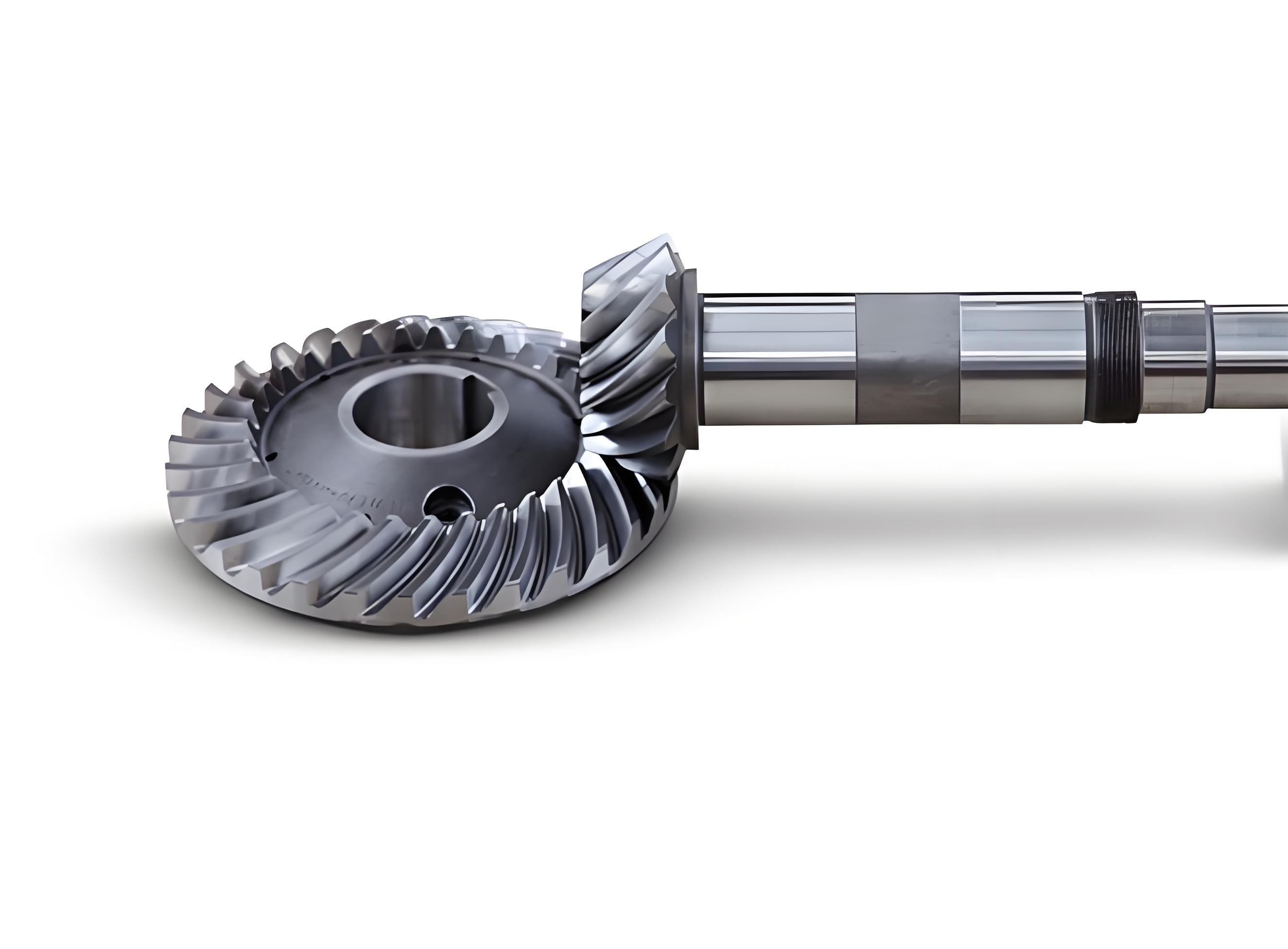
This paper presents a systematic approach to optimize the tooth surface design of spiral bevel gears for aerospace applications, focusing on improving contact ratio and reducing transmission error amplitude. By integrating TCA (Tooth Contact Analysis), LTCA (Load Tooth Contact Analysis), and local synthesis method, we establish a multi-objective optimization framework to enhance gear strength and vibration resistance.
1. Fundamental Concepts
1.1 Contact Ratio Analysis
The theoretical contact ratio (ε) of spiral bevel gears is defined as:
$$ \epsilon = \frac{C_T}{T_Z} $$
where $C_T$ represents the total contact duration and $T_Z = \frac{360^{\circ}}{N}$ denotes the angular pitch. The actual contact ratio under load considers elastic deformation effects.
1.2 Transmission Error Characteristics
The parabolic transmission error (TE) function for spiral bevel gears is expressed as:
$$ \Delta\phi_2(\phi_1) = \phi_2 – \left(\phi_2^0 + \frac{N_1}{N_2}(\phi_1 – \phi_1^0)\right) = \frac{m_{21}’}{2}(\phi_1 – \phi_1^0)^2 $$
where $m_{21}’$ represents the first derivative of transmission ratio. The TE amplitude at mesh transition is:
$$ \delta_{TE} = \frac{T_Z^2}{8}|m_{21}’| $$
2. Optimization Methodology
2.1 Multi-Objective Problem Formulation
The optimization model for spiral bevel gear design considers three second-order contact parameters:
$$ X = [\eta, m_{21}’, \delta]^T $$
with objectives:
$$ \begin{cases}
\min f_1(\eta, m_{21}’, \delta) = \frac{1}{\epsilon} \\
\min f_2(\eta, m_{21}’, \delta) = \delta_{TE}
\end{cases} $$
Subject to constraints:
$$ \begin{cases}
30^{\circ} \leq \eta \leq 90^{\circ} \\
-0.008 \leq m_{21}’ \leq 0.008 \\
0.15 \leq \delta \leq 0.20
\end{cases} $$
2.2 NSGA-II Implementation
The optimization process employs Non-dominated Sorting Genetic Algorithm II (NSGA-II) with parameters:
| Parameter | Value |
|---|---|
| Population Size | 200 |
| Crossover Probability | 0.9 |
| Mutation Probability | 0.1 |
| Generations | 500 |
3. Case Study and Results
3.1 Gear Parameters
The spiral bevel gear pair specifications are:
| Parameter | Pinion | Gear |
|---|---|---|
| Teeth Number | 28 | 73 |
| Module (mm) | 3.85 | 3.85 |
| Face Width (mm) | 40 | 40 |
| Pressure Angle | 20° | 20° |
3.2 Optimization Results
The Pareto frontier obtained through NSGA-II optimization shows significant improvements:
| Parameter | Initial | Optimized |
|---|---|---|
| Contact Trace Angle (η) | 60° | 30.38° |
| Transmission Ratio Derivative (m_{21}’) | -0.008 | -0.001 |
| Contact Ellipse Ratio (δ) | 0.18 | 0.1502 |
Performance improvements include:
$$ \begin{aligned}
&\text{Contact Ratio: } +16.69\% \\
&\text{TE Amplitude: } -87.33\% \\
&\text{Loaded TE Mean: } -11.82\% \\
&\text{Contact Stress: } -0.25\% \\
&\text{Gear Root Stress: } -13.61\%
\end{aligned} $$
3.3 LTCA Verification
Load distribution characteristics demonstrate:
$$ C_p = \frac{p}{P} $$
where $C_p$ represents load-sharing coefficient, $p$ is individual tooth load, and $P$ is total load. The optimized design shows more uniform load distribution and reduced stress concentration.
4. Conclusion
This study establishes an effective multi-objective optimization framework for spiral bevel gears, achieving simultaneous improvement in contact ratio and transmission error characteristics. The NSGA-II-based approach demonstrates superior performance in balancing conflicting design objectives, providing valuable insights for high-speed heavy-load gear design.
Key advantages of the optimized spiral bevel gear design include:
- Enhanced contact pattern stability
- Reduced vibration excitation sources
- Improved load distribution characteristics
- Increased system reliability under extreme conditions
The methodology proves particularly effective for aerospace applications where weight reduction and vibration control are critical requirements for spiral bevel gear systems.