
In modern manufacturing, the demand for energy-efficient, high-quality, and sustainable processes has led to the adoption of advanced techniques like high-speed dry gear hobbing. This method eliminates cutting fluids, reducing environmental impact, but introduces challenges such as excessive heat generation, which affects energy consumption, gear quality, and tool life. As a gear hobbing machine operator or process engineer, I often face the dilemma of selecting optimal parameters that balance these competing objectives. Traditional single or dual-objective optimizations fall short in addressing the complex interdependencies in gear hobbing. Therefore, in this work, we develop a comprehensive multi-objective optimization model focusing on minimizing energy consumption, reducing quality errors, and maximizing tool life. We employ the NSGA-III algorithm for optimization and an AHP-TOPSIS combined method for decision-making, enabling efficient ranking of parameter sets. This approach not only enhances the performance of gear hobbing operations but also supports green manufacturing initiatives. Throughout this article, we will delve into the problem formulation, model development, optimization techniques, and experimental validation, emphasizing the critical role of gear hobbing and gear hobbing machine parameters in achieving superior outcomes.
The gear hobbing process involves multiple variables, including workpiece parameters, tool characteristics, and machining conditions. For a typical gear hobbing task, the parameters can be represented as a set: gear hobbing parameters include the module, number of teeth, pressure angle, helix angle, outer diameter, and face width. The key decision variables we optimize are the axial feed rate (denoted as \( f_z \)), spindle speed (\( n_z \)), hob diameter (\( d_{a2} \)), and number of hob threads (\( z_2 \)). These variables significantly influence the energy consumption, tool longevity, and quality of the gear hobbing output. In high-speed dry gear hobbing, the absence of coolant exacerbates tool wear and heat-related issues, making parameter selection crucial. For instance, an improper axial feed rate in a gear hobbing machine can lead to increased cutting forces, higher energy usage, and accelerated tool degradation. Thus, our multi-objective framework aims to harmonize these factors, ensuring that the gear hobbing process is both efficient and reliable.
To model energy consumption in a gear hobbing machine, we consider the entire machining cycle, including standby, empty cutting, and actual cutting phases. The total energy \( E_{\text{total}} \) is the sum of energies from these stages:
$$ E_{\text{standby}} = P_{\text{standby}} T_{\text{standby}} $$
where \( P_{\text{standby}} \) is the power during standby and \( T_{\text{standby}} \) is the time. For the empty cutting phase, energy is given by:
$$ E_{\text{empty}} = P_{\text{empty}} T_{\text{empty}} $$
with \( P_{\text{empty}} = P_{\text{standby}} + P_{\text{assist}} + P_{\text{emotor}} \), and the motor power \( P_{\text{emotor}} \) relates to spindle speed as:
$$ P_{\text{emotor}} = a_1 n_z^2 + b_1 n_z + c_1 $$
The empty cutting time \( T_{\text{empty}} \) depends on axial and radial feed motions:
$$ T_{\text{empty}} = \sum_{n_{\text{walk}}} \frac{S_x}{F_x} + \sum_{n_{\text{walk}}} \frac{S_z}{F_z} $$
During cutting, the total power includes components from cutting force, which is expressed as:
$$ F_{\text{cut}} = \frac{c_f k_1 k_2 k_3 m_t^{x_f} f_z^{y_f} a_p^{z_f} v_{\text{cut}}^{-u_f} z_1^{v_f}}{d_{a2}} $$
where \( v_{\text{cut}} = \frac{\pi d_{a2} n_z}{1000} \). The load-related power loss is:
$$ P_{\text{load}} = a_2 P_{\text{cut}}^2 + b_2 P_{\text{cut}} + c_2 $$
and the cutting time \( T_{\text{cut}} \) is:
$$ T_{\text{cut}} = \frac{S_{\text{cut}}}{F_z} $$
with \( S_{\text{cut}} \) derived from gear and tool geometry. Thus, the total cutting energy is:
$$ E_{\text{cut}}^{\text{total}} = (P_{\text{empty}} + P_{\text{cut}} + P_{\text{load}}) T_{\text{cut}} $$
Summing up, the overall energy model for the gear hobbing machine is:
$$ E_{\text{total}} = E_{\text{standby}} + E_{\text{empty}} + E_{\text{cut}}^{\text{total}} $$
This comprehensive model accounts for all operational phases, providing a realistic basis for optimization in gear hobbing.
Tool life in gear hobbing is critical for cost-effectiveness and process stability. We model the hob life \( L_{\text{tool}} \) using an empirical relation:
$$ L_{\text{tool}} = \frac{C_v}{v_{\text{cut}} f_z^{y_v} m_t^{x_v} K_v^{m_v – 1}} $$
where \( C_v, K_v, x_v, y_v, m_v \) are tool-dependent coefficients. This equation highlights how axial feed rate and cutting speed impact tool longevity in a gear hobbing machine. For example, higher speeds may reduce tool life due to increased thermal stress, underscoring the need for balanced parameter selection in gear hobbing.
Quality errors in gear hobbing primarily arise from deviations in tooth profile and alignment. We define the total quality error \( Q_{\text{error}} \) as a weighted sum of profile error \( e_x \) and alignment error \( e_y \):
$$ e_x = \frac{f_z^2 \sin \alpha}{4 d_{a2} \cos^2 \beta} $$
$$ e_y = \frac{(\pi z_2)^2 m_n \sin \alpha}{4 z_1 n_i^2} $$
Thus, the quality model is:
$$ Q_{\text{error}} = 0.5 e_x + 0.5 e_y $$
This formulation captures the influence of key gear hobbing parameters like axial feed rate and hob diameter on the final gear quality.
Our multi-objective optimization problem is formulated as:
$$ \min \, f = (E_{\text{total}}, Q_{\text{error}}, -L_{\text{tool}}) $$
Note that we maximize tool life by minimizing its negative. The decision variables are bounded by practical constraints in gear hobbing:
$$ 1.2 \leq f_z \leq 2 $$
$$ 700 \leq n_z \leq 1300 $$
$$ 75 \leq d_{a2} \leq 90, \quad d_{a2} \in \mathbb{N} $$
$$ 1.9 \leq z_2 \leq 3.1, \quad z_2 \in \mathbb{N} $$
Additional constraints include limits on cutting force and surface roughness:
$$ F_{\text{cut}} \leq (F_{\text{cut}})_{\text{max}} $$
$$ R_a = 0.312 \frac{f_z^2}{r} \leq [R_a] $$
These ensure that the optimized parameters are feasible for a gear hobbing machine.
To solve this multi-objective problem, we use the NSGA-III algorithm, which is effective for three or more objectives. NSGA-III employs reference points to maintain diversity and convergence. The steps include generating reference points, combining parent and offspring populations, non-dominated sorting, and selecting individuals based on association with reference vectors. This approach yields a Pareto-optimal set of solutions for gear hobbing parameters, distributed evenly across the objective space. For decision-making, we integrate the Analytic Hierarchy Process (AHP) and Technique for Order Preference by Similarity to Ideal Solution (TOPSIS). AHP computes weights for each objective based on pairwise comparisons, while TOPSIS ranks the solutions by proximity to the ideal solution. The combined AHP-TOPSIS method dynamically assesses the trade-offs, facilitating efficient selection of gear hobbing parameters.
In AHP, we construct a judgment matrix \( A \) for the objectives (energy, quality error, tool life):
$$ A = \begin{bmatrix} 1 & a_{12} & a_{13} \\ a_{21} & 1 & a_{23} \\ a_{31} & a_{32} & 1 \end{bmatrix} $$
The weights \( \epsilon_j \) are derived from the eigenvector of \( A \). For TOPSIS, we normalize the decision matrix \( X \) of solutions:
$$ X = \begin{bmatrix} x_{11} & x_{12} & x_{13} \\ x_{21} & x_{22} & x_{23} \\ \vdots & \vdots & \vdots \\ x_{n1} & x_{n2} & x_{nm} \end{bmatrix} $$
Normalization gives:
$$ x’_{ij} = \frac{x_{ij}}{\sqrt{\sum_{k=1}^n x_{kj}^2}} $$
The weighted normalized matrix \( Z \) is:
$$ z_{ij} = x’_{ij} \epsilon_j $$
We then identify the ideal \( Z^+ \) and anti-ideal \( Z^- \) solutions, compute distances \( S_i^+ \) and \( S_i^- \), and calculate the closeness coefficient:
$$ C_i = \frac{S_i^-}{S_i^+ + S_i^-} $$
Solutions with higher \( C_i \) are preferred, providing a ranked list for gear hobbing parameter sets.
For experimental validation, we conducted tests on a YDZ3126CNC gear hobbing machine, a high-precision device suitable for high-speed dry gear hobbing. The machine specifications include a spindle speed range of 0–2,500 rpm, axial feed rate up to 7,500 mm/min, and a maximum module of 6 mm. We used a workpiece made of 45 steel with a module of 2.5 mm, 51 teeth, pressure angle of 20°, helix angle of 19°, outer diameter of 132.5 mm, and face width of 45 mm. The hob was made of high-speed steel with a normal module of 2 mm, 12 grooves, installation angle of 18°, spiral angle of 3.16°, and right-hand rotation. The following table summarizes the key parameters used in our models:
| Parameter | Value | Description |
|---|---|---|
| \( P_{\text{standby}} \) | 2300 W | Standby power |
| \( P_{\text{assist}} \) | 245 W | Auxiliary system power |
| \( T_{\text{standby}} \) | 3.5 min | Standby time |
| \( a_1 \) | 2.13e-6 | Motor power coefficient |
| \( b_1 \) | -0.08 | Motor power coefficient |
| \( c_1 \) | 0 | Motor power coefficient |
| \( a_2 \) | 1.33e-5 | Load loss coefficient |
| \( b_2 \) | 0.035 | Load loss coefficient |
| \( c_2 \) | 0 | Load loss coefficient |
| \( S_x \) | 110.6 mm | Radial travel distance |
| \( S_z \) | 22.15 mm | Axial travel distance |
| \( F_x \) | 1500 mm/min | Radial feed rate |
| \( a_p \) | 6.5 mm | Cutting depth |
| \( E \) | 2 mm | Entry safe distance |
| \( U \) | 2 mm | Exit safe distance |
| \( c_f \) | 18.2 | Cutting force coefficient |
| \( u_f \) | 0.27 | Cutting force exponent |
| \( v_f \) | 0.28 | Cutting force exponent |
| \( x_f \) | 1.76 | Cutting force exponent |
| \( y_f \) | 0.65 | Cutting force exponent |
| \( z_f \) | 0.82 | Cutting force exponent |
| \( k_1, k_2, k_3 \) | 1, 1.08, 1.11 | Workpiece coefficients |
| \( C_v \) | 289 | Tool life coefficient |
| \( K_v \) | 0.68 | Tool life coefficient |
| \( x_v \) | 0 | Tool life exponent |
| \( y_v \) | 0.5 | Tool life exponent |
| \( m_v \) | 0.33 | Tool life exponent |
We implemented the NSGA-III algorithm in MATLAB with a population size of 100, 15 reference points, and a maximum of 800 generations. The Pareto-optimal solutions obtained cover a range of trade-offs among energy consumption, quality error, and tool life. For example, one solution might prioritize low energy use, while another emphasizes high tool longevity. The distribution of solutions in the objective space shows a concentrated front, indicating effective convergence. The following table presents a subset of the optimized gear hobbing parameter sets and their objective values:
| Solution ID | \( f_z \) (mm/r) | \( n_z \) (rpm) | \( d_{a2} \) (mm) | \( z_2 \) | \( E_{\text{total}} \) (J) | \( Q_{\text{error}} \) (mm) | \( L_{\text{tool}} \) (min) |
|---|---|---|---|---|---|---|---|
| J1 | 1.5516 | 1300 | 90 | 3 | 6,632,490 | 0.0286 | 330.3415 |
| J2 | 1.3510 | 1300 | 90 | 3 | 7,148,332 | 0.0229 | 330.1892 |
| J3 | 1.2814 | 1265.4 | 84 | 2 | 7,769,636 | 0.0205 | 330.1508 |
| J4 | 1.4497 | 1300 | 89 | 3 | 6,941,909 | 0.0245 | 330.1884 |
| J5 | 1.2988 | 1267.2 | 98 | 3 | 7,588,220 | 0.0217 | 330.2103 |
| … | … | … | … | … | … | … | … |
| J30 | 1.3918 | 1276.3 | 89 | 3 | 7,220,303 | 0.0237 | 330.1503 |
To rank these solutions, we applied AHP-TOPSIS with weights derived from pairwise comparisons: energy consumption (0.5396), quality error (0.2970), and tool life (0.1634). The closeness coefficients \( C_i \) were computed, and the top 15 solutions are listed below:
| Solution ID | Closeness Coefficient \( C_i \) | Rank |
|---|---|---|
| J2 | 0.72839 | 1 |
| J21 | 0.70731 | 2 |
| J10 | 0.70436 | 3 |
| J4 | 0.69739 | 4 |
| J25 | 0.69606 | 5 |
| J29 | 0.69119 | 6 |
| J9 | 0.67658 | 7 |
| J30 | 0.66815 | 8 |
| J12 | 0.66774 | 9 |
| J13 | 0.65457 | 10 |
| J8 | 0.64959 | 11 |
| J15 | 0.64681 | 12 |
| J6 | 0.64136 | 13 |
| J7 | 0.64073 | 14 |
| J11 | 0.63562 | 15 |
Solution J2, with parameters \( f_z = 1.3510 \) mm/r, \( n_z = 1300 \) rpm, \( d_{a2} = 90 \) mm, and \( z_2 = 3 \), ranks highest, offering a balanced compromise. If energy minimization is the primary goal, J1 is preferable, whereas J3 excels in quality error reduction, and J7 maximizes tool life. This ranking system enhances decision-making in gear hobbing by providing a clear hierarchy of options.
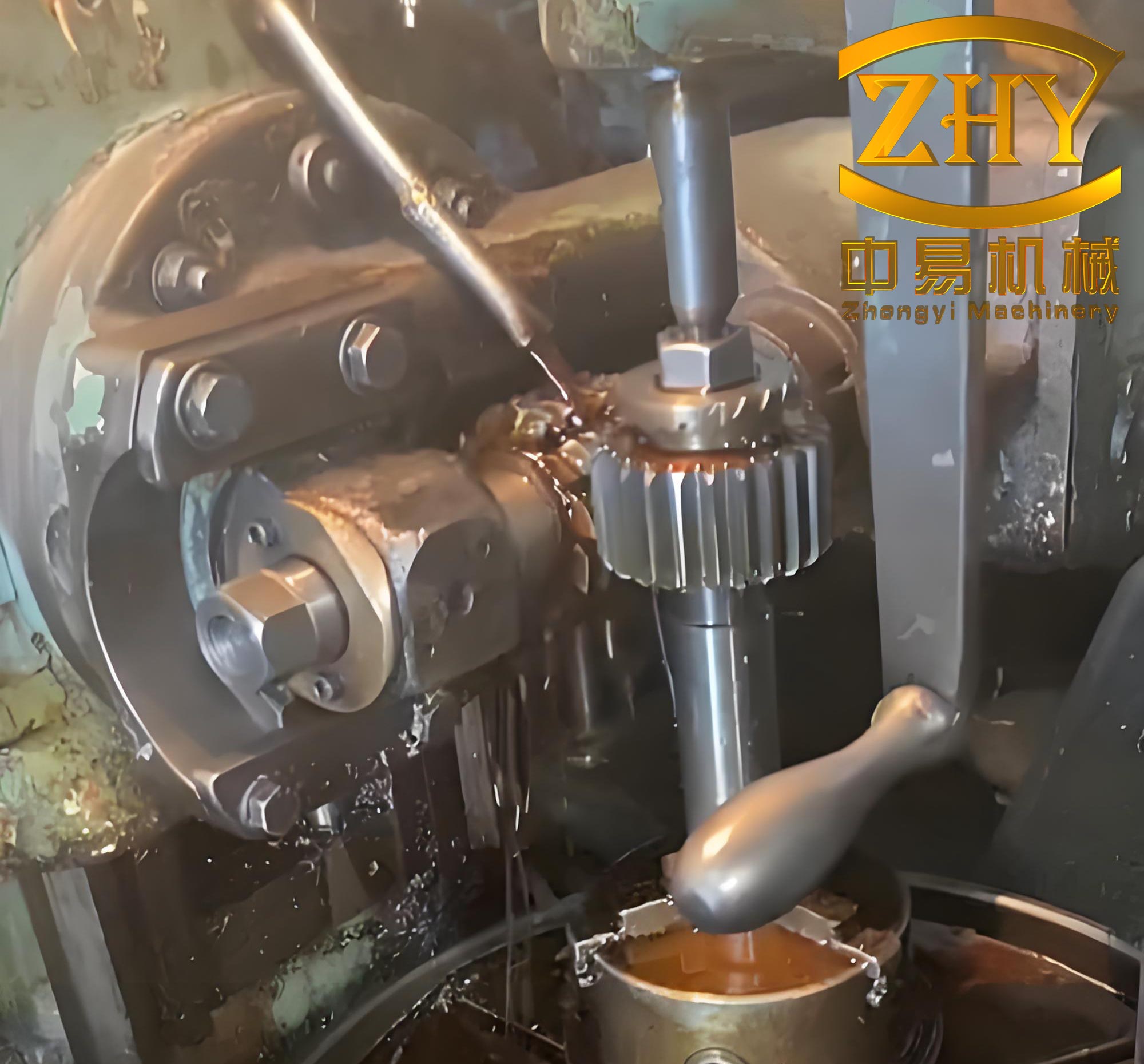
To validate our approach, we compared it with NSGA-II and MOPSO algorithms under the same conditions. NSGA-II uses crowding distance for selection, while MOPSO employs particle swarm optimization. The Pareto fronts from these methods were more dispersed, indicating inferior convergence compared to NSGA-III. Using AHP-TOPSIS, we evaluated the best solutions from each algorithm. The comparison table below shows that our method outperforms others in all objectives:
| Algorithm | \( f_z \) (mm/r) | \( n_z \) (rpm) | \( d_{a2} \) (mm) | \( z_2 \) | \( E_{\text{total}} \) (J) | \( Q_{\text{error}} \) (mm) | \( L_{\text{tool}} \) (min) |
|---|---|---|---|---|---|---|---|
| Our Method (NSGA-III) | 1.3510 | 1300 | 90 | 3 | 7,148,332 | 0.0229 | 330.1892 |
| NSGA-II | 1.3813 | 1293.7 | 89 | 3 | 7,267,248 | 0.0240 | 330.1020 |
| MOPSO | 1.6348 | 1289 | 89 | 2 | 7,462,018 | 0.0245 | 330.1180 |
Relative to NSGA-II, our method reduces energy consumption by 1.64%, quality error by 4.58%, and improves tool life by 0.026%. Compared to MOPSO, it achieves a 4.2% energy reduction, 6.53% error reduction, and 0.022% tool life improvement. These results underscore the efficacy of our multi-objective optimization and decision-making framework for gear hobbing.
In conclusion, we have presented a robust methodology for optimizing high-speed dry gear hobbing process parameters, addressing the tri-objective problem of energy consumption, quality error, and tool life. The integration of NSGA-III and AHP-TOPSIS provides a systematic way to generate and rank Pareto-optimal solutions, facilitating informed decisions in gear hobbing operations. Our experimental results demonstrate significant improvements over existing methods, highlighting the potential for enhancing the sustainability and efficiency of gear hobbing machines. Future work could explore real-time adaptive control and incorporation of additional objectives like cost or surface finish, further advancing the capabilities of gear hobbing in industrial applications.