
The pursuit of high-performance, cost-effective, and quiet power transmission systems is a central theme in advanced mechanical design, particularly in the automotive industry. Among various gear types, hyperboloidal gears stand out due to their unique offset-axis configuration. This geometry grants them exceptional advantages, including high load-carrying capacity, smooth operation, compact structure, and the ability to achieve high reduction ratios in a single stage. These attributes make hyperboloidal gears the preferred choice for critical applications such as automobile rear axle differentials, where space is constrained, loads are substantial, and noise-vibration-harshness (NVH) performance is paramount. The design of these gears, however, involves a complex interplay of numerous geometrical and performance parameters. Traditional design methodologies often rely heavily on empirical knowledge and iterative adjustments to meet basic strength requirements. This approach, while functional, frequently fails to converge on a truly optimal design that simultaneously minimizes material usage, manufacturing cost, and operational noise. Consequently, the final gear pair may be over-engineered, unnecessarily heavy, and noisier than necessary.
The advent of sophisticated computational optimization techniques offers a powerful pathway to overcome these limitations. This article presents a comprehensive framework for the optimal design of hyperboloidal gears by formulating and solving a multi-objective optimization problem. The primary goals are to minimize the overall volume of the gear pair—directly linked to material cost and weight—and to minimize transmission noise, a critical factor for passenger comfort. To effectively navigate the trade-offs between these competing objectives, we employ the Non-dominated Sorting Genetic Algorithm II (NSGA-II), a robust and efficient multi-objective evolutionary algorithm. The following sections detail the mathematical modeling of the problem, the implementation of the optimization algorithm, and a practical case study demonstrating significant improvements over a conventional design.
Mathematical Formulation of the Optimization Problem
The first and most crucial step in any optimization process is to develop a precise mathematical model that represents the physical system, its objectives, and its constraints. For hyperboloidal gears, this involves identifying independent design variables, formulating objective functions for volume and noise, and defining a set of practical and theoretical constraints.
Design Variables
The geometry and performance of a hyperboloidal gear pair are governed by several parameters. For a given transmission ratio, a subset of these parameters can be considered independent. After careful analysis of the governing equations for volume and meshing dynamics, the following five parameters are selected as the primary design variables:
Let the design variable vector be:
$$ \mathbf{X} = [z_1, d_{e2}, b_2, E, \beta_m2]^T $$
where:
- \( z_1 \): Number of teeth on the pinion (smaller gear).
- \( d_{e2} \): Outer pitch diameter of the gear (larger member).
- \( b_2 \): Face width of the gear.
- \( E \): Offset distance between the pinion and gear axes.
- \( \beta_m2 \): Mean spiral angle at the gear’s reference point.
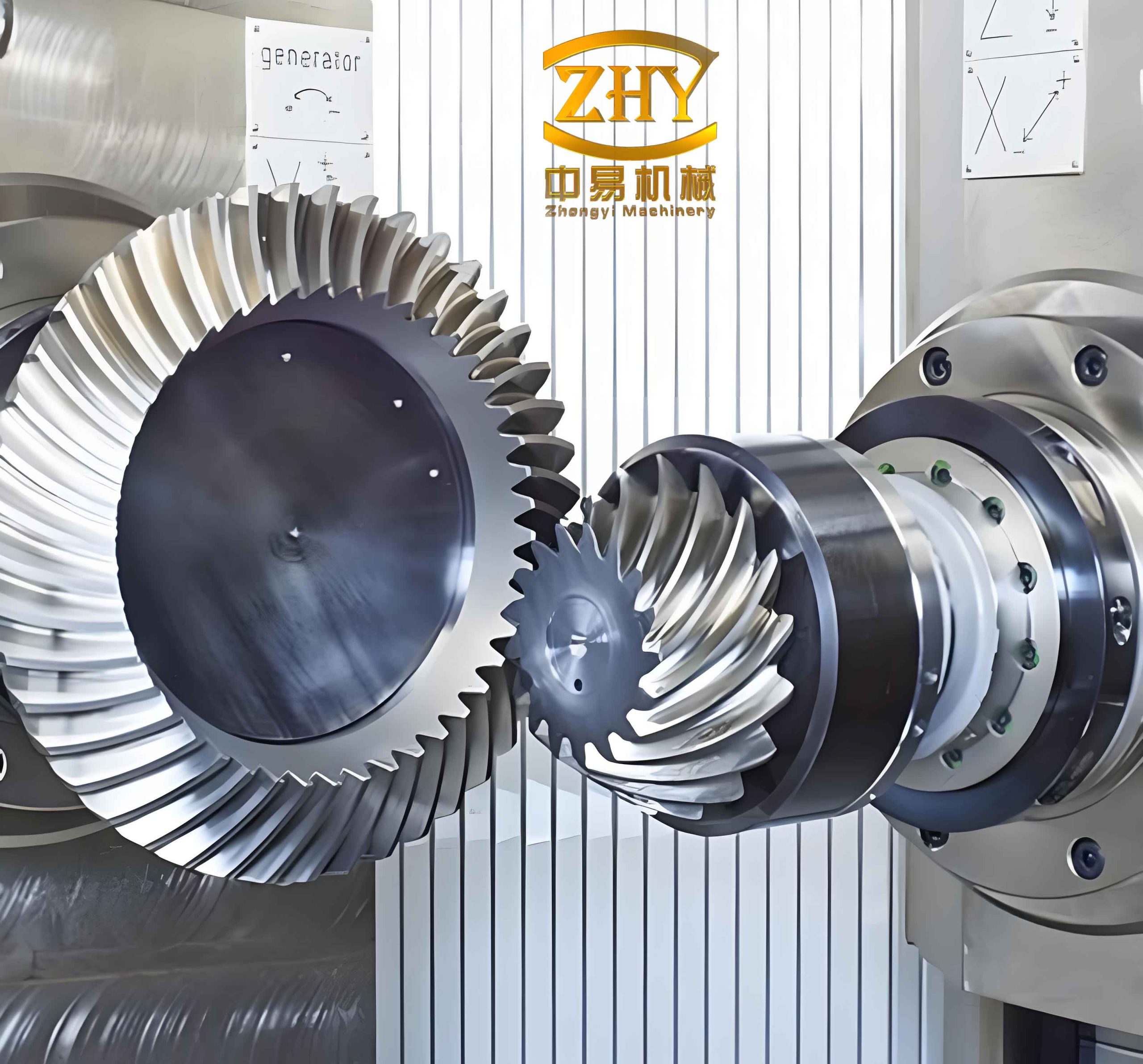
These variables offer direct control over the gear’s size, shape, and meshing characteristics. Hyperboloidal gears derive their name from the hyperboloidal shape of their pitch surfaces, and these parameters define that shape and its engagement.
Objective Functions
We define two distinct objective functions to be minimized.
1. Gear Pair Volume Minimization: The total volume of the hyperboloidal gear pair is a primary indicator of material cost and weight. An approximate yet effective method is to model each gear as a truncated cone. The total volume \( V_{total} \) is the sum of the pinion volume \( V_1 \) and the gear volume \( V_2 \).
$$ \min F_1(\mathbf{X}) = V_1 + V_2 $$
$$ V_1 = \frac{\pi}{4} \left( b_1 d_{e1}^2 – 2 d_{e1} b_1^2 \sin\delta_1 + \frac{4}{3} b_1^3 \sin^2\delta_1 \right) \cos\delta_1 $$
$$ V_2 = \frac{\pi}{4} \left( b_2 d_{e2}^2 – 2 d_{e2} b_2^2 \sin\delta_2 + \frac{4}{3} b_2^3 \sin^2\delta_2 \right) \cos\delta_2 $$
Where:
- \( b_1 \): Face width of the pinion, often related to \( b_2 \) (e.g., \( b_1 \approx 1.1 \cdot b_2 \)).
- \( d_{e1} \): Outer pitch diameter of the pinion, determined by \( d_{e1} = d_{e2} / i \), with \( i \) being the gear ratio.
- \( \delta_1, \delta_2 \): Pitch cone angles of the pinion and gear, calculated from the gear ratio and offset.
2. Meshing Noise Minimization: Gear noise is closely related to the smoothness of the power transmission, which is largely governed by the contact ratio. Research indicates that the transmission error and consequently the noise are minimized when the face contact ratio \( \varepsilon_F \) approaches a value of 2. Therefore, our second objective is to minimize the deviation of the calculated contact ratio from this ideal value.
$$ \min F_2(\mathbf{X}) = | 2 – \varepsilon_F | $$
The face contact ratio for hyperboloidal gears can be expressed as:
$$ \varepsilon_F = \left( k_2 \tan\beta – \frac{k_2^3}{3} \tan^3\beta \right) \frac{A_0}{\pi m} $$
Where:
- \( \beta \): The average of the mean spiral angles of the pinion and gear (\( \beta \approx (\beta_{m1} + \beta_{m2})/2 \)).
- \( A_0 \): The outer cone distance.
- \( m \): The outer module of the gear (\( m = d_{e2} / z_2 \)).
- \( k_2 \): A coefficient derived from the basic gear geometry parameters.
Thus, minimizing \( F_2(\mathbf{X}) \) directly promotes a design with smoother, quieter meshing action.
Constraints
The design must satisfy a set of geometric, strength, and manufacturability constraints. These are derived from engineering handbooks, design standards, and practical experience with hyperboloidal gears.
| Constraint Category | Mathematical Expression | Physical Rationale |
|---|---|---|
| Tooth Number | \( 5 \leq z_1 \leq 12 \) \( z_2 \geq 30 \) \( 40 \leq z_1 + z_2 \leq 60 \) |
Prevents undercutting, ensures smooth engagement, and maintains manufacturing feasibility. |
| Offset Distance | \( 0.1 \cdot d_{e2} \leq E \leq 0.2 \cdot d_{e2} \) | Balances compactness and load capacity; excessive offset increases sliding and risk of scoring. |
| Face Width | \( 4m \leq b_2 \leq 10m \) | Wider face increases strength/contact ratio but also volume and weight; a practical range is enforced. |
| Spiral Angle | \( 30^\circ \leq \beta_m \leq 50^\circ \) | Ensures adequate overlap ratio for smoothness while avoiding excessive axial thrust loads. |
| Contact Strength | \( S_H \geq S_{Hmin} \) | Calculated contact stress safety factor must exceed the minimum allowable value to prevent pitting. |
| Bending Strength | \( S_F \geq S_{Fmin} \) | Calculated root bending stress safety factor must exceed the minimum allowable value to prevent tooth breakage. |
The strength constraints (\( S_H, S_F \)) are evaluated using established rating formulas (e.g., Gleason or ISO standards) which involve complex calculations of geometry factors, load distribution factors, and material properties. These are implemented as nonlinear constraint functions within the optimization model.
Multi-Objective Optimization with the NSGA-II Algorithm
Single-objective optimization seeks a single best solution. In contrast, our problem has two competing objectives: minimizing volume and minimizing noise. Improving one objective typically worsens the other. This defines a multi-objective optimization problem, whose solution is not a single point but a set of optimal trade-off solutions known as the Pareto-optimal front.
To effectively find this Pareto front for hyperboloidal gear design, we employ the Non-dominated Sorting Genetic Algorithm II (NSGA-II). Genetic Algorithms (GAs) are inspired by natural selection, using operations like selection, crossover, and mutation on a population of candidate solutions. NSGA-II enhances this approach for multiple objectives with two key features:
- Fast Non-dominated Sorting: The population is ranked into fronts based on Pareto dominance. A solution dominates another if it is not worse in any objective and strictly better in at least one. Solutions in the first front (non-dominated by any others) are the best.
- Crowding Distance Calculation: Within a front, the crowding distance of a solution estimates the density of solutions around it. Solutions with a larger crowding distance are in a less “crowded” region of the objective space.
The selection process favors individuals from better (lower) fronts. When choosing between individuals in the same front, it prefers those with a larger crowding distance. This elitist strategy simultaneously pushes the population toward the Pareto front and maintains diversity along it, providing the designer with a well-distributed set of optimal choices.
The algorithm flow is as follows:
1. Initialization: Generate a random initial population of design vectors \( \mathbf{X} \).
2. Evaluation: Calculate the objective functions \( F_1 \) and \( F_2 \), and check constraints for each member.
3. Non-dominated Sort: Rank the entire population into Pareto fronts (Front 1, Front 2, …).
4. Crowding Distance: Calculate the crowding distance for each individual within its front.
5. Selection: Select parents for the next generation using binary tournament selection based on front rank and crowding distance.
6. Crossover & Mutation: Apply genetic operators to create offspring.
7. Recombination & Replacement: Combine parent and offspring populations, sort them, and select the best N individuals to form the new generation.
8. Termination: Repeat steps 2-7 until a stopping criterion (e.g., maximum generations) is met.
We implement this algorithm using the MATLAB® optimization toolbox function `gamultiobj`, which is based on a controlled, elite version of NSGA-II. Key parameters for our hyperboloidal gear optimization are set as shown in the table below.
| Parameter | Symbol / Setting | Value / Type | Purpose |
|---|---|---|---|
| Population Size | \( N_{pop} \) | 150 | Balances exploration and computational cost. |
| Maximum Generations | \( Gen_{max} \) | 1000 | Defines the stopping criterion for the evolution. |
| Crossover Fraction | – | 0.8 | 80% of the next generation is created by crossover. |
| Mutation Function | – | Adaptive Feasible | Randomly perturbs design variables while respecting constraints. |
| Pareto Fraction | – | 0.7 | Limits the number of individuals on the Pareto front in the elite population, aiding diversity. |
| Function Tolerance | – | \( 1 \times 10^{-100} \) | A very small value to ensure the algorithm runs for many generations to fully converge. |
Case Study: Optimization of an Automotive Rear Axle Gear Set
To demonstrate the effectiveness of the proposed methodology, we apply it to the optimization of a hyperboloidal gear pair for a light vehicle rear axle differential. The baseline (conventional) design parameters are given as follows:
- Gear Ratio, \( i \): 4.1
- Pinion Teeth, \( z_1 \): 10
- Gear Outer Diameter, \( d_{e2} \): 200.00 mm
- Gear Face Width, \( b_2 \): 30.00 mm
- Offset, \( E \): 20.00 mm
- Gear Mean Spiral Angle, \( \beta_{m2} \): 37.14°
The optimization task is to find designs that minimize volume and noise relative to this baseline while satisfying all constraints. The algorithm was executed, and after convergence, it produced a set of non-dominated solutions—the Pareto front.
The Pareto front is visualized as a plot of one objective against the other. For our hyperboloidal gears, we plot the Gear Pair Volume (\( F_1 \)) against the deviation of the contact ratio from 2 (\( F_2 = |2 – \varepsilon_F| \)), which is the noise objective. The resulting front shows the inherent trade-off: designs in the lower-left region have both low volume and low noise deviation but are sparse; moving upward reduces volume at the cost of higher noise, and moving rightward reduces noise at the cost of larger volume. The baseline design is plotted as a reference point. A key observation is that a significant portion of the Pareto front consists of designs that are superior to the baseline in both objectives, highlighting the sub-optimality of the initial empirical design.
From the Pareto-optimal set, a designer can select a solution based on specific priorities. For this case, aiming for a balanced improvement that guarantees lower noise than the baseline, a solution with a contact ratio deviation \( \Delta \varepsilon_F \approx 0.05 \) was selected. The comparison between the baseline and the optimized design is detailed below.
| Design Parameter / Metric | Baseline (Conventional) Design | Optimized Design (NSGA-II) | Percent Change / Improvement |
|---|---|---|---|
| Pinion Teeth (\( z_1 \)) | 10 | 10 | 0% |
| Gear Outer Diameter (\( d_{e2} \), mm) | 200.00 | 196.99 | -1.51% |
| Offset (\( E \), mm) | 20.00 | 19.72 | -1.40% |
| Gear Face Width (\( b_2 \), mm) | 30.00 | 26.13 | -12.90% |
| Gear Spiral Angle (\( \beta_{m2} \), °) | 37.14 | 38.51 | +3.69% |
| Gear Pair Volume (\( V_{total} \), mm³) | 2.8324 × 10⁵ | 2.4725 × 10⁵ | -12.71% |
| Face Contact Ratio (\( \varepsilon_F \)) | 2.1552 | 1.9532 | -9.38% (closer to 2) |
| Noise Metric (\( |2 – \varepsilon_F| \)) | 0.1552 | 0.0468 | -69.85% |
Analysis of Optimization Results
The results present a compelling case for the application of multi-objective optimization to hyperboloidal gear design. The optimized design achieves a remarkable 12.71% reduction in total volume. This translates directly into savings in raw material, reduced weight for the vehicle (contributing to fuel efficiency), and potentially lower machining time and cost.
Concurrently, the noise performance is significantly enhanced. The face contact ratio of the optimized design at 1.9532 is substantially closer to the ideal value of 2 than the baseline’s 2.1552. The deviation metric (\( |2 – \varepsilon_F| \)) is reduced by nearly 70%, indicating a theoretical foundation for much smoother and quieter operation. This improvement stems from the algorithm’s adjustment of key parameters: a slight reduction in gear diameter and offset, a more significant reduction in face width, and a modest increase in spiral angle. The algorithm found that a narrower face width (within the allowed range) was more effective in reducing volume than in increasing noise, as the concurrent increase in spiral angle helped maintain a favorable contact ratio. This complex, counter-intuitive interplay of parameters is precisely what advanced optimization algorithms like NSGA-II are adept at discovering, surpassing the capabilities of traditional trial-and-error or single-variable sensitivity approaches.
It is crucial to note that all strength constraints (contact and bending) were satisfied by the optimized design, ensuring its functional integrity and durability are not compromised. The solution is not just smaller and quieter, but also mechanically sound.
Conclusions and Design Recommendations
This study successfully establishes and demonstrates a robust framework for the multi-objective optimal design of hyperboloidal gears. By formulating the design challenge as a mathematical optimization problem with the twin goals of minimizing volume and minimizing meshing noise, and by employing the NSGA-II genetic algorithm to solve it, we move beyond subjective empirical methods to a systematic, computational approach.
The case study unequivocally validates the framework’s utility. Compared to a conventionally designed hyperboloidal gear pair, the optimized design achieved a simultaneous and significant improvement in both key performance indicators: a 12.7% reduction in material volume and a 70% reduction in the theoretical noise metric. This leads to tangible benefits in reduced manufacturing costs, lower vehicle weight, and enhanced passenger comfort through quieter operation.
For engineers and designers working with hyperboloidal gears, the following recommendations emerge from this work:
- Adopt a Multi-Objective Mindset: Recognize that critical design goals like cost (volume/weight) and performance (noise) are inherently conflicting. Optimization should seek the best possible trade-off curve (Pareto front), not just a point that meets minimum requirements.
- Leverage Advanced Algorithms: Tools like NSGA-II are highly effective for navigating the complex, non-linear design space of hyperboloidal gears. They efficiently explore interactions between parameters (spiral angle, face width, offset) that are difficult to intuit.
- Use the Pareto Front for Decision-Making: The output of the optimization is not a single answer but a spectrum of optimal choices. The final selection can be made based on project-specific priorities—e.g., prioritizing maximum quietness for a luxury car or maximum compactness for a tight packaging space.
- Integrate Early in the Design Process: Implementing such optimization during the initial design phase yields the greatest benefit, preventing costly redesigns and unlocking superior performance from the outset.
The methodology presented is not limited to volume and noise; it can be extended to incorporate other objectives such as maximizing efficiency, minimizing flash temperature, or optimizing lubrication. Furthermore, the core approach is readily adaptable to the optimization of other complex gear types, such as spiral bevel gears or hypoid gears with higher offsets, providing a powerful general tool for advancing the state-of-the-art in gear design and manufacturing.