
In the field of power transmission, spiral bevel gears are indispensable components for transmitting motion and power between intersecting shafts, most commonly at a 90-degree angle. Their curved teeth allow for gradual engagement, leading to smoother and quieter operation compared to straight bevel gears. The traditional Gleason system designs these spiral bevel gears symmetrically, assuming equal loading and performance on both sides of the tooth flank. However, this assumption often diverges from practical engineering reality. In many applications, such as automotive differentials, the drive side (or “forward” side) of the gear tooth experiences significantly higher load cycles and usage than the coast side (“reverse” side). This operational asymmetry presents an opportunity for a more efficient design philosophy.
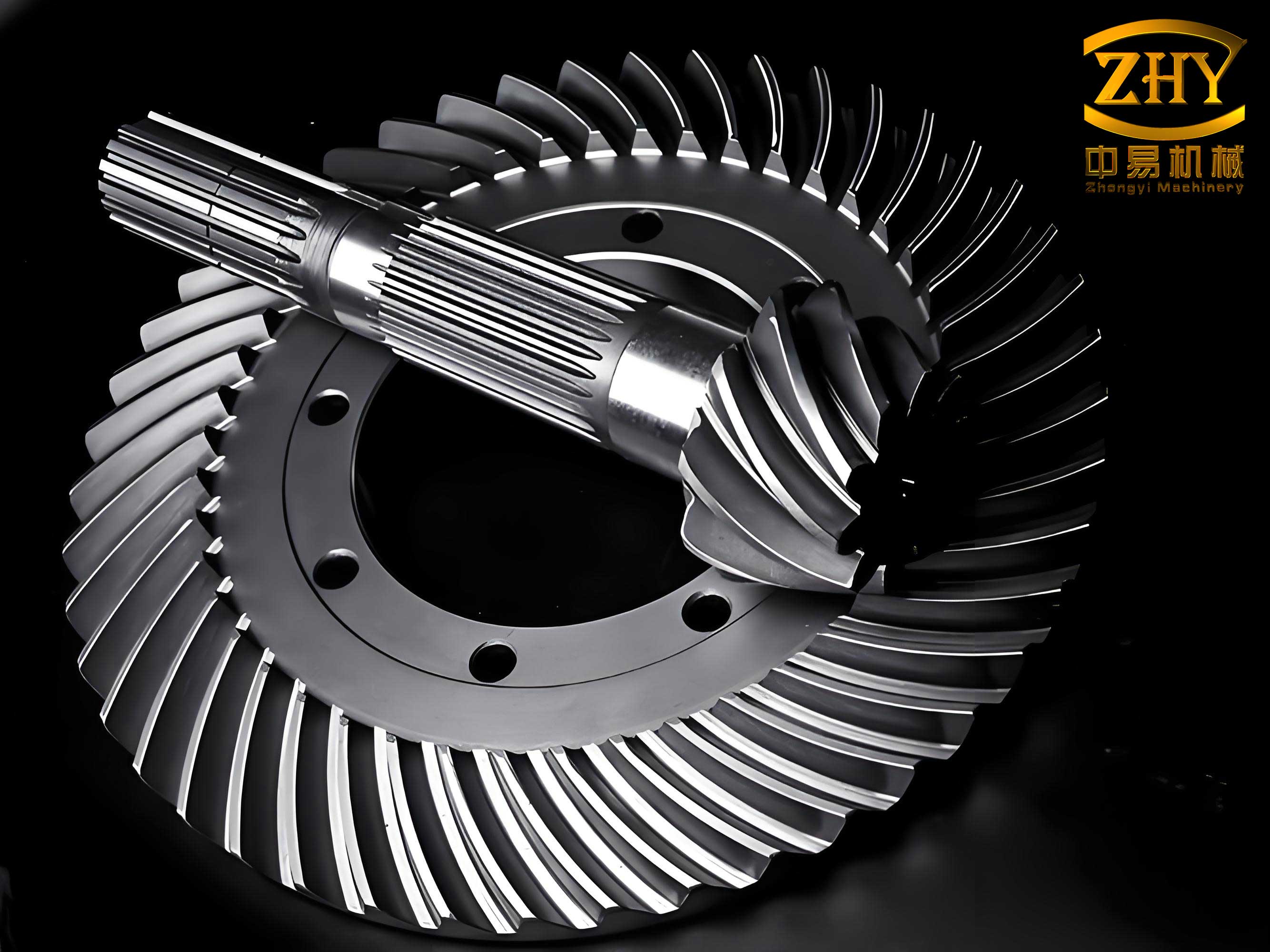
The concept of asymmetric design for spiral bevel gears addresses this opportunity head-on. By intentionally using a larger pressure angle on the high-usage forward flank and a smaller pressure angle on the reverse flank, material can be utilized more effectively. This approach enhances the bending strength, contact strength, and scuffing resistance of the primary working flank without incurring the drawbacks of a uniformly large pressure angle, such as excessive tooth tip thinning and reduced impact resistance. The foundation for this idea lies in gear geometry and contact mechanics, where parameters like the induced normal curvature play a pivotal role in determining load capacity and failure modes.
This article presents a comprehensive framework for the constrained multi-objective optimization of asymmetric spiral bevel gears. The optimization is grounded in principles from differential geometry, elastohydrodynamic lubrication (EHL) theory, gear design methodologies, and reliability engineering. The primary aim is to develop a design methodology that simultaneously minimizes the system’s physical volume for economic manufacturing and minimizes the induced normal curvature on the tooth flanks to maximize load-bearing capacity and durability. To solve this complex, non-commensurate multi-objective problem, a modern Particle Swarm Optimization (PSO) algorithm is employed and demonstrated through a detailed case study.
Fundamental Theory: Induced Normal Curvature in Spiral Bevel Gears
Understanding the contact mechanics between meshing gear teeth is crucial for predicting performance and failure. According to differential geometry and the theory of gearing, two conjugate surfaces in point contact have, at the point of tangency, a relative measure of curvature known as the induced normal curvature. For a given direction on the tangent plane, the induced normal curvature is defined as the difference between the normal curvatures of the two surfaces in that same direction. It quantifies how rapidly the surfaces separate from each other in the neighborhood of the contact point along that direction.
In the context of spiral bevel gears, which typically exhibit line contact under load, this concept is vital. One principal direction of the induced normal curvature coincides with the instantaneous contact line, where its value is zero. The other principal direction is perpendicular to this contact line. This perpendicular principal value, denoted as $k_\sigma$, represents the maximum relative curvature between the contacting flanks and is a key indicator of contact stress levels. A smaller $k_\sigma$ implies a larger equivalent radius of curvature, which directly leads to lower Hertzian contact stress, higher contact fatigue strength (resistance to pitting), and improved conditions for the formation of a protective lubricant film (increased scuffing resistance).
The formula for calculating this principal induced normal curvature $k_\sigma$ for spiral bevel gears is derived from gear geometry:
$$ k_\sigma = \frac{\cos^2 \beta + \sin^2 \alpha_n \sin^2 \beta}{L_1 \sin \alpha_n (\cot \delta_1 + \cot \delta_2)} $$
Where:
$k_\sigma$ = Principal induced normal curvature (mm$^{-1}$)
$\beta$ = Spiral angle (degrees)
$\alpha_n$ = Normal pressure angle (degrees)
$\delta_1, \delta_2$ = Pitch cone angles of the pinion and gear, respectively (degrees)
$L_1$ = Cone distance of the pinion (mm)
This equation clearly shows the influence of fundamental design parameters—spiral angle $\beta$, normal pressure angle $\alpha_n$, and cone angles $\delta$—on the contact condition. It forms the mathematical basis for one of our primary optimization objectives: minimizing $k_\sigma$ to enhance the intrinsic load capacity of the asymmetric spiral bevel gear pair.
Theoretical Foundations for Optimization Constraints
A robust optimal design must satisfy multiple performance and geometric constraints. This work incorporates constraints based on lubrication, reliability, and strength balance.
Elastohydrodynamic Lubrication and Film Thickness Constraint
To prevent failure modes like scuffing (cold welding) and wear, maintaining an adequate lubricant film between the meshing teeth is essential. Based on elastohydrodynamic lubrication theory, the minimum film thickness $h_{min}$ at the pitch point can be estimated using the well-known Dowson-Higginson formula adapted for bevel gears:
$$ h_{min} = 2.65 \frac{\alpha^{0.54} (E’)^{0.03}}{(\frac{F}{L})^{0.13}} (\frac{\pi n_1 \eta_0}{30})^{0.7} \frac{(L_m \sin \alpha_n)^{1.13}}{\cos^{1.56} \beta} \frac{i^{0.27}}{(i + 1)^{0.43}} $$
Where:
$\alpha$ = Pressure-viscosity coefficient of the lubricant (MPa$^{-1}$)
$E’$ = Effective elastic modulus (MPa), $\frac{2}{(\frac{1-\nu_1^2}{E_1}+\frac{1-\nu_2^2}{E_2})}$
$F$ = Normal load between teeth (N)
$L$ = Length of contact line (mm)
$n_1$ = Pinion rotational speed (rpm)
$\eta_0$ = Dynamic viscosity of the lubricant at operating temperature (MPa·s)
$L_m$ = Mean cone distance (mm)
$i$ = Gear ratio ($z_2/z_1$)
The state of lubrication is often judged by the specific film thickness or lambda ratio $\lambda$, which compares the minimum film thickness to the composite surface roughness:
$$ \lambda = \frac{h_{min}}{\sigma} $$
$$ \sigma = \sqrt{\sigma_1^2 + \sigma_2^2} \approx 1.25 \sqrt{Ra_1^2 + Ra_2^2} $$
Here, $Ra_1$ and $Ra_2$ are the arithmetic average surface roughness values. Empirical evidence suggests that $\lambda > 3$ indicates full-film EHL, while $\lambda > 5$ significantly enhances surface durability and can effectively suppress pitting. Therefore, a constraint of $\lambda \geq 5$ is imposed to ensure adequate protection against both scuffing and contact fatigue for the optimized spiral bevel gears.
Reliability-Based Strength Constraints
Designing for a deterministic safety factor is often insufficient. A probabilistic approach based on reliability theory accounts for the inherent uncertainties in material properties and applied loads. It is assumed that both the bending stress $\sigma_F$ and contact stress $\sigma_H$, as well as the material’s bending strength $S_F$ and contact fatigue strength $S_H$, follow lognormal distributions.
The reliability $R$ is linked to the probability of failure through a reliability index (or “safety margin”). For a target reliability (e.g., $R=0.9515$ corresponding to a reliability index $Z_R = 1.66$), the constraint is formulated using the reliability-based safety factor $n_R$:
Contact strength constraint:
$$ Z_{RH} \leq \frac{\ln n_{RH}}{\sqrt{S_{H}^2 + \gamma_{H}^2}} \quad \text{where} \quad n_{RH} = e^{Z_{RH} \sqrt{V_{\sigma_{Hs}}^2 + V_{\sigma_H}^2}} $$
Bending strength constraint:
$$ Z_{RF} \leq \frac{\ln n_{RF}}{\sqrt{S_{F}^2 + \gamma_{F}^2}} \quad \text{where} \quad n_{RF} = e^{Z_{RF} \sqrt{V_{\sigma_{Fs}}^2 + V_{\sigma_F}^2}} $$
Here, $S$ and $\gamma$ represent the coefficients of variation (COV) for strength and stress, respectively. $V_{\sigma_{Hs}}, V_{\sigma_H}, V_{\sigma_{Fs}}, V_{\sigma_F}$ are the corresponding variances. These constraints ensure that the probability of bending or contact failure remains below an acceptable threshold for the final design of the spiral bevel gears.
Geometric and Deterministic Constraints
Additional constraints are necessary to ensure manufacturability, proper mesh, and balanced design:
- Tooth Tip Thickness: $H_a \geq 0.4 m_t$ to prevent a pointed tooth tip which is prone to chipping and has poor heat dissipation.
- Contact Ratio: Minimum transverse and face contact ratio constraints to ensure smooth, continuous power transmission.
- Equal Strength Principle: Constraints to equalize the calculated contact safety factor and bending safety factor between the pinion and gear as closely as possible. This promotes balanced wear and lifespan, making full use of material in both spiral bevel gears.
- Boundary Constraints: Practical limits on design variables based on experience and manufacturing limits (detailed in the optimization model section).
Constrained Multi-Objective Optimization Model
The design problem is formalized as a constrained multi-objective optimization problem (CMOP). The goal is to find a set of design parameters that minimize two conflicting objectives while satisfying all the aforementioned constraints.
Design Variables
Seven key design parameters are selected as optimization variables, which directly influence the geometry, strength, and volume of the spiral bevel gear set:
$$ \mathbf{X} = [x_1, x_2, x_3, x_4, x_5, x_6, x_7]^T = [z_1, m_t, \alpha_n, \beta, x_t, x_a, b]^T $$
Where:
$z_1$ = Number of teeth on the pinion
$m_t$ = Transverse module (mm)
$\alpha_n$ = Normal pressure angle on the drive side (degrees)
$\beta$ = Mean spiral angle (degrees)
$x_t$ = Tangential modification coefficient for the pinion
$x_a$ = Addendum modification coefficient for the pinion
$b$ = Face width (mm)
Objective Functions
The two competing objectives are formalized mathematically.
1. Minimize Total Volume of the Gear Drive:
A proxy for material cost and system weight. The approximate total volume $V_{total}$ is calculated as the sum of the volumes of the conical ring gears.
$$ f_1(\mathbf{X}) = V_{total} \approx \frac{\pi b}{4} (d_{m1}^2 \cos \delta_1 + d_{m2}^2 \cos \delta_2) $$
Where $d_{m1}, d_{m2}$ are the mean pitch diameters.
2. Minimize Principal Induced Normal Curvature:
Directly targets the improvement of contact conditions and load capacity.
$$ f_2(\mathbf{X}) = k_\sigma = \frac{\cos^2 \beta + \sin^2 \alpha_n \sin^2 \beta}{L_1 \sin \alpha_n (\cot \delta_1 + \cot \delta_2)} $$
Summary of Constraints
The constraints are summarized in the table below for clarity.
| Constraint Type | Mathematical Expression / Description |
|---|---|
| Lubrication (Scuffing) | $\lambda = \frac{h_{min}}{\sigma} \geq 5$ |
| Reliability (Contact) | $Z_{RH} \leq \frac{\ln n_{RH}}{\sqrt{S_{H}^2 + \gamma_{H}^2}}$ |
| Reliability (Bending) | $Z_{RF} \leq \frac{\ln n_{RF}}{\sqrt{S_{F}^2 + \gamma_{F}^2}}$ |
| Tooth Tip Thickness | $H_a \geq 0.4 m_t$ |
| Contact Ratio | $\varepsilon_{\alpha} \geq \varepsilon_{\alpha,min}$, $\varepsilon_{\beta} \geq \varepsilon_{\beta,min}$ |
| Equal Strength | $|SF_{pinion} – SF_{gear}| \leq \epsilon$ (for bending and contact) |
| Variable Bounds |
$12 \leq z_1 \leq 20$ $3.5 \leq m_t \leq 10.0$ mm $19^\circ \leq \alpha_n \leq 26^\circ$ $35^\circ \leq \beta \leq 40^\circ$ $0.1 \leq x_t \leq 1.0$ $0.1 \leq x_a \leq 1.0$ $5 \leq b \leq 100$ mm |
Solution Strategy: Multi-Objective Particle Swarm Optimization
Solving the defined CMOP requires an algorithm capable of handling non-commensurate objectives and multiple constraints. Traditional methods that scalarize objectives via weighted sums are unsuitable due to the difficulty in selecting weights and the loss of information about the trade-off frontier. A modern approach based on Pareto optimality and swarm intelligence is adopted.
Particle Swarm Optimization (PSO) is a population-based stochastic algorithm inspired by the social behavior of bird flocking. In multi-objective PSO (MOPSO), a swarm of particles (candidate designs) flies through the hyper-dimensional design space. Each particle’s position $\mathbf{D}_i$ represents a potential solution vector $\mathbf{X}$, and its velocity $\mathbf{V}_i$ determines its search direction and step size.
The key adaptation for our constrained multi-objective problem lies in how the “best” positions are defined and used:
- Particle Memory (Personal Best, $\mathbf{P}_{i}$): Each particle remembers its best historical position. In a multi-objective context, $\mathbf{P}_{i}$ is not a single point but a set of non-dominated points found by that particle. A mechanism is needed to select one guide from this set. In this implementation, if the spread of the particle’s personal best set is small (distance $d_{p[i]} < d$, where $d$ is the spread of the global set), a random member is chosen; otherwise, the average of the extremal members is used. This balances exploration and exploitation.
- Global Guide (Global Best, $\mathbf{G}$): Instead of a single global best, an external archive maintains the non-dominated solutions found by the entire swarm (the Pareto-optimal front). To guide the swarm, a global guide $\mathbf{g}$ for each particle is selected from this archive. A common technique is to use the centroid (mean) of the current non-dominated set as $\mathbf{g}$ to attract particles toward the central region of the Pareto front.
- Velocity and Position Update: The standard PSO update equations are modified to incorporate the above guides and an inertia weight $w$ for convergence control.
$$ \mathbf{V}_i^{k+1} = w \mathbf{V}_i^{k} + c_1 r_1 (\mathbf{P}_{i} – \mathbf{D}_i^{k}) + c_2 r_2 (\mathbf{g} – \mathbf{D}_i^{k}) $$
$$ \mathbf{D}_i^{k+1} = \mathbf{D}_i^{k} + \mathbf{V}_i^{k+1} $$
Where $c_1, c_2$ are acceleration coefficients, and $r_1, r_2$ are random numbers in [0,1]. - Constraint Handling: A penalty function method or a dominance-based feasibility rule is often integrated. Here, particles are initially generated within bounds, and after updates, if a particle violates a boundary, its position is reset or its velocity is reflected to keep it within the feasible domain of the spiral bevel gear design parameters.
The algorithm proceeds iteratively until a stopping criterion (e.g., maximum iterations) is met, yielding a well-distributed approximation of the Pareto-optimal front for the asymmetric spiral bevel gear design problem.
Case Study and Optimization Results
To demonstrate the proposed methodology, a practical case is optimized. The initial design specifications are as follows: Pinion speed $n_1 = 960$ rpm, gear speed $n_2 = 320$ rpm ($i=3$), transmitted power $P = 100$ kW. The lubricant is gear oil HL-30 with a viscosity $\nu_{100} = 30$ cSt, operating at a sump temperature of $50^\circ$C. The surface roughness for both spiral bevel gears is $Ra_1 = Ra_2 = 1.6 \mu m$. The target reliability index for strength is $Z_R = 1.66$ ($R \approx 0.9515$).
The MOPSO algorithm was implemented in MATLAB with a swarm size of 100 particles and run for 150 generations. The resulting non-dominated solutions form the Pareto front, visualized in the objective space of total volume ($f_1$) versus induced normal curvature ($f_2$).
The Pareto front clearly shows the trade-off: designs with very low volume tend to have high induced curvature (poor contact conditions), and vice-versa. A rational design choice must be made from this frontier. For this analysis, a balanced solution is selected from the central region of the front, favoring a significant reduction in $k_\sigma$ without an excessive increase in volume.
Optimization Results Comparison:
| Design Scenario | Selected Design Variables $\mathbf{X}^*$ | Total Volume, $V_{total}$ (x10$^6$ mm$^3$) | Induced Curvature, $k_\sigma$ (mm$^{-1}$) | Notes |
|---|---|---|---|---|
| Single-Objective: Min Volume | Aggressive miniaturization | 0.2804 | 0.0569 | Best for weight/cost, but poor contact strength ($k_\sigma$ is 79% higher than balanced). |
| Single-Objective: Min $k_\sigma$ | Very robust, large gears | 1.5091 | 0.0257 | Best for durability, but heavy and expensive (volume is 81% larger than balanced). |
| Multi-Objective Balanced Choice | $[16, 7.0, 24.82^\circ, 37.10^\circ, 0.321, 0.719, 35]^T$ | 0.8321 | 0.0318 | Optimal trade-off. Good strength ($k_\sigma$ reduced by 44% vs. min-volume design) with moderate volume increase (19% of min-$k_\sigma$ design volume). |
The optimized design for the asymmetric spiral bevel gears uses a pinion with 16 teeth and a module of 7 mm. The selected drive-side pressure angle is $24.82^\circ$, which is significantly larger than the typical symmetric design range of $20^\circ-22^\circ$, directly contributing to higher bending and contact strength. The spiral angle of $37.1^\circ$ and the chosen modification coefficients $(x_t, x_a)$ work in concert with the pressure angle to achieve the minimized induced curvature while satisfying all geometric and strength constraints. The specific film thickness $\lambda$ for this design is verified to be >5, ensuring excellent lubrication conditions.
Conclusion
This work establishes a comprehensive, systematic framework for the optimal design of asymmetric spiral bevel gears. By integrating core principles from contact mechanics, tribology, reliability engineering, and modern optimization theory, a constrained multi-objective optimization model was developed. The dual objectives of minimizing system volume and minimizing the principal induced normal curvature effectively capture the conflicting goals of economic manufacturing and high performance.
The application of a specialized Multi-Objective Particle Swarm Optimization algorithm successfully solved this complex problem, generating a Pareto-optimal frontier that clearly delineates the trade-offs available to the designer. The case study demonstrates that a balanced selection from this frontier yields a superior design compared to single-objective extremes. The optimized asymmetric spiral bevel gear set shows a substantial 44% improvement in the key contact condition indicator ($k_\sigma$) over a minimum-volume design, while only occupying a fraction of the space required by a minimum-curvature design. This directly translates to higher predicted resistance to pitting and scuffing, longer service life, and maintained reliability, all achieved within a compact and cost-effective package.
The methodology is general and can be extended to other critical, constrained multi-objective problems in gear design and mechanical transmission systems, such as optimizing for minimum flash temperature (thermal scuffing), maximum efficiency, or minimum noise, alongside considerations of size, weight, and reliability. The exploration of the design space for spiral bevel gears through such advanced optimization techniques paves the way for lighter, stronger, and more reliable power transmission solutions across various industries.