
In modern manufacturing, the demand for high-precision, high-strength mechanical components is ever-increasing. Among these, spur gears serve as fundamental transmission elements in a vast array of machinery, particularly in heavy-duty applications like truck wheel-side reducers. The pursuit of superior gear performance has driven the advancement of precision forming technologies. For high-module spur gears, the composite forming process of “cold extrusion followed by cold sizing” has emerged as a predominant method. This process yields spur gears with smooth tooth surfaces, continuous metal flow lines, and enhanced load-bearing capacity, marking a significant improvement over traditional machining.
However, in our practical production, we encountered several persistent defects during the cold extrusion of large-module spur gears. The formed gears exhibited a significant machining allowance on the end face, insufficient filling at the tooth tip (manifesting as a large collapse angle), and excessively high forming loads. These issues not only compromise dimensional accuracy and increase post-processing costs but also elevate the risk of die failure and reduce production efficiency. Therefore, optimizing the cold extrusion process parameters to simultaneously minimize the end-face machining allowance, improve tooth-tip filling, and reduce the forming force became the central focus of our research.
This study aims to address these multi-faceted challenges. We employ a systematic approach combining the Response Surface Methodology (RSM) with Finite Element Method (FEM) simulations. By treating key die geometry parameters as design variables, we construct predictive models for our target objectives and perform optimization within the feasible design space to identify the best-performing parameter set.
1. Problem Formulation and Process Analysis
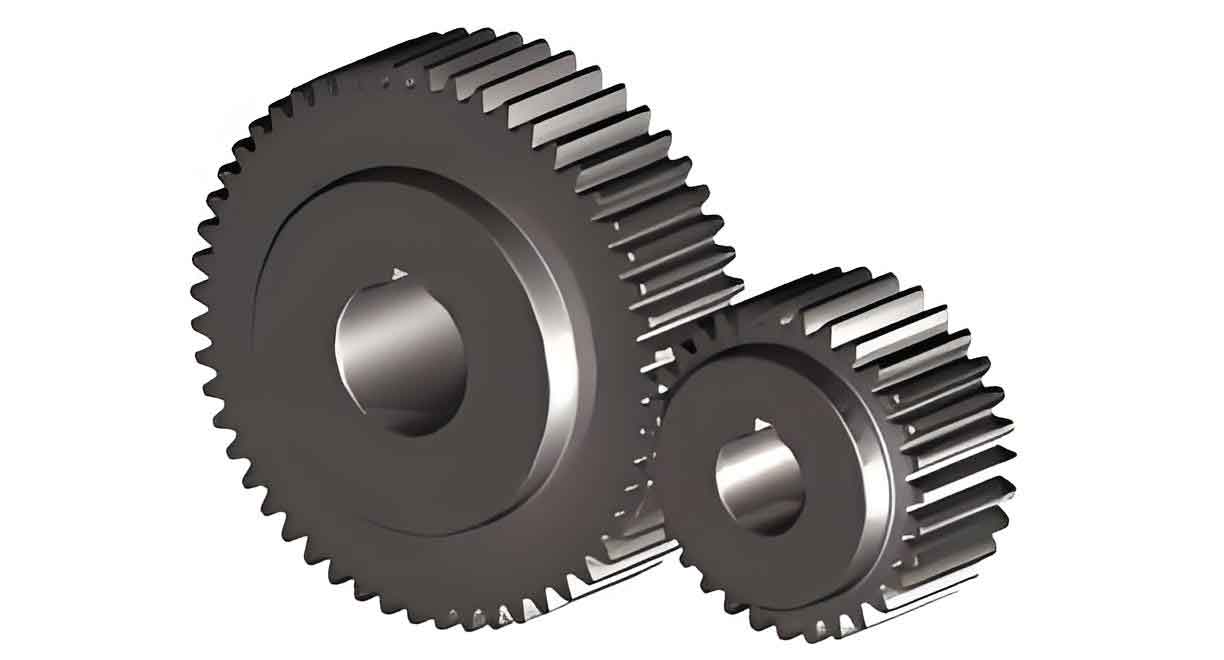
The subject of our study is a spur gear used in heavy vehicles, with a module (m) of 4, number of teeth (Z) of 16, pressure angle (α) of 20°, and a profile shift coefficient (x) of 0.45. The material is 20CrMnTi. The established production sequence is: hot forging for pre-forming, spheroidizing annealing, shot blasting, turning for blank preparation, phosphating & soaping for lubrication, and finally, cold extrusion. The extrusion is performed in a “piece-pushing-piece” continuous mode through the die.
The primary defects observed are concentrated on the lower end of the extruded spur gear. The tooth tips on this end show incomplete filling over a length (L) of 5–7 mm, with a collapse amount (δ) ranging from 0.3 to 0.5 mm. Concurrently, the lower end face bulges outward (h) by 2.5–3.5 mm. Our analysis attributes these issues to two main factors: firstly, the significant contact area between the blank and the tooth-profile die generates substantial frictional resistance, hindering metal flow; secondly, during extrusion, the lower end experiences little to no back pressure, weakening the radial filling capability of the metal into the die cavity. Although compensatory machining allowances were initially designed into the die, the inconsistent成形 quality resulted in some spur gears failing to meet specifications even after turning.
2. Methodology: Integrating FEM and RSM
Our optimization framework relies on the synergistic use of numerical simulation and statistical design of experiments. We first developed a three-dimensional finite element model to accurately simulate the cold extrusion process.
2.1 Finite Element Model Setup
The geometric model was created in CATIA and simplified for computational efficiency. The simulation was conducted using DEFORM-3D software. To balance accuracy and computation time, we exploited symmetry and modeled only 1/8 of the full spur gear. The dies (punch and extrusion die) were defined as rigid bodies, while the billet material (AISI-4120, representing 20CrMnTi) was modeled as a plastic object. The main billet was meshed with approximately 100,000 tetrahedral elements, and the preceding billet (“piece-pushing-piece”) with 30,000 elements. A shear friction model with a coefficient of 0.12 was applied, and the process was simulated at room temperature with a punch speed of 20 mm/s.
2.2 Selection of Design Variables and Objective Functions
The geometry of the extrusion die critically influences metal flow, filling behavior, and forming load. Based on our experience and preliminary analysis, we selected four key die parameters as design variables:
- x₁: Radius at Tooth Tip of Die (R) – Influences metal flow into the tooth tip corner.
- x₂: Die Semi-Angle (α) – Affects the length of contact and the deformation zone.
- x₃: Splitting Thickness (T) – The thickness of the die land at the splitting edge, impacting how the billet is divided into the tooth cavities.
- x₄: Length of Die Bearing (L) – Influences dimensional accuracy and friction.
The original die parameters were: R = 1.2 mm, α = 45°, T = 2.5 mm, L = 5 mm. Correspondingly, we defined three objective functions to quantify the成形 quality and process efficiency:
- Y₁: Collapse Amount at Tooth Tip (δ) – To be minimized for better filling.
- Y₂: Bulging Amount of End Face (h) – To be minimized to reduce machining allowance.
- Y₃: Maximum Forming Load (F) – To be minimized to reduce press tonnage and die stress.
2.3 Experimental Design using Central Composite Design (CCD)
We adopted a four-factor, five-level Central Composite Design (CCD) to plan our simulation experiments. This design is highly efficient for fitting second-order response surface models. The factors and their levels are detailed in Table 1.
| Factor | Parameter | Level | ||||
|---|---|---|---|---|---|---|
| -2 | -1 | 0 | 1 | 2 | ||
| x₁ | R (mm) | 1.0 | 1.2 | 1.4 | 1.6 | 1.8 |
| x₂ | α (°) | 35 | 40 | 45 | 50 | 55 |
| x₃ | T (mm) | 1 | 2 | 3 | 4 | 5 |
| x₄ | L (mm) | 5 | 10 | 15 | 20 | 25 |
The CCD generated 30 distinct experimental runs. For each run, we executed the FEM simulation and extracted the values for δ, h, and F. A portion of the experimental design matrix and corresponding results is shown in Table 2.
| Run | x₁ | x₂ | x₃ | x₄ | δ (mm) | h (mm) | F (kN) |
|---|---|---|---|---|---|---|---|
| 1 | -1 | -1 | -1 | -1 | 0.281 | 1.985 | 1916.07 |
| 2 | 1 | -1 | -1 | -1 | 0.278 | 1.928 | 1890.84 |
| 3 | -1 | 1 | -1 | -1 | 0.296 | 2.636 | 1795.01 |
| 4 | 1 | 1 | -1 | -1 | 0.281 | 2.383 | 1756.30 |
| 5 | -1 | -1 | 1 | -1 | 0.366 | 2.557 | 1998.24 |
| … | … | … | … | … | … | … | … |
| 30 | 0 | -2 | 0 | 0 | 0.291 | 1.911 | 2018.42 |
3. Development and Analysis of Response Surface Models
Using the simulation data, we performed regression analysis to develop second-order polynomial models for each objective function. These models describe the relationship between the design variables and the responses.
3.1 Mathematical Models
The fitted models for the collapse amount (δ), end-face bulge (h), and forming load (F) are presented below. The models are expressed in terms of the coded variables (x₁ to x₄).
Model for Collapse Amount (δ):
$$ \delta = 0.33 + 0.011x_1 + 0.024x_2 + 0.05x_3 – 9.75 \times 10^{-3}x_4 – 4.05 \times 10^{-3}x_1x_3 + 0.015x_2x_3 – 2.917 \times 10^{-3}x_1^2 – 1.4 \times 10^{-3}x_2^2 + 3.667 \times 10^{-3}x_3^2 – 4.333 \times 10^{-3}x_4^2 $$
Model for End-Face Bulge (h):
$$ h = 2.41 – 0.084x_1 + 0.28x_2 + 0.26x_3 – 0.028x_4 + 0.032x_1x_2 + 0.032x_1x_3 + 0.014x_1^2 + 0.015x_2^2 + 0.022x_3^2 + 0.021x_4^2 $$
Model for Forming Load (F):
$$ F = 1894.68 – 21.90x_1 – 58.49x_2 + 44.48x_3 – 9.44x_4 – 13.37x_1x_2 – 3.44x_1x_3 + 6.23x_2x_3 + 1.32x_2x_4 – 2.45x_1^2 + 3.44x_3^2 – 5.23x_4^2 $$
3.2 Model Adequacy and Significance
We conducted Analysis of Variance (ANOVA) to assess the statistical significance and adequacy of the developed models. Key metrics such as the F-value, p-value, coefficient of determination (R²), adjusted R² (R²adj), predicted R² (R²pred), and Adequate Precision are summarized in Table 3.
| Response | R² | R²adj | R²pred | Adequate Precision | Model p-value |
|---|---|---|---|---|---|
| δ (Collapse Amount) | 0.9836 | 0.9750 | 0.9470 | 40.031 | < 0.0001 |
| h (End-Face Bulge) | 0.9901 | 0.9849 | 0.9694 | 48.516 | < 0.0001 |
| F (Forming Load) | 0.9906 | 0.9849 | 0.9672 | 48.620 | < 0.0001 |
The very low p-values (< 0.0001) for all models confirm they are highly significant. The high R² and R²adj values (all above 0.975) indicate an excellent fit to the simulation data. The small difference (less than 0.2) between R²adj and R²pred suggests good model predictability. Furthermore, Adequate Precision values well above 4 signify adequate signal-to-noise ratio, meaning the models can be used to navigate the design space effectively. Therefore, we concluded that these second-order models accurately capture the effects of the die parameters on the成形 quality and load for cold extruded spur gears.
3.3 Analysis of Factor Effects
Analyzing the models and their interaction plots reveals the individual and combined effects of the variables.
On Collapse Amount (δ): The most significant interaction is between die semi-angle (x₂) and splitting thickness (x₃). The collapse amount increases with both factors. A larger die semi-angle extends the contact length, increasing friction and causing more severe non-uniform flow between the surface and core metal. A larger splitting thickness makes it harder for the billet to separate and flow into the tooth cavities, leading to more upward metal堆积 and greater tooth tip collapse.
On End-Face Bulge (h): The interaction between tooth tip radius (x₁) and die semi-angle (x₂) is notable. Increasing the tooth tip radius (x₁) improves metal flow uniformity, thereby reducing the end-face bulge (h). Conversely, increasing the die semi-angle (x₂) increases the contact area and frictional resistance, slowing down the surface metal flow and consequently increasing the bulge (h).
On Forming Load (F): The forming load decreases with an increase in die semi-angle (x₂), which is typical in extrusion as it can reduce redundant work. However, it increases significantly with splitting thickness (x₃), as a thicker splitting land requires more force to divide the material. The interaction between x₂ and x₃ is also significant for the load.
4. Multi-Objective Optimization and Solution
Our goal was to find a set of process parameters that simultaneously minimize all three objective functions: δ, h, and F. This is a classic multi-objective optimization problem. We utilized the desirability function approach, which converts each predicted response into an individual desirability (d_i) ranging from 0 (undesirable) to 1 (fully desirable). The overall desirability (D) is the geometric mean of these individual desirabilities:
$$ D = (d_1 * d_2 * d_3)^{1/3} $$
We defined our optimization problem mathematically as follows:
Find: $$ x_1, x_2, x_3, x_4 $$
To Minimize: $$ \delta(x_1, x_2, x_3, x_4), \quad h(x_1, x_2, x_3, x_4), \quad F(x_1, x_2, x_3, x_4) $$
Subject to the bounds:
$$ 1.0 \leq x_1 \leq 1.8 $$
$$ 35 \leq x_2 \leq 55 $$
$$ 1 \leq x_3 \leq 5 $$
$$ 5 \leq x_4 \leq 25 $$
Using the statistical software’s optimization toolbox, which maximizes the overall desirability (D), we searched the defined variable space. The optimization algorithm identified the following parameter combination as the optimal compromise solution:
| Design Variable | Parameter | Optimal Value |
|---|---|---|
| x₁ | Radius at Tooth Tip (R) | 1.6 mm |
| x₂ | Die Semi-Angle (α) | 40° |
| x₃ | Splitting Thickness (T) | 2 mm |
| x₄ | Length of Die Bearing (L) | 15 mm |
5. Validation of Optimization Results
To validate the optimization results, we performed both a confirmatory numerical simulation and a physical production trial using the optimal parameters.
5.1 Numerical Validation
We ran a new FEM simulation with the optimal parameter set (R=1.6 mm, α=40°, T=2 mm, L=15 mm). The simulation predicted the following results: δ = 0.270 mm, h = 1.750 mm, and F = 1756.31 kN. These values showed significant improvement compared to the baseline simulation with the original parameters.
5.2 Experimental Validation
A new die insert with the optimized geometry was manufactured. The die core material was YG15, and the punch was made of Cr12MoV. Billets of 20CrMnTi underwent standard spheroidizing annealing and phosphating/soaping treatment. The trials were conducted on a 4 MN hydraulic press.
Results:
- Forming Load: The measured maximum forming force was approximately 1800 kN, which is about 18.2% lower than the ~2200 kN required with the original die.
- Dimensional Quality: Five extruded spur gears were randomly selected and measured using a coordinate measuring machine (CMM). Three teeth were measured on each gear. A paired-sample t-test was performed to statistically compare the quality of gears produced with the old and new dies. The results are summarized in Tables 5 and 6.
| Metric | Die Type | Mean | Std. Deviation |
|---|---|---|---|
| Collapse Amount δ (mm) | Original | 0.3903 | 0.06061 |
| Optimized | 0.2851 | 0.04308 | |
| End-Face Bulge h (mm) | Original | 2.9561 | 0.40869 |
| Optimized | 1.9065 | 0.22653 |
| Metric | Mean Difference | t-statistic | p-value |
|---|---|---|---|
| Collapse Amount δ | 0.1052 | 5.893 | < 0.0001 |
| End-Face Bulge h | 1.0497 | 8.992 | < 0.0001 |
The extremely low p-values (<< 0.05) confirm that the reductions in both collapse amount and end-face bulge achieved with the optimized die are statistically highly significant.
5.3 Comparison of Predicted vs. Actual Results
A final comparison between the response surface prediction, the confirmatory simulation, and the actual measured values is shown in Table 7. The measured values are slightly higher than predicted, which is expected due to factors like elastic die deflection and material property variations in actual production that are not fully captured in the rigid-die simulation. However, the relative error between the predicted and measured values is less than 5%, demonstrating the high accuracy and practical utility of our optimization framework for spur gear cold extrusion.
| Result Source | δ (mm) | h (mm) | F (kN) |
|---|---|---|---|
| RSM Prediction | 0.265 | 1.705 | 1719.17 |
| Confirmatory FEM | 0.270 | 1.750 | 1756.31 |
| Actual Measurement | 0.290 | 1.910 | ~1800.00 |
6. Conclusion
In this study, we successfully addressed the multi-objective optimization problem in the cold extrusion of high-module spur gears. The key findings and contributions are summarized as follows:
1. We developed accurate second-order response surface models for three critical objectives: tooth tip collapse amount (δ), end-face bulge (h), and maximum forming load (F). The models exhibited excellent fit (R² > 0.98) and predictive capability, effectively describing the response of spur gear quality to key die geometry parameters.
2. Through analysis of the models, we elucidated the individual and interactive effects of the die’s tooth tip radius, semi-angle, splitting thickness, and bearing length on the成形 process. This provides valuable insight for process designers.
3. Using a desirability-based multi-objective optimization approach, we identified the optimal parameter combination: Tooth Tip Radius (R) = 1.6 mm, Die Semi-Angle (α) = 40°, Splitting Thickness (T) = 2 mm, and Die Bearing Length (L) = 15 mm.
4. Validation through both numerical simulation and physical production trials confirmed the effectiveness of the optimization. The optimized process yielded spur gears with a significantly reduced end-face bulge (from ~2.96 mm to ~1.91 mm) and tooth tip collapse (from ~0.39 mm to ~0.29 mm), while simultaneously lowering the forming load by approximately 18.2%. All improvements were statistically significant.
This work demonstrates the power of integrating FEM, DOE, and RSM for solving complex multi-objective optimization problems in metal forming. The methodology and findings provide a practical and effective guide for optimizing the cold extrusion process parameters for spur gears and similar components, leading to improved product quality, reduced manufacturing costs, and extended tool life.