
1. Introduction
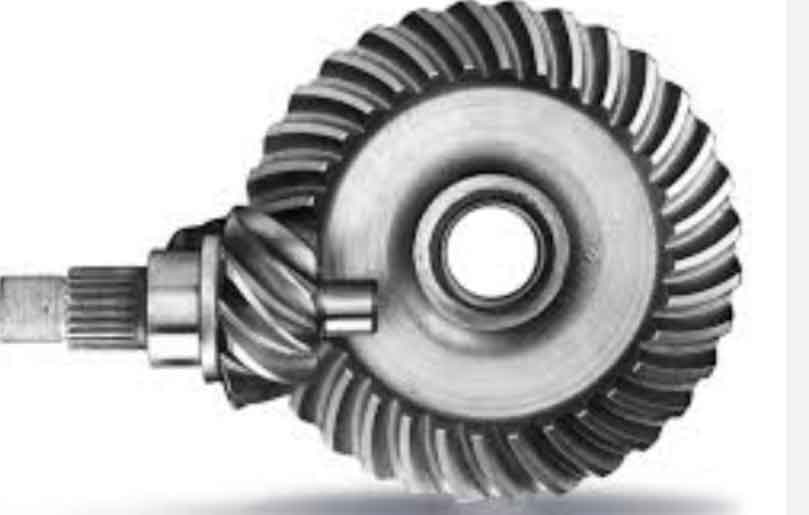
Hypoid gear is critical components in automotive drive systems, significantly influencing vehicle dynamics, fuel efficiency, and NVH (Noise, Vibration, and Harshness) performance. Their complex geometry and non-parallel, non-intersecting axes necessitate precise design and manufacturing to minimize transmission error, tooth root stress, and meshing power loss. Traditional optimization methods often focus on single-objective improvements, leaving multi-objective optimization understudied. This paper addresses this gap by integrating Ease-off topology modification with neural network surrogate modeling and NSGA-II algorithms to achieve simultaneous optimization of hypoid gear performance metrics.
2. Theoretical Framework: Ease-Off Topology Modification
2.1 Fundamentals of Ease-Off Theory
Ease-off topology modification involves adjusting the tooth surface geometry to achieve controlled mismatch between meshing gears. The deviation between the modified surface X2X2 and the original surface X1X1 is approximated by a second-order Taylor expansion:Δθ=a0+a1x+a2y+a3x2+a4y2+a5xyΔθ=a0+a1x+a2y+a3x2+a4y2+a5xy
Here, xx and yy represent the tooth length and height directions, respectively, while coefficients a0a0 to a5a5 correspond to spiral angle error, pressure angle error, tooth length curvature, tooth profile curvature, and surface torsion.
2.2 Sensitivity Analysis and Machining Parameters
The relationship between surface deviation ΔϵΔϵ and machining parameters ΔϕΔϕ is expressed as:[Δϵ1Δϵ2⋮Δϵm]=[η11η21⋯ηn1η12η22⋯ηn2⋮⋮⋱⋮η1mη2m⋯ηnm][Δϕ1Δϕ2⋮Δϕn]Δϵ1Δϵ2⋮Δϵm=η11η12⋮η1mη21η22⋮η2m⋯⋯⋱⋯ηn1ηn2⋮ηnmΔϕ1Δϕ2⋮Δϕn
Sensitivity coefficients ηijηij are derived using finite difference methods. The machining parameters are then solved via least squares:Δϕ=(YTY)−1YTΔϵΔϕ=(YTY)−1YTΔϵ
3. Hypoid Gear Drive Axle Model
3.1 Model Parameters
A hypoid gear drive axle model was developed using MASTA dynamics software. Key parameters are summarized in Table 1.
Table 1: Drive Axle Model Parameters
| Parameter | Value |
|---|---|
| Gear Ratio | 4.1 |
| Material (Gears) | Case-Hardened Steel |
| Elastic Modulus (Gears) | 207,000 MPa |
| Poisson’s Ratio (Gears) | 0.29 |
| Number of Teeth (Pinion/Gear) | 10/41 |
| Mid-Spiral Angle | 35° |
3.2 Finite Element Analysis
The finite element model (FEM) for hypoid gear was generated with HyperMesh, focusing on mesh refinement and load distribution. Key FEM settings are listed in Table 2.
Table 2: Finite Element Model Parameters
| Parameter | Pinion | Gear |
|---|---|---|
| Mesh Size (mm) | 5.95 | 27.14 |
| Profile Mesh Density | 4 | 4 |
| Circumferential Mesh Count | 8 | 8 |
4. Multi-Objective Optimization Framework
4.1 Neural Network Surrogate Model
A 5-7-4-3 BP neural network was trained to map Ease-off parameters (a0a0 to a4a4) to performance metrics:
- Transmission Error (TE): Peak-to-peak error across 1000–5000 N·m loads.
- Root Stress (RS): Maximum von Mises stress on the tension side.
- Meshing Power Loss (PMi): Calculated using:
PMi=fmT1n1cos2(βm)9549 MPMi=9549MfmT1n1cos2(βm)
where fmfm is the friction factor, T1T1 is input torque, n1n1 is rotational speed, and MM is mechanical advantage.
4.2 NSGA-II Optimization
The NSGA-II algorithm was employed to minimize TE, RS, and PMi. Key optimization parameters include:
Table 3: NSGA-II Algorithm Settings
| Parameter | Value |
|---|---|
| Population Size | 100 |
| Maximum Generations | 1,000 |
| Variable Bounds | 0≤ai≤0.00050≤ai≤0.0005 |
5. Results and Validation
5.1 Optimization Outcomes
The Pareto front (Fig. 1) illustrates trade-offs between TE, RS, and PMi. Selected optimal solutions are compared with baseline performance in Table 4.
Table 4: Performance Comparison (Baseline vs. Optimized)
| Metric | Baseline | Optimized | Improvement (%) |
|---|---|---|---|
| TE (µrad) | 178.7 | 107.9 | 39.6 |
| RS (MPa) | 387.4 | 300.7 | 22.4 |
| PMi (W) | 228.8 | 183.1 | 20.0 |
5.2 Key Observations
- Ease-off Parameter Sensitivity: a1a1 (pressure angle error) had the highest impact on TE reduction.
- Trade-off Analysis: Lower TE often correlated with higher PMi, necessitating Pareto-based decision-making.
- Validation: MASTA simulations confirmed the surrogate model’s accuracy, with errors <5% (Table 5).
Table 5: Surrogate Model Validation
| Case | TE Error (%) | RS Error (%) | PMi Error (%) |
|---|---|---|---|
| 1 | -1.35 | -2.25 | +2.71 |
| 2 | -3.27 | +1.64 | -3.18 |
6. Discussion
6.1 Advantages of Ease-off Topology
- Controlled Mismatch: Enables precise adjustment of contact patterns and stress distribution.
- Computational Efficiency: Second-order Taylor expansion simplifies sensitivity analysis.
6.2 Limitations and Future Work
- Edge Effects: Small discrepancies at tooth edges require further refinement.
- Dynamic Loading: Future studies should incorporate transient load conditions.
7. Conclusion
This study demonstrates a robust framework for multi-objective optimization of hypoid gear using Ease-off topology, neural networks, and NSGA-II. Key achievements include:
- 39.6% Reduction in TE, enhancing NVH performance.
- 22.4% Lower RS, improving fatigue life.
- 19.96% Decrease in PMi, boosting energy efficiency.
The integration of surrogate modeling and evolutionary algorithms provides a scalable solution for complex gear optimization challenges.