
In the field of industrial robotics and precision machinery, the demand for compact, efficient, and high-performance transmission systems has grown significantly. Among these, the rotary vector reducer, commonly known as the RV reducer, plays a pivotal role due to its exceptional attributes such as high precision, compact size, and superior load-bearing capacity. As a researcher focused on advancing mechanical design methodologies, I have undertaken a comprehensive study to optimize the rotary vector reducer using multi-objective optimization techniques. This article presents my firsthand perspective on developing a mathematical model and applying genetic algorithms to enhance the design of the rotary vector reducer, aiming to minimize volume and maximize transmission efficiency simultaneously. The rotary vector reducer is a two-stage transmission device combining cycloidal pin wheel and planetary gear mechanisms, widely used in robotic joints where space constraints and performance are critical. Through this work, I seek to contribute to the evolution of rotary vector reducer design, offering a novel approach that balances structural compactness with operational efficacy.
The rotary vector reducer operates on a principle that involves an initial planetary gear stage followed by a cycloidal pin wheel stage. This configuration allows for high reduction ratios and torque density, making the rotary vector reducer ideal for applications requiring precise motion control. However, traditional design methods often rely on empirical or iterative approaches, which may not fully exploit the potential for optimization. In my research, I address this gap by formulating a multi-objective optimization problem where the volume of the rotary vector reducer and its transmission efficiency are treated as competing objectives. By leveraging optimization theory and computational tools, I aim to derive design parameters that yield an optimal trade-off between these objectives, thereby improving the overall performance of the rotary vector reducer.
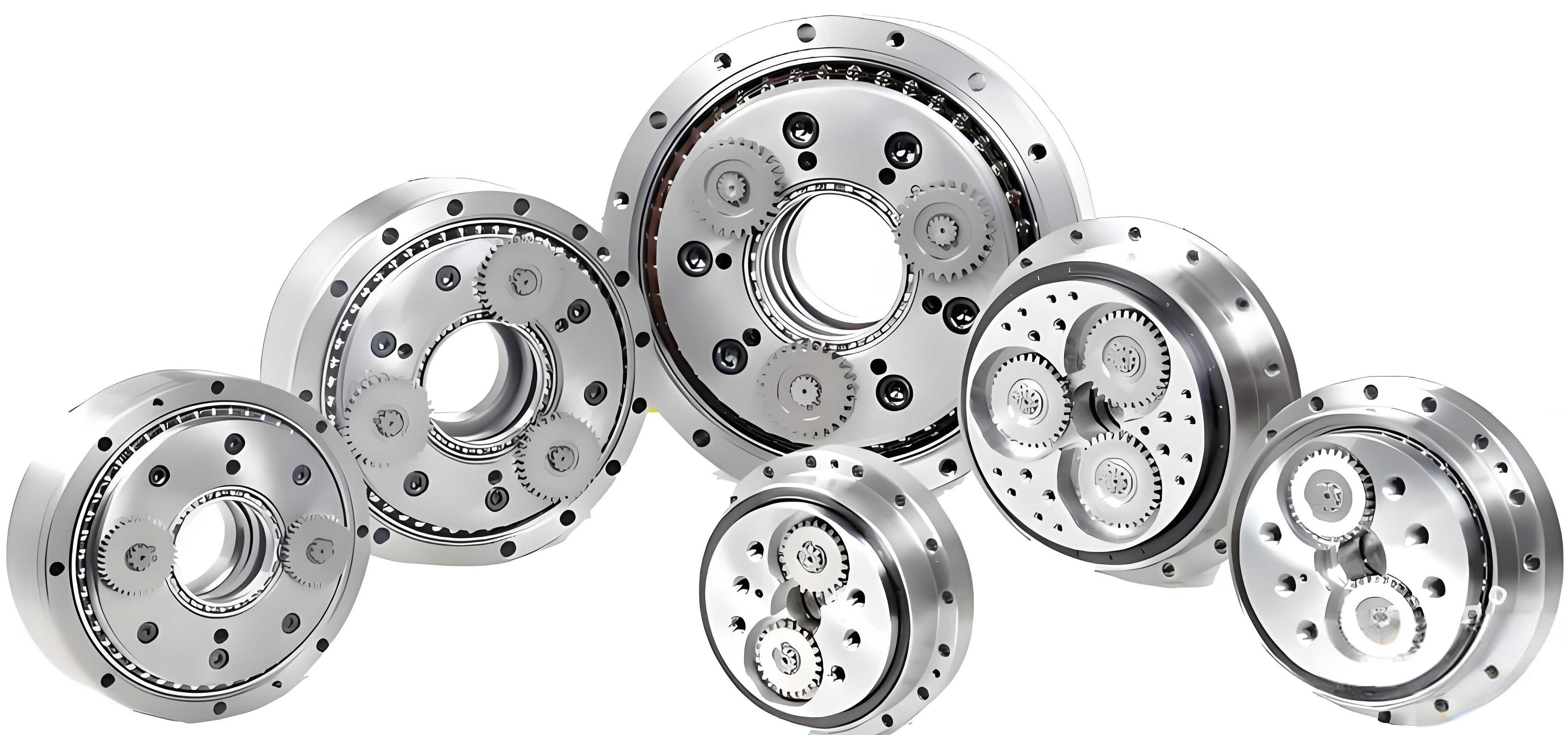
To begin, I established a detailed mathematical model for the rotary vector reducer optimization. The design variables were selected based on their influence on the objectives and constraints. These include the pin tooth center circle diameter \(D_z\), the short amplitude coefficient \(K_1\), the module of the planetary gears \(m\), the tooth width of the planetary gears \(b\), the pin tooth pin diameter \(d’_z\), the width of the cycloidal gear \(B\), the number of teeth on the sun gear \(Z_{a1}\), and the number of teeth on the pin wheel \(Z_{b2}\). Thus, the design vector is defined as:
$$ \mathbf{X} = (x_1, x_2, x_3, x_4, x_5, x_6, x_7, x_8)^T = (D_z, K_1, m, b, d’_z, B, Z_{a1}, Z_{b2})^T $$
The primary objectives for optimizing the rotary vector reducer are to minimize its overall volume and maximize its transmission efficiency. The volume of the rotary vector reducer is computed considering both the planetary gear stage and the cycloidal stage. The total volume \(V\) is given by:
$$ V = \frac{\pi}{4} m b^2 \left( Z_{a1}^2 + 3 Z_{g1}^2 \right) + \frac{\pi}{4} (D_z + d’_z + 2\Delta_1)^2 (2B + \delta) $$
where \(Z_{g1}\) is the number of teeth on the planetary gear, calculated as \(Z_{g1} = \frac{Z_{a1}(i-1)}{Z_{b2}}\), with \(i\) being the transmission ratio of the rotary vector reducer. Here, \(\Delta_1\) represents the wall thickness of the pin tooth sleeve, typically set to 3 mm, and \(\delta\) is the gap between the cycloidal gears, derived from the bearing width. Therefore, the first objective function to minimize is:
$$ \min f_1(\mathbf{X}) = \frac{\pi}{4} m b^2 \left( Z_{a1}^2 + 3 \left( \frac{Z_{a1}(i-1)}{Z_{b2}} \right)^2 \right) + \frac{\pi}{4} (D_z + d’_z + 2\Delta_1)^2 (2B + \delta) $$
The second objective focuses on the transmission efficiency \(\eta\) of the rotary vector reducer. Efficiency is a critical performance metric, especially in applications where energy conservation is vital. Based on analytical models, the efficiency can be approximated as:
$$ \eta = \eta_{AB}^E \times \eta_n \times \eta_M $$
where \(\eta_{AB}^E\) is the meshing friction loss efficiency of the RV-type planetary transmission, \(\eta_n\) accounts for rolling bearing friction losses, and \(\eta_M\) represents hydraulic losses. For the rotary vector reducer, the efficiency expression simplifies to:
$$ \eta = \left[ 1 – (1-i) \cdot \left( 1 – 2.3 f_z \left( \frac{1}{Z_{a1}} + \frac{1}{Z_{g1}} \right) \right)^3 \cdot \frac{Z_{b2} – f_z (4.8 K_1 – 9 \sqrt{K_1} + 5.6)}{Z_{b2} + f_z (Z_{b2}-1)(4.8 K_1 – 9 \sqrt{K_1} + 5.6)} \right]^2 \times 0.99^2 $$
with \(f_z = 0.035\) as the gear meshing friction coefficient. Thus, the second objective function to maximize is equivalent to minimizing \(f_2(\mathbf{X}) = 1 – \eta\), expressed as:
$$ \min f_2(\mathbf{X}) = 1 – \left[ 1 – (1-i) \cdot \left( 1 – 2.3 \times 0.035 \left( \frac{1}{Z_{a1}} + \frac{Z_{b2}}{Z_{a1}(i-1)} \right) \right)^3 \cdot \frac{Z_{b2} – 0.035(4.8 K_1 – 9 \sqrt{K_1} + 5.6)}{Z_{b2} + 0.035(Z_{b2}-1)(4.8 K_1 – 9 \sqrt{K_1} + 5.6)} \right]^2 \times 0.99^2 $$
These objective functions encapsulate the core goals for enhancing the rotary vector reducer: reducing material usage and improving energy transmission. However, optimization must adhere to various engineering constraints to ensure feasibility and reliability. I derived multiple constraint conditions based on mechanical design principles, gear theory, and practical considerations for the rotary vector reducer.
The constraints include limitations on gear module, tooth width, pin tooth distribution, contact and bending strengths, short amplitude coefficient range, cycloidal gear thickness, and geometric boundaries. For instance, the gear module must be greater than 2 mm to prevent undercutting, leading to:
$$ g_1(\mathbf{X}) = 2 – m \leq 0 $$
Similarly, the tooth width is constrained relative to the module to ensure proper gear geometry:
$$ g_2(\mathbf{X}) = b – 17m \leq 0 $$
$$ g_3(\mathbf{X}) = 5m – b \leq 0 $$
For the pin tooth distribution in the rotary vector reducer, the spacing between pin teeth must avoid interference, resulting in:
$$ g_4(\mathbf{X}) = 1.25(d’_z + 2\Delta_1) – D_z \sin\left(\frac{\pi}{Z_{b2}}\right) \leq 0 $$
$$ g_5(\mathbf{X}) = D_z \sin\left(\frac{\pi}{Z_{b2}}\right) – 4(d’_z + 2\Delta_1) \leq 0 $$
The contact stress on the cycloidal gear tooth surface must not exceed the allowable limit to prevent wear or failure. Using Hertzian contact theory, the constraint is formulated as:
$$ g_6(\mathbf{X}) = \frac{4 \times 9.064 \times 10^8 \times M_V}{D_z^2 B} Y_{1 \text{max}} (0.418)^2 – [\sigma_j]^2 \leq 0 $$
where \(M_V\) is the output torque, \(Y_{1 \text{max}}\) is the position coefficient at maximum stress, and \([\sigma_j]\) is the allowable contact stress. Additionally, the bending strength of the pin teeth must be ensured, especially for two-support pin teeth configurations common in rotary vector reducers with \(D_z < 390\) mm. The bending stress constraint is:
$$ g_7(\mathbf{X}) = 4.316 \times 10^3 \cdot M_V \cdot (0.5B + \delta + 0.5\Delta) \cdot \frac{1.5B + \delta’ + \delta + 0.5\Delta}{D_z d_z’^3 K_1 (Z_{b2}-1)(2B + \delta’ + 2\delta + \Delta)} – [\sigma_{FP}] \leq 0 $$
Here, \(\delta’\) is the clearance between the cycloidal gear and the pin wheel side, typically 4 mm, and \(\Delta\) is the wall thickness of the pin wheel side. The short amplitude coefficient \(K_1\) is critical for cycloidal tooth profile generation and is bounded to avoid sharp edges or undercutting:
$$ g_8(\mathbf{X}) = 0.5 – K_1 \leq 0 $$
$$ g_9(\mathbf{X}) = K_1 – 0.8 \leq 0 $$
The thickness of the cycloidal gear in the rotary vector reducer is proportionally related to the pin tooth center circle diameter:
$$ g_{10}(\mathbf{X}) = 0.05 D_z – B \leq 0 $$
$$ g_{11}(\mathbf{X}) = B – 0.1 D_z \leq 0 $$
Furthermore, the pin tooth center circle diameter must fall within standard ranges for different rotary vector reducer models, as tabulated below:
| Model Type | \(D_z\) Range (mm) |
|---|---|
| 0 | 75–94 |
| 1 | 95–105 |
| 2 | 106–120 |
| 3 | 140–155 |
| 4 | 165–185 |
| 5 | 210–230 |
| 6 | 250–275 |
| 7 | 280–300 |
For a specific rotary vector reducer model, such as RV250, the diameter constraints are:
$$ g_{12}(\mathbf{X}) = D_z – d_1 \leq 0 $$
$$ g_{13}(\mathbf{X}) = d_2 – D_z \leq 0 $$
where \(d_1\) and \(d_2\) are the lower and upper bounds, respectively. To prevent root cutting in gears, the sun gear tooth number must satisfy:
$$ g_{14}(\mathbf{X}) = 17 – Z_{a1} \leq 0 $$
Lastly, avoiding root cutting in the cycloidal tooth profile requires that the ratio of pin tooth sleeve radius to pin tooth center circle radius is less than the minimum curvature radius coefficient:
$$ g_{15}(\mathbf{X}) = 2(d’_z + 2\Delta_1) – \frac{D_z (1 + K_1)^2}{1 + K_1 + (Z_{b2}-1)K_1} \leq 0 $$
With these constraints, the multi-objective optimization problem for the rotary vector reducer is formally defined as:
$$ \min \mathbf{F}(\mathbf{X}) = [f_1(\mathbf{X}), f_2(\mathbf{X})] $$
$$ \text{subject to } g_i(\mathbf{X}) \leq 0 \quad (i = 1, 2, \dots, 15) $$
This constitutes a constrained nonlinear multi-objective optimization challenge. To solve it, I employed a weighted sum method to transform the multi-objective problem into a single-objective one, facilitating the use of optimization algorithms. The combined objective function is:
$$ F(\mathbf{X}) = \lambda_1 f_1(\mathbf{X}) + \lambda_2 f_2(\mathbf{X}) $$
where \(\lambda_1\) and \(\lambda_2\) are weighting coefficients. To ensure balanced consideration, I set these coefficients as the reciprocals of the optimal values of each single objective, i.e., \(\lambda_i = 1 / f’_i(\mathbf{X})\) with \(f’_i(\mathbf{X}) = \min f_i(\mathbf{X})\). This approach normalizes the objectives and reduces bias from differing scales, making it suitable for the rotary vector reducer optimization.
For the optimization process, I chose genetic algorithms (GAs) due to their global search capabilities and ability to handle complex, non-convex spaces without getting trapped in local minima. GAs are population-based heuristic methods inspired by natural selection, involving selection, crossover, and mutation operations. I implemented the GA using MATLAB, coding the objective functions, constraints, and algorithm parameters to iteratively evolve design solutions for the rotary vector reducer.
The GA parameters were set as follows: a population size of 100, a maximum of 500 generations, a crossover probability of 0.8, and a mutation probability of 0.05. The constraints were handled using penalty functions, where infeasible solutions are penalized by adding large values to the objective function, steering the search toward feasible regions. The algorithm was run multiple times to ensure robustness and convergence for the rotary vector reducer optimization.
After extensive computation, the GA yielded optimized design parameters for the rotary vector reducer. The results, compared to initial design values, are summarized in the table below. The optimization was performed for a rotary vector reducer with a transmission ratio \(i = 101\), initial parameters based on the RV250 model, and allowable stresses \([\sigma_j] = 850\) MPa and \([\sigma_{FP}] = 150\) MPa.
| Design Variable | Initial Data | GA Optimization Result | Rounded Result |
|---|---|---|---|
| \(D_z\) (mm) | 229 | 228.9514 | 229 |
| \(K_1\) | 0.7682 | 0.8010 | 0.8010 |
| \(m\) | 2 | 1.9990 | 2 |
| \(b\) (mm) | 13 | 9.9940 | 10 |
| \(d’_z\) (mm) | 10 | 8.3707 | 8 |
| \(B\) (mm) | 22 | 11.4466 | 11 |
| \(Z_{a1}\) | 21 | 25.9990 | 26 |
| \(Z_{b2}\) | 40 | 42.0010 | 42 |
| Volume \(V\) (mm³) | 5,093,600 | 3,670,600 | 3,628,800 |
| Efficiency \(\eta\) | 0.8567 | 0.8892 | 0.8886 |
The optimization results demonstrate significant improvements for the rotary vector reducer. The volume decreased from approximately 5.09 million mm³ to 3.67 million mm³, a reduction of about 27.9%, indicating a more compact and material-efficient design. Simultaneously, the transmission efficiency increased from 0.8567 to 0.8892, a gain of roughly 3.0%, enhancing the energy performance of the rotary vector reducer. These outcomes validate the effectiveness of the multi-objective optimization approach for the rotary vector reducer, achieving both smaller size and higher efficiency—key goals in modern mechanical design.
To further analyze the results, I examined the sensitivity of the objectives to design variables. For instance, the pin tooth center circle diameter \(D_z\) and the cycloidal gear width \(B\) directly influence volume, while the short amplitude coefficient \(K_1\) and tooth numbers affect efficiency. The GA successfully navigated these dependencies, as seen in the optimized values: \(K_1\) increased to 0.8010, closer to the upper bound of 0.8, which generally improves cycloidal meshing efficiency; the module \(m\) remained near 2 mm, satisfying strength requirements; and tooth widths were reduced, contributing to volume savings. The rounded results maintain practical manufacturability, ensuring the rotary vector reducer can be produced with standard tools.
The convergence behavior of the GA is illustrated through the evolution of fitness values across generations. The algorithm showed steady improvement, with the best fitness decreasing over iterations and the population diversity preserved through mutation. This highlights GA’s suitability for complex optimization tasks like that of the rotary vector reducer, where traditional gradient-based methods might struggle due to non-linearity and multiple constraints.
In addition to the primary objectives, the optimization indirectly benefits other aspects of the rotary vector reducer. For example, reduced volume leads to lower weight, which is advantageous in robotic applications where payload capacity is critical. Higher efficiency minimizes heat generation and power losses, extending the lifespan of the rotary vector reducer. Moreover, the optimized parameters adhere to all mechanical constraints, ensuring structural integrity and reliability under operational loads. This comprehensive optimization of the rotary vector reducer aligns with industry trends toward miniaturization and sustainability.
To contextualize this work, I compare it with existing optimization methods for rotary vector reducers. Previous studies often focus on single objectives, such as minimizing volume or maximizing torque capacity, using techniques like parametric analysis or sequential quadratic programming. However, multi-objective optimization for rotary vector reducers is less common, especially with efficiency as a key target. My approach integrates both volume and efficiency through weighted sum and GA, offering a balanced solution. Furthermore, the use of genetic algorithms provides a global perspective, avoiding local optima that might occur in conventional methods. This advances the design paradigm for rotary vector reducers, enabling more holistic improvements.
The mathematical model developed here can be extended or modified for other types of rotary vector reducers with different specifications. For instance, varying transmission ratios or load conditions can be incorporated by adjusting the objective functions and constraints. Additionally, other objectives like cost minimization or vibration reduction could be included in future multi-objective frameworks for rotary vector reducers. The flexibility of GA allows for such expansions, making it a versatile tool for rotary vector reducer design optimization.
In practice, implementing the optimized design requires consideration of manufacturing tolerances and assembly processes. The rounded values from the optimization, such as \(d’_z = 8\) mm and \(B = 11\) mm, are feasible for production using standard machining techniques. Prototyping and testing would be the next steps to validate the performance of the optimized rotary vector reducer under real-world conditions. However, simulation-based validation using finite element analysis (FEA) could precede physical tests to assess stress distributions and dynamic behavior.
From a broader perspective, this research contributes to the field of precision transmission systems by demonstrating the value of computational optimization in mechanical design. The rotary vector reducer, as a critical component in robotics and automation, benefits from such advancements, potentially leading to more efficient and compact robotic joints. As industries embrace Industry 4.0 and smart manufacturing, optimized rotary vector reducers can enhance the performance and reliability of automated systems.
In conclusion, through this study, I have presented a multi-objective optimization methodology for the rotary vector reducer using genetic algorithms. By formulating volume minimization and efficiency maximization as competing objectives, and incorporating detailed engineering constraints, I derived an optimized set of design parameters that significantly improve the rotary vector reducer’s performance. The results show a substantial reduction in volume and a noticeable increase in efficiency, proving the efficacy of this approach. This work not only provides a practical solution for rotary vector reducer design but also establishes a framework that can be adapted for similar mechanical systems. Future work may explore multi-objective evolutionary algorithms like NSGA-II for Pareto-front analysis or integrate real-time simulation for dynamic optimization. Ultimately, optimizing the rotary vector reducer is a step toward more advanced and sustainable mechanical transmissions, supporting innovation in robotics and beyond.
The journey of optimizing the rotary vector reducer has reinforced the importance of interdisciplinary approaches, blending mechanical engineering principles with computational intelligence. As I continue to explore optimization techniques, I aim to further refine the design of rotary vector reducers and contribute to the evolution of high-performance transmission technologies. The rotary vector reducer, with its unique capabilities, remains a fascinating subject for research and development, driving progress in precision engineering.