
In the field of mechanical engineering, the design of gear reducers is critical for transmitting torque and matching rotational speeds in various applications, including aerospace and conveyor systems. Spur gears, which are a fundamental component in these systems, offer advantages such as high efficiency and reliability. However, designing a two-stage spur gear reducer involves addressing complex multi-objective optimization problems to ensure balanced performance. In this article, I will explore the application of genetic algorithms to optimize the design of two-stage spur gear reducers, focusing on minimizing center distance and maximizing transmission efficiency. The use of spur gears is emphasized throughout, as they play a key role in achieving compact and efficient designs. I will begin by establishing a multi-objective optimization model, including initial and final objective functions, along with constraints. Then, I will detail the genetic algorithm approach for solving these problems, supported by simulation tests and practical case studies. The integration of mathematical formulations, such as equations and tables, will help illustrate the optimization process. Finally, I will discuss the results and implications for real-world applications.
The design of two-stage spur gear reducers requires careful consideration of multiple conflicting objectives. For instance, reducing the center distance can lead to a more compact design, but it may compromise transmission efficiency or structural integrity. Similarly, minimizing the volume or inertia of the gears can enhance performance but must be balanced against other factors like strength and durability. In this context, spur gears are often preferred due to their simplicity and effectiveness in power transmission. However, optimizing their parameters—such as module, number of teeth, and transmission ratios—involves discrete variables and nonlinear relationships. Traditional design methods often rely on iterative trials, which can be time-consuming and suboptimal. Therefore, I propose a multi-objective optimization framework that leverages advanced computational techniques to achieve a Pareto-optimal solution, where no single objective can be improved without degrading another.
To begin, let me define the initial objective functions for the optimization model. The primary goals include minimizing the center distance, minimizing the moment of inertia, and minimizing the overall volume of the spur gears. These objectives are formulated based on the geometric and dynamic properties of the gears. For example, the center distance function, denoted as F1, is derived from the sum of the center distances of the high-speed and low-speed stages. It can be expressed as:
$$ F1 = \frac{1}{\cos \beta} \left[ m_{n1} z_1 (1 + i_1) + m_{n2} z_2 (1 + i_2) \right] $$
Here, \( m_{n1} \) and \( m_{n2} \) represent the normal modules of the high-speed and low-speed spur gears, respectively; \( z_1 \) and \( z_2 \) are the number of teeth on the pinions; \( i_1 \) and \( i_2 \) are the transmission ratios; and \( \beta \) is the helix angle, which for spur gears is typically zero, but in generalized cylindrical gears, it may vary. However, in the context of spur gears, we often assume \( \beta = 0 \) to simplify calculations, though the model can accommodate non-zero values for broader applications.
Next, the objective function for minimizing the moment of inertia, F2, accounts for the rotational dynamics of the spur gear system. It is given by:
$$ F2 = J_1 + (J_2 + J_3) \frac{1}{i_1^2} + J_4 \frac{1}{i_1^2 i_2^2} $$
where \( J_1 \) to \( J_4 \) represent the moments of inertia of the four gears in the system. These values can be approximated using the gear dimensions, such as the pitch diameter and face width, which are critical for spur gears to ensure smooth operation and minimal energy loss.
The third objective function, F3, focuses on minimizing the total volume of the spur gears, which is essential for reducing weight and material costs. It is formulated as:
$$ F3 = \frac{\pi \alpha_{d1}}{4} \left( \frac{m_{n1} z_1}{\cos \beta} \right)^3 (1 + i_1^3) + \frac{\pi \alpha_{d2}}{4} \left( \frac{m_{n2} z_2}{\cos \beta} \right)^3 \left(1 + \left(\frac{i}{i_1}\right)^3\right) $$
In this equation, \( \alpha_{d1} \) and \( \alpha_{d2} \) are the face width coefficients for the high-speed and low-speed stages, and \( i \) is the total transmission ratio. For spur gears, the volume calculation assumes solid cylindrical shapes, but in practice, factors like gear teeth geometry must be considered.
These initial objective functions often conflict with each other. For example, reducing the center distance might require smaller modules or fewer teeth, which could increase stress and reduce efficiency. Therefore, I combine them into a single multi-objective function using a weighted sum approach. The design variables are defined as a vector:
$$ X = [m_{n1}, m_{n2}, z_1, z_2, i_1, \beta]^T = [x_1, x_2, x_3, x_4, x_5, x_6]^T $$
The final objective function, F(X), is then expressed as:
$$ \min F(X), \quad X \in \mathbb{R}^6 $$
$$ \text{subject to } g_m(x) \geq 0 \quad (m = 5, 6, \ldots, 23) $$
$$ F(X) = \sum_{j=1}^{3} w_j F_j’ $$
where \( w_j \) are the weights assigned to each objective, summing to 1, and \( F_j’ \) are normalized versions of the initial functions to ensure they are on a comparable scale. The normalization is done as follows:
$$ F_j'(X) = \frac{F_j(X) – m_j}{M_j – m_j} $$
Here, \( m_j \) and \( M_j \) are the minimum and maximum values of \( F_j(X) \) over the feasible domain, respectively. This transformation helps in handling the different units and magnitudes of the objectives, making the optimization process more robust.
The constraints in this model are crucial for ensuring the practical feasibility of the spur gear design. They include limits on gear parameters based on mechanical standards and performance requirements. For instance, the normal module for spur gears typically ranges from 2 to 3 mm to balance size and strength. The number of teeth on the pinion is constrained to avoid undercutting, usually between 20 and 30. The helix angle \( \beta \) is often set to zero for spur gears, but if considered, it might be limited to small values to minimize axial forces. Additionally, strength constraints based on contact and bending stresses must be satisfied. The contact stress \( \sigma_H \) and bending stresses \( \sigma_{F1} \) and \( \sigma_{F2} \) are given by:
$$ \sigma_H = 305 \sqrt{\frac{(i+1)^3 K_i T_i}{i b \alpha^2}} \leq [\sigma_H] $$
$$ \sigma_{F1} = \frac{1.5 K_i T_i}{b d_1 m_{n1} Y_i} \leq [\sigma_F]_1 $$
$$ \sigma_{F2} = \sigma_{F1} \frac{Y_1}{Y_2} \leq [\sigma_F]_2 $$
where \( K_i \) is the load factor, \( T_i \) is the torque on the shaft, \( b \) is the face width, \( d_1 \) is the pitch diameter, \( Y_i \) is the form factor for the teeth, and \( [\sigma_H] \) and \( [\sigma_F] \) are the allowable stresses. For spur gears, these constraints ensure that the gears can withstand operational loads without failure.
Another important constraint is the avoidance of interference between the low-speed shaft and the high-speed gear, which can be expressed as:
$$ \alpha_2 – E – \frac{d_{r2}}{2} \geq 0 $$
where \( \alpha_2 \) is the center distance between stages, \( E \) is the clearance, and \( d_{r2} \) is the tip diameter of the high-speed gear. This is particularly relevant for spur gears to prevent physical collisions during operation.
To solve this multi-objective optimization problem, I employ a genetic algorithm (GA), which is well-suited for handling nonlinear, discrete variables and multiple objectives. Genetic algorithms mimic natural selection processes, using operations like selection, crossover, and mutation to evolve a population of solutions toward the Pareto front. In the context of spur gear optimization, GA helps maintain diversity in solutions while ensuring convergence to optimal designs. The algorithm starts by initializing a population of random designs, each represented by the variable vector X. Then, it evaluates the fitness of each design based on the objective function F(X) and constraints. Non-dominated sorting is used to rank solutions, and selection pressure is applied to favor better-performing individuals.
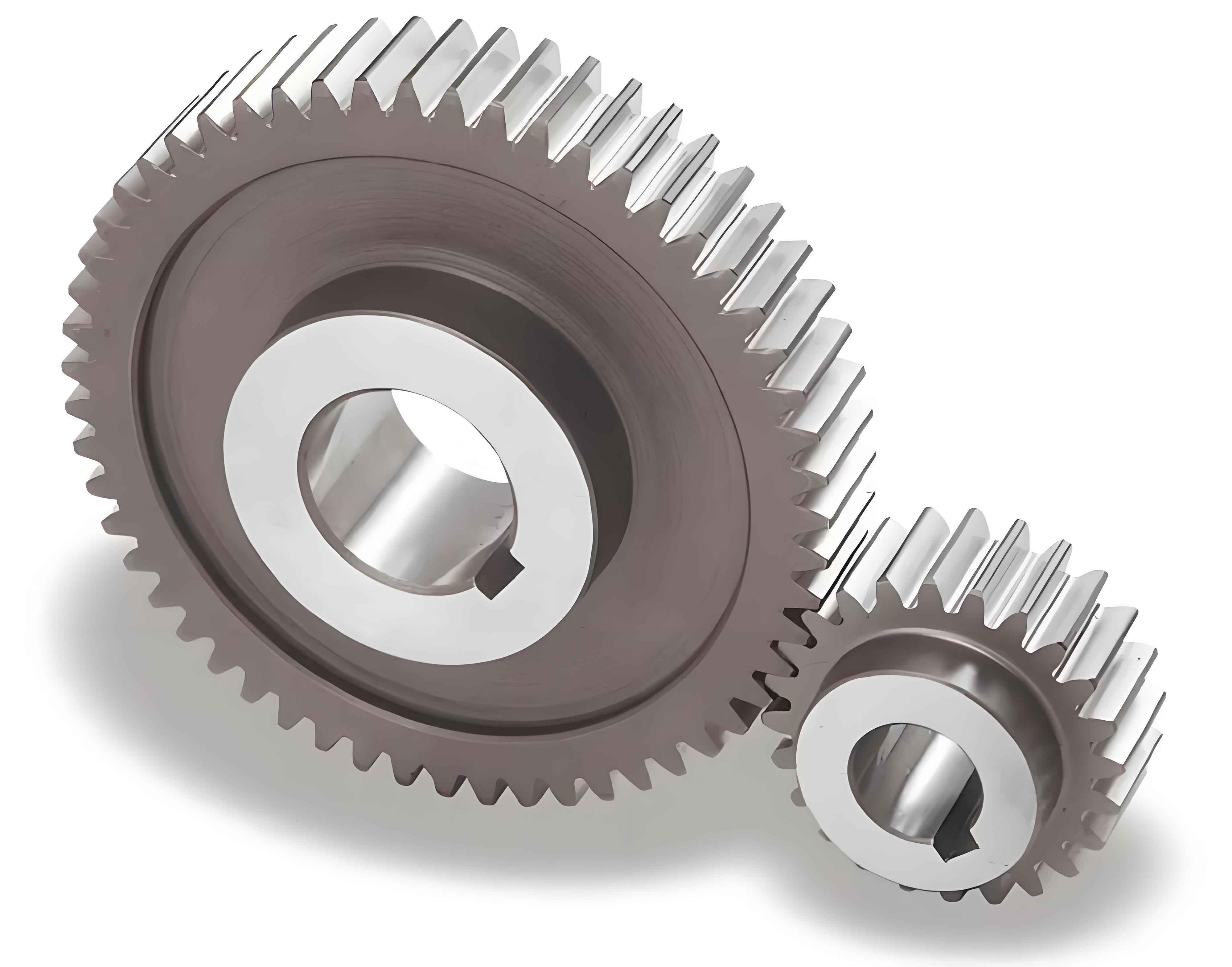
One key aspect of the GA is its ability to identify “knee points” on the Pareto front—solutions that offer the best trade-offs between objectives. For example, in a two-objective minimization problem, the knee point is the solution where the improvement in one objective leads to the greatest degradation in the other. This is illustrated in the following conceptual diagram, which shows non-dominated solutions and the knee point region for spur gear design optimization.
The GA adapts the neighborhood size around these knee points to enhance search efficiency. During iterations, the algorithm calculates the Euclidean distance between solutions and adjusts the selection process to explore promising regions. This approach reduces the risk of premature convergence and ensures a diverse set of solutions. For instance, in each generation, the algorithm copies knee points from the previous generation, applies crossover and mutation to create offspring, and merges them with the current population. Then, non-dominated sorting is performed, and if the number of non-dominated solutions exceeds a threshold, knee points are identified, and their neighborhoods are defined to select individuals for the next generation.
To validate the effectiveness of the genetic algorithm for spur gear optimization, I conducted simulation tests comparing it with other algorithms, such as traditional evolutionary algorithms and bubble sort-based methods. The tests were performed on multi-objective problems with three and four objectives, using performance metrics like inverted generational distance (IGD). Lower IGD values indicate better convergence and diversity. The results, based on 30 independent runs with a population size of 100 and 10,000 iterations, are summarized in the table below.
| Multi-Objective Problem | Genetic Algorithm | Traditional Evolutionary Algorithm | Bubble Sort Algorithm |
|---|---|---|---|
| Three Objectives | 2.417e-1 (6.72e-3) | 2.895e-1 (1.23e-2) | 3.067e-1 (9.53e-3) |
| Four Objectives | 6.942e-1 (1.24e-2) | 8.124e-1 (1.05e-1) | 7.787e-1 (2.24e-2) |
The values in parentheses represent standard deviations. As shown, the genetic algorithm consistently outperforms the others in terms of lower IGD values, demonstrating its superiority in handling the complexity of spur gear optimization. This is because the GA effectively balances convergence and diversity by adapting to the problem structure, making it ideal for real-world applications.
In a practical case study, I applied this multi-objective optimization approach to design a two-stage spur gear reducer for an automotive application. The reducer is driven by a motor with a rated power of 9 kW and an output speed of 80 rpm. The design life is 12 years, assuming 8 hours of daily operation for 300 days per year. The total transmission ratio is 31.5, with an allowable error of 5%. The spur gears are standard, with a pressure angle of 20° and a face width coefficient of 1. The high-speed stage gears are made of 45 steel, heat-treated to a hardness of 228-255 HB, while the low-speed pinion is made of 40Cr steel with a hardness of 187-207 HB. All gears are soft-faced with an accuracy grade of 8.
The optimization objectives are to minimize the total center distance and maximize the transmission efficiency. Using MATLAB’s GUI and optimization toolbox, I implemented the genetic algorithm to solve this problem. The objective function and constraints were coded, and the algorithm parameters were set to a population size of 200 and 10,000 evaluations. The results were compared with single-objective optimizations—one focusing solely on center distance minimization and another on efficiency maximization. The table below presents the optimized design parameters and performance metrics for each approach.
| Design Scheme | \( m_1 \) (mm) | \( m_2 \) (mm) | \( z_1 \) | \( z_2 \) | \( i_1 \) | \( \beta \) (°) | Center Distance (mm) | Transmission Efficiency (%) |
|---|---|---|---|---|---|---|---|---|
| Original Design | 3 | 3 | 30 | 30 | 5 | 20 | 598.5 | 97.2 |
| Single-Objective (Center Distance) | 2.5 | 3 | 20 | 30 | 5.7 | 17 | 459.4 | 96.7 |
| Single-Objective (Efficiency) | 2.5 | 3 | 21 | 30 | 5.7 | 16 | 469.2 | 97.9 |
| Multi-Objective Optimization | 2.5 | 3 | 20 | 29 | 5.7 | 18 | 451.1 | 98.1 |
As evident, the multi-objective optimization achieves a center distance of 451.1 mm and an efficiency of 98.1%, outperforming the single-objective approaches in overall balance. For instance, the single-objective center distance minimization yields a smaller center distance but lower efficiency, while the efficiency maximization gives higher efficiency but a larger center distance. The multi-objective solution, however, strikes a compromise, resulting in a compact and efficient spur gear reducer. To verify the design, I calculated the gear teeth numbers: for the high-speed stage, the gear teeth are \( z_1 = 20 \) and \( z_2 = 20 \times 5.7 = 114 \); for the low-speed stage, \( z_3 = 29 \) and \( z_4 = 29 \times (31.5 / 5.7) \approx 160 \). The actual transmission ratio is \( 114/20 \times 160/29 = 31.45 \), which is within the 5% error tolerance.
The success of this optimization hinges on the genetic algorithm’s ability to handle the discrete nature of spur gear parameters, such as module and teeth counts. By using software tools like MATLAB, the process becomes efficient and reproducible. The algorithm’s adaptive mechanisms ensure that the solution set remains diverse and converges to the Pareto front, providing designers with multiple viable options. In practice, this means that spur gear reducers can be tailored to specific applications without sacrificing performance or reliability.
In conclusion, the multi-objective optimization of two-stage spur gear reducers using genetic algorithms offers a robust framework for achieving optimal designs. By integrating mathematical models, constraints, and advanced algorithms, I have demonstrated how to minimize center distance and maximize transmission efficiency simultaneously. The case study confirms that multi-objective approaches yield balanced results compared to single-objective methods, making them ideal for real-world engineering challenges. Future work could explore other objectives, such as cost minimization or noise reduction, and extend the application to other types of gears. Nonetheless, the principles discussed here provide a solid foundation for optimizing spur gear systems in various industries.