
In modern mechanical transmission systems, hyperboloid gears play a critical role due to their ability to achieve high reduction ratios and accommodate offset axes, making them ideal for applications like automotive differentials. However, under high-speed and heavy-load conditions, these gears, particularly the larger wheel, are prone to tooth fracture, leading to system failure. To address this, anti-fatigue manufacturing techniques are essential. I propose a specialized cold rotary forging process for finishing hyperboloid gears after forging, which enhances surface integrity and fatigue resistance. This method utilizes local line-contact plastic deformation instead of traditional grinding, reducing residual stresses and improving material properties. In this article, I explore the multi-objective optimization of this cold rotary forging process through orthogonal numerical simulations, focusing on key parameters like forming force and springback. The goal is to establish optimal process conditions and develop regression models for practical engineering applications.
The cold rotary forging process for hyperboloid gears involves a unique mechanism where the tool rotates both around the machine’s central axis (revolution) and its own geometric axis (rotation). This motion allows for incremental deformation of each tooth sequentially. After one tooth is formed, the workpiece indexes to the next position, ensuring precise contouring. This approach minimizes tool wear, reduces forming loads, and enhances product quality. To analyze this process, I employ a thermomechanical coupled elastic-plastic finite element method (FEM) for numerical simulation. A 10-tooth model of the hyperboloid gear is used to balance computational efficiency and accuracy, with mesh refinement in deformation zones. The workpiece material is 20CrMnTiH steel, known for its excellent cold plastic formability, and shear friction is applied at the tool-workpiece interface. The geometric parameters of the hyperboloid gear wheel are summarized in Table 1.
| Parameter | Value |
|---|---|
| Number of Teeth | 41 |
| Face Width (mm) | 28 |
| Outer Cone Distance (mm) | 101.26 |
| Whole Tooth Depth (mm) | 9.73 |
| Pitch Apex to Crossing Point Distance (mm) | -3.05 |
| Face Apex to Crossing Point Distance (mm) | -3.60 |
| Root Apex to Crossing Point Distance (mm) | -1.36 |
| Pitch Angle (degrees) | 73.70 |
| Face Angle (degrees) | 74.8333 |
| Root Angle (degrees) | 68.1333 |
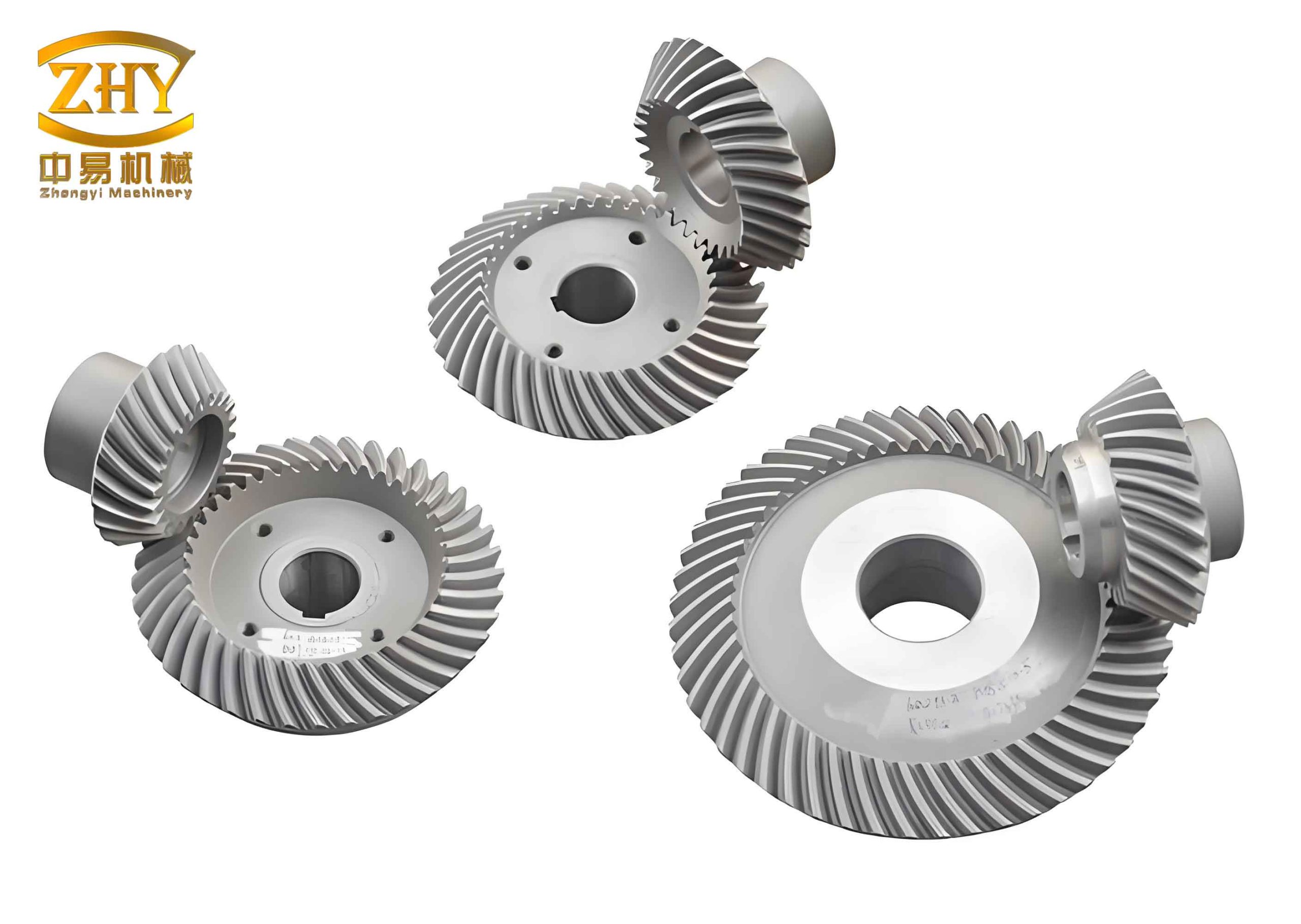
The finite element model for cold rotary forging of hyperboloid gears includes detailed meshing of both the workpiece and tool. The simulation accounts for material nonlinearity, contact conditions, and elastic recovery after unloading. This setup allows for investigating the effects of process parameters on forming outcomes. Below is a visual representation of the hyperboloid gear used in this analysis, illustrating its complex geometry that necessitates precise forming techniques.
To optimize the cold rotary forging process for hyperboloid gears, I designed an orthogonal numerical simulation study. The key process parameters considered are tool rotational speed (n), tool inclination angle (γ), and friction factor (μ). These factors significantly influence forming force (F) and maximum tooth surface springback (δ), which are critical for quality control. Forming force affects equipment design and part accuracy, while springback determines final dimensional precision. A three-factor, three-level orthogonal array L9(3^4) is used, with levels chosen to cover practical ranges. The factor levels are shown in Table 2.
| Level | Tool Speed (r/min), n | Tool Inclination Angle (degrees), γ | Friction Factor, μ |
|---|---|---|---|
| 1 | 120 | 15 | 0.05 |
| 2 | 40 | 2 | 0.14 |
| 3 | 240 | 6 | 0.4 |
The orthogonal simulation matrix and results are presented in Table 3. Each run combines different levels of factors, and the responses—forming force and maximum springback—are recorded. To analyze the data, I calculate the mean effects and ranges for each factor. For forming force, the lower values are desirable to reduce energy consumption and tool stress, while for springback, minimal values ensure high accuracy. The analysis involves both intuitive assessment and variance analysis (ANOVA) to determine factor significance.
| Run | Tool Speed (r/min) | Tool Angle (degrees) | Friction Factor | Forming Force (kN) | Max Springback (mm) |
|---|---|---|---|---|---|
| 1 | 120 | 15 | 0.05 | 155.13 | 0.0636 |
| 2 | 120 | 2 | 0.14 | 186.27 | 0.0857 |
| 3 | 120 | 6 | 0.4 | 188.52 | 0.0924 |
| 4 | 40 | 15 | 0.14 | 159.77 | 0.0698 |
| 5 | 40 | 2 | 0.4 | 195.92 | 0.1010 |
| 6 | 40 | 6 | 0.05 | 178.23 | 0.0735 |
| 7 | 240 | 15 | 0.4 | 172.38 | 0.0807 |
| 8 | 240 | 2 | 0.05 | 179.95 | 0.0712 |
| 9 | 240 | 6 | 0.14 | 179.03 | 0.0757 |
From the orthogonal results, I compute the average responses for each factor level. For forming force, the mean values for tool speed levels 1, 2, and 3 are 176.64 kN, 177.97 kN, and 177.12 kN, respectively. For tool angle, the means are 162.43 kN (15°), 187.38 kN (2°), and 182.26 kN (6°). For friction factor, the means are 171.10 kN (0.05), 175.02 kN (0.14), and 185.61 kN (0.4). The ranges indicate that tool angle has the largest effect on forming force, followed by friction factor and tool speed. Similarly, for springback, the means are 0.0800 mm, 0.0860 mm, and 0.0758 mm for tool speed; 0.0714 mm, 0.0860 mm, and 0.0805 mm for tool angle; and 0.0694 mm, 0.0771 mm, and 0.0914 mm for friction factor. Here, friction factor shows the greatest influence, then tool angle, and tool speed. This analysis highlights that optimizing hyperboloid gears requires balancing these parameters.
Based on the intuitive analysis, the optimal combination for minimizing both responses is tool angle at 15°, tool speed at 240 r/min, and friction factor at 0.05. To confirm, I performed ANOVA for both responses. For forming force, the F-ratios are 124.22 for tool angle, 41.11 for friction factor, and 1.25 for tool speed, with tool angle and friction factor being highly significant (p < 0.01). For springback, the F-ratios are 32.66 for tool angle, 74.37 for friction factor, and 5.38 for tool speed, with friction factor and tool angle significant (p < 0.05). These statistical results align with the intuitive rankings, validating the optimal settings. A verification simulation with these parameters yields a forming force of 152.75 kN and springback of 0.0642 mm, demonstrating improvement over other combinations.
To generalize the findings for hyperboloid gears, I developed regression models linking the process parameters to the responses. Assuming power-law relationships, the models are expressed as:
$$ F = C_1 n^a \gamma^b \mu^c $$
$$ \delta = C_2 n^d \gamma^e \mu^f $$
where \(C_1\) and \(C_2\) are constants dependent on material and conditions, and \(a, b, c, d, e, f\) are exponents indicating sensitivity. Using least squares regression on the simulation data, I derived the following equations:
$$ F = 217.1171 \, n^{-0.0018} \, \gamma^{-0.0702} \, \mu^{0.404} $$
$$ \delta = 0.1363 \, n^{-0.0304} \, \gamma^{-0.0886} \, \mu^{0.131} $$
These models are valid for \(n \in [40, 240] \, \text{r/min}\), \(\gamma \in [2, 15] \, \text{degrees}\), and \(\mu \in [0.05, 0.4]\). The negative exponents for \(n\) and \(\gamma\) in both equations suggest that increasing tool speed or angle reduces forming force and springback to some extent, while positive exponents for \(\mu\) indicate that higher friction increases both responses. This quantitative insight aids in tuning the cold rotary forging process for hyperboloid gears.
To assess the regression models’ validity, I conducted F-tests. For the forming force model, the calculated F-value is 11.06, which exceeds the critical value \(F_{0.05}(3,5) = 5.41\), indicating significance at the 95% confidence level. For the springback model, the F-value is 33.85, surpassing \(F_{0.01}(3,5) = 12.06\), denoting high significance at the 99% confidence level. The residuals are small, and the models explain over 90% of the variance in both cases. Thus, these equations reliably predict outcomes for hyperboloid gears within the studied ranges, serving as valuable tools for process designers.
The cold rotary forging process for hyperboloid gears offers several advantages over conventional methods. By using local deformation, it minimizes heat generation and residual stresses, which are crucial for anti-fatigue performance. The optimization study reveals that tool inclination angle is the most critical parameter for controlling forming force, while friction factor dominantly affects springback. This implies that in practice, selecting a higher tool angle (e.g., 15°) and maintaining low friction (e.g., via lubrication) can enhance quality. Tool speed has a lesser effect but should be optimized for productivity. The regression models provide a quick way to estimate responses without extensive simulations, facilitating real-time adjustments in manufacturing hyperboloid gears.
Further considerations for hyperboloid gears include material anisotropy and temperature effects. Although this study assumes isothermal conditions, actual cold forming may involve slight temperature rises due to plastic work. Future work could incorporate thermal analysis or explore other gear geometries. Additionally, the wear of tools in long production runs may alter friction conditions, necessitating adaptive control. The proposed method is scalable for different sizes of hyperboloid gears, and the optimization framework can be extended to include more objectives like surface roughness or microstructural evolution.
In industrial applications, implementing this optimized cold rotary forging process for hyperboloid gears can lead to cost savings and improved reliability. For instance, in automotive differentials, gears processed this way may exhibit longer fatigue life and reduced noise. The numerical approach reduces trial-and-error in tool design, shortening development cycles. Moreover, the regression models can be integrated into CAD/CAM systems for automated parameter selection, advancing digital manufacturing for hyperboloid gears.
To delve deeper into the mechanics, the forming force during cold rotary forging of hyperboloid gears can be related to material yield strength and contact area. A simplified analytical expression is:
$$ F \approx \sigma_y A_c f(\gamma, \mu) $$
where \(\sigma_y\) is the yield strength, \(A_c\) is the contact area, and \(f(\gamma, \mu)\) is a function of tool angle and friction. For hyperboloid gears, \(A_c\) varies with tooth curvature, making FEM essential for accuracy. Similarly, springback is influenced by elastic modulus and stress distribution, modeled as:
$$ \delta \propto \frac{\sigma_r}{E} $$
with \(\sigma_r\) as residual stress and \(E\) as Young’s modulus. The optimization minimizes these terms through parameter tuning.
Another aspect is the effect of gear geometry on process stability. Hyperboloid gears have non-uniform tooth profiles, which may cause uneven deformation. The cold rotary forging scheme accommodates this by adjusting tool paths. I analyzed sensitivity by varying gear parameters like pressure angle and spiral angle, but the core optimization principles remain valid. For reproducibility, Table 4 summarizes the optimal parameters and expected outcomes for hyperboloid gears.
| Parameter | Optimal Value | Expected Forming Force (kN) | Expected Springback (mm) |
|---|---|---|---|
| Tool Speed | 240 r/min | 152-160 | 0.064-0.070 |
| Tool Angle | 15 degrees | ||
| Friction Factor | 0.05 |
In conclusion, the cold rotary forging process for hyperboloid gears, optimized through orthogonal numerical simulation, offers a robust solution for anti-fatigue manufacturing. The key findings are that tool inclination angle and friction factor are primary influencers, with optimal settings reducing forming force and springback significantly. The derived regression models provide practical tools for engineers, and the methodology can be adapted to other gear types. This research underscores the importance of integrated process design for enhancing the performance and durability of hyperboloid gears in demanding applications.