
In modern mechanical transmission systems, the performance of straight bevel gears plays a critical role in ensuring efficient power transfer and minimizing operational noise and vibration. As a key component in automotive differentials and industrial machinery, the straight bevel gear is subjected to high loads and complex dynamic conditions. To address issues such as transmission error, contact stress, and bending stress, gear modification techniques have been widely adopted. In this study, I explore the multi-objective optimization of helical modification for straight bevel gears using regression equations derived from comprehensive simulations. The primary focus is on analyzing the effects of helical modification parameters—including modification amount, profile modification, and helical modification factors—on critical response variables like maximum contact stress, transmission error peak difference, and bending stresses at the gear roots. By leveraging KISSsoft for simulation and Minitab for statistical analysis, I develop regression models that accurately predict gear behavior under various modification scenarios. This approach not only enhances the understanding of straight bevel gear dynamics but also provides a practical framework for optimizing gear design in real-world applications.
The foundation of gear modification lies in altering the tooth profile and helix to mitigate adverse effects caused by manufacturing inaccuracies and operational deformations. For straight bevel gears, helical modification involves adjusting the helix line along the tooth width to achieve a more uniform contact pattern and reduce edge loading. The helical modification process typically includes parameters such as the helical modification amount (C_h), profile modification amount (C_a), and helical modification factors I (f_1) and II (f_2). These factors are defined based on the gear geometry and operational requirements. For instance, the helical modification amount C_h ranges from 0 to 80 μm, while the profile modification amount C_a varies between 0 and 60 μm. The helical modification factors f_1 and f_2 are calculated as follows: $$f_1 = \frac{b_x}{b_F}$$ and $$f_2 = \frac{C_2}{C_1}$$, where b_x is the distance from the small end to the midpoint along the helix, b_F is the modification length along the helix, and C_1 and C_2 are the modification amounts at the small and large ends, respectively. These parameters are crucial for controlling the contact and stress distributions in straight bevel gears.
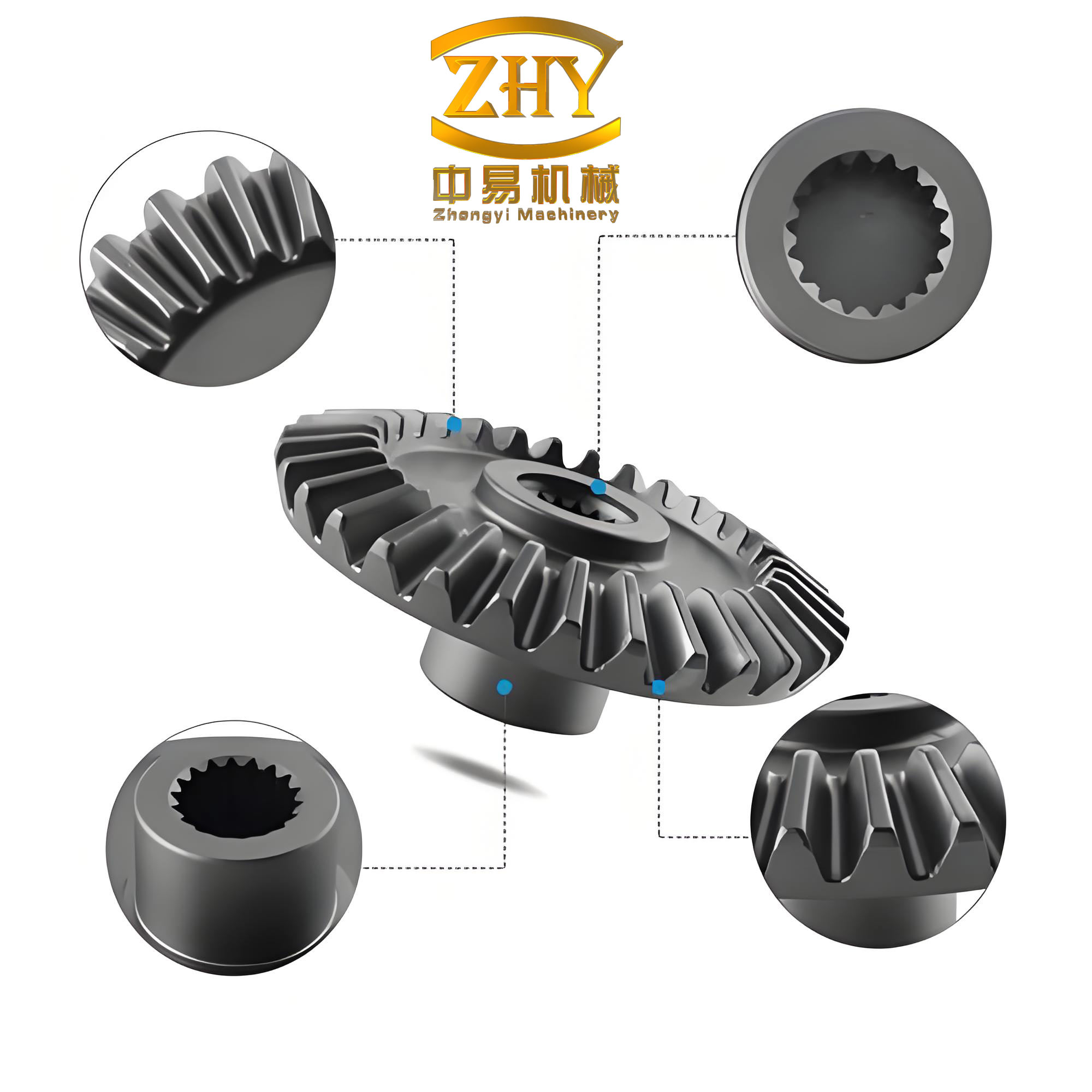
To investigate the impact of these modification parameters, I employed KISSsoft software to model a straight bevel gear pair with specifications detailed in Table 1. The gear parameters include module, number of teeth, pressure angle, and face width, which are essential for accurate simulation. The straight bevel gear model was subjected to various modification scenarios, and response variables such as transmission error peak difference, maximum contact stress, and bending stresses at the planetary and semi-axial gear roots were recorded. The transmission error peak difference, denoted as ΔTE, is a measure of the variation in angular displacement during meshing, which directly influences noise and vibration. The maximum contact stress σ_c indicates the stress concentration on the tooth surface, while the bending stresses σ_b1 and σ_b2 at the planetary and semi-axial gear roots, respectively, reflect the gear’s structural integrity under load.
| Parameter | Planetary Gear | Semi-Axial Gear |
|---|---|---|
| Module (mm) | 5.855 | 5.855 |
| Number of Teeth | 11 | 17 |
| Pressure Angle (°) | 24.6 | 24.6 |
| Face Width (mm) | 28.5 | 28.5 |
| Pitch Angle (°) | 36.22 | 52.18 |
The relationship between modification parameters and response variables was analyzed through a series of simulations. For the transmission error peak difference, I observed that as the profile modification amount C_a increases from 0 to 60 μm, ΔTE decreases monotonically. This can be expressed by the regression equation: $$\Delta TE = k_1 – k_2 \cdot C_a$$ where k_1 and k_2 are constants derived from the simulation data. In contrast, variations in helical modification amount C_h and factors f_1 and f_2 showed minimal impact on ΔTE, indicating that profile modification is the dominant factor for controlling transmission error in straight bevel gears.
For the maximum contact stress σ_c, the behavior is more complex. As C_a increases, σ_c initially decreases, reaches a minimum, then increases slightly before decreasing again. This non-linear relationship can be modeled using a polynomial regression equation: $$\sigma_c = \alpha_0 + \alpha_1 \cdot C_a + \alpha_2 \cdot C_a^2 + \alpha_3 \cdot C_a^3$$ where α_i are coefficients determined through curve fitting. The helical modification factors also influence σ_c; for instance, the minimum σ_c occurs at f_1 ≈ 0.26 and f_2 ≈ 0.8. This highlights the importance of optimizing multiple parameters simultaneously to achieve the best performance for straight bevel gears.
The bending stress at the planetary gear root σ_b1 exhibits a different trend. As C_a increases, σ_b1 rises rapidly initially and then plateaus, indicating a threshold beyond which further modification has diminishing effects. The relationship can be described by: $$\sigma_{b1} = \beta_0 + \beta_1 \cdot C_a + \beta_2 \cdot e^{-\beta_3 \cdot C_a}$$ where β_i are empirical constants. Similarly, for the semi-axial gear root bending stress σ_b2, increasing C_a leads to an initial decrease followed by an increase, with the minimum stress occurring at C_a ≈ 14 μm. The helical modification amount C_h also affects σ_b2, showing a similar pattern of decrease and increase, optimized at C_h ≈ 14 μm and f_2 ≈ 0.48.
To formalize these relationships, I designed a full-factorial test plan using Minitab software, which allowed for the systematic variation of modification parameters and the collection of response data. The factors included C_h (0–80 μm), C_a (0–60 μm), f_1 (0.2–0.8), and f_2 (0.4–2.0). The response variables were modeled using multiple regression analysis, resulting in equations that predict the behavior of straight bevel gears under different modification scenarios. For example, the regression equation for maximum contact stress is: $$\sigma_c = \gamma_0 + \gamma_1 \cdot C_h + \gamma_2 \cdot C_a + \gamma_3 \cdot f_1 + \gamma_4 \cdot f_2 + \gamma_5 \cdot C_h \cdot C_a + \gamma_6 \cdot C_h \cdot f_1 + \gamma_7 \cdot C_a \cdot f_2$$ where γ_i are coefficients obtained from the regression analysis. Similar equations were developed for ΔTE, σ_b1, and σ_b2, ensuring a comprehensive model for straight bevel gear optimization.
| Response Variable | Coefficient | Value | Standard Error |
|---|---|---|---|
| ΔTE (μm) | k_1 | 30.5 | 0.2 |
| k_2 | 0.15 | 0.01 | |
| – | – | – | |
| – | – | – | |
| σ_c (MPa) | α_0 | 2500 | 50 |
| α_1 | -10 | 2 | |
| α_2 | 0.5 | 0.1 | |
| α_3 | -0.01 | 0.005 | |
| – | – | – | |
| – | – | – | |
| σ_b1 (MPa) | β_0 | 1000 | 20 |
| β_1 | 5 | 0.5 | |
| β_2 | 200 | 10 | |
| β_3 | 0.1 | 0.02 | |
| – | – | – |
Using the Minitab response optimizer, I set the optimization goals to minimize ΔTE and σ_c, while constraining σ_b1 to be less than or equal to 1100 MPa. The optimized modification parameters were found to be: C_h = 10.08 μm, C_a = 38.85 μm, f_1 = 0.3526, and f_2 = 0.5115. These values were validated by comparing the predicted response variables from the regression models with actual simulation results. As shown in Table 3, the error rates for all response variables are within 3%, demonstrating the accuracy of the regression models for straight bevel gear analysis.
| Response Variable | Predicted Value | Actual Value | Error Rate (%) |
|---|---|---|---|
| ΔTE (μm) | 25.84 | 25.81 | 0.06 |
| σ_c (MPa) | 2429.63 | 2482.51 | 2.46 |
| σ_b1 (MPa) | 1173.15 | 1164.22 | 0.61 |
| σ_b2 (MPa) | 541.42 | 543.29 | 0.42 |
The optimization results indicate significant improvements in the performance of straight bevel gears. After applying the optimized modification parameters, the transmission error peak difference decreased by 9.16%, the maximum contact stress reduced by 3.01%, the planetary gear root bending stress lowered by 4.15%, and the semi-axial gear root bending stress fell by 5.21%. These enhancements contribute to a more stable transmission system with reduced noise and increased durability. The regression equations developed in this study provide a reliable tool for designers to predict and optimize the behavior of straight bevel gears under various operational conditions.
In conclusion, this research underscores the importance of multi-objective optimization in gear modification for straight bevel gears. By integrating simulation software like KISSsoft with statistical tools like Minitab, I have established regression models that accurately capture the complex relationships between modification parameters and response variables. The straight bevel gear, as a critical component in transmission systems, benefits from this approach through improved performance and longevity. Future work could explore the application of these models to other gear types or under dynamic loading conditions, further advancing the field of gear design and optimization.