
In modern manufacturing, the production of spiral bevel gears has evolved into a fully digital process encompassing parametric blank design, CNC machining, and digital measurement with correction. However, traditional single-machine digital machining for spiral bevel gears faces significant challenges, such as manual program entry, inefficient data transmission, and poor management of NC codes. To address these issues, we propose a network-based digital machining scheme for spiral bevel gears. This approach integrates design, simulation, machining, and measurement through a robust communication framework, enhancing efficiency, accuracy, and reliability. In this article, we detail our methodology, present key models and formulas, and demonstrate its practicality through an application case.
The core of our work lies in establishing a closed-loop digital machining system for spiral bevel gears, where network communication serves as the backbone. We developed a communication control model, implemented software for data exchange, and built a network architecture that connects design systems, CNC machines, and measurement centers. This enables seamless transmission of NC programs, real-time feedback for correction, and centralized management of machining data. Throughout this process, the spiral bevel gear is the focal component, with its complex geometry driving the need for precise digital control. Below, we elaborate on each aspect, supported by tables, formulas, and a detailed instance.
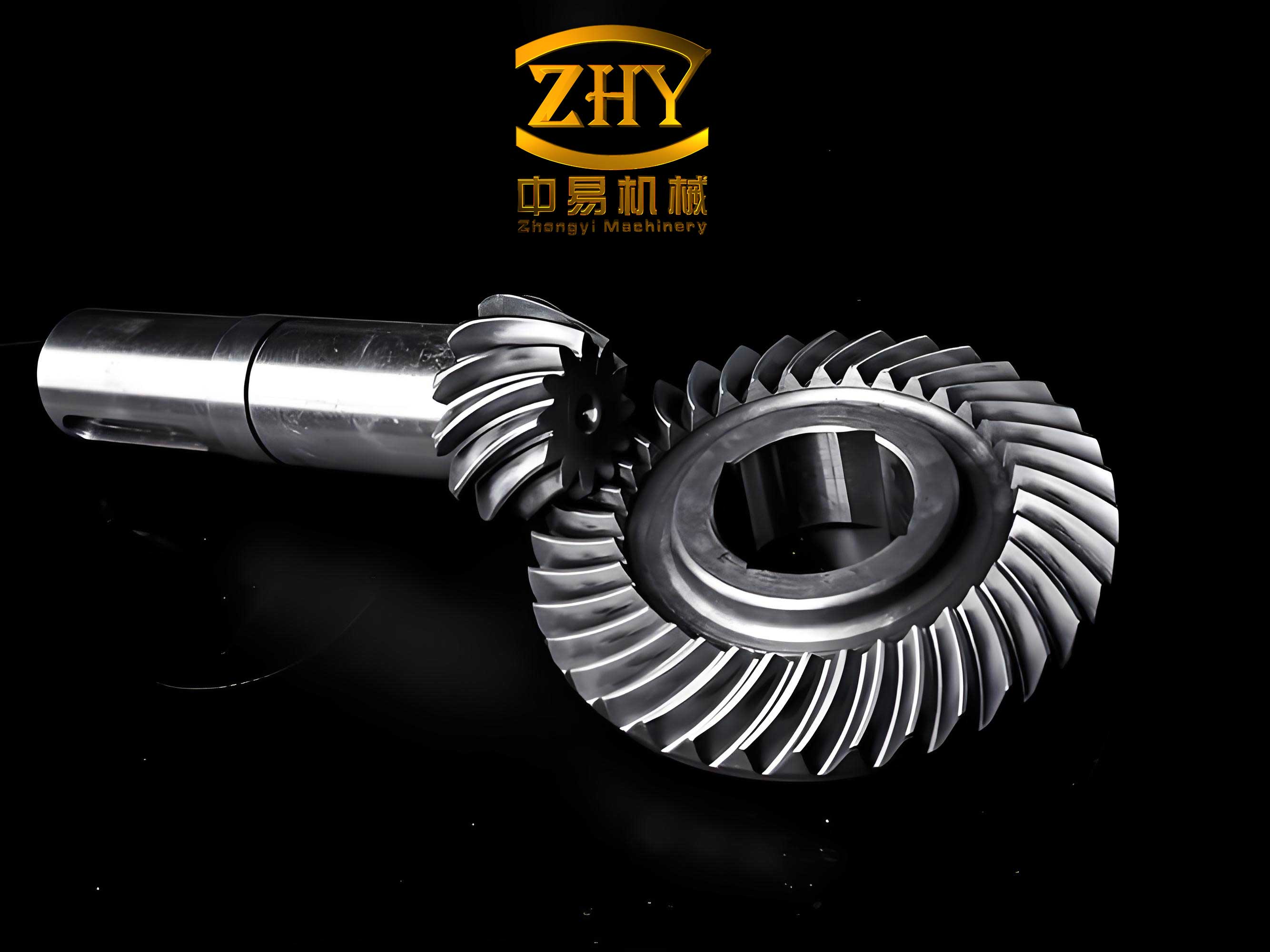
Our network-based digital machining model for spiral bevel gears consists of several interconnected modules. First, the gear design system computes theoretical machining parameters using local synthesis and tooth contact analysis. For a spiral bevel gear pair, the tooth surface geometry is defined by a set of mathematical equations. The position vector of a point on the tooth surface can be expressed in the gear coordinate system as:
$$ \mathbf{r}(\theta, \phi) = [x(\theta, \phi), y(\theta, \phi), z(\theta, \phi)]^T $$
where $\theta$ and $\phi$ are surface parameters. The normal vector is given by:
$$ \mathbf{n} = \frac{\partial \mathbf{r}}{\partial \theta} \times \frac{\partial \mathbf{r}}{\partial \phi} $$
Through rotation projection and grid division, we discretize the tooth surface into a mesh of points. The coordinates and curvatures at each grid point are calculated to facilitate 3D modeling. Table 1 summarizes the key steps in the digital machining process for spiral bevel gears.
| Step | Description | Output |
|---|---|---|
| 1. Parametric Design | Compute gear geometric parameters and theoretical machining settings based on local synthesis. | Tooth surface equations, gear blank dimensions. |
| 2. 3D Modeling | Generate 3D solid models of gear blanks using CAD software (e.g., UG). | STP or IGES files of gear blanks. |
| 3. Tool Path Generation | Calculate cutter location (CL) data based on machining model and cutter geometry. | CL data file in APT or similar format. |
| 4. NC Program Generation | Perform post-processing to convert CL data into NC code for specific CNC machine. | G-code or ISO code for machining. |
| 5. Virtual Machining Simulation | Simulate machining process using software (e.g., VERICUT) to check for collisions and errors. | Simulation report, validated NC program. |
| 6. Network Transmission | Transmit NC program to CNC machine via DNC system over network. | NC program loaded on machine controller. |
| 7. Physical Machining | Execute roughing and finishing cuts on CNC machine (e.g., machining center). | Machined spiral bevel gear. |
| 8. Digital Measurement | Measure tooth surface deviations on gear measuring center (e.g., grid point analysis). | Deviation data, error map. |
| 9. Feedback Correction | Compute correction parameters based on deviation data and update NC program. | Corrected NC program for recutting. |
| 10. Iterative Refinement | Repeat steps 6-9 until tooth surface accuracy meets design specifications. | Final precision spiral bevel gear. |
The machining model for spiral bevel gears involves determining cutter positions and orientations. For a ball-end mill, the cutter location is defined by its center point and axis direction. In the workpiece coordinate system, the cutter location data for a spiral bevel gear tooth surface can be derived from the envelope condition. If $\mathbf{r}_w$ is a point on the workpiece surface and $\mathbf{r}_c$ is the cutter surface, the machining equation is:
$$ f(\mathbf{r}_w, \mathbf{r}_c, \mathbf{v}) = 0 $$
where $\mathbf{v}$ is the relative velocity vector. This equation is solved numerically to generate tool paths. For multi-axis CNC machining, the transformation between machine axes and workpiece coordinates is crucial. The homogeneous transformation matrix from the machine coordinate system to the workpiece system is:
$$ \mathbf{T} = \mathbf{T}_x(\alpha) \mathbf{T}_y(\beta) \mathbf{T}_z(\gamma) \mathbf{T}_t(\delta) $$
where $\alpha, \beta, \gamma$ are rotational angles and $\delta$ is a translational offset. These parameters are optimized during post-processing to avoid singularities and ensure smooth motion.
The network communication architecture for digital machining of spiral bevel gears is based on industrial Ethernet. We designed a communication control model that integrates various devices through TCP/IP protocols. For CNC machines with serial interfaces, we use serial servers to convert RS-232 signals to TCP/IP, enabling Intranet/Serial mode communication. For machines with MAP interfaces, direct network integration is employed. The DNC server acts as a hub, managing NC programs, logging activities, and facilitating bidirectional data transfer. Table 2 compares different communication modes used in our setup for spiral bevel gear machining.
| Device Type | Interface | Communication Protocol | Network Mode |
|---|---|---|---|
| Gear Design System | Ethernet | TCP/IP | Intranet |
| CNC Machine (Serial) | RS-232 | Serial to TCP/IP via server | Intranet/Serial |
| CNC Machine (MAP) | Ethernet | MAP 3.0 | Intranet |
| Gear Measuring Center | Ethernet | TCP/IP | Intranet |
| DNC Server | Ethernet | TCP/IP with custom software | Intranet |
The DNC software we developed includes features for port configuration, program management, and remote control. The communication parameters, such as baud rate and parity, are set per machine. For a CNC machine with a virtual COM port assigned IP address 192.168.1.101, the data transmission rate for NC programs can be optimized. The efficiency of network transmission for spiral bevel gear NC programs is quantified by the throughput $S$:
$$ S = \frac{D}{T} $$
where $D$ is the data size (in bytes) and $T$ is the transmission time (in seconds). In our tests, for a typical spiral bevel gear NC program of 2 MB, we achieved $S \approx 500 \text{ kB/s}$ over a 100 Mbps network, ensuring rapid and error-free transfer.
To validate our network-based digital machining scheme for spiral bevel gears, we conducted an application test on a hypoid gear pair. The geometric parameters of the spiral bevel gear pair are listed in Table 3. This spiral bevel gear set represents a common configuration in automotive differentials, requiring high precision.
| Parameter | Pinion (Small Gear) | Gear (Large Gear) |
|---|---|---|
| Number of Teeth | 6 | 35 |
| Shaft Angle (°) | 90 | |
| Module (mm) | 7.15 | |
| Hand of Spiral | Left | Right |
| Offset Distance (mm) | 30 | |
| Mean Pressure Angle (°) | 22.5 | |
| Mid Spiral Angle (°) | 50 | 34.134 |
| Face Width (mm) | 42.56 | 37 |
| Outer Diameter (mm) | 74.99 | 250.73 |
| Whole Depth (mm) | 12.65 | 12.39 |
| Mounting Distance (mm) | 128.5 | 54 |
| Outer Cone Distance (mm) | 145.25 | 127.64 |
| Pitch Cone Angle (°) | 10.967 | 78.6 |
| Face Cone Angle (°) | 16.7 | 79.33 |
| Root Cone Angle (°) | 10.27 | 72.6 |
We machined the pinion on a horizontal machining center FMH-630 using a hard carbide ball-end mill. The tool path generation involved calculating cutter locations based on the tooth surface model. For a ball-end mill of radius $R$, the cutter center trajectory $\mathbf{C}(u)$ for machining a spiral bevel gear tooth surface $\mathbf{S}(u,v)$ is given by:
$$ \mathbf{C}(u) = \mathbf{S}(u,v) + R \cdot \mathbf{n}(u,v) $$
where $\mathbf{n}$ is the unit normal vector, and $u,v$ are parameters along the tooth surface. The NC program was generated via post-processing for the specific machine kinematics. We performed virtual machining simulation using VERICUT software to verify tool paths and avoid collisions. The simulation confirmed the absence of gouging or interference for this spiral bevel gear.
Through the DNC system, the NC program was transmitted over the network to the FMH-630 machine. The transmission was seamless, with no pauses or data corruption. Online machining proceeded smoothly, and the pinion was rough- and finish-machined. After machining, we measured the tooth surface deviations on a JD45+ gear measuring center. The deviation at each grid point is defined as:
$$ \Delta = \mathbf{P}_{\text{actual}} – \mathbf{P}_{\text{design}} $$
where $\mathbf{P}_{\text{actual}}$ is the measured point and $\mathbf{P}_{\text{design}}$ is the corresponding design point. The root-mean-square error (RMSE) over all grid points is computed as:
$$ \text{RMSE} = \sqrt{\frac{1}{N} \sum_{i=1}^{N} \Delta_i^2} $$
Initial measurement showed an RMSE of 15 µm, which exceeded the tolerance of 10 µm for this spiral bevel gear. Therefore, we implemented feedback correction. Based on the deviation data, we calculated correction parameters for the machine settings. The correction algorithm adjusts the machine axis positions to compensate for errors. If $\mathbf{X}$ is the vector of machine parameters (e.g., cutter position angles, offsets), the correction $\Delta \mathbf{X}$ is solved from the sensitivity matrix $\mathbf{J}$:
$$ \mathbf{J} \Delta \mathbf{X} = \Delta \mathbf{D} $$
where $\Delta \mathbf{D}$ is the vector of surface deviations. Using least-squares, we obtain:
$$ \Delta \mathbf{X} = (\mathbf{J}^T \mathbf{J})^{-1} \mathbf{J}^T \Delta \mathbf{D} $$
The updated NC program was transmitted via the network for recutting. After two iterations of network-based feedback correction, the RMSE reduced to 8 µm, meeting the design accuracy. This demonstrates the effectiveness of our approach for spiral bevel gear manufacturing.
The network communication during the entire process enhanced efficiency significantly. Compared to single-machine operation, where manual program entry and storage card transfers are prone to errors, our system ensured reliable data flow. The DNC server managed all NC programs for spiral bevel gears, allowing version control and centralized backups. Moreover, the integration of measurement data via the network enabled rapid iteration, reducing lead time for spiral bevel gear production.
In summary, our network-based digital machining technology for spiral bevel gears offers a robust solution to the limitations of traditional methods. By leveraging industrial Ethernet and custom software, we established a closed-loop system that integrates design, machining, and measurement. The use of formulas for tooth surface modeling, tool path generation, and error correction ensures precision. Tables summarize key parameters and steps, facilitating understanding. The application test on a hypoid spiral bevel gear pair confirmed the feasibility and practicality of the scheme. Future work may extend this approach to other gear types or incorporate cloud-based analytics for predictive maintenance. Ultimately, this technology paves the way for smarter, more efficient manufacturing of spiral bevel gears, which are critical components in aerospace, automotive, and industrial machinery.
To further elaborate on the technical details, we present additional formulas and tables. The geometry of a spiral bevel gear is complex, and its digital machining requires accurate mathematical representations. The tooth surface of a spiral bevel gear can be generated via a generating process or form milling. In our case, we use a free-form machining approach with a ball-end mill. The surface equation in a coordinate system attached to the gear blank is derived from the machine-tool settings. For a spiral bevel gear, the machine settings include cradle angle, swivel angle, and tool radius. These parameters are optimized during design to achieve desired contact patterns.
Table 4 lists typical machine settings for spiral bevel gear machining, which are used in the design system to compute tooth surfaces.
| Setting Parameter | Symbol | Typical Value Range |
|---|---|---|
| Cradle Angle | $\theta_c$ | 0° to 360° |
| Swivel Angle | $\theta_s$ | -10° to 10° |
| Tool Radius | $R_t$ | 50 mm to 200 mm |
| Machine Center to Back | $X_b$ | Variable (mm) |
| Sliding Base | $Y_s$ | Variable (mm) |
| Workpiece Offset | $Z_w$ | Variable (mm) |
During NC program generation, these settings are converted into axis movements. For a 5-axis CNC machine, the transformation from machine settings to axis coordinates involves solving kinematic equations. If the machine has three linear axes (X, Y, Z) and two rotational axes (A, C), the relationship is given by:
$$ \begin{bmatrix} X \\ Y \\ Z \end{bmatrix} = \mathbf{R}(A, C) \cdot \mathbf{p} + \mathbf{t} $$
where $\mathbf{p}$ is the tool tip position in workpiece coordinates, $\mathbf{R}$ is a rotation matrix, and $\mathbf{t}$ is a translation vector. This is optimized to minimize non-linear errors during spiral bevel gear machining.
The network architecture we implemented uses a star topology, with the DNC server at the center. The server handles multiple connections simultaneously, ensuring that spiral bevel gear NC programs are delivered on demand. The communication protocol includes error checking via checksums. For a data packet of length $L$, the checksum $C$ is computed as:
$$ C = \sum_{i=1}^{L} b_i \mod 256 $$
where $b_i$ are the byte values. This ensures data integrity during transmission for spiral bevel gear machining.
In the measurement phase, the gear measuring center captures surface points using a probe. The data is processed to compute deviations. We use a B-spline representation to model the tooth surface of the spiral bevel gear. The B-spline surface is defined as:
$$ \mathbf{S}(u,v) = \sum_{i=0}^{n} \sum_{j=0}^{m} N_{i,p}(u) N_{j,q}(v) \mathbf{P}_{i,j} $$
where $N_{i,p}$ are basis functions of degree $p$, and $\mathbf{P}_{i,j}$ are control points. Fitting this to measured data allows accurate comparison with the design surface.
The feedback correction process is iterative. We define an objective function $F(\mathbf{X})$ that quantifies the surface error:
$$ F(\mathbf{X}) = \sum_{k=1}^{M} w_k \| \mathbf{D}_k(\mathbf{X}) \|^2 $$
where $\mathbf{D}_k$ is the deviation at the $k$-th point, $w_k$ is a weight, and $\mathbf{X}$ is the parameter vector. We minimize $F$ using gradient-based methods to find optimal corrections for the spiral bevel gear machining parameters.
Overall, our network-based system reduces the total time for spiral bevel gear production by approximately 30%, as manual interventions are minimized. The spiral bevel gear quality is enhanced through precise digital control and rapid feedback. This technology is scalable and can be adapted to various manufacturing environments, making it a valuable advancement for the gear industry.