
The design and manufacturing of hypoid gears represent a pinnacle of complexity in gear engineering. Their unique offset configuration, providing high torque capacity and smooth meshing in compact assemblies, demands precise geometrical definition. At the heart of this definition lies the accurate calculation of pitch cone parameters, which form the foundation for determining blank dimensions, cutter specifications, and critical machine-tool settings. Traditional calculation methods, while established, often involve intricate and multi-step procedures that can obscure the fundamental geometric relationships. This text presents a novel, systematic algorithm for establishing the pitch cone geometry of hypoid gear drives. This approach clarifies the interdependencies between parameters and provides a streamlined foundation for subsequent calculations in gear design and tooth surface generation.
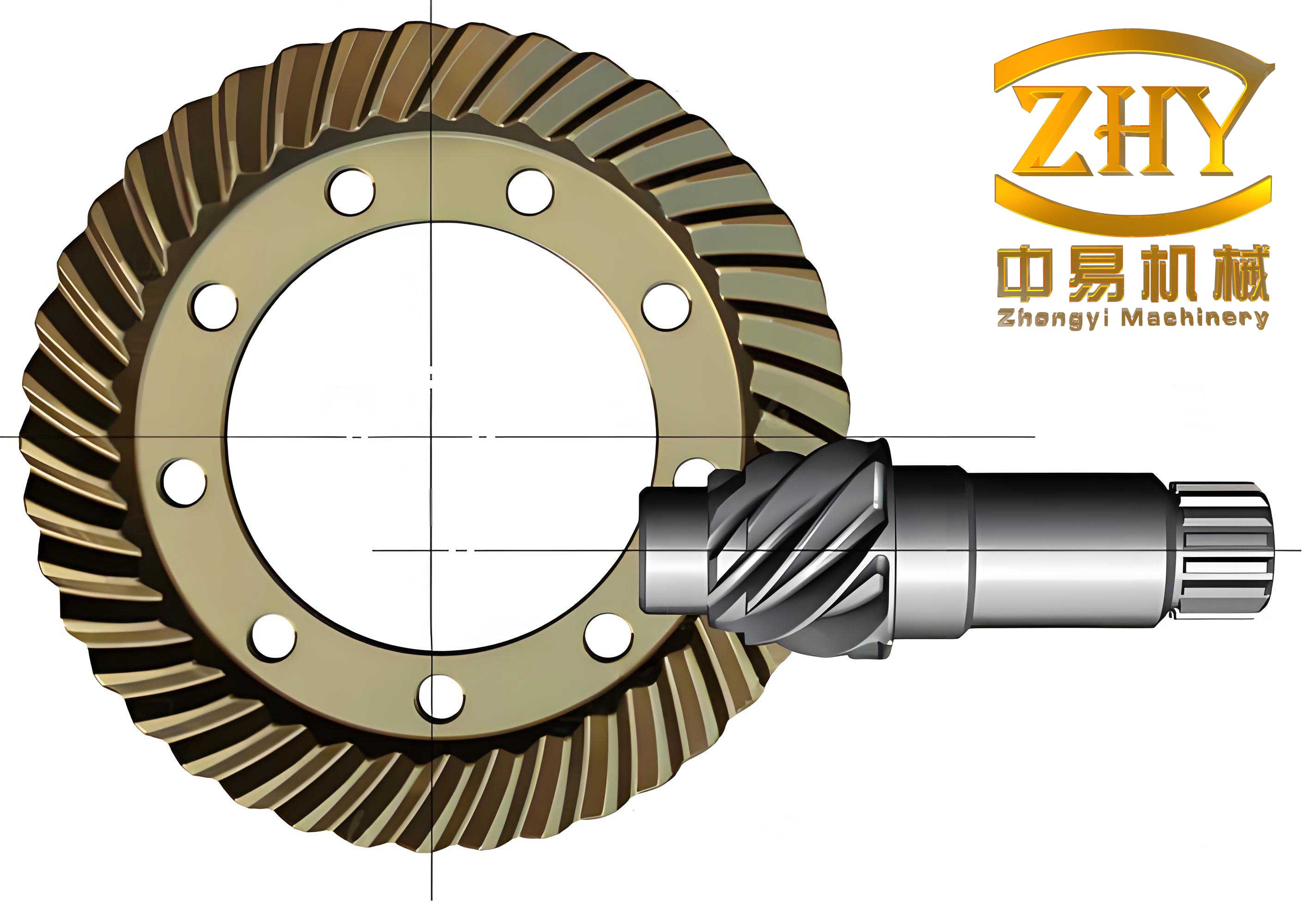
The relative motion between the pinion and gear in a hypoid gear set is a screw motion. The axes of rotation, non-intersecting and typically at a 90-degree angle, generate a pair of hyperboloids. For design and manufacturing purposes, these hyperboloidal pitch surfaces are approximated by two cones that are tangent at a single point, known the pitch point, P. The geometry of these conical approximations—the pitch cones—is what we aim to define algorithmically.
Fundamental Geometry and the Novel Pitch Parameter Algorithm
Consider a hypoid gear pair with a pinion axis \( c_1 \) and a gear axis \( c_2 \). The shaft angle is denoted by \( \Sigma \), and the offset distance (the shortest distance between the two axes) is \( E \). The theoretical crossing points on each axis are \( O_1 \) and \( O_2 \). The core of the new algorithm is to define all pitch parameters based on the spatial coordinates of the pitch point P relative to a coordinate system attached to the pinion, \( \sigma_1 = \{ O_1; \mathbf{i}, \mathbf{j}, \mathbf{k} \} \), where \( \mathbf{k} \) is along \( c_1 \). Let the coordinates of P be \( (P_x, P_y, P_z) \).
From this single point, all other classical pitch cone parameters can be derived unambiguously. The following sequence establishes these relationships, forming the core of the new calculation method for hypoid gears.
1. Pinion and Gear Offset Angles (η, ε): These angles define the orientation of the pitch point relative to the pinion and gear axes in their respective axial planes.
$$ \tan \eta = \frac{P_z}{P_y \sin \Sigma – P_x \cos \Sigma} $$
$$ \tan \varepsilon = \frac{E – P_z}{P_x} $$
2. Pitch Radii (r₁, r₂): The distances from point P to the pinion and gear axes.
$$ r_1 = \frac{P_z}{\sin \eta}, \quad r_2 = \frac{P_x}{\cos \varepsilon} $$
3. Auxiliary Distances (Q, Z_p, F, Z_G): Intermediate lengths crucial for defining cone vertices.
$$ Q = \frac{E \cot \eta}{\sin \Sigma}, \quad Z_p = P_y $$
$$ F = \frac{E \cos \varepsilon}{\sin \Sigma}, \quad Z_G = \frac{P_x}{\sin \Sigma} + (P_y – P_x \cot \Sigma) \cos \Sigma $$
4. Pitch Cone Angles (δ₁, δ₂): The angles defining the apex of the pitch cones.
$$ \tan \delta_2 = \frac{Q – Z_p}{r_2} $$
$$ \tan \delta_1 = \frac{F – Z_G}{r_1} $$
5. Cone Distances (R₁, R₂) and Vertex Locations (Z, G):
$$ R_1 = \frac{r_1}{\sin \delta_1}, \quad R_2 = \frac{r_2}{\sin \delta_2} $$
$$ Z = \frac{R_2}{\cos \delta_2} – Q, \quad G = \frac{R_1}{\cos \delta_1} – F $$
6. Offset Angle (ξ): The angular difference between the spiral angles of the pinion and gear at the pitch point.
$$ \sin \xi = \frac{\sin \Sigma \sin \varepsilon}{\cos \delta_1} $$
Spiral Angle, Pressure Angle, and the Gear Ratio Relationship
To define the tooth direction at the pitch point, we establish a local coordinate system \( \sigma_e = \{ P; \mathbf{e}_1, \mathbf{e}_2, \mathbf{e}_3 \} \), where \( \mathbf{e}_1 \) is tangent to the tooth line, \( \mathbf{e}_3 \) is normal to the pitch plane T (the plane tangent to both pitch cones at P), and \( \mathbf{e}_2 = \mathbf{e}_3 \times \mathbf{e}_1 \). The spiral angles \( \beta_1 \) and \( \beta_2 \) are measured from \( \mathbf{e}_2 \) to the projection of the respective axis onto the pitch plane. Their relationship is defined by the offset angle:
$$ \beta_1 = \beta_2 + \xi $$
The unit vectors along the pinion and gear axes in this system are:
$$ \mathbf{p}_1 = \cos\delta_1 \cos\beta_1 \mathbf{e}_1 + \cos\delta_1 \sin\beta_1 \mathbf{e}_2 + \sin\delta_1 \mathbf{e}_3 $$
$$ \mathbf{p}_2 = \cos\delta_2 \cos\beta_2 \mathbf{e}_1 + \cos\delta_2 \sin\beta_2 \mathbf{e}_2 – \sin\delta_2 \mathbf{e}_3 $$
The relative velocity \( \mathbf{v}_{12} \) at the pitch point P between the gear (angular velocity \( \omega_2 \)) and the pinion (angular velocity \( \omega_1 = -(z_2/z_1)\omega_2 \mathbf{p}_1 \)) can be derived. The common unit normal vector \( \mathbf{n} \) at the point of contact lies in the \( (\mathbf{e}_2, \mathbf{e}_3) \)-plane and forms the pressure angle \( \alpha \) with \( \mathbf{e}_2 \):
$$ \mathbf{n} = \cos\alpha \, \mathbf{e}_2 + \sin\alpha \, \mathbf{e}_3 $$
The fundamental law of gearing (the meshing equation) requires that the relative velocity has no component along the common normal:
$$ \mathbf{v}_{12} \cdot \mathbf{n} = 0 $$
Solving this equation yields a critical relationship linking the gear ratio to the pitch radii and spiral angles, a cornerstone in the design of hypoid gears:
$$ \frac{z_2}{z_1} = \frac{r_2 \cos \beta_2}{r_1 \cos \beta_1} $$
Combining this with the spiral angle relationship allows us to solve explicitly for the gear spiral angle:
$$ \tan \beta_2 = \frac{\cos \xi – \frac{z_1 r_2}{z_2 r_1}}{\sin \xi} $$
Therefore, given the pitch point coordinates \( (P_x, P_y, P_z) \), the shaft angle \( \Sigma \), offset \( E \), and tooth numbers \( z_1, z_2 \), all other pitch cone parameters, spiral angles, and the pressure angle condition are determined. This set of seven independent parameters (\( P_x, P_y, P_z, \Sigma, E, z_1, z_2 \)) fully defines the pitch geometry of the hypoid gear pair. Furthermore, key tooth contact geometry parameters like the limit pressure angle \( \alpha^* \), limit curvature \( \kappa^* \), contact line direction \( \omega \), and lengthwise induced curvature \( \tilde{B} \) can be derived from this foundation.
| Parameter | Symbol | Defining Equation(s) | Dependency |
|---|---|---|---|
| Pinion Offset Angle | \( \eta \) | $$ \tan \eta = P_z / (P_y \sin\Sigma – P_x \cos\Sigma) $$ | P, Σ |
| Gear Offset Angle | \( \varepsilon \) | $$ \tan \varepsilon = (E – P_z) / P_x $$ | P, E |
| Pinion Pitch Radius | \( r_1 \) | $$ r_1 = P_z / \sin \eta $$ | P, η |
| Gear Pitch Radius | \( r_2 \) | $$ r_2 = P_x / \cos \varepsilon $$ | P, ε |
| Gear Pitch Cone Angle | \( \delta_2 \) | $$ \tan \delta_2 = (Q – Z_p) / r_2 $$ | Q, Z_p, r₂ |
| Pinion Pitch Cone Angle | \( \delta_1 \) | $$ \tan \delta_1 = (F – Z_G) / r_1 $$ | F, Z_G, r₁ |
| Offset Angle | \( \xi \) | $$ \sin \xi = (\sin\Sigma \sin\varepsilon) / \cos\delta_1 $$ | Σ, ε, δ₁ |
| Gear Spiral Angle | \( \beta_2 \) | $$ \tan \beta_2 = (\cos\xi – \frac{z_1 r_2}{z_2 r_1}) / \sin\xi $$ | ξ, z₁, z₂, r₁, r₂ |
Application of the Algorithm: Pitch Cone Design
In practical design, input parameters are often different. A typical starting point includes the shaft angle \( \Sigma \), pinion and gear tooth numbers \( z_1, z_2 \), offset \( E \), and the gear outer pitch diameter \( d_2 \). The goal is to determine a consistent set of pitch cone parameters that satisfy these constraints. The proposed algorithm, based on the three independent parameters \( r_2 \), \( \beta_1 \), and \( \eta \), provides an efficient iterative solution. The gear pitch radius \( r_2 \) is directly related to \( d_2 \), and \( \beta_1 \) and \( \eta \) are chosen based on design experience regarding strength and sliding conditions. The calculation flow is as follows:
- Initialize: Start with given \( \Sigma, E, z_1, z_2, d_2 \). Set target values for \( r_2 = d_2/2 \), \( \beta_1 \), and \( \eta \).
- Calculate Intermediate Geometry:
- Compute \( \varepsilon \) from \( \eta \) and \( \Sigma \) using geometric relations on the pitch plane.
- Compute \( P_x = r_2 \cos \varepsilon \).
- Compute \( P_z \) from the definition of \( \eta \), which involves \( P_x, P_y, \) and \( \Sigma \). This requires an initial estimate for \( P_y \).
- Iterate to Find P: The system of equations defining the pitch point is nonlinear. An iterative loop (e.g., using Newton-Raphson) adjusts \( P_y \) (and consequently \( P_z \)) until the derived parameters \( r_2^{calc}, \beta_1^{calc}, \eta^{calc} \) match the target values within a specified tolerance. The formulas from the core algorithm are used within this loop.
- Compute Final Parameters: Once convergence is achieved, the final coordinates \( (P_x, P_y, P_z) \) are used to compute all remaining pitch cone parameters \( (\delta_1, \delta_2, R_1, R_2, \xi, \beta_2) \) using the explicit formulas provided earlier.
This method streamlines the pitch cone design process for hypoid gears by directly targeting intuitive design parameters and leveraging the clear computational relationships of the new algorithm.
| Step | Action | Key Equations Used |
|---|---|---|
| 1. Input | Specify \( \Sigma, E, z_1, z_2, d_2, \beta_1^{(tgt)}, \eta^{(tgt)} \). | – |
| 2. Initial Guess | Set \( r_2^{(tgt)} = d_2/2 \). Guess \( P_y^{(0)} \). | – |
| 3. Compute ε, P_x | $$ \varepsilon = f(\eta^{(tgt)}, \Sigma) $$ $$ P_x = r_2^{(tgt)} \cos \varepsilon $$ |
Geometric relation on pitch plane. |
| 4. Compute P_z | $$ P_z^{(k)} = (P_y^{(k)} \sin\Sigma – P_x \cos\Sigma) \tan \eta^{(tgt)} $$ | Definition of \( \eta \). |
| 5. Evaluate | Use \( P_x, P_y^{(k)}, P_z^{(k)} \) in core algorithm to compute \( r_2^{(calc)}, \beta_1^{(calc)}, \eta^{(calc)} \). | All equations from Section 1. |
| 6. Check & Update | If \( |r_2^{(calc)}-r_2^{(tgt)}|, |\beta_1^{(calc)}-\beta_1^{(tgt)}|, |\eta^{(calc)}-\eta^{(tgt)}| > tol \), update \( P_y^{(k+1)} \) and return to Step 4. | Newton-Raphson or similar method. |
| 7. Output | Upon convergence, finalize all pitch cone parameters from final \( P \). | All equations from Section 1. |
Application of the Algorithm: Gear Tooth Surface Generation (Formate Process)
The generation of the gear tooth surface typically involves simulating the meshing of the gear with a theoretical generating gear (cradle). This pair itself constitutes a hypoid gear set. The goal is to find the pitch cone parameters of this gear/cradle pair such that the generated tooth surface has the desired localized contact properties (curvatures) when meshing with the pinion.
Let the gear have pitch parameters \( \delta_{f2}, R_{f2}, \beta_{f2} \) (calculated in the pitch cone design stage). The generating cradle is usually considered as a crown gear with a pitch cone angle \( \delta_{02} = 90^\circ \). Its other parameters—cradle cone distance \( R_{02} \), spiral angle \( \beta_{02} \), offset \( E_{02} \), and “tooth number” \( z_{02} \)—are unknowns to be determined.
The key link is the tooth contact geometry. From the designed hypoid gear pair (pinion and gear), we can calculate the limit parameters \( \alpha_f^* \) and \( \kappa_f^* \) (or limit radius \( r_f^* = 1/\kappa_f^* \)) at the pitch point. For the gear generation process to impart the correct curvature onto the gear tooth surface, the meshing between the gear and the cradle must exhibit the same limit parameters at their instantaneous pitch point. Therefore, the generation pair must satisfy:
$$ \alpha_{02}^* = \alpha_f^*, \quad \kappa_{02}^* = \kappa_f^* \quad \text{or} \quad r_{02}^* = r_f^* $$
For this new hypoid gear pair (gear and cradle), the shaft angle is \( \Sigma_{02} = \delta_{02} + \delta_{f2} \), and the gear tooth number \( z_2 \) is known. We have two target equations (for \( \alpha^* \) and \( \kappa^* \)) and several unknowns. The proposed method selects \( R_{02} \) and \( \beta_{02} \) as the primary iteration variables. The calculation proceeds as follows:
- Initialize: Start with known \( \delta_{f2}, \beta_{f2}, R_{f2}, z_2, \alpha_f^*, r_f^* \). Set \( \delta_{02} = 90^\circ \). Choose initial guesses for \( R_{02} \) and \( \beta_{02} \).
- Solve for Generation Pair Geometry: For the assumed \( R_{02} \) and \( \beta_{02} \), and the fixed \( \Sigma_{02} \) and \( \delta_{02} \), the core algorithm for hypoid gears can be applied in reverse. Using relationships for a hypoid pair, one can solve for the equivalent pitch point coordinates and subsequently for the cradle offset \( E_{02} \) and tooth number \( z_{02} \) that satisfy the basic pitch geometry.
- Calculate Limit Parameters: Using the fully defined geometry of the gear/cradle pair (including the now-known \( E_{02} \) and \( z_{02} \)), calculate the resulting limit pressure angle \( \alpha_{02}^* \) and limit curvature radius \( r_{02}^* \).
- Iterate: Compare \( (\alpha_{02}^*, r_{02}^*) \) with the target \( (\alpha_f^*, r_f^*) \). Adjust \( R_{02} \) and \( \beta_{02} \) iteratively until the targets are met.
- Output Machine Settings: Once converged, the parameters \( R_{02}, \beta_{02}, E_{02}, z_{02}, \Sigma_{02}, \delta_{f2} \) directly translate into the machine tool settings for cutting the gear: radial setting \( S_2 \), angular setting \( q_2 \), machine root angle \( \delta_{M2} \), sliding base setting \( X_{B2} \), work offset \( X_2 \), and the ratio of roll \( i_{02} \).
Application of the Algorithm: Pinion Tooth Surface Generation (Helixform/Formate Process)
The pinion is generated by a separate hypoid gear pair consisting of the pinion and its own generating crown gear (cradle). The objective is to determine the parameters of this generation pair so that the finished pinion tooth surface meshes correctly with the gear tooth surface, achieving the desired contact pattern and motion transmission.
The link here is provided by the pinion’s tooth surface curvature parameters relative to its generating process. From the global design of the hypoid gear pair, we can compute the pinion’s principal directions and curvatures at the pitch point. Specifically, the contact line direction angle \( \omega_{f1} \) and the lengthwise induced normal curvature \( \tilde{B}_{f1} \) are critical.
For the pinion generation pair, these must match corresponding parameters derived from the generating process. If \( \omega_{01} \) and \( \tilde{B}_{01} \) are the contact line direction and induced curvature for the pinion/cradle meshing, the matching conditions are:
$$ \tan \omega_{01} = -C_{f1} / B_{f1}, \quad \tilde{B}_{01} = -B_{f1} $$
where \( B_{f1} \) and \( C_{f1} \) are the pinion’s normal curvature and geodesic torsion in the tooth profile direction, respectively, obtained from the global pair analysis.
In the pinion generation setup, the machine root angle \( \delta_{M1} \) is often a chosen setup parameter. This defines the shaft angle for the generation pair as \( \Sigma_{01} = 90^\circ + \delta_{M1} \). The pinion tooth number \( z_1 \) is known. The unknowns are the cradle offset \( E_{01} \) and the generating crown gear tooth number \( z_{01} \). With two target conditions (\( \omega_{01} \) and \( \tilde{B}_{01} \)), a unique solution exists. The calculation flow is:
- Initialize: Start with known pinion data from the global design (\( \delta_1, \beta_1, r_1, z_1 \), and calculated \( \omega_{f1}, B_{f1}, C_{f1} \)). The machine root angle \( \delta_{M1} \) is given, setting \( \Sigma_{01} \). The cradle is a crown gear: \( \delta_{01} = 90^\circ \).
- Iterate to Match Curvature Conditions: The core algorithm for hypoid gears is embedded within an iteration loop. For trial values of the generation pair parameters (effectively searching over the pitch point location for this pair), the algorithm calculates the resulting meshing geometry. The loop adjusts the parameters until the calculated \( \omega_{01}^{calc} \) and \( \tilde{B}_{01}^{calc} \) satisfy the target conditions derived from \( \omega_{f1} \) and \( B_{f1} \). This solves for the unique \( E_{01} \) and \( z_{01} \).
- Output Machine Settings: The solved parameters \( \Sigma_{01}, \delta_{M1}, E_{01}, z_{01} \), along with the derived cradle cone distance \( R_{01} \) and spiral angle \( \beta_{01} \), yield the complete set of pinion machine settings: radial setting \( S_1 \), angular setting \( q_1 \), cutter tilt angle \( i \), cutter swivel angle \( j \), cutter blade point radius \( r_{01} \), and the ratio of roll \( i_{01} \).
The structured approach outlined above, from pitch cone definition to gear and pinion generation, demonstrates the power and clarity of the new fundamental algorithm. By rooting all calculations in the unambiguous geometry defined by the pitch point coordinates, the processes for designing hypoid gears and determining their manufacturing settings become more transparent and computationally efficient. This methodology not only simplifies the derivation of machine-tool settings but also provides a robust framework for the optimization of tooth surface geometry in advanced hypoid gear design systems.