
The geometrical design of hypoid gears is a fundamental and critical step in the development of efficient power transmission systems, particularly in automotive drive axles. This process determines the basic size and spatial relationship of the gear pair, laying the foundation for subsequent tooth flank design, strength calculation, and manufacturing. A thorough understanding of the underlying geometrical principles is essential for developing robust and efficient design methodologies, moving beyond the mere application of pre-defined calculation cards or handbooks. This article delves into the core geometric relationships governing a hypoid gear pair, establishes a fundamental system of equations, and presents a novel, systematic numerical method for determining the primary design parameters. The method emphasizes clarity and computational reliability, providing designers with a deeper insight into the design space of hypoid gears.
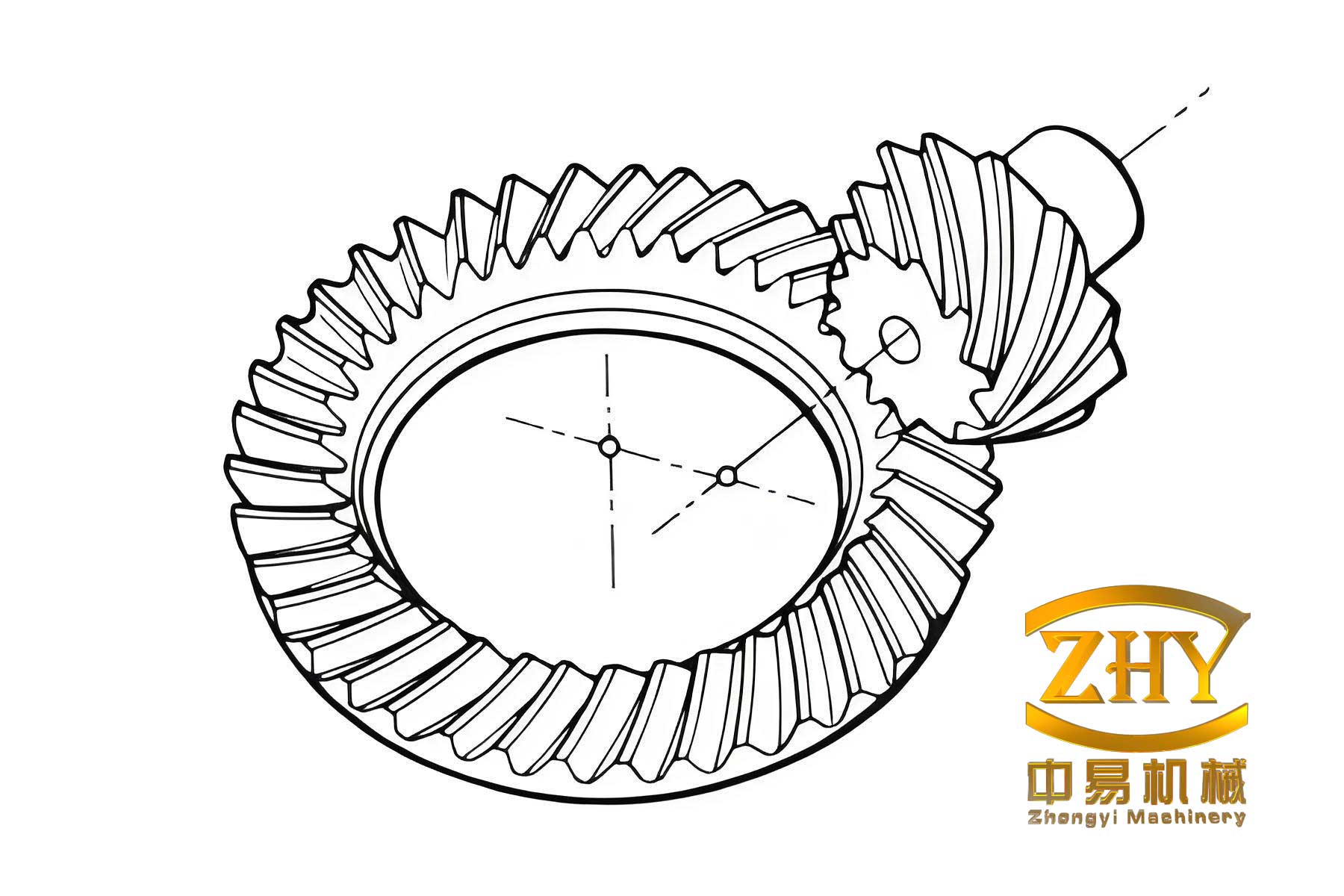
The kinematic operation of a pair of hypoid gears can be conceptualized through their pitch cones. Unlike bevel gears, the axes of these pitch cones are non-intersecting and offset by a distance known as the offset. These pitch cones are tangent to each other along a line, and their geometry defines the fundamental macro-parameters of the gear set. The spatial arrangement is defined by the shaft angle $\Sigma$, which is typically 90° in automotive applications, and the offset distance $E$. The primary goal of the geometrical design phase is to determine the parameters of these pitch cones: the pitch radii $r_1$ and $r_2$, the pitch angles $\delta_1$ and $\delta_2$, the spiral angles $\beta_1$ and $\beta_2$, and the offset angle $\varepsilon’$. These parameters are not independent; they are bound by rigorous geometric and kinematic constraints arising from the spatial tangency of the cones and the basic law of gearing at the pitch point.
Fundamental Geometric Relationships of the Pitch Cones
Consider the pitch cones of a hypoid gear pair, where the pinion axis $a_1$ and the gear axis $a_2$ are offset by a distance $E$. The cones are tangent at point $P$, the pitch point. The plane tangent to both cones at $P$ is the pitch plane. The key geometric elements are illustrated in the figure above. The line $O_1P$ is the generating line of the pinion pitch cone, making an angle $\delta_1$ with the pinion axis $a_1$. Similarly, $O_2P$ is the generating line of the gear pitch cone, making an angle $\delta_2$ with the gear axis $a_2$. The angle between $O_1P$ and $O_2P$ within the pitch plane is defined as the offset angle $\varepsilon’$.
To derive the governing equations, we establish coordinate systems and vector relationships. Let unit vectors $\mathbf{e_1}$, $\mathbf{e_2}$, and $\mathbf{e_3}$ be mutually perpendicular at point $P$. $\mathbf{e_1}$ is directed along the gear pitch element $O_2P$, $\mathbf{e_2}$ is perpendicular to $\mathbf{e_1}$ within the pitch plane, and $\mathbf{e_3}$ is normal to the pitch plane, pointing from the gear towards the pinion (along $K_2K_1$). Thus, $\mathbf{e_3} = \mathbf{e_1} \times \mathbf{e_2}$.
The unit vector along the pinion pitch element $O_1P$ is denoted $\mathbf{j}$. From the geometry in the pitch plane, it is clear that:
$$\mathbf{j} = \cos\varepsilon’ \mathbf{e_1} + \sin\varepsilon’ \mathbf{e_2}$$
The unit vectors along the pinion and gear axes, $\mathbf{a_1}$ and $\mathbf{a_2}$, can be expressed as:
$$\mathbf{a_1} = \cos\delta_1 \mathbf{j} + \sin\delta_1 \mathbf{e_3} = \cos\delta_1\cos\varepsilon’ \mathbf{e_1} + \cos\delta_1\sin\varepsilon’ \mathbf{e_2} + \sin\delta_1 \mathbf{e_3}$$
$$\mathbf{a_2} = \cos\delta_2 \mathbf{e_1} – \sin\delta_2 \mathbf{e_3}$$
The shaft angle $\Sigma$ is defined by the dot product of the axis vectors:
$$\mathbf{a_1} \cdot \mathbf{a_2} = \cos\Sigma$$
Substituting the expressions for $\mathbf{a_1}$ and $\mathbf{a_2}$ yields the first fundamental relationship among the pitch angles and the offset angle:
$$\cos\Sigma = \cos\delta_1 \cos\delta_2 \cos\varepsilon’ – \sin\delta_1 \sin\delta_2 \tag{1}$$
The offset distance $E$ is the shortest distance between the two axes. This can be derived by examining the perpendicular distances from the cone apices to the opposite axis. The result is a function of the pitch radii and angles:
$$E = (r_1 \cos\delta_2 + r_2 \cos\delta_1) \frac{\sin\varepsilon’}{\sin\Sigma} \tag{2}$$
The spiral angles $\beta_1$ and $\beta_2$ are defined as the angles between the pitch element and the tooth trace on the pitch cone surface. For conjugate motion at the pitch point, the relationship between the spiral angles and the offset angle is straightforward:
$$\beta_1 = \beta_2 + \varepsilon’ \tag{3}$$
This equation states that the pinion spiral angle is the sum of the gear spiral angle and the offset angle.
Finally, the basic law of gearing requires that the normal components of the pitch surface velocities be equal at the point of contact. For pitch point contact, this leads to the velocity ratio relationship. Equivalently, since the normal module must be the same for mating gears, we have:
$$\frac{z_2}{z_1} = \frac{r_2 \cos\beta_2}{r_1 \cos\beta_1} \tag{4}$$
where $z_1$ and $z_2$ are the numbers of teeth on the pinion and gear, respectively.
Equations (1) through (4) form the complete set of fundamental constraints for the pitch cone parameters of a hypoid gear pair. These four equations govern the seven primary variables: $r_1$, $r_2$, $\delta_1$, $\delta_2$, $\beta_1$, $\beta_2$, and $\varepsilon’$. The known design inputs are typically the offset $E$, the shaft angle $\Sigma$, and the tooth numbers $z_1$ and $z_2$. This leaves three degrees of freedom, meaning three parameters must be chosen by the designer to arrive at a unique solution. The selection of these free parameters is a critical aspect of the design strategy for hypoid gears.
| Symbol | Parameter Name | Typical Role |
|---|---|---|
| $E$ | Offset Distance | Primary Input / Design Constraint |
| $\Sigma$ | Shaft Angle | Primary Input (often 90°) |
| $z_1$, $z_2$ | Number of Teeth | Primary Input / Ratio Definition |
| $r_1$, $r_2$ | Pitch Radii | Output / Free Variable Candidate |
| $\delta_1$, $\delta_2$ | Pitch Angles | Output / Free Variable Candidate |
| $\beta_1$, $\beta_2$ | Spiral Angles | Output / Free Variable Candidate |
| $\varepsilon’$ | Offset Angle | Output / Pivotal Variable |
A Systematic Numerical Design Method
Traditional design methods for hypoid gears often rely on extensive tables or a fixed sequence of over 100 calculation steps, which can obscure the underlying geometric relationships. The method proposed here leverages the fundamental equations directly and employs a robust numerical algorithm to solve for the pitch cone parameters. The core idea is to select a specific set of free variables that offer good control over the final gear geometry and to solve the remaining equations systematically.
We propose selecting the gear pitch radius $r_2$, the gear pitch angle $\delta_2$, and the pinion spiral angle $\beta_1$ as the primary free variables. This choice is advantageous because $r_2$ and $\delta_2$ are often constrained by the overall gearbox size and the desired gear blank geometry, while $\beta_1$ significantly influences the bearing loads and axial thrust characteristics. The offset angle $\varepsilon’$ becomes the key iterative variable.
The solution algorithm is based on the bisection method, exploiting the monotonic behavior of the offset equation. From Equation (3), the valid range for $\varepsilon’$ is $0 \le \varepsilon’ \le \beta_1$. When $\varepsilon’ = 0$, the system describes a spiral bevel gear with zero offset ($E=0$). As $\varepsilon’$ increases, the calculated offset from Equation (2) increases monotonically. We define a residual function $\Delta E$ based on Equation (2):
$$\Delta E(\varepsilon’) = (r_1 \cos\delta_2 + r_2 \cos\delta_1) \frac{\sin\varepsilon’}{\sin\Sigma} – E \tag{5}$$
The goal is to find the root $\varepsilon’$ such that $\Delta E(\varepsilon’) = 0$. For a given trial value of $\varepsilon’$, the other variables are determined sequentially from the fundamental equations.
The step-by-step algorithm for designing hypoid gears is as follows:
- Input Fixed Parameters: Specify the known values: offset $E$, shaft angle $\Sigma$, pinion teeth $z_1$, gear teeth $z_2$.
- Choose Free Variables: Select desired values for the gear pitch radius $r_2$, gear pitch angle $\delta_2$, and pinion spiral angle $\beta_1$.
- Initialize Bisection: Set the search interval for $\varepsilon’$ to $[0, \beta_1]$. Calculate $\Delta E$ at both endpoints.
- At $\varepsilon’ = 0$, $\delta_1 = \Sigma – \delta_2$, $\beta_2 = \beta_1$, $r_1 = r_2 z_1 / z_2$ (from Eq. 4 with $\beta_1=\beta_2$). Then $\Delta E(0) = -E < 0$.
- At $\varepsilon’ = \beta_1$, $\beta_2 = 0$ from Eq. (3). Calculate $\delta_1$ from Eq. (1), $r_1$ from Eq. (4), and then $\Delta E(\beta_1)$ from Eq. (5). This value is typically $>0$ for a valid hypoid gear design.
- Iterate: While $|\Delta E| > \text{tolerance}$:
- Set $\varepsilon’ = (\text{low} + \text{high}) / 2$.
- Solve for $\delta_1$: From Equation (1), rearrange to solve for $\delta_1$ explicitly. Let:
$$a = \cos\delta_2 \cos\varepsilon’$$
$$b = \sin\delta_2$$
$$c = \sqrt{a^2 + b^2}$$
$$\theta = \arctan(b/a)$$
Then, the pinion pitch angle is given by:
$$\delta_1 = \arccos\left(\frac{\cos\Sigma}{c}\right) – \theta \tag{6}$$ - Solve for $\beta_2$: From Equation (3):
$$\beta_2 = \beta_1 – \varepsilon’ \tag{7}$$ - Solve for $r_1$: From Equation (4):
$$r_1 = r_2 \frac{z_1}{z_2} \frac{\cos\beta_2}{\cos\beta_1} \tag{8}$$ - Evaluate Residual: Calculate $\Delta E$ using Equation (5).
- Update Interval: If $\Delta E < 0$, set $\text{low} = \varepsilon’$. If $\Delta E > 0$, set $\text{high} = \varepsilon’$.
- Output Solution: When convergence is achieved, the complete set of pitch cone parameters $(r_1, r_2, \delta_1, \delta_2, \beta_1, \beta_2, \varepsilon’)$ is determined.
This algorithm is guaranteed to converge for any valid combination of inputs and free variables that yields a real hypoid gear solution, because the function $\Delta E(\varepsilon’)$ is continuous and monotonic over the search interval.
| Free Variable Set | Designer’s Control Over | Solution Complexity | Typical Application |
|---|---|---|---|
| $(r_2, \delta_2, \beta_1)$ | Gear size, pinion spiral angle | Low (direct bisection) | General-purpose design, thrust control |
| $(r_2, \beta_1, \beta_2)$ | Gear size, both spiral angles | Medium (requires solving Eq.1 & 2) | Balancing bearing loads |
| $(\delta_1, \delta_2, \varepsilon’)$ | Pitch cone geometry, offset | High (requires solving for radii) | Constrained housing geometry |
| $(r_1, r_2, \beta_1)$ | Both pitch diameters, pinion spiral | Medium (requires solving Eq.1 & 2) | Speed ratio and size priority |
Detailed Calculation Example and Analysis
To demonstrate the practical application of this method for the geometrical design of hypoid gears, consider a common automotive drive axle specification.
Given Inputs:
Shaft angle: $\Sigma = 90^\circ$
Offset: $E = 34 \text{ mm}$
Pinion teeth: $z_1 = 11$
Gear teeth: $z_2 = 43$
Selected Free Variables:
Gear pitch radius: $r_2 = 88.0 \text{ mm}$
Gear pitch angle: $\delta_2 = 75.0^\circ$
Pinion spiral angle: $\beta_1 = 50.0^\circ$
Iteration Process: The bisection method is applied with the initial interval $\varepsilon’ \in [0, 50]^\circ$. The table below shows key iterations. For each $\varepsilon’$, $\delta_1$ is computed via Eq. (6), $\beta_2$ via Eq. (7), $r_1$ via Eq. (8), and finally $\Delta E$ via Eq. (5).
| Iteration | $\varepsilon’$ (°) | $\delta_1$ (°) (Eq.6) | $\beta_2$ (°) (Eq.7) | $r_1$ (mm) (Eq.8) | $\Delta E$ (mm) (Eq.5) |
|---|---|---|---|---|---|
| 1 (low) | 0.000000 | 15.000000 | 50.000000 | 22.511628 | -34.000000 |
| 1 (high) | 50.000000 | 9.772434 | 0.000000 | 35.021884 | 39.377416 |
| 2 | 25.000000 | 13.649727 | 25.000000 | 31.740605 | 5.611856 |
| 3 | 12.500000 | 14.659932 | 37.500000 | 27.784717 | -14.016920 |
| 4 | 18.750000 | 14.237163 | 31.250000 | 29.940624 | -4.091217 |
| 5 | 21.875000 | 13.963769 | 28.125000 | 30.886540 | 0.796824 |
| 6 | 20.312500 | 14.105588 | 29.687500 | 30.424891 | -1.639173 |
| 7 | 21.093750 | 14.035957 | 28.906250 | 30.658561 | -0.419026 |
| 8 | 21.484375 | 14.000182 | 28.515625 | 30.773269 | 0.189447 |
| 9 | 21.289063 | 14.018149 | 28.710937 | 30.716093 | -0.114657 |
| 10 | 21.386719 | 14.009190 | 28.613281 | 30.744723 | 0.037434 |
| 11 | 21.337891 | 14.013674 | 28.662109 | 30.730423 | -0.038611 |
| 12 | 21.362305 | 14.011433 | 28.637695 | 30.737572 | -0.000589 |
After 12 iterations, the solution converges with a very small residual. The final pitch cone parameters for this hypoid gear pair are:
$$ \varepsilon’ = 21.3623^\circ, \quad \delta_1 = 14.0114^\circ, \quad \beta_2 = 28.6377^\circ, \quad r_1 = 30.7376 \text{ mm} $$
These parameters, along with the chosen $r_2=88.0 \text{ mm}$, $\delta_2=75.0^\circ$, and $\beta_1=50.0^\circ$, satisfy all four fundamental equations (1-4) for the given inputs $E=34 \text{ mm}$, $\Sigma=90^\circ$, $z_1=11$, and $z_2=43$.
Parameter Sensitivity and Design Considerations
Understanding the sensitivity of the hypoid gears geometry to the chosen free variables is crucial for optimal design. The proposed method makes it easy to analyze these relationships by simply varying the inputs $r_2$, $\delta_2$, or $\beta_1$ and observing the resulting changes in the other parameters.
Effect of Gear Pitch Radius ($r_2$): Increasing $r_2$ while holding $\delta_2$ and $\beta_1$ constant generally leads to an increase in the pinion pitch radius $r_1$ (to maintain the velocity ratio with adjusted $\beta_2$). The offset angle $\varepsilon’$ typically decreases slightly to satisfy the offset equation with the larger radii. This results in a gear pair with larger overall size but a marginally reduced offset angle.
Effect of Gear Pitch Angle ($\delta_2$): Increasing $\delta_2$ (making the gear pitch cone steeper) directly affects the pinion pitch angle $\delta_1$ through the shaft angle constraint (Eq. 1). For a fixed $\Sigma=90^\circ$, a larger $\delta_2$ forces a smaller $\delta_1$. This significantly alters the cone geometry and the load distribution between the teeth. The offset angle $\varepsilon’$ must adjust to compensate in the offset equation (Eq. 2).
Effect of Pinion Spiral Angle ($\beta_1$): This is one of the most influential parameters. Increasing $\beta_1$ expands the allowable range for $\varepsilon’$ and usually results in a larger solved value for $\varepsilon’$. This increases the gear spiral angle $\beta_2$ as well (since $\beta_2 = \beta_1 – \varepsilon’$, and $\varepsilon’$ increases less than $\beta_1$). Larger spiral angles improve smoothness and load capacity but increase axial thrust forces, which must be managed by the bearings.
The interdependencies can be summarized by the following partial derivatives, which can be derived implicitly from the system of equations (1-4), illustrating the complex coupling in the design of hypoid gears:
$$
\begin{aligned}
\frac{\partial \varepsilon’}{\partial \beta_1} & > 0, \quad \frac{\partial \beta_2}{\partial \beta_1} > 0 \\
\frac{\partial \delta_1}{\partial \delta_2} & < 0 \quad \text{(for constant } \Sigma \text{ and } \varepsilon’\text{)} \\
\frac{\partial r_1}{\partial r_2} & = \frac{z_1}{z_2} \frac{\cos\beta_2}{\cos\beta_1} > 0
\end{aligned}
$$
| Changed Free Variable | Effect on $\varepsilon’$ | Effect on $\delta_1$ | Effect on $\beta_2$ | Effect on $r_1$ | Primary Design Implication |
|---|---|---|---|---|---|
| Increase $r_2$ | Slight Decrease | Minor Change | Slight Increase | Increase | Larger gear set, slightly modified kinematics. |
| Increase $\delta_2$ | Decrease | Decrease | Increase | Decrease | Flatter pinion, steeper gear, altered mounting. |
| Increase $\beta_1$ | Increase | Decrease | Increase | Increase | Smoother engagement, higher axial thrust. |
Extensions and Applications of the Method
The proposed systematic method for the geometrical design of hypoid gears is not limited to the specific choice of free variables $(r_2, \delta_2, \beta_1)$. The core numerical framework—using one variable as the iterative key to satisfy the offset equation—can be adapted to other design scenarios. For instance, if the design goal is to achieve a specific pinion pitch angle $\delta_1$ and spiral angle $\beta_1$, one could choose $(\delta_1, \beta_1, r_2)$ as free variables and iterate on $\varepsilon’$ (or another suitable parameter) to satisfy the constraints. The fundamental equations (1-4) remain the same; only the sequence of solving them changes.
Furthermore, this method integrates seamlessly with subsequent design stages for hypoid gears. Once the pitch cone parameters are fixed, the blank dimensions (face width, apex locations, back angles) can be calculated. These dimensions, along with the determined spiral angles, provide the necessary input for the complex tooth flank design process, which involves defining the machine tool settings (cutter radius, blade angle, machine root angle, sliding base setting) to generate tooth surfaces with prescribed contact patterns and low transmission error.
An important application is in the redesign or adaptation of existing hypoid gear sets. For example, if an existing gearbox housing constrains the values of $r_2$, $\delta_2$, and $E$, but a new ratio ($z_2/z_1$) is required, the designer can use $\beta_1$ and $\varepsilon’$ (or $r_1$) as free variables to find a new viable geometry. The numerical robustness of the bisection method ensures a solution will be found if one exists within the physical limits of hypoid gears geometry.
In conclusion, the geometrical design of hypoid gears is governed by a elegant yet stringent set of kinematic and geometric constraints. Moving beyond traditional calculation sequences to a first-principles approach using the fundamental equation system empowers designers. The numerical method presented, based on selecting key free variables and efficiently solving for the offset angle, provides a clear, reliable, and flexible framework for determining the pitch cone parameters of hypoid gears. This foundational step is critical for achieving optimal performance in terms of strength, efficiency, noise, and durability in the final manufactured gear pair. Mastery of this geometrical foundation is indispensable for the advanced design and development of modern hypoid gear drives.