
In the field of mechanical transmission, spiral bevel gears play a critical role due to their superior load-bearing capacity and smooth operation compared to straight bevel gears. These components are extensively used in automotive, engineering machinery, and machine tool applications, where high-speed and heavy-duty performance is essential. Traditional manufacturing methods for spiral bevel gears often involve cutting processes, which are time-consuming, material-intensive, and result in discontinuous fiber flow lines, reducing fatigue resistance. To address these limitations, precision plastic forming technologies have emerged as a promising alternative, offering higher material utilization, productivity, and improved mechanical properties through continuous fiber flow. However, the precision forming of spiral bevel gears, especially for driving gears in automotive drive axiles, remains a developing area, with challenges in die design, cavity filling, and process efficiency.
This article introduces a novel forming process termed “two-way extrusion high-efficiency precision forming” for spiral bevel gears, specifically focusing on driving gears. The process aims to enhance production efficiency by simultaneously forming two identical parts using a bidirectional squeezing action, thereby reducing costs and energy consumption. Based on the shape characteristics and forming requirements of spiral bevel gears, this method utilizes a closed-die configuration with dual-action buffering, where two billets are stacked and compressed from both ends by upper and lower punches. This approach not only improves cavity filling uniformity but also lowers the required forming load compared to traditional one-way flashless die forging. The feasibility of this new process is validated through numerical simulations and physical experiments, with detailed analyses of metal flow patterns, load-stroke curves, and stress distributions. The results demonstrate that the two-way extrusion process effectively fills the gear tooth cavities, produces well-formed spiral bevel gears with minimal defects, and reduces the maximum load by approximately 18%. This innovation represents a significant step forward in the precision forming of spiral bevel gears, contributing to the advancement of manufacturing technologies in high-performance transmission systems.
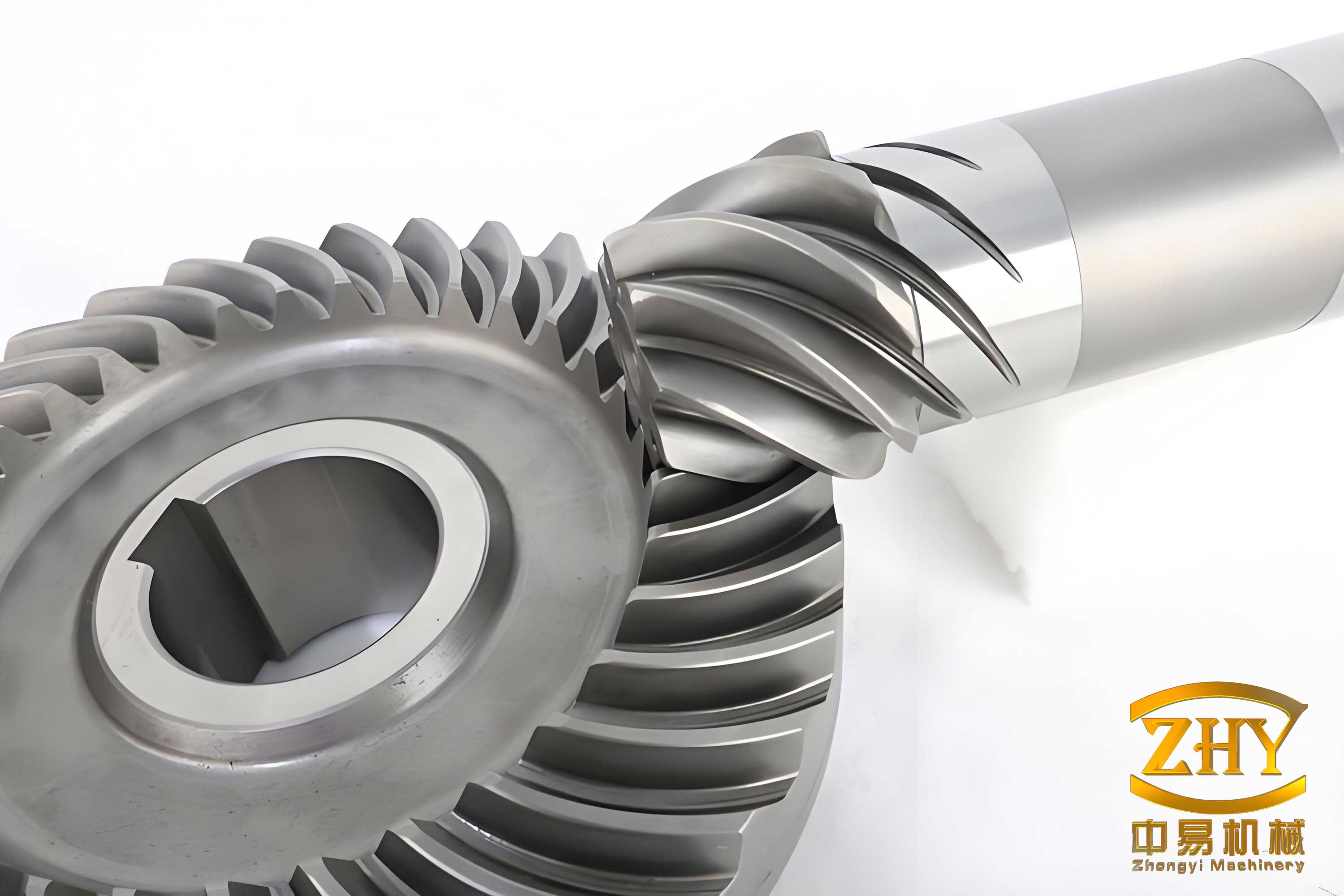
The design of spiral bevel gears involves complex geometry, including parameters such as tooth number, mid-point normal module, working and non-working pressure angles, spiral angle, and installation distance. For instance, a typical driving spiral bevel gear might have 10 teeth, a mid-point normal module of 3.338 mm, a pressure angle of 20°, a spiral angle of 37.13°, and an installation distance of 85 mm. These parameters influence the forming process, particularly in terms of die cavity design and material flow. The precision forming of such gears requires careful consideration of billet preparation, die alignment, and process control to avoid defects like folding, cracking, or incomplete filling. The two-way extrusion process proposed here addresses these challenges by promoting uniform metal flow from both ends of the billets, ensuring that the tooth profiles are fully filled without excessive stress concentrations.
To understand the mechanics of the two-way extrusion process for spiral bevel gears, it is essential to analyze the deformation stages. The process can be divided into three key phases: free deformation, cavity filling, and corner filling. During free deformation, the billets undergo upsetting as the punches move inward, with metal flowing radially toward the central gear region. This phase is characterized by a rapid increase in load as the billets make initial contact with the die cavity. In the cavity filling phase, the metal gradually fills the tooth profiles, starting from the middle sections and extending toward the ends. This stage accounts for the majority of the punch stroke and involves a steady rise in load as resistance increases. Finally, the corner filling phase involves the complete filling of the gear tooth corners, particularly at the larger end, which requires a small additional stroke but a sharp load increase due to the constrained flow. The overall load-stroke curve for the two-way extrusion process exhibits a smooth progression, with a maximum load lower than that of traditional one-way forging, highlighting the efficiency of the bidirectional approach.
The numerical simulation of the two-way extrusion process for spiral bevel gears was conducted using Deform-3D software, a finite element analysis tool specialized for metal forming. The billet material was set as AISI-1045 steel, modeled as a plastic body at an elevated temperature of 1100°C to account for thermal effects. The mesh consisted of approximately 250,000 tetrahedral elements to accurately simulate temperature conduction and deformation. The dies were treated as rigid bodies at 350°C, focusing solely on billet deformation. A shear friction model with a coefficient of 0.3 was applied to represent the contact conditions, and the punch speed was set to 22 mm/s for both the upper and lower punches. The simulation step size was 0.1 mm, ensuring stability and accuracy. For comparison, a traditional one-way flashless die forging simulation was also performed, with the lower punch fixed and other parameters identical. The results from the numerical simulation provided insights into the filling behavior, stress distribution, and load requirements, confirming the advantages of the two-way extrusion process for spiral bevel gears.
One of the critical aspects in forming spiral bevel gears is the cavity filling pattern. The simulation results showed that in the two-way extrusion process, the gear tooth cavities were filled uniformly and smoothly. Initially, the cylindrical ends of the billets experienced free upsetting, with metal flowing quickly toward the central gear section. As the punches advanced, the metal spread divergently into the tooth cavities, filling the middle regions and small-end corners first. The large-end corners were filled last, requiring minimal additional stroke. The final formed spiral bevel gears exhibited clear tooth profiles, smooth transitions from tooth tip to root, and no visible defects like folds or cracks. However, minor flash formation occurred at the die gaps, which is typical in closed-die forging and can be minimized with proper die design. The successful filling of spiral bevel gear cavities in the simulation underscores the effectiveness of the two-way extrusion approach in managing complex geometries.
The load-stroke curve from the simulation revealed important characteristics of the two-way extrusion process for spiral bevel gears. The curve showed three distinct regions corresponding to the deformation phases. In the free deformation stage, the load increased rapidly as the billets were compressed. During cavity filling, the load rose gradually, reflecting the progressive resistance as metal filled the tooth profiles. In the corner filling stage, the load spiked sharply but briefly, reaching a maximum value of approximately 1.44 × 10^6 N. Compared to the traditional one-way process, which had a maximum load of 1.76 × 10^6 N, the two-way extrusion reduced the load by about 18%. This reduction is attributed to the bidirectional metal flow, which distributes the deformation more evenly and reduces the peak pressure on the dies. The lower load not only enhances die life but also allows for the use of smaller equipment, contributing to cost savings in the production of spiral bevel gears.
Stress analysis is crucial for assessing the integrity of formed spiral bevel gears and the durability of dies. The effective stress distribution from the simulation indicated that the highest stresses occurred at the tooth root corners of the smaller end, with a maximum value of around 569 MPa. This is expected because metal must flow through these constrained regions to fill the cavities. However, no stress concentration or destructive phenomena were observed, suggesting that the material flow was smooth and the process is feasible within die strength limits. The stress levels remained within acceptable ranges for typical die steels, ensuring that the two-way extrusion process can be implemented without premature die failure. This analysis further supports the suitability of the new process for manufacturing high-quality spiral bevel gears.
To validate the numerical findings, physical simulation experiments were conducted using industrial pure lead as a model material. Lead is often used in physical simulations due to its low yield strength and similar deformation behavior to hot steel at room temperature. The experimental setup mirrored the numerical model, with a dual-action die assembly consisting of upper and lower punches and split die halves. The billets were prepared to match the dimensions used in the simulation, and the punches were moved simultaneously at a controlled speed of 0.1 mm/s over a stroke of 22.3 mm. After forming, the dies were opened, and the parts were ejected without difficulty. The formed spiral bevel gears exhibited excellent filling, with sharp tooth contours and no defects such as folding or cracking. The physical results closely matched the simulation predictions, confirming the accuracy of the numerical model and the practicality of the two-way extrusion process for spiral bevel gears.
The experimental process highlighted several practical considerations for implementing the two-way extrusion of spiral bevel gears. Accurate billet volume calculation is essential to prevent underfilling or excessive flash. Adequate preload must be applied to the die halves to prevent metal leakage at the seams. Although the surface finish of the lead parts was acceptable, higher precision can be achieved with optimized die surfaces and post-forming machining. These factors are critical for scaling up the process to industrial production of spiral bevel gears. The successful physical simulation demonstrates that the two-way extrusion method is not only theoretically sound but also practically viable for forming complex gear geometries.
In comparison to other forming techniques for spiral bevel gears, such as open-die forging or one-way闭塞模锻, the two-way extrusion process offers distinct advantages. Open-die forging often results in flash and requires secondary operations, increasing material waste and cost. One-way flashless die forging, while precise, imposes higher loads and may lead to uneven filling. The two-way extrusion process mitigates these issues by enabling simultaneous deformation from both ends, promoting balanced metal flow and reducing the required force. This makes it particularly suitable for high-efficiency production of spiral bevel gears, where precision and economy are paramount. The ability to form two parts in a single operation doubles the output, further enhancing productivity.
The development of the two-way extrusion process for spiral bevel gears also involves considerations of die design and material selection. Dies must withstand high temperatures and pressures, so materials like H13 tool steel are commonly used. The die cavity should be polished to reduce friction and improve surface quality. Lubrication plays a key role in minimizing wear and ensuring smooth metal flow. For spiral bevel gears, the die design must account for the helical tooth profile to facilitate ejection. Finite element analysis tools like Deform-3D are invaluable for optimizing these parameters before physical trials, reducing development time and cost.
From a broader perspective, the precision forming of spiral bevel gears aligns with trends in sustainable manufacturing. By reducing material waste and energy consumption, processes like two-way extrusion contribute to greener production. Moreover, the improved mechanical properties of forged gears, such as enhanced fatigue resistance due to continuous grain flow, lead to longer service life and reliability in critical applications. As industries demand higher performance and efficiency, innovative forming technologies for spiral bevel gears will continue to evolve, with bidirectional methods playing a pivotal role.
To summarize the key parameters and results, the following tables provide a concise overview of the spiral bevel gear specifications, simulation settings, and comparative loads.
| Parameter | Value |
|---|---|
| Number of Teeth | 10 |
| Mid-point Normal Module (mm) | 3.338 |
| Working Pressure Angle (°) | 20 |
| Non-working Pressure Angle (°) | 20 |
| Spiral Angle (°) | 37.13 |
| Installation Distance (mm) | 85 |
| Spiral Direction | Left-hand |
| Simulation Parameter | Setting |
|---|---|
| Billet Material | AISI-1045 |
| Billet Temperature (°C) | 1100 |
| Die Temperature (°C) | 350 |
| Friction Model | Shear (μ=0.3) |
| Punch Speed (mm/s) | 22 |
| Mesh Elements | 250,000 tetrahedra |
| Step Size (mm) | 0.1 |
| Process Type | Maximum Load (N) | Load Reduction |
|---|---|---|
| Two-way Extrusion | 1.44 × 10^6 | – |
| One-way Flashless Forging | 1.76 × 10^6 | 18% |
The deformation mechanics of spiral bevel gears during two-way extrusion can be described using analytical models. For instance, the effective strain rate $\dot{\epsilon}$ during the free deformation phase can be approximated by the formula:
$$\dot{\epsilon} = \frac{v}{h} \ln\left(\frac{h_0}{h}\right)$$
where $v$ is the punch speed, $h_0$ is the initial billet height, and $h$ is the instantaneous height. This equation helps in understanding the rapid initial deformation. During cavity filling, the pressure $P$ required to fill the tooth profiles can be related to the flow stress $\sigma_f$ of the material and the geometry of the spiral bevel gears:
$$P = \sigma_f \left(1 + \frac{\mu \pi d}{4h}\right)$$
where $\mu$ is the friction coefficient, $d$ is the gear pitch diameter, and $h$ is the tooth height. These formulas illustrate the interplay between material properties, friction, and geometry in the forming of spiral bevel gears.
In conclusion, the two-way extrusion high-efficiency precision forming process represents a significant advancement in the manufacturing of spiral bevel gears. By leveraging bidirectional deformation, this method achieves uniform cavity filling, reduces forming loads, and enables the simultaneous production of two parts, enhancing productivity. Numerical simulations and physical experiments confirm the feasibility and benefits of the process, with spiral bevel gears exhibiting excellent dimensional accuracy and mechanical integrity. Future work could explore the application of this process to other complex gear types, optimize die designs for mass production, and integrate real-time monitoring for quality control. As the demand for high-performance transmission components grows, innovations like two-way extrusion will play a crucial role in meeting industry needs for efficient, reliable, and cost-effective manufacturing of spiral bevel gears.