
The pursuit of quieter household appliances is a significant driver in product design and refinement. In robotic vacuum cleaners, the acoustic performance of the gearbox is a critical factor influencing user comfort, perceived quality, and long-term reliability. Excessive noise not only detracts from the user experience but can also be symptomatic of poor meshing conditions that may lead to premature wear and failure. This investigation delves into a specific case concerning a worm-helical gear drive within a sweeping robot, where a pronounced noise issue was identified following a product function optimization that deactivated a masking fan. The core of the problem was traced to manufacturing tolerances in the gearbox housing, leading to sub-optimal gear engagement. This article presents a systematic approach to noise source identification, theoretical analysis of the gear meshing dynamics, and a practical solution implemented through the strategic modification of the helical gear’s geometry, specifically its profile shift coefficient.
The gear system in question is a single-stage, right-angle drive utilizing a single-start worm and a plastic helical gear. This configuration is common in compact applications due to its ability to achieve high reduction ratios in a limited space. The primary parameters of the gear set are detailed in Table 1. The gearbox is powered by a DC motor, and the entire assembly is constructed from POM (Polyoxymethylene), a common engineering plastic known for its good wear resistance, low friction, and inherent damping properties, which are generally beneficial for noise reduction.
| Helical Gear Parameters | Value | Worm Parameters | Value |
|---|---|---|---|
| Number of Teeth, z₂ | 30 | Number of Threads, z₁ | 1 |
| Normal Module, mₙ (mm) | 0.6 | Normal Module, mₙ (mm) | 0.6 |
| Helix Angle, β (°) | 5.44 | Lead Angle, γ (°) | 5.44 |
| Tip Diameter, dₐ₂ (mm) | 7.53 | Tip Diameter, dₐ₁ (mm) | 19.28 |
| Reference Diameter, d₂ (mm) | 6.33 | Reference Diameter, d₁ (mm) | 18.08 |
| Material | POM | Material | POM |
The initial step in resolving the noise issue was to definitively identify the source. Isolating the gearbox from other components was crucial. Testing the motor alone confirmed its contribution to the overall sound pressure level was minimal and stable. Subsequent acoustic testing of the fully assembled left (L) and right (R) gearboxes revealed unacceptably high noise levels, averaging above 52 dB(A), with the L-unit consistently louder. The noise was characterized by a periodic “whirring” sound and, in severe cases, a pronounced hum. Since both gearboxes used identical worm and helical gear components from the same batch, the disparity pointed towards the gearbox housing as the likely root cause.
精密 measurement of the housings’ critical dimension—the center distance between the worm and helical gear shafts—confirmed this hypothesis. The designed center distance was 12.20 ± 0.05 mm. However, measurements from multiple housing cavities showed significant deviations, with most falling below 12.00 mm. This undersized center distance forced the helical gears into an overly tight mesh with the worm.
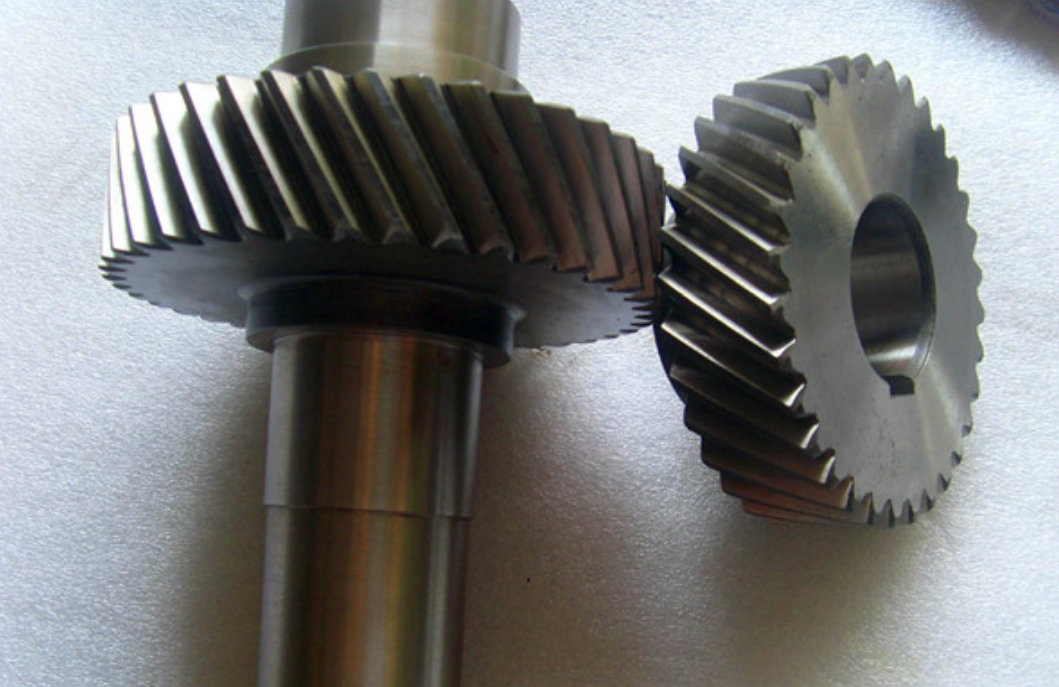
An excessively small center distance in a worm-helical gear pair has several detrimental effects that directly contribute to noise and vibration. Firstly, it drastically reduces backlash, leading to high contact pressure and friction. For plastic helical gears, this can cause localized deformation. As the gears rotate, this deformation and recovery cycle introduces a tangential acceleration component, resulting in what is known as meshing impact. Secondly, the effective line of action is altered, increasing transmission error and generating abnormal radial forces. In extreme cases, “tip-root interference” can occur, where the worm thread tip digs into the root of the helical gear tooth, creating a severe source of impact noise and vibration. Correcting the housing center distance to the nominal value yielded a measurable improvement, reducing average sound pressure to below 50 dB(A) and eliminating the hum, but a persistent cyclical whirring indicated the meshing conditions were still not optimal.
To achieve a further and more robust reduction in noise, the analysis shifted from the housing to the gear design itself. The goal was to improve the quality of mesh between the existing worm and a modified helical gear. A key metric for assessing the smoothness of gear transmission is the contact ratio or transverse contact ratio, often denoted as ε. A higher contact ratio means more teeth are in contact on average during operation, which distributes the load, reduces the force per tooth pair, and smooths out transmission variations, thereby lowering vibration and noise excitation.
For a worm drive, the meshing in a transverse plane can be approximated as that between a rack (the worm thread profile) and a gear (the helical gear). The contact ratio for a worm-helical gear pair can be derived from the geometry of engagement. It is a function of the number of teeth on the helical gear, pressure angles, helix angle, and the addendum modification coefficient (profile shift coefficient), xₙ. The general expression considers the lengths of the approach and recess paths along the line of action. A detailed derived form for the transverse contact ratio is given by:
$$
\varepsilon = \frac{1}{2\pi} \left[ \sqrt{ \left( \frac{d_{a2}}{m_n \cos \beta} \right)^2 – \left( \frac{z_2}{\cos^2 \beta} \cos \alpha_t \right)^2 } – z_2 \tan \alpha_t \right] + \frac{z_2 (\tan \alpha_{at2} – \tan \alpha_t)}{2\pi}
$$
Where $d_{a2}$ is the tip diameter of the helical gear, $z_2$ is its number of teeth, $m_n$ is the normal module, $\beta$ is the helix angle, $\alpha_t$ is the transverse pressure angle ($\arctan(\tan \alpha_n / \cos \beta)$), and $\alpha_{at2}$ is the transverse pressure angle at the helical gear tip. The tip diameter $d_{a2}$ is directly influenced by the profile shift coefficient $x_n$: $d_{a2} = m_n (z_2/\cos \beta + 2h_{a}^* + 2x_n)$. Therefore, $\varepsilon$ is implicitly a function of $x_n$.
An analysis of this relationship reveals a crucial trend: within a practical range, the contact ratio decreases as the profile shift coefficient increases (for positive shift). Conversely, applying a negative profile shift to the helical gear can increase the theoretical contact ratio. Furthermore, a negative shift reduces the tooth thickness at the tip and the root diameter, effectively creating more operational backlash when meshed with an unmodified worm. This combination—increased contact ratio and increased effective clearance—directly addresses the problems caused by the tight mesh: it mitigates meshing impacts and prevents tip-root interference.
Based on this theoretical understanding, a solution was formulated: apply a negative profile shift to the helical gears. This modification would make the teeth slightly thinner, providing the necessary clearance to compensate for housing tolerances while simultaneously promoting a smoother mesh via a higher potential contact ratio. The optimal amount of negative shift needed to be determined experimentally, balancing noise reduction with maintaining sufficient tooth strength and avoiding undercut.
A series of modified helical gears were manufactured with different negative profile shift coefficients: -0.20, -0.25, -0.30, -0.35, and -0.40. These were assembled into gearboxes (using housings with the corrected nominal center distance) and subjected to standardized acoustic testing. The results are summarized in Table 2.
| Profile Shift Coefficient, xₙ | Avg. Sound Pressure (Forward) [dB(A)] | Avg. Sound Pressure (Reverse) [dB(A)] |
|---|---|---|
| -0.20 | 50.1 | 49.7 |
| -0.25 | 49.5 | 49.6 |
| -0.30 | 49.1 | 49.2 |
| -0.35 | 49.3 | 49.4 |
| -0.40 | 49.2 | 49.4 |
The data clearly shows that all negative shift variants yielded an improvement over the baseline. The helical gear with a profile shift coefficient of -0.30 delivered the best overall performance, achieving the lowest and most stable sound pressure levels in both directions of rotation. This specific modification provided the ideal compromise: sufficient additional clearance to eliminate binding and intermittent contact, coupled with an optimized contact condition that minimized dynamic excitation. The inherent damping of the POM material for these helical gears further aided in dissipating the remaining vibrational energy.
In conclusion, this study demonstrates a systematic methodology for diagnosing and solving noise issues in precision plastic gearboxes. The primary noise source was identified as an undersized center distance in the gearbox housing, forcing the worm and helical gear pair into a poor meshing state. Theoretical analysis of the worm-helical gear meshing dynamics, particularly the relationship between the profile shift coefficient and the contact ratio, provided the foundation for an effective solution. By implementing a -0.30 negative profile shift on the helical gears, the effective operational backlash was increased to accommodate housing variances, and the mesh smoothness was enhanced. This targeted modification successfully reduced the gearbox noise to an acceptable level, resolving the cyclical whirring and ensuring reliable, quiet operation for the sweeping robot application. The principles explored here—centered on optimizing the engagement of helical gears through calculated profile shifts—are widely applicable to noise reduction efforts in small-module plastic gear drives across various industries.