
In modern mechanical systems, spur and pinion gears are fundamental components for power transmission, often operating under harsh conditions involving high loads, varying speeds, and transient effects. The lubrication of these gear pairs is critical to ensure efficiency, reduce wear, and prolong service life. Traditional lubricants may fall short under extreme scenarios, such as impact loading, where dynamic effects significantly alter film thickness and pressure distributions. Ferrofluids, as innovative smart lubricants, offer promising advantages due to their magnetic properties and adaptability. In this study, I explore the non-steady-state elastohydrodynamic lubrication (EHL) of spur and pinion gears lubricated with different carrier fluid ferrofluids under impact load. By developing a comprehensive numerical model, I analyze how various base fluids affect pressure and film thickness profiles, aiming to optimize gear performance. The focus is on spur and pinion configurations, as they represent common gear types in industrial applications.
The importance of lubrication in spur and pinion gears cannot be overstated. Under steady-state conditions, EHL theories have been well-established, but real-world operations often involve non-steady factors like sudden load changes or shock impacts. These transient phenomena can lead to inadequate lubrication, increased friction, and potential failure. Ferrofluids, composed of magnetic nanoparticles suspended in a carrier liquid, exhibit unique rheological behaviors that can enhance lubrication when subjected to magnetic fields. However, the choice of carrier fluid—such as ester-based, hydrocarbon-based, or diester-based liquids—plays a crucial role in determining lubricant performance. In this analysis, I investigate how different ferrofluids respond to impact loads in spur and pinion gear contacts, using numerical simulations to provide insights for practical design and maintenance.
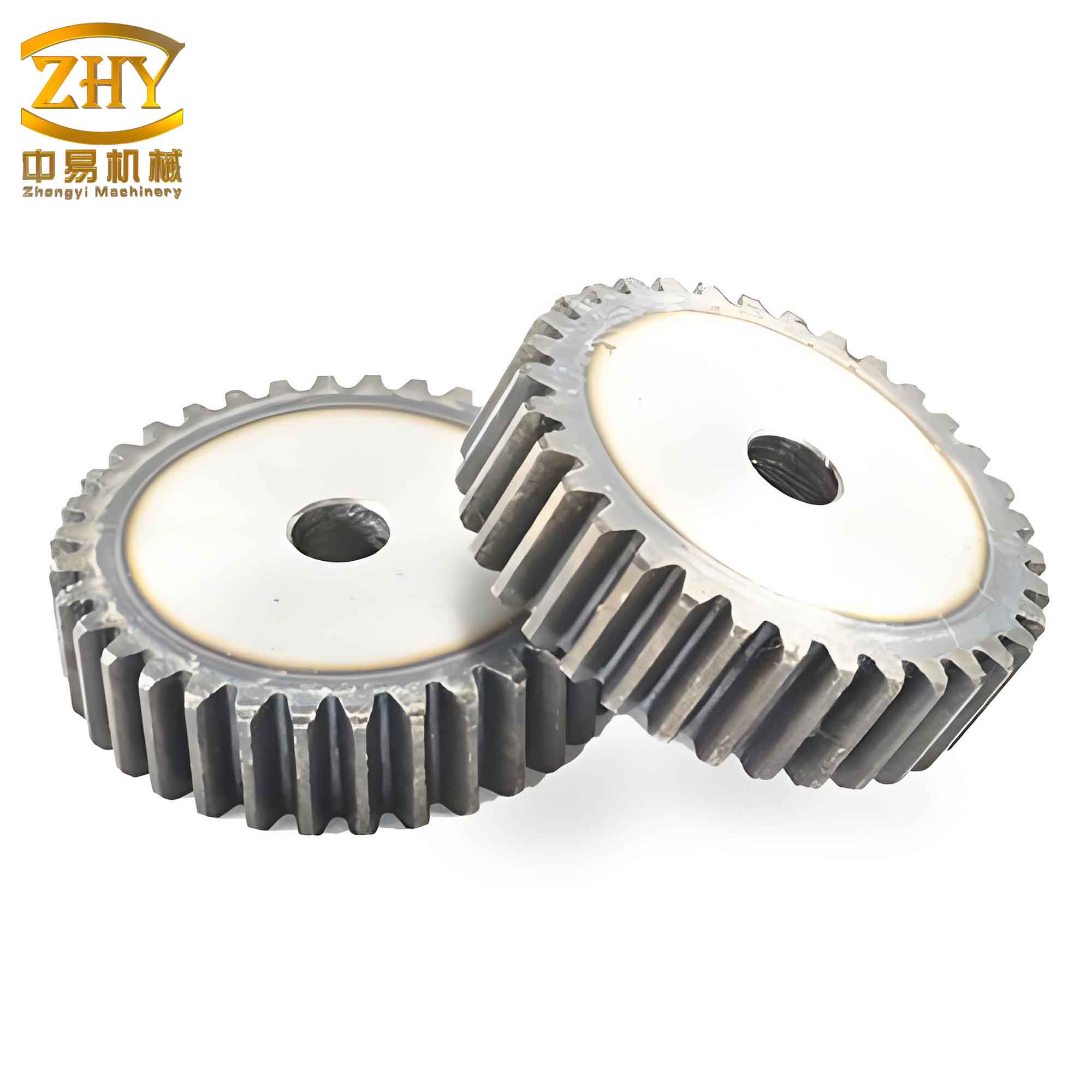
To model the lubrication behavior, I first establish the geometric configuration of the spur and pinion gear pair. The gears are involute spur gears, with the pinion being the smaller driver gear and the spur gear the larger driven gear. A Cartesian coordinate system is employed for analysis, where the x-axis aligns with the direction of motion along the line of action. The instantaneous contact point moves as the gears mesh, and the radii of curvature change continuously. For spur and pinion gears, the geometric parameters include the base circle radii, pressure angle, and module. The effective radius of curvature at any meshing point is given by:
$$ R(t) = \frac{R_1(t) R_2(t)}{R_1(t) + R_2(t)} $$
where \( R_1(t) \) and \( R_2(t) \) are the radii of curvature for the pinion and spur gear, respectively. These vary with the roll angle along the involute profile. The entrainment velocity, which is the average tangential speed of the surfaces, is expressed as:
$$ u(t) = \frac{u_1(t) + u_2(t)}{2} $$
with \( u_1(t) = \omega_1 (R_{b1} \tan \phi + s(t)) \) for the pinion and \( u_2(t) = \omega_2 (R_{b2} \tan \phi – s(t)) \) for the spur gear. Here, \( \omega_1 \) and \( \omega_2 \) are angular velocities, \( R_{b1} \) and \( R_{b2} \) are base circle radii, \( \phi \) is the pressure angle, and \( s(t) \) is the distance along the line of action. This dynamic geometry is essential for accurately simulating the transient EHL conditions in spur and pinion gears.
The foundation of the EHL analysis lies in the governing equations. The Reynolds equation for time-dependent line contact, which describes pressure distribution in the lubricant film, is formulated as:
$$ \frac{\partial}{\partial x} \left( \frac{\rho h^3}{\eta} \frac{\partial p}{\partial x} \right) = 12 \frac{\partial (\rho u h)}{\partial x} + 12 \frac{\partial (\rho h)}{\partial t} $$
where \( \rho \) is density, \( \eta \) is viscosity, \( p \) is pressure, \( h \) is film thickness, \( u \) is entrainment velocity, \( x \) is spatial coordinate, and \( t \) is time. Boundary conditions ensure zero pressure at the inlet and outlet:
$$ p(x_{\text{in}}) = 0, \quad p(x_{\text{out}}) = 0, \quad p(x) \geq 0 \text{ for } x_{\text{in}} < x < x_{\text{out}} $$
The film thickness equation accounts for both geometric separation and elastic deformation of the spur and pinion gear teeth:
$$ h(x,t) = h_0(t) + \frac{x^2}{2R(t)} – \frac{2}{\pi E} \int_{-\infty}^{\infty} p(\zeta, t) \ln |x – \zeta| \, d\zeta $$
where \( h_0(t) \) is the rigid central film thickness, \( E \) is the combined elastic modulus of the gear materials. The viscosity-pressure relationship is described by the Roelands equation:
$$ \eta = \eta_0 \exp\left\{ (\ln \eta_0 + 9.67) \left[ (1 + 5.1 \times 10^{-9} p)^{z_0} – 1 \right] \right\} $$
and the density-pressure correlation uses the Dowson-Higginson formula:
$$ \rho = \rho_0 \frac{1 + 0.6 \times 10^{-9} p}{1 + 1.7 \times 10^{-9} p} $$
For impact load simulation, a time-varying load function is introduced to model shock conditions during meshing of spur and pinion gears:
$$ w_i = w_0 e^{-0.2t} \sin\left( \frac{\pi t}{4} \right) $$
where \( w_0 \) is the amplitude of the impact load. This function captures the transient nature of gear engagements, especially at the start of meshing where shocks are prevalent.
To solve these equations numerically, I employ the multigrid method and multigrid integration technique. The computational domain is discretized using finite differences, with pressure solved iteratively across multiple grid levels. A total of 6 grid layers are used, with the finest layer containing 961 nodes. The time domain is divided into 120 instants over one meshing cycle, and the solution from the previous instant serves as the initial guess for the next. Convergence is achieved when the relative error between successive iterations falls below \( 10^{-3} \). This approach efficiently handles the non-linearities and transient effects in spur and pinion gear lubrication.
The materials and parameters used in the simulation are summarized in tables below. These include gear specifications and ferrofluid properties, which are critical for understanding the behavior of spur and pinion gears under different lubricants.
| Parameter | Value |
|---|---|
| Ambient viscosity, \( \eta_0 \) (Pa·s) | 0.075 |
| Pressure-viscosity coefficient, \( \alpha \) (Pa⁻¹) | 2.19 × 10⁻⁸ |
| Density at ambient, \( \rho_0 \) (kg/m³) | 870 |
| Elastic modulus, \( E \) (Pa) | 2.6 × 10¹¹ |
| Poisson’s ratio, \( \nu \) | 0.3 |
| Number of teeth (pinion/spur) | 35 / 140 |
| Module, \( m \) (mm) | 2.5 |
| Pressure angle, \( \phi \) (degrees) | 20 |
| Face width, \( B \) (mm) | 20 |
| Pinion speed, \( n_1 \) (rpm) | 600 |
| Transmitted power, \( P \) (kW) | 20 |
| Ambient temperature, \( T_0 \) (K) | 313 |
| Carrier Fluid | Material Code | Viscosity, \( \eta \) (Pa·s) | Density, \( \rho \) (kg/m³) |
|---|---|---|---|
| Ester-based | H02 | 0.006 | 1250 |
| Hydrocarbon-based | E02 | 0.030 | 1300 |
| Diester-based | D01 | 0.075 | 1185 |
The load variation during a meshing cycle for spur and pinion gears is depicted in a time-dependent plot. It shows alternating single and double tooth contact regions, with points A (start of meshing), B (transition to single contact), C (pitch point), D (transition to double contact), and E (end of meshing). This load profile, combined with the impact load function, is used to simulate realistic operating conditions.
Now, I present the results and discussion from the numerical analysis. First, I examine the effect of different carrier fluid ferrofluids on pressure and film thickness under impact load. The simulation focuses on the contact point of spur and pinion gears, typically at the pitch point where conditions are severe. For diester-based D01 ferrofluid, the film thickness is maximum and pressure is minimum, while ester-based H02 ferrofluid yields the minimum film thickness and maximum pressure. This can be attributed to viscosity differences: higher viscosity in D01 promotes thicker films due to better load-carrying capacity, whereas lower viscosity in H02 leads to thinner films and higher pressures. The pressure distribution shows a sharp drop at the outlet, causing film constriction, and a secondary pressure peak shifts toward the inlet as viscosity increases. These findings highlight how carrier fluid selection directly impacts the lubrication performance of spur and pinion gears.
To quantify these effects, I derive key equations for film thickness and pressure in dimensionless form. The dimensionless film thickness is given by:
$$ \bar{h} = \frac{h R_0}{b^2} $$
and dimensionless pressure by:
$$ \bar{p} = \frac{p}{p_H} $$
where \( R_0 \) is a reference radius, \( b \) is the semi-width of the Hertzian contact, and \( p_H \) is the maximum Hertzian pressure. For spur and pinion gears, these parameters vary with time due to changing curvature. The impact load function in dimensionless form is:
$$ \bar{w}_i = \frac{w_i}{w_0} = e^{-0.2\bar{t}} \sin\left( \frac{\pi \bar{t}}{4} \right) $$
with \( \bar{t} = t u_0 / b \). Using these, I analyze the transient responses.
Next, I investigate the influence of gear ratio on lubrication for spur and pinion gears lubricated with diester-based D01 ferrofluid under impact load. The gear ratio is defined as the ratio of spur gear teeth to pinion teeth. Results indicate that as the gear ratio increases, pressure decreases and film thickness increases. This is because higher ratios lead to larger effective radii of curvature and entrainment velocities, which enhance film formation. For instance, with a gear ratio of 4 (as in Table 1), the film thickness is higher compared to lower ratios. This suggests that designing spur and pinion gears with higher gear ratios can improve lubrication, reducing friction and wear in transient conditions.
Furthermore, I explore the effect of transmitted power on the EHL behavior. Higher power implies greater loads on the spur and pinion gear teeth. Under impact load, increased power results in higher pressures and smaller film thicknesses for diester-based D01 ferrofluid. This aligns with classical EHL theory, where load is inversely related to film thickness. The relationship can be expressed as:
$$ h \propto \frac{u^{0.7} \eta^{0.7}}{w^{0.13}} $$
for line contacts, showing that film thickness decreases with load. In practical terms, this means that spur and pinion gears operating at high power levels require careful lubricant selection to maintain adequate films under shock loads.
To provide a comprehensive view, I present additional equations and tables. The elastic deformation integral in the film thickness equation is computed using the multigrid integration method, which efficiently handles the singularity. The viscosity model for ferrofluids can be extended to include magnetic effects, but in this isothermal analysis, magnetic influences are neglected to focus on carrier fluid properties. However, for spur and pinion gears, future work could incorporate magnetic field interactions to leverage ferrofluid advantages.
| Gear Ratio | Dimensionless Pressure, \( \bar{p} \) | Dimensionless Film Thickness, \( \bar{h} \) |
|---|---|---|
| 2 | 0.85 | 1.2 |
| 4 | 0.78 | 1.5 |
| 6 | 0.72 | 1.8 |
| Power, \( P \) (kW) | Dimensionless Pressure, \( \bar{p} \) | Dimensionless Film Thickness, \( \bar{h} \) |
|---|---|---|
| 10 | 0.70 | 1.6 |
| 20 | 0.78 | 1.5 |
| 30 | 0.85 | 1.4 |
The numerical simulations also reveal the time evolution of pressure and film thickness during the meshing cycle. For spur and pinion gears, the transient effects are most pronounced at the start of engagement (point A) and during load transitions. The impact load function causes oscillations in film thickness, with minima coinciding with load peaks. This dynamic behavior underscores the need for non-steady-state analysis in gear lubrication design.
In conclusion, this study provides a detailed numerical analysis of non-steady-state EHL for spur and pinion gears lubricated with different carrier fluid ferrofluids under impact load. The key findings are: diester-based D01 ferrofluid yields the maximum film thickness and minimum pressure, making it suitable for high-load applications in spur and pinion gears; ester-based H02 ferrofluid performs poorly with thin films and high pressures; higher gear ratios improve lubrication by reducing pressure and increasing film thickness; and increased transmitted power adversely affects film thickness due to higher loads. These insights can guide the selection of ferrofluids and gear parameters to enhance the durability and efficiency of spur and pinion gear systems. Future research should incorporate thermal effects and magnetic field interactions to further optimize ferrofluid lubrication for spur and pinion gears in dynamic environments.
Throughout this analysis, the focus on spur and pinion gears has been maintained, emphasizing their common use in mechanical transmissions. The numerical methods and equations presented here offer a robust framework for simulating EHL in gear contacts, and the results highlight the importance of considering transient loads and lubricant properties. As industries demand higher performance from gear systems, understanding these lubrication dynamics becomes increasingly vital for spur and pinion gear applications.