
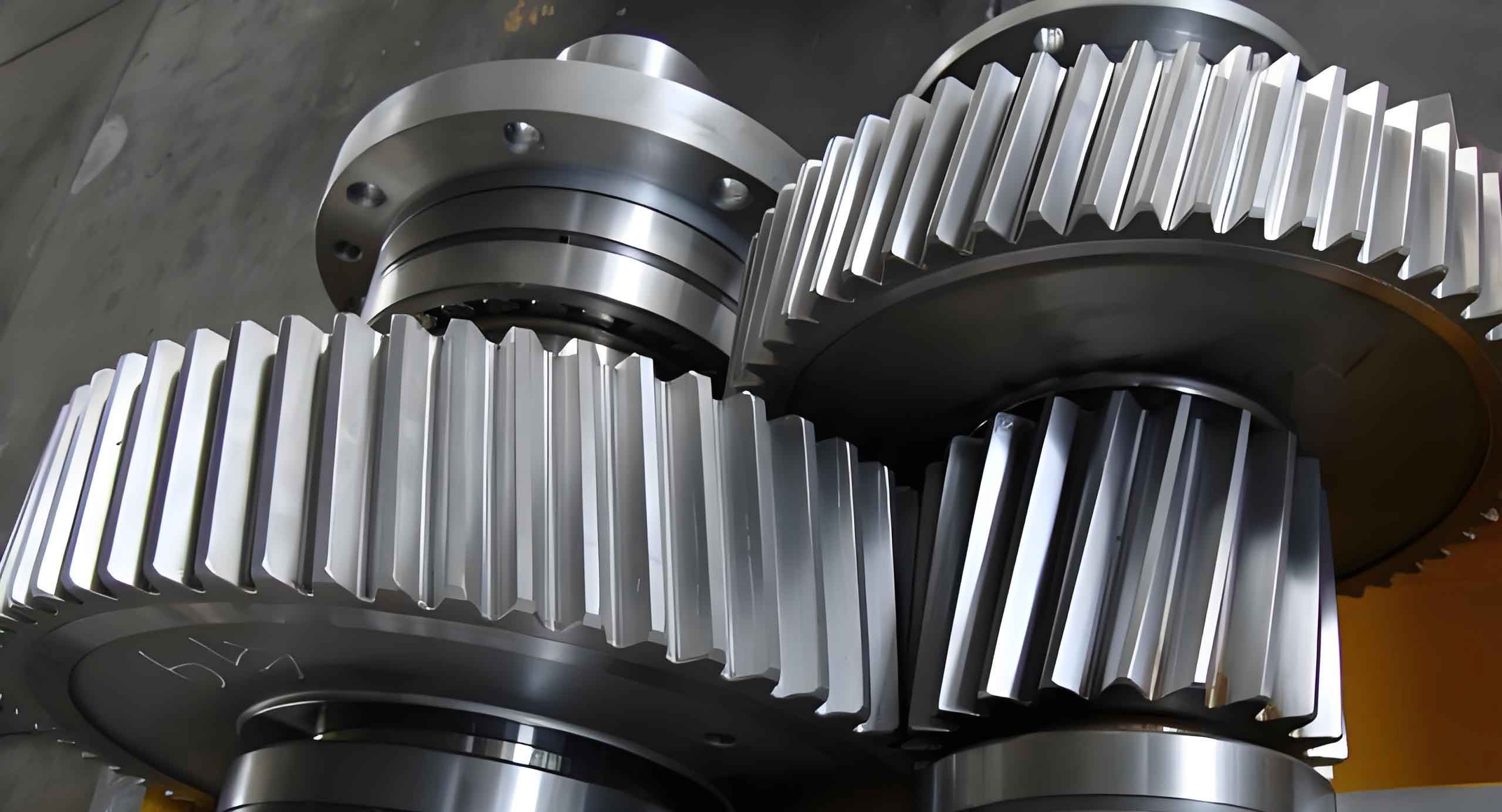
The study of gear dynamics is fundamental to the design of reliable and quiet power transmission systems. Among various gear types, the helical gear is widely favored for its smooth operation and high load-carrying capacity, attributed to the gradual engagement of its teeth along the helix. However, this very characteristic introduces complexities in its dynamic behavior. Compared to spur gears, the vibration of a helical gear transmission system is more intricate, potentially involving multiple degrees of freedom including torsional, transverse, axial, and disk vibrations. For many engineering applications, focusing on the dominant torsional vibration in the circumferential direction provides a sufficiently accurate model, allowing the system to be simplified into a torsional vibration model of the gear pair, much like for spur gears. The torsional model is a fundamental form for analyzing helical gear dynamics.
Real-world helical gear systems exhibit nonlinear behavior due to factors such as time-varying mesh stiffness (TVMS) and tooth flank backlash. Analyzing these nonlinearities has become a key research focus. This article establishes a single-degree-of-freedom pure torsional model for a helical gear pair, explicitly incorporating TVMS and backlash. We analyze the characteristics of these nonlinearities, propose concise methods for their representation, solve the nonlinear dynamic model, and investigate the influence of key parameters like face width and backlash magnitude on the system’s vibratory response.
1. Establishment of the Pure Torsional Vibration Model
Figure 1 shows the torsional dynamic model of a helical gear pair. Applying Newton’s second law yields the equations of motion for the driving gear (a) and the driven gear (p):
$$I_a \ddot{\theta}_a + c_n R_a [R_a \dot{\theta}_a – R_p \dot{\theta}_p – \dot{e}(t)] \cos\beta + k_n(t) R_a f[R_a \theta_a – R_p \theta_p – e(t)] \cos\beta = T_a$$
$$I_p \ddot{\theta}_p – c_n R_p [R_a \dot{\theta}_a – R_p \dot{\theta}_p – \dot{e}(t)] \cos\beta – k_n(t) R_p f[R_a \theta_a – R_p \theta_p – e(t)] \cos\beta = -T_p$$
where:
- $\theta_i$, $\ddot{\theta}_i$ (i = a, p) are the angular displacement and acceleration of the gears about their axes.
- $I_i$ are the mass moments of inertia.
- $T_i$ are the externally applied torques.
- $R_i$ are the base circle radii.
- $e(t)$ is the static transmission error.
- $k_n(t)$ and $c_n$ are the time-varying mesh stiffness and damping, respectively.
- $\beta$ is the helix angle.
- $f[x(t)]$ is the nonlinear displacement function accounting for backlash, defined below.
The dynamic transmission error (DTE) along the line of action is defined as $x_d(t) = R_a \theta_a – R_p \theta_p$. Let $x(t)$ be the difference between the DTE and the static transmission error: $x(t) = R_a \theta_a – R_p \theta_p – e(t)$. The backlash nonlinearity is described by a piecewise function:
$$
f[x(t)] =
\begin{cases}
x(t) – b, & x(t) > b \\
0, & -b \le x(t) \le b \\
x(t) + b, & x(t) < -b
\end{cases}
$$
where $b$ is half the total gear backlash. Combining the two equations of motion and using the defined terms, we obtain a single-degree-of-freedom nonlinear differential equation:
$$m_e \ddot{x}(t) + c_e \dot{x}(t) + k_e(t) f[x(t)] = F(t)$$
where the equivalent parameters are:
$$m_e = \frac{I_a I_p}{I_a R_p^2 + I_p R_a^2}, \quad c_e = c_n \cos^2\beta, \quad k_e(t) = k_n(t) \cos^2\beta$$
$$F(t) = \frac{T_a R_p}{I_p} + \frac{T_p R_a}{I_a} – m_e \ddot{e}(t)$$
2. Analysis and Characterization of Nonlinear Factors
2.1 Time-Varying Mesh Stiffness (TVMS)
In a helical gear mesh, the contact lines are inclined, and multiple tooth pairs are typically in contact simultaneously. For simplification, assuming load is uniformly distributed along the contact lines, the variation in the total length of contact lines can represent the variation in instantaneous mesh stiffness. The meshing plane of a helical gear pair is shown schematically, where the face width is $B$, the base pitch is $p_b$, the base helix angle is $\beta_b$, and $\varepsilon_{\alpha}$ and $\varepsilon_{\beta}$ are the transverse and axial contact ratios, respectively.
The change in contact length for a single tooth pair during mesh can be approximated as piecewise linear. When $\varepsilon_{\alpha} \ge \varepsilon_{\beta}$, the maximum contact length per pair is $l_m = B / \cos\beta_b$, and the varying length $l(x)$ over a base pitch $p_b$ is:
$$
l(x) =
\begin{cases}
\frac{l_m}{\varepsilon_{\beta}} x, & 0 \le x \le \varepsilon_{\beta} \\
l_m, & \varepsilon_{\beta} < x < \varepsilon_{\alpha} \\
\frac{l_m}{\varepsilon_{\beta}} (\varepsilon_{\alpha} + \varepsilon_{\beta} – x), & \varepsilon_{\alpha} \le x \le \varepsilon_{\alpha}+\varepsilon_{\beta}
\end{cases}
$$
Due to the total contact ratio being greater than one, multiple tooth pairs share the load. The total contact length $L(t)$ is the sum of the individual contact lengths of all engaging pairs, resulting in a periodic waveform. The mesh stiffness is assumed proportional to the total contact length: $k_n(t) = k_l L(t)$, where $k_l$ is a proportionality constant. If $k_m$ is the average mesh stiffness and $L_a$ is the average contact length over one period $T$ (where $T=60/(n z)$, $n$ is rpm, $z$ is teeth), then $k_l = k_m / L_a$.
The periodic TVMS function $k_n(t)$ can be expanded into a Fourier series. For practical analysis, truncating the series after the first five harmonics provides sufficient accuracy for many engineering applications:
$$k_n(t) = \frac{a_0}{2} + \sum_{n=1}^{5} \left[ a_n \cos(n \omega_m t) + b_n \sin(n \omega_m t) \right]$$
where $\omega_m = 2\pi / T_m$ is the mesh frequency in rad/s, and $T_m$ is the mesh period. The coefficients $a_n$ and $b_n$ are determined from the piecewise contact length function. An example set of coefficients for a specific helical gear pair is given in Table 1.
| Coefficient | n=0 (DC) | n=1 | n=2 | n=3 | n=4 | n=5 |
|---|---|---|---|---|---|---|
| $a_n$ (N/m) | $5.85 \times 10^9$ | $-1.55 \times 10^8$ | $-2.0 \times 10^5$ | $-1.83 \times 10^7$ | $-3.0 \times 10^5$ | $-5.5 \times 10^6$ |
| $b_n$ (N/m) | – | $1.52 \times 10^8$ | $5.7 \times 10^5$ | $-1.92 \times 10^7$ | $-1.0 \times 10^5$ | $5.1 \times 10^6$ |
2.2 Backlash Nonlinearity
The piecewise backlash function $f[x(t)]$ is non-differentiable at $x = \pm b$. For analytical convenience, especially when applying perturbation or harmonic balance methods, it is often approximated by a continuous odd polynomial function within a certain range $[-d, d]$ where $d > b$. A cubic polynomial is often adequate to capture the essential nonlinear effect:
$$f[x(t)] \approx \gamma_1 x(t) + \gamma_3 [x(t)]^3$$
The coefficients $\gamma_1$ and $\gamma_3$ are determined by fitting the polynomial to the piecewise linear function, for instance, using a least-squares method over the interval $[-d, d]$. For a backlash of $2b = 100 \mu m$ ($b=5\times10^{-5}$ m) and fitting range $d = 2\times10^{-4}$ m, typical values could be $\gamma_1 \approx 0.344$ and $\gamma_3 \approx 1.201 \times 10^7$ m$^{-2}$.
3. Model Solution and Analysis of Nonlinear Effects
3.1 Model Simplification and Numerical Solution
Substituting the Fourier series for $k_n(t)$ and the cubic polynomial for $f[x(t)]$ into the single-degree-of-freedom equation yields:
$$
\begin{aligned}
m_e \ddot{x}(t) &+ c_e \dot{x}(t) + \left\{ \frac{a_0}{2}\cos^2\beta + \cos^2\beta \sum_{n=1}^{5} \left[ a_n \cos(n \omega_m t) + b_n \sin(n \omega_m t) \right] \right\} \\
&\times \left\{ \gamma_1 x(t) + \gamma_3 [x(t)]^3 \right\} = F(t)
\end{aligned}
$$
This is a nonlinear differential equation with parametric excitation (due to TVMS) and geometric nonlinearity (due to the cubic term from backlash). For a specific helical gear system with parameters listed in Table 2, this equation can be solved numerically using methods like the fourth-order Runge-Kutta method.
| Parameter | Symbol | Value | Unit |
|---|---|---|---|
| Equivalent Mass | $m_e$ | 42.921 | kg |
| Equivalent Damping | $c_e$ | 318.7 | N·s/m |
| Mean Mesh Stiffness Term | $K_m = (a_0/2)\cos^2\beta$ | $2.881 \times 10^9$ | N/m |
| Mean Force | $F_0$ | $1.149 \times 10^5$ | N |
| Helix Angle | $\beta$ | 15 | deg |
Initial conditions, e.g., $x(0)=3.938\times10^{-5}$ m and $\dot{x}(0)=3.165$ m/s, and a forcing function $F(t)$ (which may include components from $T_a$, $T_p$, and transmission error excitation) complete the formulation for time-domain simulation.
3.2 Influence of Face Width on Time-Varying Stiffness
The face width $B$ directly influences the axial contact ratio: $\varepsilon_{\beta} = \frac{B \sin\beta}{\pi m_n}$, where $m_n$ is the normal module. The axial contact ratio $\varepsilon_{\beta}$ is a key parameter determining the amplitude of the TVMS fluctuation. Analysis shows that the average mesh stiffness increases with face width $B$. However, more importantly, the amplitude of the stiffness variation is highly sensitive to how close $\varepsilon_{\beta}$ is to an integer value.
When the axial contact ratio $\varepsilon_{\beta}$ is exactly 1, 2, etc., the total contact line length remains nearly constant throughout the mesh cycle because as one tooth pair loses contact, another pair simultaneously establishes full contact. This results in a very small amplitude of TVMS fluctuation. Conversely, when $\varepsilon_{\beta}$ is a non-integer (e.g., 1.2 or 1.8), the transition of contact lines causes a more significant variation in total length, leading to a larger TVMS amplitude and consequently greater dynamic excitation. Therefore, in the design of a helical gear, selecting a face width that makes $\varepsilon_{\beta}$ close to an integer can significantly reduce vibration and noise originating from stiffness variation.
3.3 Influence of Backlash Magnitude on System Vibration
The magnitude of backlash $2b$ has a pronounced effect on the dynamic response of the helical gear system. Numerical simulations with varying backlash levels reveal its impact on vibration metrics such as peak acceleration, acceleration amplitude, and root-mean-square (RMS) acceleration. The relationship is nonlinear.
For small backlash values (e.g., less than 60 µm total), the system’s vibratory response is very sensitive. The vibration metrics increase almost linearly with increasing backlash. In this regime, even a small increase in clearance allows for more impactful contact separation and re-engagement events, amplifying the dynamic forces.
Beyond a certain threshold (approximately >60 µm in the studied case), the system’s response becomes less sensitive to further increases in backlash. While the overall vibration level may still show a slight increasing trend, the rate of change diminishes. This suggests that while minimizing backlash is beneficial for reducing vibration, there is a point of diminishing returns, and controlling backlash to within a tight but practical range (e.g., below 40-60 µm) is crucial for optimal dynamic performance of a helical gear drive.
4. Conclusion
This analysis focused on the nonlinear torsional dynamics of a helical gear pair, incorporating the essential nonlinearities of time-varying mesh stiffness and tooth flank backlash. A single-degree-of-freedom model was developed, and effective methods for characterizing these nonlinearities were presented: a Fourier series expansion for TVMS and a cubic polynomial approximation for backlash. Numerical solution of the model provided insights into key design parameters.
The primary conclusions are:
- The face width of a helical gear should be designed to make the axial contact ratio $\varepsilon_{\beta}$ as close to an integer as possible. This minimizes the amplitude of the time-varying mesh stiffness, thereby reducing a major source of dynamic excitation.
- The backlash magnitude significantly affects system vibration, particularly in the lower range. For the studied helical gear system, backlash under 60 µm had a strong, nearly linear effect on increasing vibration levels. Maintaining tight control of backlash within this lower range is critical for achieving smooth operation and low noise.
The presented modeling and analysis framework provides a practical approach for understanding and optimizing the dynamic behavior of helical gear systems, contributing to the design of more reliable and efficient mechanical transmissions.