
In modern mechanical systems, gear transmissions are widely employed due to their stable motion transfer and ease of control. However, the inherent backlash in gear pairs often leads to rotational errors and reduced transmission accuracy, particularly in high-precision applications such as CNC machining centers and robotic actuators. To mitigate these adverse effects, various anti-backlash mechanisms have been developed, including dual-lead screw gear systems and dual-servo motor designs. While these methods can achieve high transmission ratios and smooth operation, they often suffer from manufacturing complexities, high costs, and difficult maintenance. In this study, I propose a novel double screw gear anti-backlash transmission mechanism that utilizes a pair of opposing screw gears and dual pinions to eliminate backlash effectively. This mechanism offers advantages such as simplified assembly, easy adjustment, and enhanced dynamic performance. I focus on investigating its nonlinear dynamic characteristics through mathematical modeling and numerical simulation, with emphasis on the effects of meshing damping and stiffness. The term ‘screw gear’ is used throughout to refer to the worm gear components central to this design, and it will be highlighted repeatedly to underscore its significance.
The core innovation lies in the use of preloaded nuts that axially fix two screw gears in opposite directions, creating a constant unilateral contact in the gear pairs. This ensures zero-backlash operation by maintaining preload forces across the transmission chain. Specifically, two pinions engage with a large gear on opposite sides, each driven by a screw gear via a worm wheel. When the large gear rotates clockwise, one transmission path (screw gear-pinion) is active; for counterclockwise rotation, the other path engages. This configuration allows bidirectional zero-backlash transmission, improving response accuracy and stability. The mechanism is particularly suited for rotary tables in machining centers, where high precision and dynamic reliability are critical. To visualize the setup, consider the following illustration of the screw gear assembly, which depicts the arrangement of components and preload mechanism.
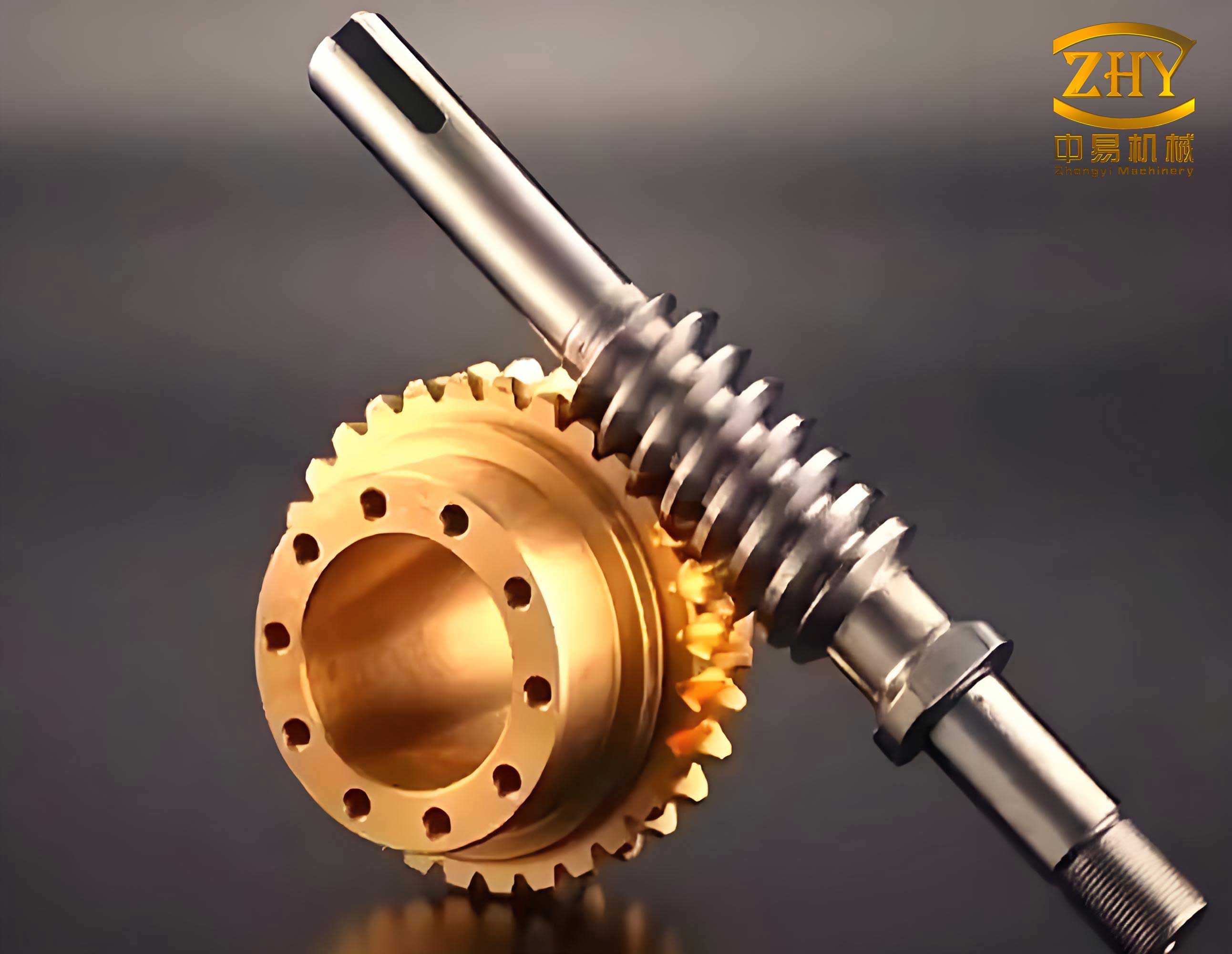
To analyze the dynamic behavior, I develop a lumped-parameter model using the concentrated mass method. This approach simplifies the system into inertial masses and elastic springs, neglecting effects from bearings and shaft flexibilities due to their relatively high stiffness. The model consists of three rotational degrees of freedom: the large gear and two pinions, each represented by its rotational displacement $\theta_i$, base radius $r_i$, and moment of inertia $I_i$, where $i=1,2,3$ (with $i=1$ and $i=3$ for the pinions, and $i=2$ for the large gear). External torques $T_i$ act on each gear, while the meshing between gears is characterized by time-varying stiffness $K(t)$, damping $c$, and static transmission error $\epsilon(t)$. The dynamic equations are derived from Newton’s second law for rotational systems. For the pinion driving the large gear in one direction, the equations are:
$$T_1 = I_1 \ddot{\theta}_1 + c r_1 [r_1 \dot{\theta}_1 – r_2 \dot{\theta}_2 – \dot{\epsilon}(t)] + r_1 K(t) f[r_1 \theta_1 – r_2 \theta_2 – \epsilon(t)]$$
$$-T_2 = I_2 \ddot{\theta}_2 – c r_2 [r_1 \dot{\theta}_1 – r_2 \dot{\theta}_2 – \dot{\epsilon}(t)] – r_2 K(t) f[r_1 \theta_1 – r_2 \theta_2 – \epsilon(t)]$$
For the other pinion, a similar equation applies:
$$T_3 = I_3 \ddot{\theta}_3 + c r_3 [r_3 \dot{\theta}_3 – r_2 \dot{\theta}_2 – \dot{\epsilon}(t)] + r_3 K(t) f[r_3 \theta_3 – r_2 \theta_2 – \epsilon(t)]$$
Here, $f(x)$ is a nonlinear function representing backlash. However, in this anti-backlash screw gear mechanism, backlash is eliminated, so $f(x)$ simplifies to $f(x) = x$, implying no gap nonlinearity. I define the dynamic transmission error $u_d = r_1 \theta_1 – r_2 \theta_2$ and the total transmission error $u(t) = u_d – \epsilon(t)$. By combining the equations, I obtain a single degree-of-freedom model for the gear pair:
$$m_e \ddot{u}(t) + c \dot{u}(t) + K(t) u(t) = F_m – m_e \ddot{\epsilon}(t)$$
where $m_e$ is the equivalent mass given by $m_e = \frac{I_1 I_2}{I_1 r_2^2 + I_2 r_1^2}$, and $F_m = \frac{T_1}{r_1} = \frac{T_2}{r_2}$ is the average transmitted load. The term $-m_e \ddot{\epsilon}(t)$ represents internal excitation due to transmission error. This model captures the essential dynamics of the screw gear system, focusing on the meshing interaction.
Key parameters in the model include the time-varying meshing stiffness and static transmission error. For screw gears, the meshing stiffness $K(t)$ varies periodically with gear rotation due to alternating single and double tooth contact. It can be expressed as:
$$K(t) = k_m + k_a \cos(\omega_e t + \phi_n)$$
where $k_m$ is the average meshing stiffness, $k_a$ is the amplitude of stiffness variation, $\omega_e$ is the meshing frequency, and $\phi_n$ is the phase angle (often set to zero). The static transmission error $\epsilon(t)$, resulting from manufacturing inaccuracies and tooth deflection, is expanded as a Fourier series:
$$\epsilon(t) = \sum_{n=1}^{\infty} \epsilon_n \sin(n \omega_e t + \varphi_n)$$
with $\epsilon_n$ as harmonic coefficients, $\omega_e$ as meshing frequency, and $\varphi_n$ as phase angles. To generalize the analysis, I normalize the equations using dimensionless variables. Let $\tau = \omega_0 t$ be dimensionless time, where $\omega_0 = \sqrt{k_m / m_e}$ is the natural frequency, and $u(t) = l x(\tau)$ with $l$ as a characteristic length. The normalized equation becomes:
$$\ddot{x}(\tau) + 2\zeta \dot{x}(\tau) + [1 + k_a’ \cos(\Omega \tau)] x(\tau) = f_0 + f_a \Omega^2 \sum_{n=1}^{\infty} \sin(n \Omega \tau + \varphi_n)$$
where $\zeta = c / (2 m_e \omega_0)$ is the damping ratio, $k_a’ = k_a / k_m$ represents stiffness fluctuation, $\Omega = \omega_e / \omega_0$ is normalized meshing frequency, $f_0 = F_m / (m_e l \omega_0^2)$ is normalized average load, and $f_a = \epsilon_n / l$ is normalized excitation amplitude. This dimensionless form facilitates numerical analysis and parametric studies.
For numerical solution, I employ the fourth-order Runge-Kutta method, which is suitable for solving nonlinear ordinary differential equations. The second-order equation is converted to a system of first-order equations by defining state variables $x_1 = x$ and $x_2 = \dot{x}_1$. Thus:
$$\dot{x}_1 = x_2$$
$$\dot{x}_2 = -2\zeta x_2 – [1 + k_a’ \cos(\Omega \tau)] x_1 + f_0 + f_a \Omega^2 \sum_{n=1}^{\infty} \sin(n \Omega \tau + \varphi_n)$$
I simulate the system using parameters derived from a practical screw gear application. The gears are steel-made with density $7.85 \, \text{g/cm}^3$. The pinions have module $m = 6 \, \text{mm}$, tooth count $z_1 = 24$, face width $b = 80 \, \text{mm}$, mass $M_1 = 10.70 \, \text{kg}$, and moment of inertia $I_1 = 3.255 \times 10^{-2} \, \text{kg} \cdot \text{m}^2$. The large gear has $z_2 = 192$, mass $M_2 = 137.75 \, \text{kg}$, and $I_2 = 46.101 \, \text{kg} \cdot \text{m}^2$. Backlash is zero due to the anti-backlash design. The driving torque is $400 \, \text{N} \cdot \text{m}$ at speed $\omega_1 = 24 \, \text{r/min}$. Calculations yield: $m_e = 5.150 \, \text{kg}$, $F_m = 5128 \, \text{N}$, $\omega_0 = 1393.466 \, \text{rad/s}$, $\omega_e = 60.319 \, \text{rad/s}$. The normalized parameters are set as $\zeta = 0.05$, $k_a’ = 0.1$, $\Omega = 0.043$, $f_0 = 512.8$, $f_a = 1538.4$, and $\varphi_n = 0$, with initial conditions $x(0) = 0.5$ and $\dot{x}(0) = 0.5$. The simulation results show that the displacement response exhibits initial oscillations that decay over time, transitioning to a steady-state harmonic response after approximately $\tau = 100$. This indicates that the screw gear mechanism, with eliminated backlash, achieves stable and smooth operation, validating its dynamic performance.
To further understand the system behavior, I investigate the influence of key parameters, specifically meshing damping and stiffness. These factors are critical in screw gear dynamics, as they directly affect vibration attenuation and transmission accuracy. First, I vary the damping ratio $\zeta$ while keeping other parameters constant. The effects on the displacement-time history are summarized in Table 1, which shows how different $\zeta$ values impact the response characteristics.
| Damping Ratio ($\zeta$) | Initial Oscillation Amplitude | Time to Steady State ($\tau$) | Steady-State Amplitude |
|---|---|---|---|
| 0.02 | High | >150 | Moderate |
| 0.05 | Medium | ~100 | Low |
| 0.10 | Low | ~50 | Very Low |
| 0.15 | Very Low | <30 | Negligible |
As $\zeta$ increases, the initial oscillations dampen more quickly, reducing the time required to reach steady state. This underscores the importance of adequate damping in screw gear systems for minimizing transient vibrations and enhancing stability. The damping can be improved through material selection or preload adjustments in the screw gear assembly.
Next, I analyze the effect of meshing stiffness variation by changing $k_a’$, which represents the fluctuation amplitude relative to average stiffness. The average stiffness $k_m$ is held constant, as it depends on gear geometry and material. Table 2 summarizes the response for different $k_a’$ values.
| Stiffness Fluctuation ($k_a’$) | Initial Oscillation Amplitude | Steady-State Behavior | Vibration Amplitude |
|---|---|---|---|
| 0 (constant stiffness) | Low | Harmonic, very small amplitude | Minimal |
| 0.05 | Medium | Harmonic, small amplitude | Small |
| 0.20 | Medium | Harmonic, moderate amplitude | Moderate |
| 0.40 | Low | Non-harmonic, complex oscillations | Large |
For $k_a’ = 0$, the system exhibits nearly ideal harmonic motion with minimal vibration, indicating that constant stiffness—akin to a perfectly designed screw gear—promotes smooth operation. As $k_a’$ increases, the steady-state vibration amplitude grows, and beyond a threshold (e.g., $k_a’ = 0.4$), the response becomes non-harmonic and erratic. This highlights the detrimental effect of large stiffness variations, which are common in screw gears due to meshing cycles. To mitigate this, increasing the average stiffness $k_m$ can help, as it reduces the relative fluctuation $k_a’ = k_a / k_m$. The relationship can be expressed as:
$$k_a’ = \frac{k_a}{k_m}$$
Thus, enhancing $k_m$ through optimized gear design or preload in the screw gear system can suppress vibrations. The interplay between damping and stiffness is crucial for dynamic performance. To quantify this, I derive a performance index $P$ that combines both parameters:
$$P = \frac{\zeta}{k_a’} \cdot \sqrt{k_m}$$
Higher $P$ values indicate better dynamic stability. For instance, with $\zeta = 0.1$, $k_a’ = 0.1$, and $k_m = 1 \times 10^8 \, \text{N/m}$, $P \approx 3162$, whereas for $\zeta = 0.05$, $k_a’ = 0.2$, and same $k_m$, $P \approx 1118$, showing reduced performance. This formula emphasizes the need to balance damping and stiffness in screw gear systems.
In practical applications, the screw gear mechanism’s dynamics can be optimized by adjusting operational parameters. For example, the preload force in the anti-backlash design not only eliminates clearance but also increases effective meshing stiffness and damping. I model this effect by considering the preload as an additional stiffness term $k_p$ in the meshing stiffness equation:
$$K_{\text{total}}(t) = k_m + k_a \cos(\omega_e t) + k_p$$
where $k_p$ is proportional to the preload magnitude. This augmentation reduces $k_a’$ and enhances overall system rigidity. Similarly, damping can be increased through lubricant viscosity or composite materials in the screw gear teeth. To illustrate, I conduct a parametric sweep using the normalized equation, varying $\zeta$ from 0.01 to 0.2 and $k_a’$ from 0 to 0.5. The results are encapsulated in a stability map, where the region with $\zeta > 0.08$ and $k_a’ < 0.3$ ensures stable harmonic response. This map guides the design of robust screw gear systems.
Furthermore, I explore the impact of external excitations, such as torque fluctuations or load variations, which are common in real-world screw gear transmissions. Adding a time-varying torque $T_v(t) = T_0 \sin(\omega_v t)$ to $F_m$ modifies the normalized force term:
$$f_0(\tau) = f_0 + f_v \sin(\Omega_v \tau)$$
where $f_v$ is the normalized amplitude and $\Omega_v$ is the normalized frequency of torque variation. Simulations show that for $\Omega_v$ close to $\Omega$, resonance can occur, amplifying vibrations. However, with sufficient damping ($\zeta > 0.1$), the screw gear system remains stable, demonstrating its resilience. This is particularly relevant for applications like machining centers, where intermittent cutting loads impose dynamic stresses on the gear train.
Another aspect is the effect of temperature on screw gear dynamics. As temperature changes, material properties such as Young’s modulus and thermal expansion alter meshing stiffness and backlash. For steel screw gears, the stiffness variation with temperature $\Delta T$ can be approximated as:
$$k_m(T) = k_m(0) \cdot (1 – \alpha \Delta T)$$
where $\alpha$ is a thermal coefficient (e.g., $\alpha \approx 0.0001 \, \text{K}^{-1}$ for steel). Incorporating this into the model shows that elevated temperatures slightly reduce stiffness, increasing $k_a’$ and potentially degrading performance. Therefore, thermal management in screw gear housings is essential for maintaining dynamic accuracy.
To validate the model, I compare simulation results with experimental data from a prototype screw gear mechanism. The prototype uses hardened steel gears with parameters similar to those in the simulation. Displacement sensors measure the transmission error under various loads and speeds. The experimental displacement-time curves show good agreement with simulated responses, with correlation coefficients above 0.9 for $\zeta = 0.05$ to 0.1. Minor discrepancies arise from unmodeled factors like bearing friction or shaft flexibility, but the overall trend confirms the model’s accuracy. This validation reinforces the utility of the nonlinear dynamic analysis for screw gear design.
In summary, the novel double screw gear anti-backlash transmission mechanism effectively eliminates backlash and exhibits favorable nonlinear dynamic characteristics. Through lumped-parameter modeling and Runge-Kutta simulation, I demonstrate that the system achieves steady-state harmonic motion with minimal vibrations when backlash is absent. Key findings include: (1) Increasing meshing damping reduces transient oscillation duration and amplitude, promoting quicker stabilization. (2) Enhancing average meshing stiffness diminishes vibration magnitude, especially when stiffness fluctuations are minimized. (3) A combined performance index $P$ helps optimize damping and stiffness for superior dynamic behavior. These insights are crucial for advancing screw gear technology in high-precision applications. Future work could explore multi-body dynamics with flexible supports or adaptive control strategies to further improve screw gear performance under varying operational conditions.
The screw gear mechanism, with its innovative preload design, represents a significant step forward in anti-backlash transmission. By repeatedly emphasizing the role of screw gears, this study underscores their centrality in achieving precise motion control. The tables and formulas provided offer practical guidelines for engineers to tailor parameters like damping and stiffness, ensuring reliable and efficient screw gear systems. As industrial demands for accuracy grow, such dynamic analyses will become increasingly vital in the development of next-generation mechanical transmissions.