
The pursuit of increased power density, reliability, and smooth operation in advanced mechanical transmissions, particularly for applications such as helicopter drivetrains and high-performance industrial machinery, has driven significant interest in herringbone gears. These gears offer distinct advantages over their spur and single-helical counterparts by eliminating net axial thrust loads through the use of two opposed helices, thereby increasing the total contact ratio and promoting superior load distribution and quieter operation. Understanding the complex nonlinear dynamic behavior of herringbone gear systems, especially under the demanding conditions of high speed and heavy load, is paramount for optimal design, vibration suppression, and the prevention of premature failure. This analysis delves into the formulation of a comprehensive nonlinear dynamic model for a high-speed, heavy-duty herringbone gear transmission system, incorporating key real-world excitations and nonlinearities. The model is then employed to investigate the influence of critical system parameters on the dynamic response, stability, and the emergence of complex phenomena such as bifurcation and chaos.
The dynamic behavior of geared systems is inherently nonlinear due to several factors. Time-varying mesh stiffness, resulting from the changing number of tooth pairs in contact during the meshing cycle, acts as a fundamental parametric excitation. Furthermore, manufacturing imperfections, assembly errors, and intentional design allowances introduce static transmission error (STE), which serves as a primary internal displacement excitation. The presence of backlash, the clearance between non-contacting tooth flanks, introduces a piecewise-linear nonlinearity that can lead to impacts and loss of contact, severely affecting dynamic loads and noise. Supporting structures, particularly rolling-element bearings with internal clearance, contribute additional nonlinear restoring forces. Prior research has extensively explored these factors in spur and helical gear dynamics. Studies have incorporated friction effects, tooth cracks, and combined errors into dynamic models. For herringbone gears, coupled lateral-torsional models considering mixed elastohydrodynamic lubrication and bearing waviness excitations have been developed. This work synthesizes these aspects into a focused analysis of the high-speed, heavy-duty regime specific to herringbone gear applications.
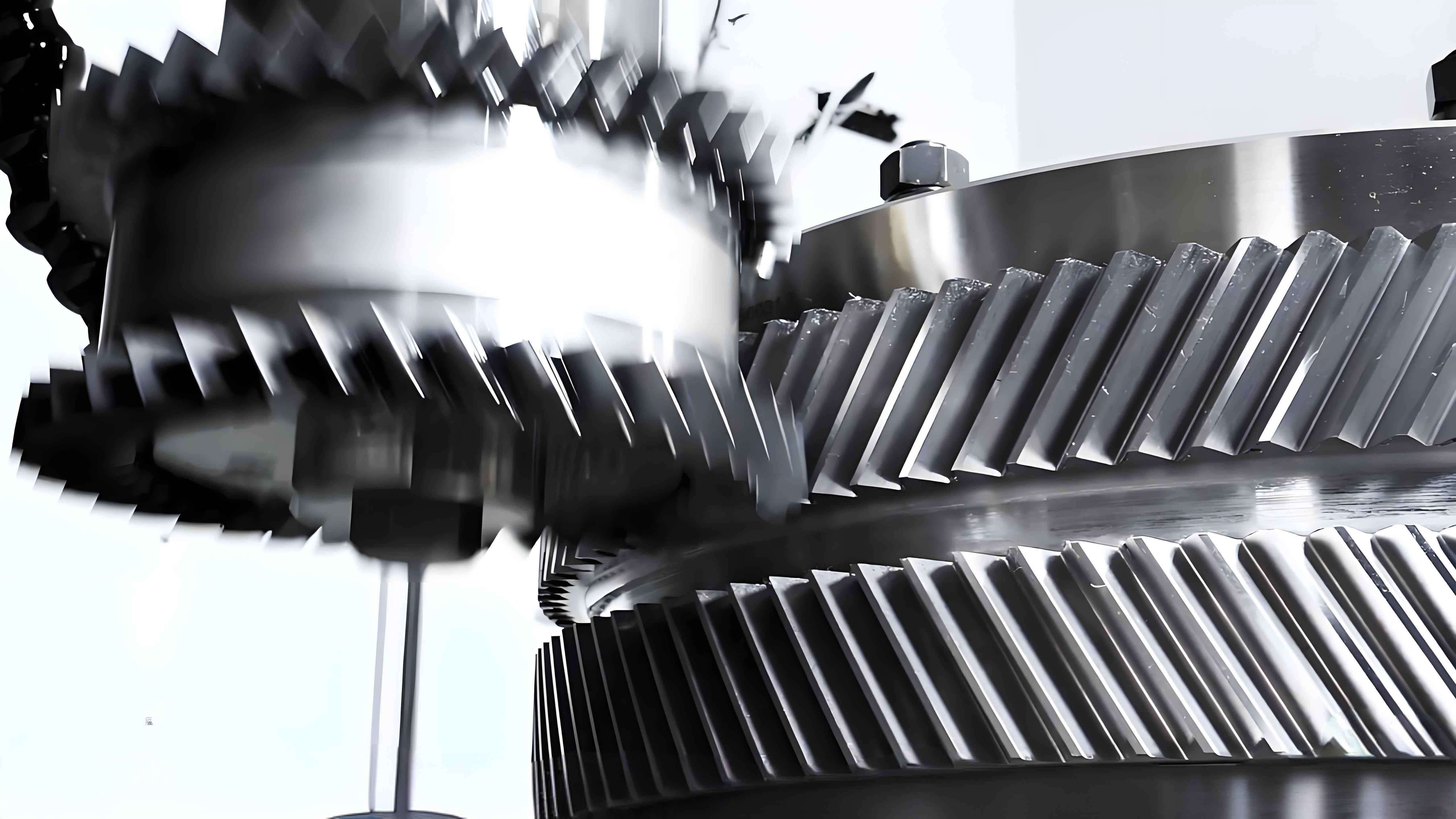
The cornerstone of this investigation is a multi-degree-of-freedom (DOF) coupled lateral-torsional-axial vibration model for a parallel-shaft herringbone gear pair. The system, as schematically represented, considers two distinct meshing lines: one for the right-hand helix pair (Pinion1-Gear2) and one for the left-hand helix pair (Pinion3-Gear4). Each gear body is assigned four degrees of freedom: translational displacements \(x_i, y_i, z_i\) in the coordinate directions and a torsional displacement \(\theta_i\), where \(i=1,2,3,4\). The supporting rolling-element bearings (A1, A2, A3, A4) are modeled as nonlinear spring-damper elements connecting the gear shafts to ground, with their inner races having two translational degrees of freedom \(x_{Aj}, y_{Aj}\) (\(j=1,2,3,4\)). This results in a total of 24 degrees of freedom for the complete system. The shafts connecting the two halves of the herringbone pinion and gear are modeled with lumped stiffness and damping elements (\(k_{13i}, c_{13i}, k_{24i}, c_{24i}\)).
The key parameters for the herringbone gears and bearings used in this analysis are summarized in the tables below. The system is designed for a high-speed, heavy-duty operational regime.
| Parameter | Pinion (Input) | Gear (Output) |
|---|---|---|
| Number of Teeth, \(z\) | 22 | 41 |
| Module, \(m_n\) (mm) | 5 | 5 |
| Normal Pressure Angle, \(\alpha_n\) (deg) | 20 | 20 |
| Helix Angle, \(\beta\) (deg) | 22 | 22 |
| Face Width per Helix, \(b\) (mm) | 120 | 120 |
| Mass, \(m\) (kg) | 10.7 | 29.74 |
| Moment of Inertia, \(I\) (kg·m²) | To be calculated | To be calculated |
| Bearing | A1 & A3 (Input Shaft) | A2 & A4 (Output Shaft) |
|---|---|---|
| Type | NJ209 | 6211 |
| Inner Raceway Diameter, \(d_i\) (mm) | 45 | 55 |
| Outer Raceway Diameter, \(d_o\) (mm) | 85 | 95 |
| Width, \(B\) (mm) | 19 | 21 |
| Radial Clearance, \(c_r\) (μm) | Assumed Value | Assumed Value |
The equations of motion are derived using Newton’s second law. For each gear body \(i\), the governing equations in the translational directions are:
$$
m_i \ddot{x}_i + c_{xi}(\dot{x}_i – \dot{x}_{Av}) + c_{xj}(\dot{x}_i – \dot{x}_p) + k_{xi}(x_i – x_{Av}) + k_{xj}(x_i – x_p) = (-F_{mk}) \sin\alpha_n
$$
$$
m_i \ddot{y}_i + c_{yi}(\dot{y}_i – \dot{y}_{Av}) + c_{yj}(\dot{y}_i – \dot{y}_p) + k_{yi}(y_i – y_{Av}) + k_{yj}(y_i – y_p) = (-F_{mk}) \cos\alpha_n \cos\beta – m_i g
$$
$$
m_i \ddot{z}_i + c_{zi}(\dot{z}_i – \dot{z}_{Av}) + c_{zj}(\dot{z}_i – \dot{z}_p) + k_{zi}(z_i – z_{Av}) + k_{zj}(z_i – z_p) = (-F_{mk}) \cos\alpha_n \sin\beta
$$
The torsional equation for gear \(i\) is:
$$
I_i \ddot{\theta}_i + c_{tj}(\dot{\theta}_i – \dot{\theta}_p) + c_{ti}\dot{\theta}_i + k_{tj}(\theta_i – \theta_p) + k_{ti}\theta_i = T_i – F_{mk} R_{bi} \cos\alpha_n \cos\beta
$$
Where \(F_{mk}\) is the dynamic mesh force on the corresponding mesh line \(k\) (\(k=1\) for right helix, \(k=2\) for left helix). The indices \(v\) and \(p\) refer to the supporting bearing and the coupled gear on the opposite helix of the same shaft, respectively. For the bearings, the equations are simpler, reflecting their connection to the gear shaft and ground:
$$
m_{Aj} \ddot{x}_{Aj} + c_{xj}(\dot{x}_{Aj} – \dot{x}_i) + c_{xAj}\dot{x}_{Aj} + k_{xj}(x_{Aj} – x_i) + k_{xAj}x_{Aj} = -F_{bx, Aj}
$$
$$
m_{Aj} \ddot{y}_{Aj} + c_{yj}(\dot{y}_{Aj} – \dot{y}_i) + c_{yAj}\dot{y}_{Aj} + k_{yj}(y_{Aj} – y_i) + k_{yAj}y_{Aj} = -F_{by, Aj} – m_{Aj}g
$$
To facilitate numerical solution and generalization, the equations are non-dimensionalized. The dimensionless time is defined as \(\tau = \omega_n t\), where \(\omega_n\) is the natural frequency of the gear mesh. Displacements are normalized by half the backlash, \(b_m\). The dimensionless mesh displacement along the line of action for mesh \(k\) is a key variable:
$$
\bar{x}_{nk} = (\bar{x}_p – \bar{x}_g)\sin\alpha_n + (\bar{y}_p – \bar{y}_g)\cos\alpha_n\cos\beta + (\bar{z}_p – \bar{z}_g)\cos\alpha_n\sin\beta + (R_{bp}\bar{\theta}_p – R_{bg}\bar{\theta}_g)\cos\alpha_n\cos\beta – \bar{e}_k(\tau)
$$
where \(\bar{e}_k(\tau) = e_k(\tau)/b_m\) is the dimensionless static transmission error for mesh \(k\).
Time-Varying Excitations and Nonlinear Forces
The dynamic mesh force \(F_{mk}\) is the primary source of excitation and nonlinearity. It is composed of a nonlinear elastic restoring force and a linear damping force:
$$
F_{mk}(t) = k_{mk}(t) \cdot f(\delta_{mk}) + c_{mk} \dot{\delta}_{mk}
$$
Here, \(\delta_{mk} = x_{nk} – e_k(t)\) is the dynamic transmission error along the line of action for mesh \(k\). The function \(f(\delta_{mk})\) represents the backlash nonlinearity, modeled as a piecewise-linear function:
$$
f(\delta_{mk}) =
\begin{cases}
\delta_{mk} – b_m, & \text{if } \delta_{mk} > b_m \\
0, & \text{if } |\delta_{mk}| \le b_m \\
\delta_{mk} + b_m, & \text{if } \delta_{mk} < -b_m
\end{cases}
$$
The time-varying mesh stiffness \(k_{mk}(t)\) for each helical pair is calculated based on the potential energy method or approximate analytical formulas from standards like ISO 6336. It is typically represented as a Fourier series dominated by the fundamental meshing frequency \(\omega_m = z_p \Omega_p\) (where \(\Omega_p\) is the pinion rotational speed in rad/s):
$$
k_{mk}(t) = k_{m,avg} + \sum_{j=1}^{N} k_{m,j} \cos(j\omega_m t + \phi_j)
$$
For this analysis, a simplified sinusoidal variation is often sufficient to capture the primary parametric effect:
$$
k_{mk}(t) = k_{m,avg} + k_{m,amp} \cos(\omega_m t)
$$
The mean mesh stiffness \(k_{m,avg}\) for herringbone gears can be approximated as that of a single helical gear with the total face width, though coupling effects between the two helices can modify this. The damping coefficient \(c_{mk}\) is usually expressed as a fraction of the critical damping.
The bearing forces \(F_{bx, Aj}\) and \(F_{by, Aj}\) arise from the nonlinear Hertzian contact between rolling elements and raceways, considering internal radial clearance \(c_r\). For a bearing with \(Z\) rolling elements, the total restoring force in the x-direction is:
$$
F_{bx} = \sum_{j=1}^{Z} K_b \cdot \delta_j^{3/2} \cdot H(\delta_j) \cdot \cos \psi_j
$$
where \(K_b\) is the Hertzian contact stiffness coefficient, \(\delta_j\) is the contact deformation at the \(j\)-th rolling element position, \(H(\cdot)\) is the Heaviside step function (accounting for loss of contact when \(\delta_j \le 0\)), and \(\psi_j\) is the angular position of the \(j\)-th element. The deformation \(\delta_j\) depends on the relative displacement between the inner and outer races \((x, y)\) and the clearance \(c_r\):
$$
\delta_j = x \cos\psi_j + y \sin\psi_j – c_r
$$
A similar summation gives the force in the y-direction. This model introduces significant nonlinearity and can excite sub-harmonic components in the system response.
Analysis of Nonlinear Dynamic Response
The system of 24 second-order, nonlinear, ordinary differential equations is solved numerically using a fourth-order Runge-Kutta method with a fixed time step. Transient effects are discarded, and the steady-state response is analyzed. The influence of key parameters—input torque (\(T_{in}\)), mesh damping ratio (\(\xi_m = c_{mk}/(2 \sqrt{k_{m,avg} m_e})\)), half-backlash (\(b_m\)), mesh stiffness (\(k_{m,avg}\)), and dimensionless excitation frequency (\(\omega_e = \omega_m / \omega_n\))—on the system’s nonlinear dynamics is investigated using a control variable approach.
The dynamic response is characterized using time-domain waveforms, phase plane portraits, Poincaré maps, frequency spectra, bifurcation diagrams, and Lyapunov exponents. Poincaré maps, sampled at the period of the mesh frequency \(T_m = 2\pi/\omega_m\), are particularly useful for identifying periodic, quasi-periodic, and chaotic motions. The Largest Lyapunov Exponent (LLE) provides a quantitative measure of chaotic behavior (positive LLE indicates chaos).
Effect of Input Torque
Under a constant high-speed condition (e.g., 6000 rpm), increasing the input torque \(T_{in}\) from a nominal load (e.g., 150 Nm) to an overload condition (e.g., 300 Nm) typically increases the mean mesh force. This can drive the system from a stable periodic motion, where the Poincaré map shows a single isolated point, into a region of complex dynamics. As torque increases, the system may undergo a period-doubling bifurcation (two points in the Poincaré map), then further period-doubling, eventually leading to a chaotic attractor characterized by a fractal set of points in the Poincaré map and a broad spectrum. The vibration amplitude generally increases with torque. This highlights that herringbone gear systems, despite their inherent smoothness, are not immune to nonlinear instabilities under heavy loads.
Effect of Mesh Damping
Mesh damping is a critical factor in suppressing vibrations. Reducing the dimensionless mesh damping ratio \(\xi_m\) diminishes the system’s ability to dissipate energy from the parametric and forced excitations. Consequently, at a fixed speed and load, a reduction in damping can destabilize a stable periodic orbit. The system may transition from a single-periodic (1T) motion to a multi-periodic or chaotic state. This is evident in the phase plot, where the limit cycle becomes more complex, and the Poincaré point set expands. Therefore, adequate damping, whether from material hysteresis or external dampers, is crucial for maintaining the stability of high-speed herringbone gear drives.
Effect of Backlash
Backlash \(2b_m\) introduces a dead-zone nonlinearity. For small dynamic transmission errors relative to the backlash, the teeth remain in contact, and the system behaves nearly linearly. As the vibration amplitude grows (due to increased load, resonance, etc.), impacts occur at the boundaries of the backlash zone. This nonlinearity can generate subharmonic and superharmonic components. Increasing the backlash generally widens the region of chaotic motion in parameter space. Bifurcation diagrams with \(b_m\) as the control parameter show that as backlash increases, the response may transition from a period-1 motion directly into a chaotic regime or a sequence of period-doublings leading to chaos. Proper control of backlash is thus essential in the design of herringbone gear systems to avoid detrimental nonlinear responses.
Effect of Mesh Stiffness
The mean mesh stiffness \(k_{m,avg}\) directly affects the system’s natural frequency \(\omega_n\). Increasing stiffness raises \(\omega_n\), thereby lowering the dimensionless frequency ratio \(\omega_e = \omega_m/\omega_n\) for a fixed operating speed \(\omega_m\). If the system is operating in a chaotic region at a certain \(\omega_e\), increasing stiffness (thus lowering \(\omega_e\)) may move the system into a stable periodic region. Conversely, reducing stiffness can push the system into resonance (\(\omega_e \approx 1\)) or other critical regions, potentially exciting complex dynamics. The variation in mesh stiffness also alters the parametric excitation amplitude, which can influence stability boundaries.
Effect of Excitation Frequency (Operating Speed)
Sweeping the dimensionless excitation frequency \(\omega_e\) (effectively the pinion speed) provides the most comprehensive view of the system’s global nonlinear behavior. A bifurcation diagram and LLE plot versus \(\omega_e\) reveal rich dynamics. A typical pattern for a nonlinear gear system with backlash and parametric excitation includes:
- Low \(\omega_e\) (Low Speed): Stable periodic (1T) motion. The LLE is negative.
- Increasing \(\omega_e\): A period-doubling (2T) bifurcation may occur, followed by a cascade of further period-doublings (4T, 8T…).
- Critical Region: The period-doubling cascade culminates in a chaotic motion, indicated by a positive LLE and a broad, dense band in the bifurcation diagram.
- Further Increase in \(\omega_e\): Windows of periodic motion (e.g., period-3, period-5) may appear within the chaotic sea.
- High \(\omega_e\) (High Speed): The system may “re-stabilize” into periodic motion again, often through a reverse bifurcation sequence, as it moves away from primary and secondary resonance conditions.
This analysis for herringbone gears shows similar patterns but with coupling effects between the two meshes. The left and right mesh lines may exhibit slightly different bifurcation sequences due to asymmetries in manufacturing errors or mounting, but their overall trends are coupled and follow the described nonlinear roadmap. Identifying and avoiding speed ranges associated with dense chaotic bands or severe periodic windows is critical for reliable operation.
The following table summarizes the qualitative influence of the studied parameters on system stability for the high-speed, heavy-duty herringbone gear system, assuming other parameters are held at nominal values.
| Parameter | Increase in Parameter Value | Typical Effect on System Stability (Tendency) | Primary Mechanism |
|---|---|---|---|
| Input Torque, \(T_{in}\) | Increase | De-stabilizing | Increased forcing amplitude, driving system into nonlinear regime. |
| Mesh Damping Ratio, \(\xi_m\) | Increase | Stabilizing | Increased energy dissipation, suppression of resonant growth. |
| Half-Backlash, \(b_m\) | Increase | De-stabilizing | Larger dead-zone promotes impacts and broader chaotic regions. |
| Mean Mesh Stiffness, \(k_{m,avg}\) | Increase | Context-dependent (Often Stabilizing if moving away from resonance) | Changes natural frequency \(\omega_n\), shifting \(\omega_e\) ratio. |
| Excitation Freq. (Speed), \(\omega_e\) | Increase | Highly Nonlinear (See bifurcation diagram) | Traverses regions of periodic, bifurcating, and chaotic response. |
Conclusions
This comprehensive nonlinear dynamic analysis of a high-speed, heavy-duty herringbone gear transmission system yields critical insights for design and operation. A multi-degree-of-freedom model incorporating time-varying mesh stiffness, static transmission error, backlash, and nonlinear bearing clearance forces accurately captures the complex coupled lateral-torsional-axial vibrations inherent to these systems.
The numerical investigation demonstrates that system stability is highly sensitive to operational and design parameters. Within practical ranges:
- System stability shows a positive correlation with mesh damping and, in many operating regions, with mesh stiffness. Adequate damping is essential to suppress nonlinear instabilities.
- Stability shows a negative correlation with both input torque (load) and the magnitude of gear backlash. Higher loads and larger clearances promote the onset of period-doubling bifurcations and chaotic motion, leading to increased vibration amplitudes and dynamic loads.
- The most complex behavior is observed when varying the external excitation frequency (operating speed). The system response undergoes a classical nonlinear evolution: starting from stable single-period motion, it progresses through period-doubling bifurcations into a wide region of chaotic oscillation, before potentially re-stabilizing into periodic motion at very high frequencies. This underscores the absolute necessity of carefully selecting and, if possible, avoiding operational speeds that lie within chaotic or heavily bifurcated regions.
Therefore, to ensure the smooth and reliable operation of high-performance herringbone gear drives, designers must prioritize optimal gear geometry to maximize mesh stiffness and contact ratio, specify tight tolerance controls on backlash, incorporate sufficient system damping, and conduct thorough nonlinear dynamic analyses across the entire intended speed and load envelope to identify and mitigate potential instability zones. The presented modeling and analysis framework provides a robust tool for such an engineering endeavor.