
My research focuses on the complex nonlinear dynamic behaviors inherent in geared power transmission systems. Among various gear types, helical gears are widely prized for their smooth operation, high load capacity, and reduced noise compared to spur gears. However, this operational advantage comes with increased dynamical complexity due to the three-dimensional nature of the meshing forces. In this detailed exposition, I will share my comprehensive investigation into the bifurcation and chaotic characteristics of helical gear systems and the profound influence of key design and operational parameters on their stability. Understanding these nonlinear phenomena—periodic, quasi-periodic, and chaotic motions—is not merely academic; it is crucial for the predictive dynamic design and reliable operation of high-performance transmission systems, helping to avoid undesirable vibrations and premature failures.
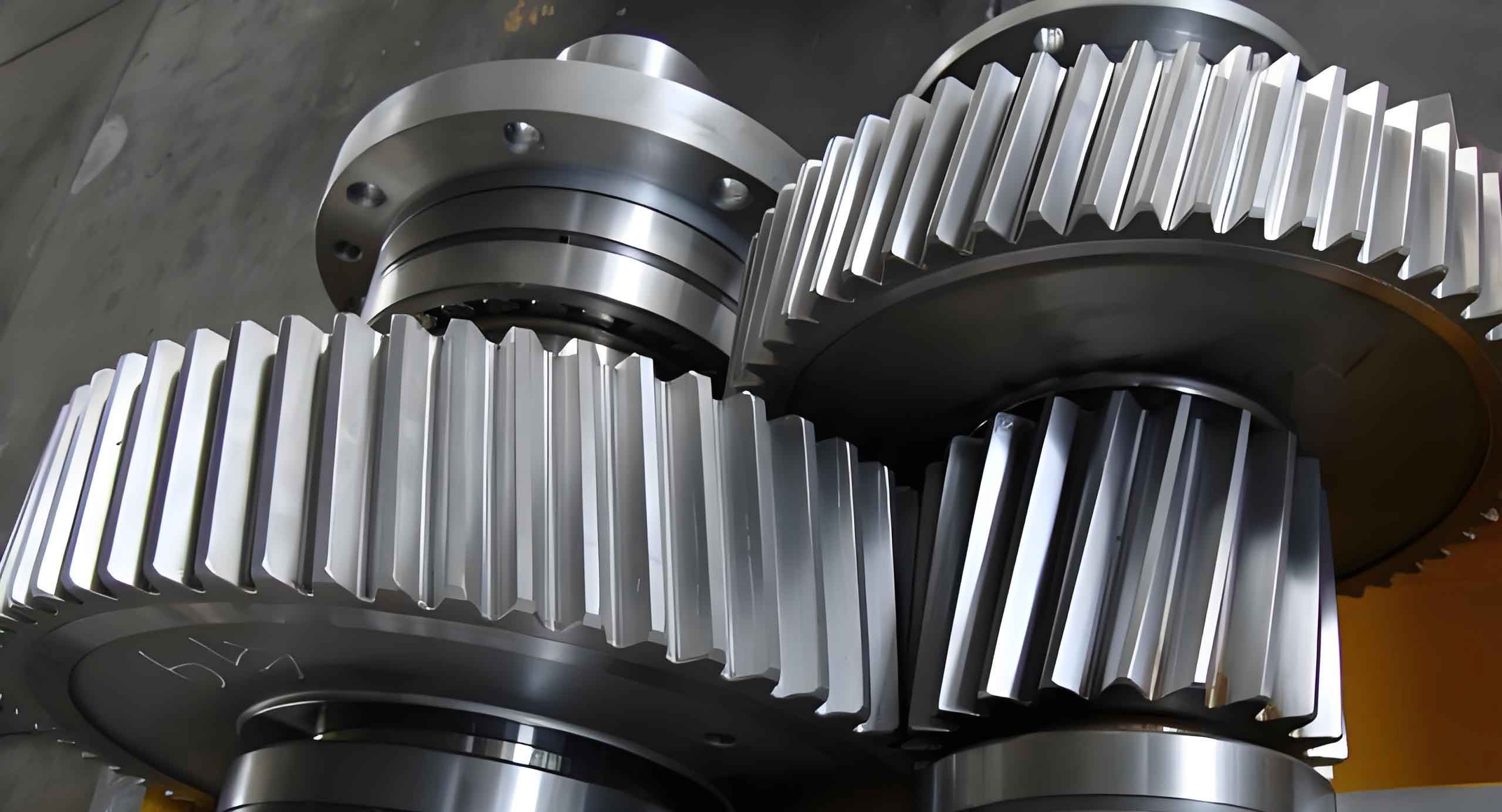
1. Development of a Nonlinear Dynamic Model for Helical Gears
To accurately capture the rich dynamics of helical gears, a model must account for their spatial vibration. I considered a two-gear system where each gear is treated as a rigid body with six degrees of freedom: transverse bending vibration perpendicular to the shaft, torsional vibration around the shaft, and axial vibration along the shaft. The model incorporates several critical nonlinear factors that define the system’s behavior:
- Time-Varying Mesh Stiffness ( \( k_h(t) \) ): As the number of teeth in contact changes during rotation, the effective stiffness of the gear pair fluctuates periodically. This is a primary source of parametric excitation. I represented it as a Fourier series:
$$ k_h(t) = k_m + \sum_{n=1}^{N} \left( a_n \cos(n \omega_h t) + b_n \sin(n \omega_h t) \right) $$
where \( k_m \) is the average mesh stiffness, \( \omega_h \) is the gear mesh frequency, and \( a_n, b_n \) are Fourier coefficients.
- Gear Backlash ( \( 2b \) ): The inevitable clearance between mating teeth introduces a piecewise-linear nonlinearity, causing impacts when teeth separate and re-engage. This is modeled by a gap function \( f(x) \):
$$
f(x) =
\begin{cases}
x – b, & x > b \\
0, & |x| \le b \\
x + b, & x < -b
\end{cases}
$$
- Static Transmission Error ( \( e(t) \) ): Manufacturing imperfections and deflections cause deviations from perfect conjugate motion, acting as a kinematic excitation. I modeled it as: \( e(t) = e_0 + e_a \sin(\omega_h t + \phi) \).
- Mesh Damping ( \( c_m \) ): This represents the energy dissipation in the gear mesh, typically expressed as a damping ratio \( \zeta \).
Considering these factors, the governing equations of motion for the bending-torsion-axial coupled 6-DOF system are derived using D’Alembert’s principle. For the driving gear (gear 1) and driven gear (gear 2), the equations in the transverse (y), axial (z), and torsional (θ) directions are:
$$
\begin{aligned}
m_1 \ddot{y}_1 + c_{1y}\dot{y}_1 + k_{1y}y_1 &= -k_h(t)\cos\alpha\cos\beta \, f(\delta_y) – c_m\cos\alpha\cos\beta \, \dot{\delta}_y \\
m_1 \ddot{z}_1 + c_{1z}\dot{z}_1 + k_{1z}z_1 &= -k_h(t)\cos\alpha\sin\beta \, f(\delta_z) – c_m\cos\alpha\sin\beta \, \dot{\delta}_z \\
J_1 \ddot{\theta}_1 &= T_1 – \left[ k_h(t)\cos\alpha\cos\beta \, f(\delta_y) + c_m\cos\alpha\cos\beta \, \dot{\delta}_y \right] R_1 \\
m_2 \ddot{y}_2 + c_{2y}\dot{y}_2 + k_{2y}y_2 &= k_h(t)\cos\alpha\cos\beta \, f(\delta_y) + c_m\cos\alpha\cos\beta \, \dot{\delta}_y \\
m_2 \ddot{z}_2 + c_{2z}\dot{z}_2 + k_{2z}z_2 &= k_h(t)\cos\alpha\sin\beta \, f(\delta_z) + c_m\cos\alpha\sin\beta \, \dot{\delta}_z \\
J_2 \ddot{\theta}_2 &= -T_2 + \left[ k_h(t)\cos\alpha\cos\beta \, f(\delta_y) + c_m\cos\alpha\cos\beta \, \dot{\delta}_y \right] R_2
\end{aligned}
$$
where \( \alpha \) is the pressure angle, \( \beta \) is the helix angle, \( R_i \) are base circle radii, and \( \delta_y, \delta_z \) are the relative displacements along the lines of action incorporating error \( e(t) \).
2. Non-Dimensionalization and Analysis Methodology
To facilitate numerical simulation and generalize the results, I non-dimensionalized the equations. Defining the natural frequency \( \omega_n = \sqrt{k_m / m_e} \) (with \( m_e \) as equivalent mass) and using backlash \( b \) as the characteristic length, I introduced dimensionless time \( \tau = \omega_n t \) and dimensionless displacements \( p_i \). The resulting dimensionless equations condense the system parameters into key groups: dimensionless stiffness \( \eta \), dimensionless damping \( \xi \), and dimensionless excitation frequency \( \Omega = \omega_h / \omega_n \). This process reduces numerical stiffness and highlights the governing dimensionless parameters that control the system’s dynamics.
The parameters for the specific helical gear pair I analyzed are summarized below:
| Parameter | Pinion | Gear |
|---|---|---|
| Number of Teeth (Z) | 34 | 85 |
| Base Circle Radius (mm) | 107.249 | 268.123 |
| Normal Module (mm) | 6 | |
| Pressure Angle (α) | 25° | |
| Helix Angle (β) | -18° | |
| Face Width (mm) | 70 | |
| Average Mesh Stiffness (N/m) | 5.968 × 10⁹ | |
| Total Backlash, 2b (μm) | 220 | |
To study bifurcation and chaos, I employed a combined qualitative and quantitative toolkit:
- Qualitative Methods: Time history, phase portraits, Poincaré maps (sampled at the mesh period), and power spectra.
- Quantitative Methods: The largest Lyapunov exponent (LLE) as a definitive metric for chaos (positive LLE indicates chaos), and bifurcation diagrams to visualize global behavior as a parameter varies.
I integrated these methods to reliably distinguish between periodic, quasi-periodic, and chaotic motions in the helical gear system.
3. Parametric Influence on Bifurcation and Chaos
3.1. Influence of Excitation Frequency (Operational Speed)
The dimensionless excitation frequency \( \Omega \) is directly related to the rotational speed of the helical gears. I varied \( \Omega \) over a wide range from 0.0273 (very low speed) to 1.637 (high speed) while keeping other parameters constant. The bifurcation diagram for the torsional displacement of the pinion and the corresponding Largest Lyapunov Exponent (LLE) plot revealed a highly complex landscape.
$$
\text{LLE} = \lim_{t \to \infty} \frac{1}{t} \ln \frac{\|\delta \mathbf{Z}(t)\|}{\|\delta \mathbf{Z}(0)\|}
$$
At very low frequencies (\( \Omega < 0.2 \)), the system exhibited primarily periodic motion. As \( \Omega \) increased, a rich sequence of bifurcations unfolded. I observed windows of period-doubling bifurcations leading directly into chaotic regimes, characterized by a broad band in the power spectrum and a fractal-like structure in the Poincaré map. Notably, chaotic attractors were found in the intervals approximately \( \Omega \in [0.25, 0.3] \) and \( \Omega \in [0.6, 0.68] \), where the LLE was positive. Within these chaotic bands, sudden “jumps” in the bifurcation diagram indicated boundary crises. Interestingly, at higher frequencies (\( \Omega > 0.7 \)), the system predominantly settled into stable periodic orbits, with only isolated, narrow windows of quasi-periodicity or chaos. This suggests that helical gear systems, while potentially chaotic at intermediate speeds, can regain orderly periodic motion at high operational speeds, which is counter-intuitive but critical for design.
| Frequency Region (Ω) | Dynamic Behavior | LLE | Observation |
|---|---|---|---|
| 0.0 – 0.2 | Mostly Period-1, Some Period-2 | < 0 | Stable low-speed operation. |
| 0.2 – 0.24 | Period-Doubling Route to Chaos | Transition > 0 | Classic Feigenbaum scenario. |
| 0.25 – 0.3 | Chaos | > 0 | Broadband spectrum, fractal Poincaré map. |
| 0.34 – 0.58 | Mostly Period-1 | < 0 | Stable operating window. |
| 0.6 – 0.68 | Chaos & Quasi-Periodicity | > 0 in parts | Another major chaotic band. |
| > 0.7 | Predominantly Period-1 | < 0 | High-speed stability. |
3.2. Influence of Mesh Damping Ratio
Mesh damping \( \zeta_g \) is a crucial design parameter representing energy dissipation in the gear contact. I investigated its effect by varying \( \zeta_g \) from 0.03 (very lightly damped) to 0.17 (highly damped) at a fixed excitation frequency. The results demonstrate damping’s role as a powerful stabilizing agent for helical gear dynamics.
For low damping ratios (\( \zeta_g < 0.08 \)), the system exhibited persistent chaotic motion. The phase portrait was a tangled, non-closed curve, the Poincaré map was a cloud of scattered points, and the LLE was distinctly positive. As I increased \( \zeta_g \) beyond 0.08, the LLE became negative. Initially, the system transitioned through a quasi-periodic state (where the Poincaré map formed a closed curve) before finally settling into a stable period-1 limit cycle at higher damping values. The transition was not abrupt but rather a gradual suppression of the chaotic oscillations. This underscores a critical design insight: ensuring sufficient mesh damping is one of the most effective ways to suppress chaotic vibrations and maintain stable, predictable operation in helical gear systems, albeit with a trade-off in potentially forcing higher dynamic loads during transient events.
3.3. Influence of Gear Backlash
Backlash is an unavoidable nonlinearity in helical gears. I studied its unique impact by varying the half-backlash \( b \) from 0.01 mm (very tight mesh) to 0.20 mm (large clearance) at a nominal speed. The relationship between backlash and stability was non-monotonic and particularly interesting.
The bifurcation diagram and LLE plot revealed three distinct regimes:
- Small Backlash ( \( b < 0.02 \) mm ): The system exhibited periodic motion (negative LLE). The teeth are in near-permanent contact with minimal separation, reducing the severity of the piecewise-linear nonlinearity.
- Medium Backlash ( \( 0.02 < b < 0.065 \) mm ): This was the primary chaotic regime. The LLE was positive, and the Poincaré map showed a complex, strange attractor. In this range, the clearance is sufficient to allow teeth to separate and impact with significant force, exciting the nonlinearities and leading to chaotic behavior.
- Large Backlash ( \( b > 0.065 \) mm ): Surprisingly, the system re-stabilized into periodic motion (negative LLE). While impacts are severe, they become more predictable and periodic because the system spends a significant portion of the mesh cycle out of contact, effectively reducing the constant forcing from the time-varying stiffness.
This result has profound implications. It indicates that an optimal “window” of backlash exists for minimizing chaotic response. Neither excessively tight nor excessively loose meshing is desirable from a purely nonlinear dynamics perspective. For helical gears, a carefully controlled backlash, often achieved through precision manufacturing and assembly, is essential to avoid operating in the chaotic medium-backlash regime.
4. Synthesis and Implications for Dynamic Design
My systematic investigation into the bifurcation and chaotic dynamics of helical gear systems reveals a complex interplay between key parameters. The pathways to chaos primarily involve period-doubling bifurcations, particularly sensitive to changes in excitation frequency (speed). The stability maps in the parameter space of frequency, damping, and backlash are not simple but contain intricate structures of periodic, quasi-periodic, and chaotic attractors.
The most significant findings for the dynamic design of helical gear transmissions can be summarized as follows:
- Operational Speed Planning: Critical speed ranges where chaotic motion is likely (e.g., \( \Omega \approx 0.25-0.3 \) and \( 0.6-0.68 \)) should be identified and, if possible, avoided during prolonged operation or during run-up/run-down sequences. High-speed operation often offers inherent stability.
- Damping as a Stabilizer: Incorporating or designing for adequate mesh damping (\( \zeta_g > 0.08-0.1 \)) is a highly effective strategy to expand the region of periodic motion and suppress chaotic vibrations.
- Backlash Optimization: Backlash should be treated as a critical design variable, not just a manufacturing tolerance. The goal should be to specify backlash values that lie in the stable periodic regions—either sufficiently small or, counter-intuitively, sufficiently large—to avoid the chaotic middle ground. This requires a balance with other gear design requirements like lubrication and thermal expansion.
The mathematical models and analysis presented here, combining detailed multi-degree-of-freedom modeling with nonlinear dynamics theory, provide a powerful framework. By using tools like Lyapunov exponents and bifurcation diagrams, I can move beyond simply calculating vibration amplitudes to predicting the very nature of the motion itself. This deeper understanding enables a proactive approach to the dynamic design of helical gear systems, allowing engineers to tailor parameters not just for strength and efficiency, but for inherent dynamic stability, leading to more reliable, quieter, and longer-lasting gear transmissions.