
The quest for efficient, reliable, and quiet power transmission in demanding applications such as marine propulsion and heavy machinery has consistently driven innovation in gear design. Among the various configurations, helical gears stand out due to their superior characteristics, including high load capacity, smooth and quiet operation resulting from gradual tooth engagement, and greater resistance to root bending failures. A particularly interesting and complex variant is the cross-connected double helical gear train. This configuration is pivotal in systems requiring power split or summation, such as marine combined power plants, where it enhances system redundancy, survivability, and acoustic stealth. However, the very features that make it advantageous also introduce significant dynamic complexity.
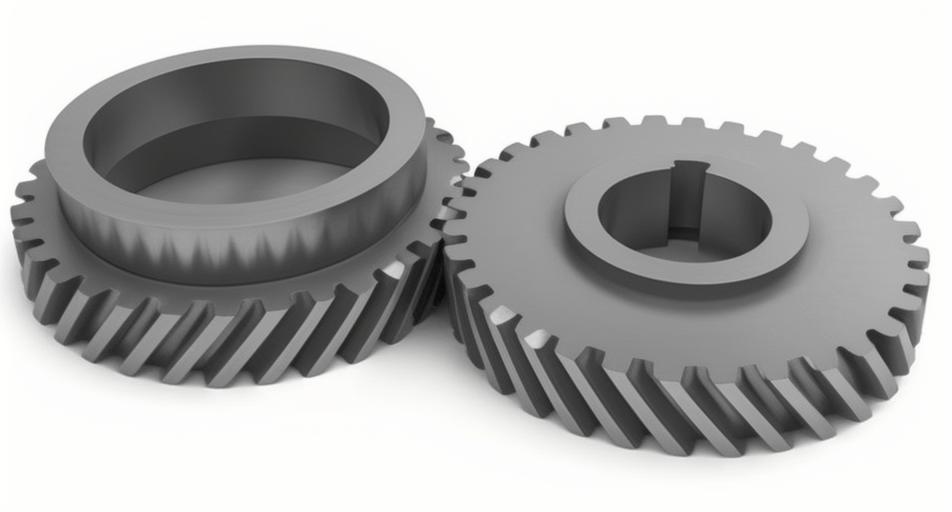
In a cross-connected arrangement, a single double helical pinion simultaneously meshes with two separate double helical gears, creating four distinct meshing paths within a compact space. This intricate coupling, combined with inherent transmission nonlinearities like time-varying mesh stiffness (TVMS) and gear backlash, can lead to strongly nonlinear dynamic behavior. This behavior manifests as sub-harmonic and chaotic vibrations, bifurcations, and jump phenomena, which are primary sources of excessive noise, vibration, and harshness (NVH). More critically, these nonlinear dynamics can induce uneven and unstable power distribution among the meshing paths, leading to localized overloading, accelerated fatigue, and compromised system reliability. Therefore, a deep understanding of the nonlinear vibration characteristics and the associated power-split behavior in such cross-connected double helical gear systems is not merely academic but essential for designing robust, high-performance transmission systems. This work aims to establish a comprehensive nonlinear dynamic model for a cross-connected double helical gear set and systematically investigate the influence of key parameters on its dynamic response and power flow patterns.
1. Nonlinear Dynamic Modeling of the Cross-Connected System
The physical model under investigation consists of six helical gears: two double helical gears (a1-a2, c1-c2) and one cross-connecting double helical pinion (b1-b2). Power is input at gear b2 through an input torque \(T_i\). The power is then split and delivered to two output shafts at gears a1 and c1, which are loaded by torques \(T_{o1}\) and \(T_{o2}\), respectively. The double helical design inherently cancels net axial forces, allowing the analysis to focus solely on torsional vibrations. Each gear is assigned a rotational degree of freedom, with clockwise rotation defined as positive. These rotations are converted to equivalent linear displacements at the pitch circle for modeling convenience. The interactions are defined through relative displacements at the four meshes and three torsional couplings between the halves of each double helical gear.
The governing equations of motion are derived using Lagrange’s equations, considering the kinetic and potential energy of the six inertial elements and the elastic/dissipative elements in the mesh and torsion paths. After eliminating the rigid-body mode and normalizing the equations, the system is described by the following set of coupled, nonlinear differential equations:
$$
\begin{align*}
m_{a1}\ddot{u}_{a1} + c_1 \dot{u}_1 \cos\beta + k_1(t) f(u_1) \cos\beta + c_{u1} \dot{u}_5 + k_{u1} u_5 &= -F_{a1} \\
m_{a2}\ddot{u}_{a2} + c_2 \dot{u}_2 \cos\beta + k_2(t) f(u_2) \cos\beta – c_{u1} \dot{u}_5 – k_{u1} u_5 &= -F_{a2} \\
m_{b1}\ddot{u}_{b1} + c_1 \dot{u}_1 \cos\beta + k_1(t) f(u_1) \cos\beta + c_3 \dot{u}_3 \cos\beta + k_3(t) f(u_3) \cos\beta + c_{u2} \dot{u}_6 + k_{u2} u_6 &= 0 \\
m_{b2}\ddot{u}_{b2} + c_2 \dot{u}_2 \cos\beta + k_2(t) f(u_2) \cos\beta + c_4 \dot{u}_4 \cos\beta + k_4(t) f(u_4) \cos\beta – c_{u2} \dot{u}_6 – k_{u2} u_6 &= F_{b2} \\
m_{c1}\ddot{u}_{c1} + c_3 \dot{u}_3 \cos\beta + k_3(t) f(u_3) \cos\beta + c_{u3} \dot{u}_7 + k_{u3} u_7 &= F_{c1} \\
m_{c2}\ddot{u}_{c2} + c_4 \dot{u}_4 \cos\beta + k_4(t) f(u_4) \cos\beta – c_{u3} \dot{u}_7 – k_{u3} u_7 &= F_{c2}
\end{align*}
$$
Where:
- \(m_{\alpha} = J_{\alpha} / r_j^2\) is the equivalent mass, with \(J_{\alpha}\) being the mass moment of inertia and \(r_j\) the base radius.
- \(u_1 = (u_{a1}+u_{b1})\cos\beta\), \(u_2 = (u_{a2}+u_{b2})\cos\beta\), \(u_3 = (u_{b1}+u_{c1})\cos\beta\), \(u_4 = (u_{b2}+u_{c2})\cos\beta\) are the relative mesh displacements.
- \(u_5 = u_{a1}-u_{a2}\), \(u_6 = u_{b1}-u_{b2}\), \(u_7 = u_{c1}-u_{c2}\) are the relative torsional displacements between gear halves.
- \(c_i, k_i(t)\) are the damping and time-varying stiffness of the \(i\)-th mesh (\(i=1,2,3,4\)).
- \(c_{ui}, k_{ui}\) are the damping and stiffness of the \(j\)-th torsional coupling (\(j=1,2,3\)).
- \(\beta\) is the helix angle.
- \(F_{\alpha}\) represents the normalized external force/torque on gear \(\alpha\).
The time-varying mesh stiffness (TVMS) \(k_i(t)\) is a primary source of parametric excitation. For helical gears, the stiffness fluctuates due to the changing number of tooth pairs in contact. It can be represented as a Fourier series expansion around a mean stiffness \(\bar{k}_a\):
$$ k_i(t) = \bar{k}_a \left[ 1 + \sum_{j=1}^{N} \kappa_j \cos(j\omega_m t + \phi_j) \right] $$
Here, \(\omega_m\) is the mesh frequency, \(\phi_j\) is the phase angle, and \(\kappa_j\) is the \(j\)-th order stiffness variation coefficient, defined as the ratio of the variation amplitude to the mean stiffness (\(\kappa_j = k_{vj}/\bar{k}_a\)). The coefficient \(\kappa = \kappa_1\) is often used as a key parameter to represent the intensity of stiffness fluctuation.
The gear backlash nonlinearity \(f(u_i)\) is modeled as a piecewise linear function, representing the loss of contact when the meshing teeth separate:
$$
f(u_i) =
\begin{cases}
u_i – b_i, & u_i > b_i \\
0, & |u_i| \le b_i \\
u_i + b_i, & u_i < -b_i
\end{cases}
$$
where \(2b_i\) is the total backlash in the \(i\)-th mesh path. This function introduces a dead-zone nonlinearity, which is the source of impacting behavior and complex sub-harmonic responses.
The system of equations is solved numerically using a variable-step 4th/5th order Runge-Kutta (RK45) method, suitable for handling stiff and highly nonlinear systems. Frequency-response curves are generated by plotting the root-mean-square (RMS) of the normalized displacements against the mesh frequency, using both forward and backward frequency sweeps to capture hysteresis and jump phenomena.
| Parameter | Symbol | Value |
|---|---|---|
| Number of Teeth | \(Z\) | 55 (all gears) |
| Module | \(m_n\) | 4 mm |
| Helix Angle | \(\beta\) | 15° |
| Base Radius (Stage 1 & 2) | \(r_1, r_2\) | 100 mm |
| Mean Mesh Stiffness | \(\bar{k}_a\) | 5 × 10⁸ N/m |
| Torsional Stiffness | \(k_u\) | 1 × 10⁸ N/m |
| Mass Moment of Inertia | \(J\) | 0.09 kg·m² (all gears) |
| Input Torque | \(T_i\) | 100 Nm |
| Stiffness Variation Coeff. | \(\kappa\) | 0.2 |
| Half-Backlash | \(b\) | 0.05 mm |
2. Analysis of Nonlinear Vibration Characteristics
The dynamic response of the cross-connected double helical gear system is profoundly influenced by several design and operational parameters. The interplay between the parametric excitation from TVMS and the piecewise nonlinearity from backlash creates a rich tapestry of nonlinear phenomena.
2.1 Influence of Gear Backlash
Backlash is a critical parameter governing the severity of nonlinear behavior. Figure 4 (conceptual) shows frequency-response curves for different backlash values. A key observation is the emergence of a nonlinear resonance region beyond a certain mesh frequency threshold. In this region, the response exhibits:
- Amplitude Jump: A sudden, discontinuous change in vibration amplitude as frequency is varied quasi-statically.
- Hysteresis/Multi-value Response: The system’s response depends on the direction of the frequency sweep (forward or backward), indicating the coexistence of multiple stable periodic solutions.
- Sub-harmonic and Chaotic Motions: Time-domain analysis reveals that within this jump region, the motion often transitions from simple periodic to complex periodic or even chaotic, characterized by a broadband frequency spectrum.
The phase portraits and time histories confirm that this jump corresponds to the onset of tooth separation and subsequent impacts. When the dynamic transmission error exceeds the backlash, the meshing teeth lose contact and later re-engage with an impact, leading to severe transient loads. Interestingly, the RMS amplitude in the jump region can be lower than in the adjacent linear region because the period of non-contact reduces the average force transmission. Larger backlash widens the frequency range of the nonlinear region and generally increases the severity of impacts, though its effect on the RMS value in the purely forced vibration regime can be non-monotonic.
| Backlash Level | Onset Frequency of Nonlinearity | Width of Jump Region | Maximum RMS Amplitude | Observed Dynamic State |
|---|---|---|---|---|
| Small (0.04 mm) | Higher | Narrow | Moderate | Periodic, mild impacts |
| Medium (0.08 mm) | Medium | Medium | Higher | Periodic/Chaotic, clear impacts |
| Large (0.12 mm) | Lower | Wide | Highest (in linear region) | Predominantly chaotic, severe double-sided impacts |
2.2 Influence of Stiffness Variation Coefficient (κ)
The coefficient \(\kappa\) quantifies the fluctuation of mesh stiffness. Its effect is paramount, as shown in Figure 6. An increase in \(\kappa\) significantly amplifies the parametric excitation.
- A higher \(\kappa\) lowers the threshold mesh frequency at which the nonlinear jump phenomenon occurs, making the system more prone to complex dynamics at lower speeds.
- The amplitude of the response, both inside and outside the jump region, increases with \(\kappa\).
- For sufficiently large \(\kappa\) (e.g., 0.3), the response in the nonlinear region can become highly irregular and unpredictable, indicating a strong chaotic tendency. This underscores the importance of designing helical gears with high contact ratio to minimize stiffness fluctuations and ensure smoother dynamics.
2.3 Influence of Torsional Stiffness between Gear Halves
The torsional stiffness \(k_u\) connecting the two halves of a double helical gear primarily affects the relative motion within the gear pair itself. As illustrated in Figure 7:
- Increasing \(k_u\) dramatically reduces the amplitude of torsional vibrations (\(u_5, u_6, u_7\)) between the gear halves. A stiffer connection forces the two halves to behave more as a single rigid body.
- Conversely, its direct effect on the four main mesh path vibrations (\(u_1\) to \(u_4\)) is relatively minor. The mesh dynamics are more strongly governed by the direct mesh stiffness and backlash.
- This parameter is crucial for controlling phasing between the two helices and preventing undue winding or torsional oscillation within the compound gear, which could affect load sharing.
2.4 Influence of Helix Angle (β)
The helix angle \(\beta\) influences the force decomposition and the effective coupling in the equations. From Figure 8:
- Increasing \(\beta\) amplifies the vibration amplitudes in the mesh paths. This is because a larger helix angle increases the transverse component of the mesh force for a given torque, effectively increasing the dynamic excitation in the plane of the model.
- Simultaneously, a larger \(\beta\) reduces the torsional vibration amplitudes between gear halves. The kinematic constraint provided by the helical mesh may contribute to this effect.
- This trade-off highlights a design consideration: while a larger helix angle improves smoothness and load capacity statically, it may exacerbate dynamic meshing forces.
2.5 Influence of Load Torque
The input load torque \(T_i\) has a profound effect, as seen in Figure 9.
- Higher load increases the mean deflection, pushing the operating point within the backlash nonlinearity. This can actually suppress tooth separation at lower frequencies, leading to a linearized response.
- However, at higher frequencies, even under heavy load, the system can still enter a nonlinear regime due to large dynamic forces. In this state, severe double-sided impacts can occur (Figure 10), where the gear teeth clatter between both drive-side and coast-side flanks. This is extremely detrimental to gear life and noise.
- Heavy load also increases the overall amplitude of vibration across all degrees of freedom, indicating greater dynamic strain energy in the system.
The governing equation shows the load effect through the force term \(F\). The dynamic transmission error \(u_i\) can be expressed as the sum of a static deflection \(\delta_{s,i}\) due to load and a dynamic component \(\delta_{d,i}(t)\): \(u_i(t) = \delta_{s,i} + \delta_{d,i}(t)\). The nonlinear function then operates on this sum: \(f(\delta_{s,i} + \delta_{d,i}(t))\). A large \(\delta_{s,i}\) can bias the operation away from the dead-zone center, affecting the symmetry and nature of the impacting.
| Parameter | Increase Leads to… | Primary Effect on Nonlinearity | Key Dynamic Consequence |
|---|---|---|---|
| Backlash (\(b\)) | Lower onset frequency, wider jump region, more severe impacts | Stronger piecewise nonlinearity | Tooth separation, chaotic motion, increased noise |
| Stiffness Var. Coeff. (κ) | Lower onset frequency, higher response amplitude | Stronger parametric excitation | Premature jump, potential for chaotic response |
| Torsional Stiffness (\(k_u\)) | Greatly reduced internal torsional vibration | Minor effect on mesh nonlinearity | Improved synchronization of gear halves |
| Helix Angle (\(\beta\)) | Increased mesh vibration, decreased torsional vibration | Altered force coupling and excitation | Trade-off in dynamic force transmission |
| Load Torque (\(T_i\)) | Increased overall amplitude, possible suppression or induction of severe impacts | Shifts operating point in backlash function | Risk of double-sided impacting under high-speed, high-load conditions |
3. Power Flow and Dynamic Load Sharing Characteristics
The power split behavior is intrinsically linked to the dynamic state of the system. The instantaneous power flow through a mesh interface \(i\) is given by \(P_i(t) = F_{mi}(t) \cdot v_i\), where \(F_{mi}(t)\) is the dynamic mesh force and \(v_i\) is the relative pitch line velocity. A more practical measure is the dynamic load factor \(K_{d,i}\), the ratio of the maximum dynamic mesh force to the static mesh force calculated from the input torque.
3.1 Periodic (Linear) Regime Operation
When operating below the nonlinear threshold (e.g., at 600 rpm, 550 Hz mesh frequency), the system exhibits steady periodic vibration. Analysis reveals a specific power flow structure:
- Balanced Output Power: The dynamic load factors for mesh pairs \(u_1\) and \(u_3\) are equal, and similarly for pairs \(u_2\) and \(u_4\). This indicates that the input power \(P_{in}\) is split evenly between the two output branches: \(P_{o1} \approx P_{o2}\).
- Unbalanced Input Branch Loading: However, the load is not equally distributed between the two meshes on the input pinion. Typically, \(K_{d,2} > K_{d,1}\), meaning one helix of the input double helical pinion carries more dynamic load than the other. This is a critical design insight; the input gear cannot be assumed to share load equally between its halves, and its design (e.g., tooth width, material) must account for this uneven dynamic loading.
This state can be summarized by the power flow diagram where \(P_{in} \rightarrow (P_1 + P_2) \rightarrow P_{o1}\) and \(P_{in} \rightarrow (P_3 + P_4) \rightarrow P_{o2}\), with \(P_1 \approx P_3\) and \(P_2 \approx P_4\), but \(P_1 \neq P_2\).
3.2 Nonlinear (Chaotic/Impact) Regime Operation
Operation within the jump region (e.g., at 1800 rpm, 1650 Hz) leads to a dramatic change. The dynamic load factors for all meshes increase significantly, often by a factor of 2 or more compared to the periodic regime. More importantly, the power flow becomes unstable and time-variant. Due to random-like tooth separation and impacts, the instantaneous power transmission through each of the four mesh paths fluctuates wildly. Statistical analysis of the contact forces reveals five predominant, transient power flow modes, as conceptualized in Figure 13:
| Mode | Description | Contact State | Power Output | Consequence |
|---|---|---|---|---|
| I: Single Mesh | Only one of the four meshes is in contact. | Three separations | Single-sided, highly fluctuating | Extreme torsion on shafts, very poor load sharing. |
| II: Single-Side Dual Mesh | Both meshes on one side are in contact, but unequally loaded. | Two separations on opposite side | Single-sided, unbalanced | Large bending moment on cross-shaft, uneven bearing loads. |
| III: Dual-Side Single Mesh | One mesh on each side is in contact. | Two separations (one per side) | Dual-sided, unbalanced | Unbalanced output torque, potential for shaft whirl. |
| IV: Mixed Mesh (3-Path) | Three meshes are in contact (both on one side, one on the other). | One separation | Dual-sided, highly unbalanced | Complex internal force redistribution, high stress in one mesh. |
| V: Full Mesh (4-Path) | All four meshes are in contact, but with unequal, chaotic loads. | All in contact | Dual-sided, chaotic sharing | Highly unpredictable dynamic stresses, accelerated fatigue. |
The system chaotically switches between these modes. This results in:
- Unsteady Input and Output Power: The instantaneous input torque and output torques exhibit large fluctuations, which can excite other drivetrain components and structures.
- Highly Uneven and Time-Varying Load Sharing: The fundamental purpose of the double helical design—to share load—is compromised. Certain teeth experience sporadic, high-impact loads far exceeding design expectations.
- Increased Noise and Vibration: The impacting associated with these mode transitions is a potent source of broadband acoustic emission.
This analysis conclusively shows that operating in the nonlinear regime is highly undesirable for a cross-connected double helical gear system intended for precise power splitting. Design must focus on avoiding the parameter combinations that lead to this state.
4. Conclusions
This investigation into the nonlinear dynamics of a cross-connected double helical gear train has yielded critical insights for the design and analysis of such complex power-split systems. A comprehensive nonlinear model incorporating time-varying mesh stiffness, gear backlash, and inter-gear torsional flexibility was developed and solved numerically.
The key findings are summarized as follows:
- The system exhibits strong nonlinear behavior, including amplitude jumps, hysteresis, and chaotic vibrations, beyond a critical mesh frequency. This behavior is primarily governed by the interaction of parametric excitation from TVMS and piecewise nonlinearity from backlash.
- Gear backlash is a dominant factor determining the onset and severity of nonlinearity. Larger backlash promotes tooth separation and severe impacting, leading to more complex dynamic states.
- The stiffness variation coefficient (κ) should be minimized through design (e.g., high contact ratio) as it lowers the speed threshold for nonlinear behavior and increases vibration amplitudes.
- The torsional stiffness between the halves of a double helical gear is crucial for controlling internal vibration but has less direct impact on the main mesh dynamics.
- The helix angle presents a trade-off, increasing dynamic mesh forces while reducing internal torsional oscillations.
- While high load torque can sometimes suppress separation at lower speeds, it increases overall vibration levels and, in conjunction with high speed, can lead to the most damaging condition: double-sided tooth impacting.
- In the periodic operating regime, power is split evenly to the two outputs, but the load is not equally shared between the two meshes of the input double helical pinion. This necessitates asymmetric design considerations for the input gear.
- In the nonlinear regime, the dynamic load factors increase dramatically, and the power flow becomes chaotic, switching unpredictably between several distinct modes (single-path, single-side dual-path, etc.). This results in unsteady input/output power and highly uneven, impact-driven load sharing, which is detrimental to system life and performance.
Therefore, the primary design imperative for cross-connected double helical gear trains is to avoid operation in the nonlinear dynamic regime. This can be achieved by carefully controlling backlash, minimizing mesh stiffness fluctuations, selecting appropriate torsional coupling, and ensuring the system’s operational mesh frequencies remain below the identified nonlinear threshold. Furthermore, dynamic load sharing, especially on the input pinion, must be explicitly considered during the design phase, rather than assuming perfect static load division. This work provides a foundational model and analysis framework to guide the design of more reliable, quiet, and efficient helical gear-based power-split systems.